
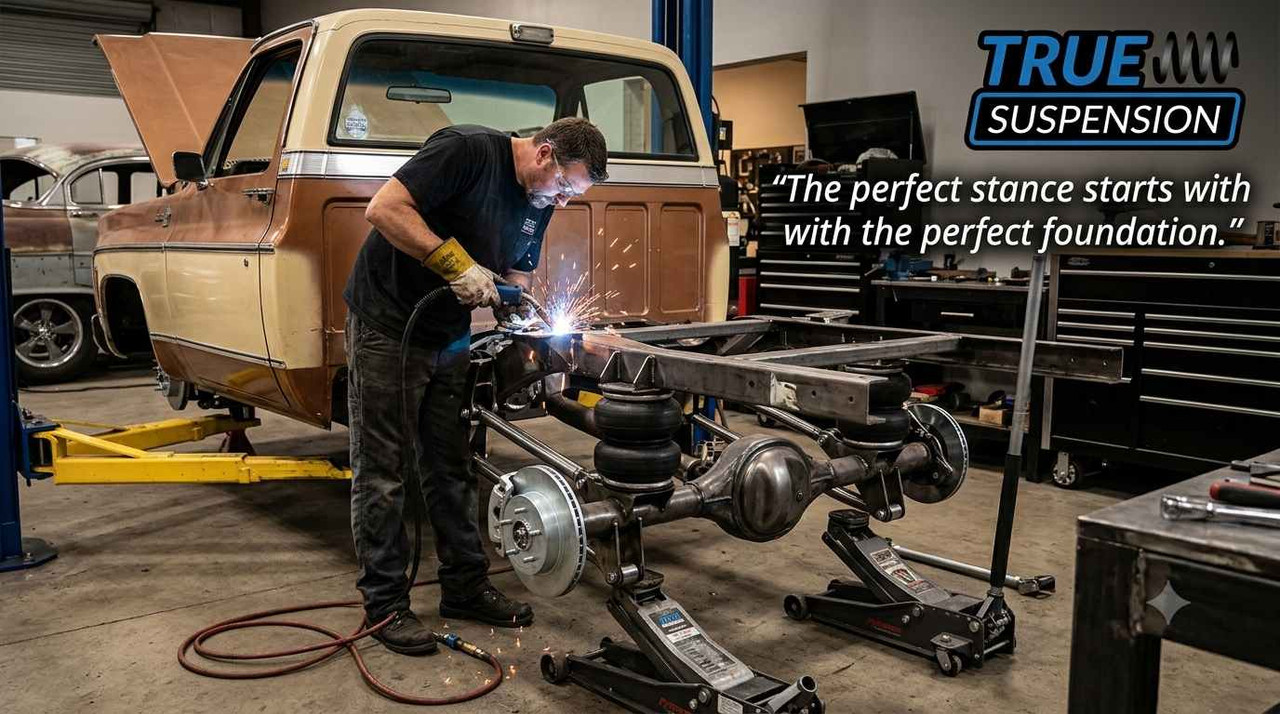
If you are building a classic car or truck, the suspension setup you choose defines everything. It shapes how the car rides, sits, handles, and how it looks slammed or riding high. For serious builders, the combination of a 4-link suspension system with air bags has become the gold standard. It delivers precision, adjustability, and that jaw-dropping stance that every classic car enthusiast dreams of.
This Classic Car Builder's Guide walks you through every critical decision, from 4-link geometry to air spring selection, from weld-on brackets to full management systems. We cover the technology, the numbers, the tradeoffs, and we show you why True Suspension is the trusted name builders rely on to get it right the first time.
What Is a 4-Link Suspension System and Why Does It Matter?
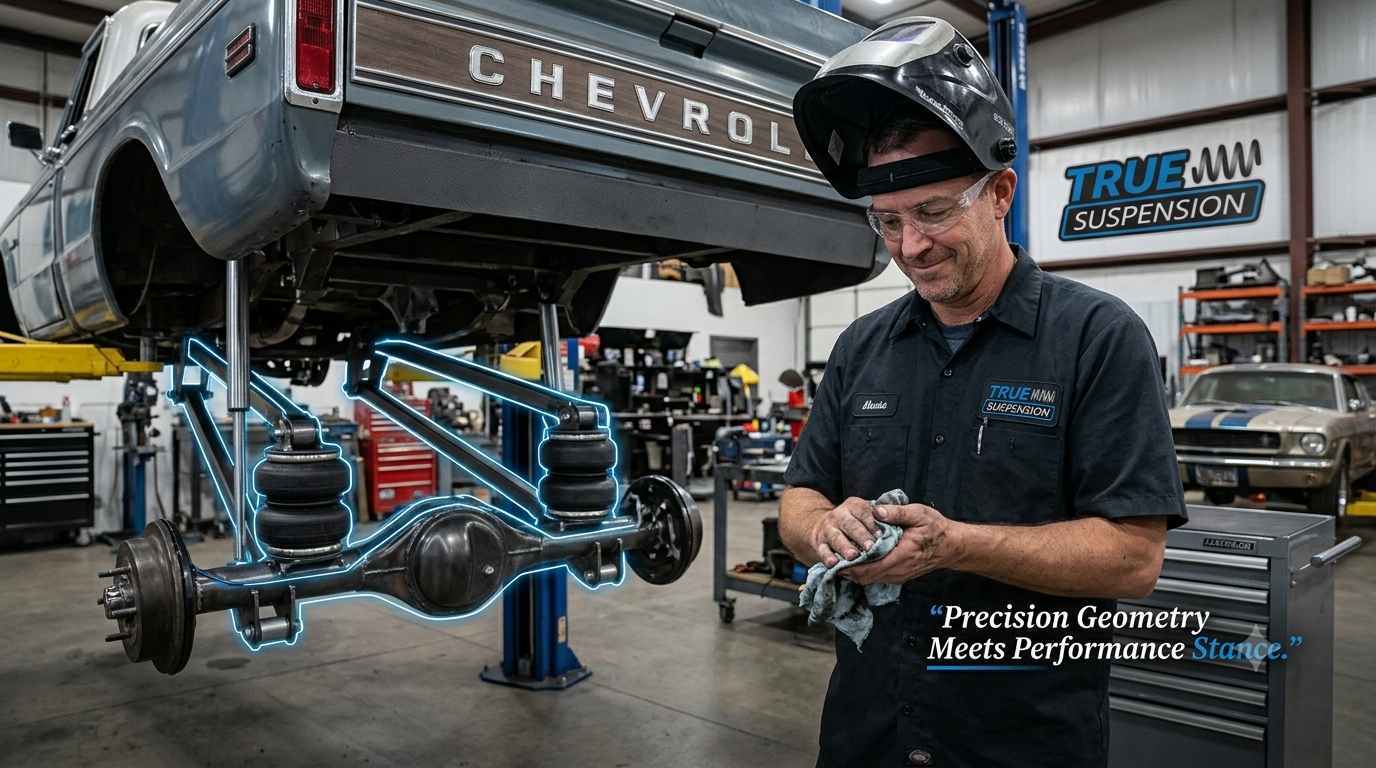
A 4-link suspension uses four control arms, two upper and two lower, to locate the rear axle. Unlike a leaf spring setup, a 4-link rear suspension controls axle movement in every direction. It prevents axle rotation under acceleration, eliminates wheel hop, and allows the axle to move predictably through its travel arc.
There are two primary configurations:
|
Configuration |
How It Works |
Best For |
|
Parallel 4-link |
Upper and lower links run parallel |
Lowriders, slammed builds, smooth ride |
|
Triangulated 4-link |
Upper links angle inward to the frame |
Compact builds, no panhard bar needed |
For classic car builds, especially on C10s, C20s, and early Ford pickups, a parallel setup paired with a Watts link or panhard bar gives the cleanest geometry and most predictable handling.
Why does geometry matter so much? Because a poorly designed 4-link creates bind, bump steer, and axle tramp under load. A correctly designed 4-link rear suspension puts the instant center of rotation exactly where the physics demand it, giving smooth, controlled motion whether the car is at ride height or slammed on the bump stops.
True Suspension's Complete Rear Universal Active Air Ride Suspension Weld-On Heavy Duty Parallel 4-Link Kit with 2600 Air Springs is engineered with correct geometry baked in. You are not guessing. You are building from proven data.
Air Bags vs. Coilovers, Why Air Wins for Classic Car Builds?
This debate comes up on every build thread. Coilovers are stiff, set-it-and-forget-it spring units. Air ride suspension uses inflatable air springs that you adjust on the fly. For a classic car builder, the advantages of air are overwhelming.
Head-to-Head Comparison
|
Feature |
Air Ride |
Coilovers |
|
Ride height adjustment |
Yes, instant |
No, fixed |
|
Load compensation |
Yes, automatic or manual |
No |
|
Ride comfort |
Excellent |
Firm to harsh |
|
Show stance capability |
Yes, slam to the ground |
Limited |
|
Towing/hauling assist |
Yes |
No |
|
Cost |
Higher upfront |
Lower upfront |
|
Complexity |
Moderate |
Simple |
The key stat that matters: air ride suspension can adjust ride height by 4–8 inches on a properly set up classic truck or car. That means you can cruise at a comfortable highway height, then drop to show stance at a car meet, then raise back up to clear a driveway, all with a switch.
Coilovers cannot do that. They pick one height and stay there.
For builds focused on lowering, stance, and show quality, air wins every time. The Air Ride Suspension vs. Coilovers: Which Is Right for Your Classic Car? blog from True Suspension breaks this down in even more depth. Read it before you commit to either path.
Understanding Air Spring Types for 4-Link Builds
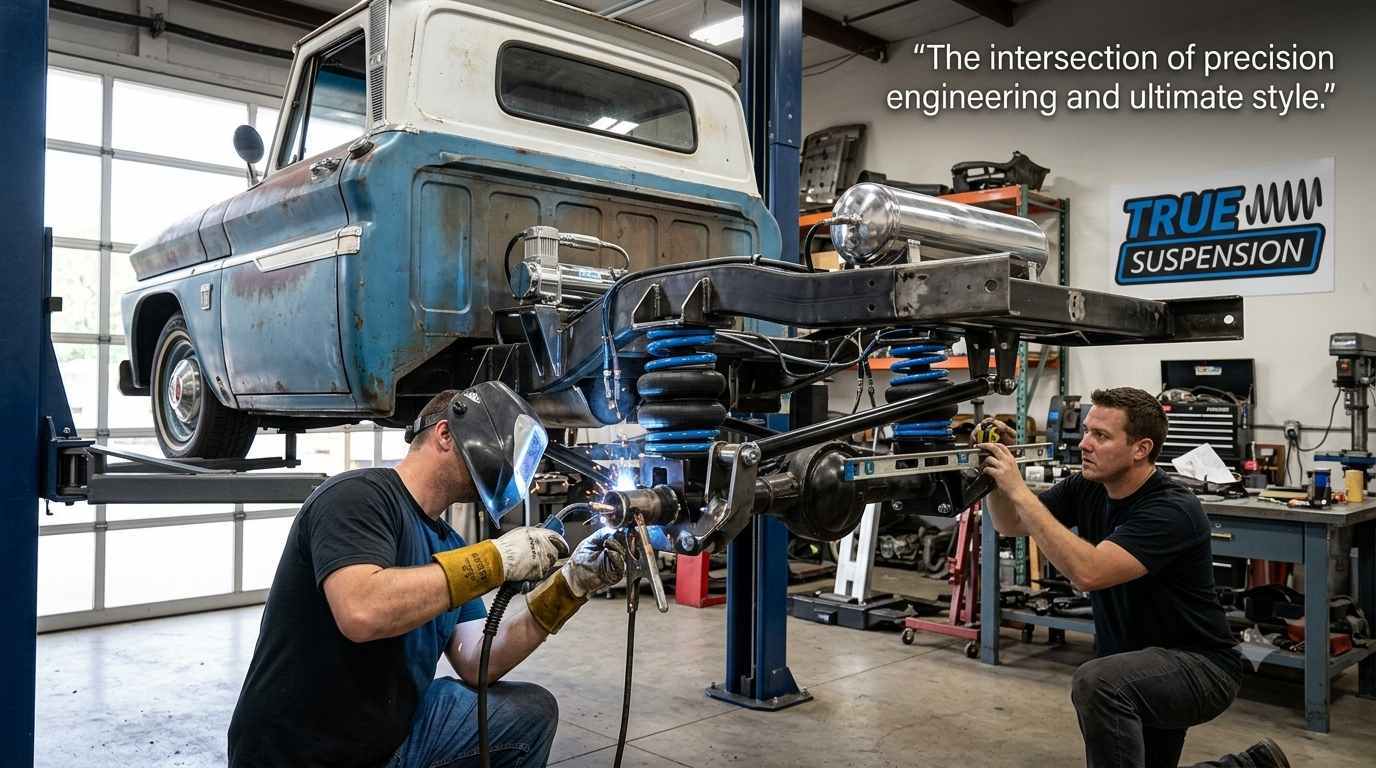
Not all air bags are the same. Choosing the wrong air spring ruins ride quality and limits your travel range. Here are the main types every classic car builder needs to understand:
1. Double Convoluted Air Springs (2600 Series)
- Shape: Stacked rolling lobes
- Load capacity: High, excellent for heavy classic trucks
- Travel: Moderate
- Best for: Parallel 4-link setups, C10/C20 truck builds, heavy sedan lowriders
True Suspension's Universal 2600 Series Air Spring Double Convoluted is the go-to for builders who need load support and a smooth ride in a compact package.
2. Sleeve-Style Air Springs (110 Tapered Sleeve)
- Shape: Single rolling sleeve
- Load capacity: Moderate
- Travel: Maximum, excellent for long-travel builds
- Best for: Triangulated 4-link setups, builds needing maximum drop
The Rear Universal Air Ride Suspension Weld-On Axle Bracket with 110 Tapered Sleeve Air Springs Kit is engineered for maximum drop potential.
3. Air-Over-Shock (2400 Series)
- Shape: Air spring wrapped around a shock absorber
- Load capacity: Moderate
- Travel: Tied to shock travel
- Best for: Coilover-style replacement, front air ride setups
The Universal Active Air Spring Over Shocks 2400 Series replaces traditional coilovers cleanly.
Choosing the Right Air Spring
|
Air Spring Type |
Load Rating |
Drop Potential |
Complexity |
|
Double Convoluted 2600 |
High |
Moderate |
Low |
|
Tapered Sleeve 110 |
Moderate |
High |
Low |
|
Air Over Shock 2400 |
Moderate |
Moderate |
Moderate |
Match your air spring to your 4-link geometry. A parallel 4-link with long lower links pairs best with the 2600 series double convoluted bags. A triangulated setup with shorter upper links pairs well with the tapered sleeve for maximum drop.
How to Plan Your 4-Link Geometry, The Numbers That Matter?
Getting 4-link geometry right is the most critical part of the build. Poor geometry causes bind, excessive pinion angle change, and handling issues. Here is what to calculate before you weld a single bracket.
Key Geometry Measurements
Instant Center (IC): The point where the upper and lower link lines intersect when extended forward. The IC controls how the axle reacts under acceleration and braking.
- IC too far forward: Soft anti-squat, axle tramps under acceleration
- IC too far back: Harsh anti-squat, rear rises violently under acceleration
- IC target zone: 60–100% anti-squat for a street-driven classic car
Anti-Squat Percentage Formula: Anti-Squat % = (CG Height / Wheelbase) × (IC Distance / CG Height) × 100
For most classic cars and trucks, target 80–100% anti-squat for a balanced feel.
Link Length Guidelines:
|
Link |
Recommended Length |
|
Lower links |
24–32 inches (longer = better geometry) |
|
Upper links |
12–18 inches |
|
Upper link angle |
5–15° down toward rear |
Pinion Angle: Set the pinion angle parallel to the driveshaft at ride height or 1–2° below. This minimizes U-joint vibration and wear.
True Suspension's weld-on 4-link kits come with pre-calculated geometry that handles these variables for you. The Complete Rear Universal Active Air Smooth Ride 4-Link Suspension Kit with 110 Tapered Air Sleeve Springs includes brackets engineered to the correct geometry for popular classic truck frames.
Weld-On 4-Link Brackets, What to Look for Before You Buy?
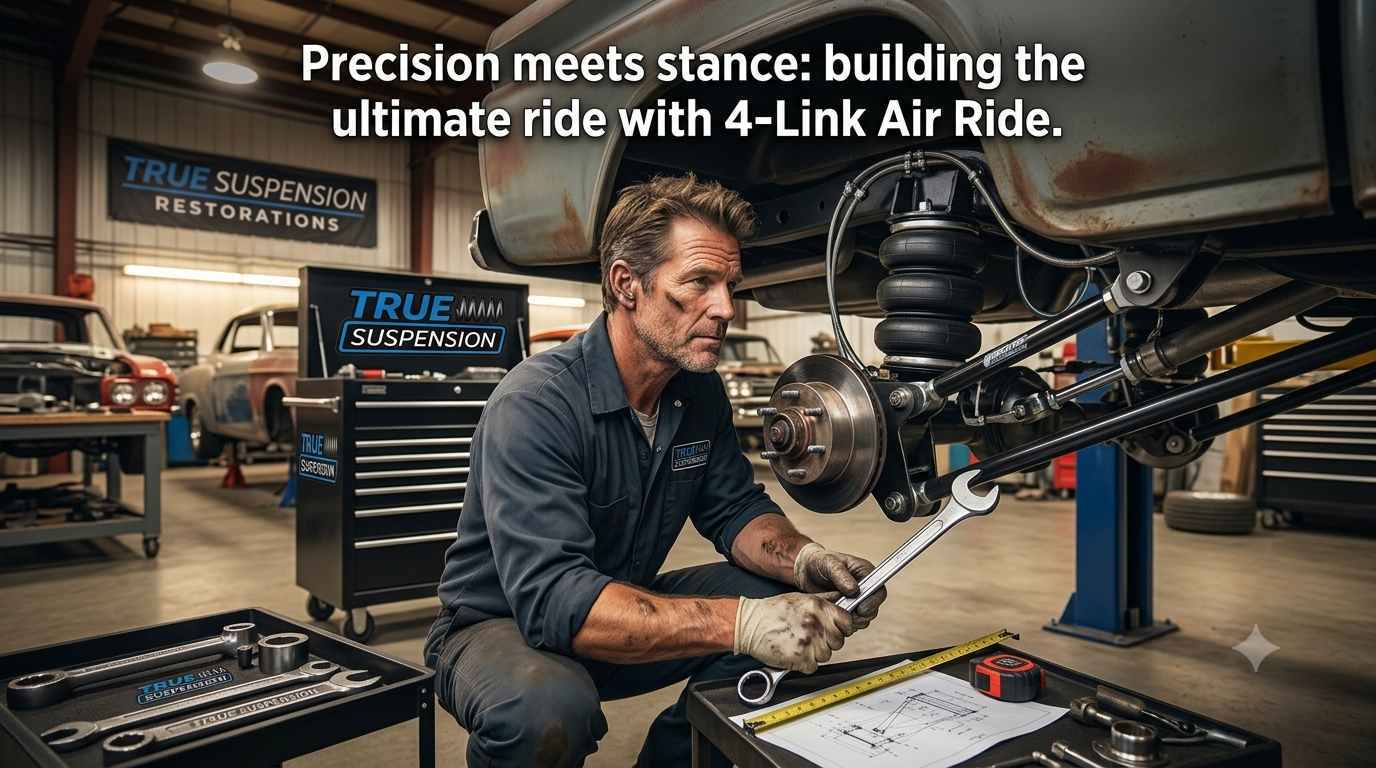
The quality of your weld-on axle brackets and frame brackets determines the long-term durability of the entire build. Cheap brackets flex, crack welds, and allow axle movement that throws off your geometry over time.
What True Suspension's Brackets Deliver
- Heavy-duty steel construction, rated for the load
- Pre-drilled and notched for clean fitment
- Compatible with popular air spring sizes, 2600 series and 110 tapered sleeve
- Precise hole placement for correct geometry
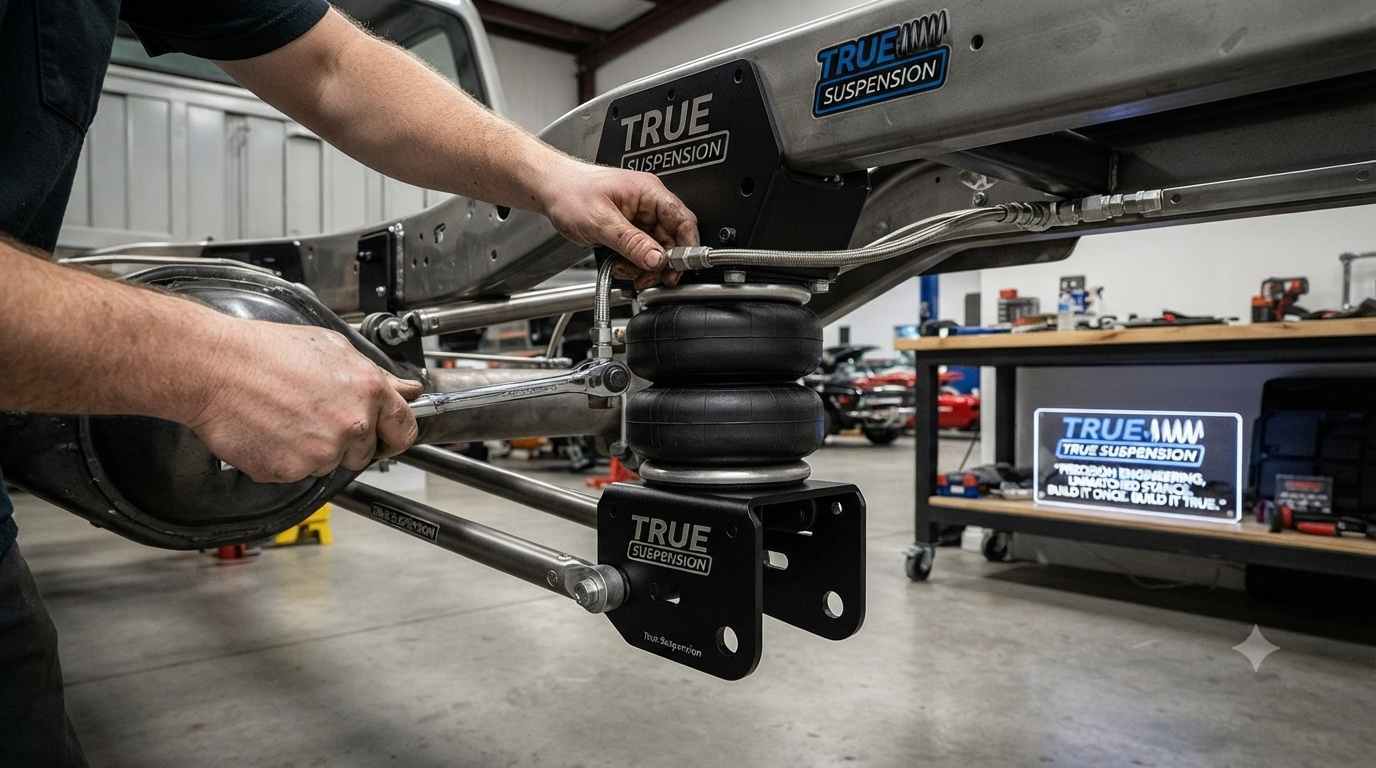
The Rear Universal Air Ride Suspension Weld-On Axle Brackets with 2600 Series Air Springs Kit includes everything needed to mount the air springs correctly on a drop-low parallel 4-link setup.
Installation Checklist
- Verify the axle tube is clean and straight before welding
- Square the axle housing before tacking brackets
- Double-check bracket spacing matches your air spring diameter
- Confirm link mounting holes align with frame brackets
- Set pinion angle before final weld
- Check for clearance at full compression and full droop
Pros and Cons of Weld-On vs. Bolt-On Kits
|
Type |
Pros |
Cons |
|
Weld-On |
Strongest, permanent, custom fitment |
Requires welding skill or professional install |
|
Bolt-On |
Easy install, removable |
Not always available for classic frames |
For classic car builds with custom or heavily modified frames, weld-on brackets are the correct choice. They allow precise placement and deliver maximum strength.
Air Ride Management Systems, Manual vs. FBSS vs. Digital
You have chosen your 4-link geometry. You have selected your airbags. Now you need to control them. This is where many builders cut corners, and regret it later.
Three Tiers of Air Management
- Manual Fill System
- Use a hand valve and Schrader fitting to add or release air
- Lowest cost
- No automation; you check and adjust manually
- Good for: Budget builds, tow-assist setups, basic lowriders
True Suspension's Universal Active Air Tow Assist Manual Fill Kit is the entry-level option that still uses quality components.
- Dual Switch In-Cab Management
- Two paddle switches control inflate/deflate for each bag
- Driver adjusts from inside the cab
- No compressor needed for basic setups
- Good for: Classic trucks, tow-assist builds, show cars
The Universal Towing Assist Helper Air Ride Suspension Control System Dual Switch gives cab-level control with a clean, professional look.
- FBSS, Full Bag Suspension System
- Electronic solenoid manifold controls all four corners
- Compressor fills an onboard tank
- Handheld controller or smartphone integration
- Automatic ride height sensing available
- Good for: Full air ride builds, show cars, maximum adjustability
True Suspension's Active Air Universal Air Ride Suspension Complete 4-Corner FBSS Management Control System is the top-tier option for builders who want the full show-car experience.
Management System Comparison
|
System |
Cost |
Adjustability |
Automation |
Best For |
|
Manual Fill |
$ |
Low |
None |
Budget, basic |
|
Dual Switch In-Cab |
$$ |
Medium |
None |
Tow assist, show trucks |
|
FBSS Electronic |
$$$ |
Maximum |
Full |
Show cars, full builds |
Top Classic Cars and Trucks That Shine on a 4-Link Air Ride Setup
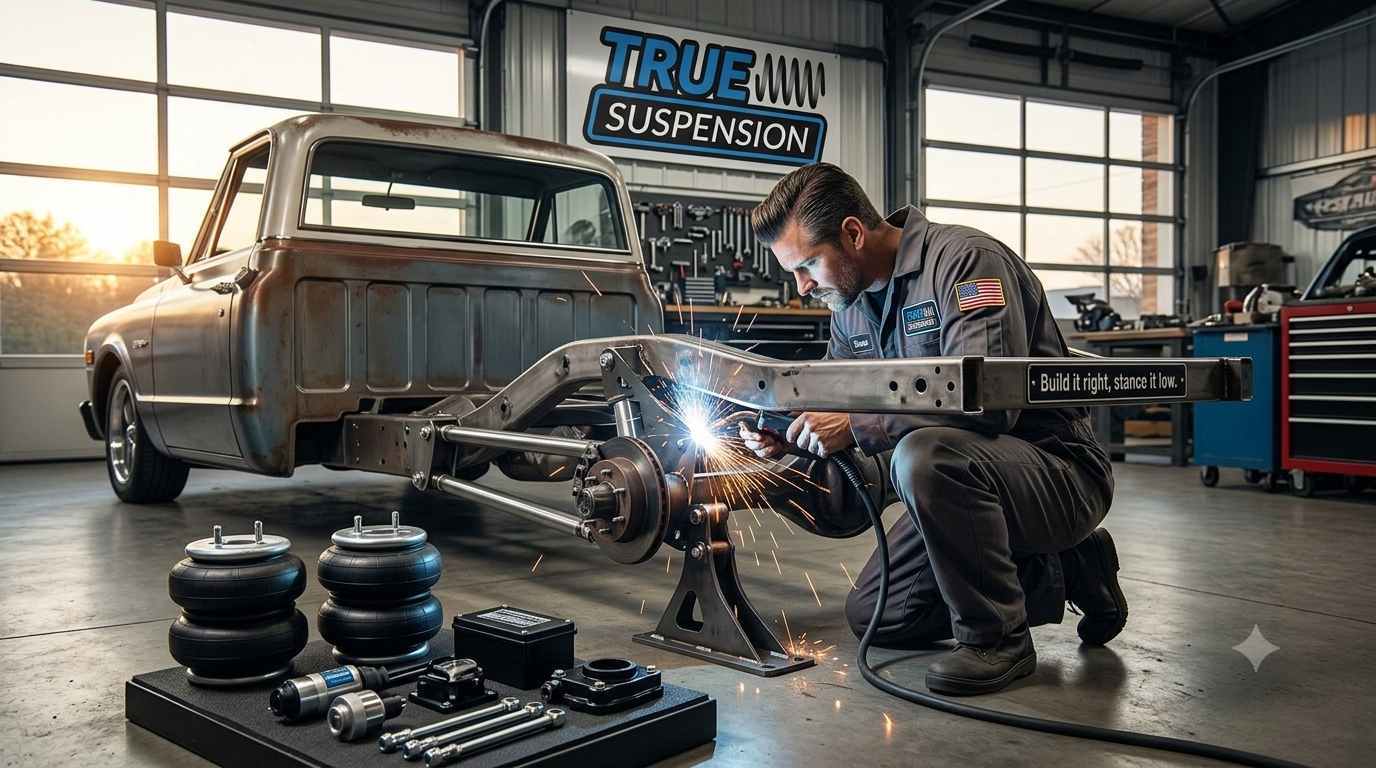
4-link air ride transforms classic vehicles. Here are the platforms where it works best, and the setups True Suspension supports:
Chevrolet C10 / C20 (1969–1987)
The C10 is the most popular classic truck build platform in North America. The frame rails are wide, the axle housing is robust, and there is plenty of room under the bed for a parallel 4-link with 2600 series bags.
True Suspension builds complete systems for this platform: Compatible with Chevrolet GMC C10 (73-87) Pickup Truck Complete FB Active Air Ride Bolt-On Suspension with 4-Link Kit 2WD.
The Top 10 Classic Cars on Air Ride That Look Incredible blog features several C10 builds that demonstrate just how stunning this combination looks at show height.
Chevrolet C30 / C20 1-Ton (1973–1991)
Heavier platforms need more load capacity. The C30 and C20 3/4-ton trucks use heavier axle housings that need properly rated brackets and higher-capacity air springs.
True Suspension covers this with the Compatible with Chevrolet Chevy GMC C30 1-Ton Pickup Truck (73-91) Complete Active Air Ride Bolt-On Triangulated 4-Link Kit 2WD.
Chevrolet Bel Air / Impala / Biscayne (1958–1970)
Full-size sedans are iconic air ride platforms. These cars have long wheelbases and heavy curb weights, exactly where airbags and a proper 4-link shine.
- Chevrolet Bel Air 1958–1964 Complete Lowering Air Ride Suspension System Kit
- Chevrolet Impala 1958–1964 Complete Lowering Air Ride Suspension System Kit
- Chevrolet Impala 1965–1970 Complete Lowering Air Ride Suspension System Kit
Ford F100 Pickup (1965–1979)
The early Ford F100 is experiencing a massive resurgence in the build community. True Suspension has the Complete 1965–1979 Ford F100 Pickup Air Ride Suspension Lowering System Kit ready to go.
Ford Galaxie / Fairlane / Falcon
Ford's full-size and mid-size classic platforms respond beautifully to air ride treatment:
- 1963–1964 Ford Galaxie Air Ride Suspension Lowering System Kit
- 1955–1970 Ford Fairlane Air Ride Suspension Lowering System Kit
- 1960–1965 Ford Falcon Air Ride Suspension Lowering System Kit
Complete 4-Link Air Ride Kit vs. Building Piece by Piece
Many builders face this decision: buy a complete kit or source every component individually. Here is an honest breakdown.
Complete Kit Advantages
|
Benefit |
Why It Matters |
|
Pre-matched components |
Air springs, brackets, and links designed to work together |
|
Correct geometry built-in |
No guessing on link lengths or bracket placement |
|
Faster build time |
Everything arrives together, no waiting on parts |
|
Single-source support |
One company to contact with questions |
|
Cost efficiency |
Bundle pricing beats buying piece by piece |
Piece-by-Piece Advantages
|
Benefit |
Why It Matters |
|
Full customization |
Choose every component independently |
|
Phased spending |
Buy in stages as budget allows |
|
Platform-specific tuning |
Optimize for your exact vehicle weight and use |
Our recommendation: For classic car builders on a first 4-link air ride build, start with a complete kit. The geometry is proven, the components are matched, and you build confidence in the system before experimenting with custom configurations.
True Suspension offers complete systems for the most popular platforms, so you get the full kit advantage without sacrificing quality.
Air Line and Fittings, The Details That Kill a Good Build
A 4-link air ride system is only as reliable as its weakest fitting. Many builds fail, not from bad brackets or bad bags, but from leaking air lines and cheap fittings that fail under pressure.
Air Line Specifications
|
Line Size |
Best Used For |
Max Pressure |
|
1/4 inch |
Standard tow assist, single-bag systems |
150 PSI |
|
3/8 inch |
High-flow FBSS systems, faster fill/dump |
150 PSI |
|
1/2 inch |
High-volume commercial applications |
150 PSI |
Push-In Fitting Quality
Cheap push-in fittings crack, leak, and fail at the worst time, when you are aired up at a show and the car slowly settles to the ground. True Suspension uses quality push-in fittings across the lineup:
- 1/4" Air Hose Push-In Fittings, Tube-to-Tube Female Union Connector (2-Pack)
- 3/8" Air Hose Push-In Fittings, Tube-to-Tube Female Union Connector (2-Pack)
Routing Best Practices
- Keep air lines away from exhaust and heat sources
- Use grommets wherever lines pass through metal
- Support lines every 12 inches with nylon clamps
- Avoid sharp bends; use 90° push-in elbows instead of forcing a straight fitting to bend
- Run 3/8" line from the compressor to the manifold for fastest fill times
Compressors and Tanks, Sizing Your Air System Correctly
Your air management system needs a compressor and tank sized to match your air spring volume and how fast you want to fill or dump.
Compressor Selection Guide
|
Compressor Type |
Duty Cycle |
Fill Speed |
Best For |
|
Compact 1/3 HP |
100% |
Moderate |
Tow assist, basic show builds |
|
Dual 100% Duty |
100% |
Fast |
Full FBSS, four-corner systems |
|
Single 50% Duty |
50% |
Slow |
Budget builds, light use |
The Active Air Compact Compressor 1/3 HP 100% Duty Cycle Air Ride Suspension Management is the go-to for most classic car builds. A 100% duty cycle means it runs continuously without overheating, critical for daily-driven builds or show cars that cycle the air system frequently.
Tank Sizing
- No tank (tankless): Works for tow-assist and manual systems, compressor fills bags directly
- 1-gallon tank: Adequate for two-corner systems or light daily use
- 2–5 gallon tank: Correct for full 4-corner air ride with fast fill/dump times
A larger tank reduces compressor run time and extends its service life. For show builds that air up and down multiple times per day, invest in at least a 3-gallon tank.
Control Panel Options, From Simple Switches to Full Dashboards
The control panel is what the driver interacts with, and it affects the entire experience of your classic car build. True Suspension offers a range from simple single-switch panels to full four-corner gauge panels.
Single Switch Panels
Clean and simple. One switch raises and lowers the rear. Perfect for basic tow assist or a rear 4-link air setup.
Dual Switch Panels
Control left and right rear bags independently. Critical for a parallel 4-link where independent control maintains level stance.
- Universal Towing Assist Helper Air Ride Suspension Control Panel, 150 PSI Gauge, Dual Paddle Switch, White Face
- Universal Towing Assist Helper Air Ride Suspension Control Panel, Black Face Round
Four-Corner Control Panels
Full control of all four airbags independently. Required for a complete front and rear air ride setup.
- Universal Air Ride Suspension 4-Corner Control Panel, 150 PSI Gauges, Quad Paddle Switches, White Face Round
- Universal Air Ride Suspension 4-Corner Control Panel, Black Face Round
FBSS Handheld Controller
For FBSS builds, the handheld controller puts four-corner control in the palm of your hand.
Frame Notching: Maximizing Drop on Classic Truck Builds
A 4-link with air bags lets you drop the body low, but the frame can limit how far you go. When the axle housing contacts the frame rails at full compression, a frame notch creates the clearance you need to slam the truck.
True Suspension offers precision bolt-on frame notch kits for the most popular classic truck platforms:
- C10 1/2-Ton (73–91) Bolt-On Frame Notch Kit, 6–7 Inch Drop
- C20 3/4-Ton (73–91) Bolt-On Frame Notch Kit, 6–7 Inch Drop
- C30 1-Ton (73–91) Bolt-On Frame Notch Kit, 6–7 Inch Drop
The bolt-on design is critical. It eliminates the need to cut and weld your frame, preserving structural integrity and making the job accessible to builders who are not professional fabricators.
Target drop with frame notch + 4-link + air bags:
|
Setup |
Expected Drop |
|
Air bags alone (no notch) |
3–5 inches |
|
Air bags + frame notch |
5–8 inches |
|
Air bags + notch + mini-tub |
7–10+ inches |
The Rubber Block vs. Air Ride Suspension: Which Is Best for You? blog explores exactly how much drop potential each suspension type offers, and the 4-link air combination wins decisively.
Why True Suspension Is the Builder's First Choice
Every section of this Classic Car Builder's Guide points to the same conclusion: the quality of your components determines the quality of your build. True Suspension is built around that truth.
What Sets True Suspension Apart
Engineering-First Design: Every kit starts with correct geometry. The brackets are placed where the physics demand them, not where manufacturing is cheapest. This is why True Suspension's 4-link kits deliver smooth, predictable behavior right out of the box.
Complete System Availability: You can buy every piece of a full 4-link air ride system from one source. Brackets, air springs, air lines, fittings, compressor, tank, management panel, all available, all matched. No hunting across five different suppliers and hoping the parts work together.
Proven Platforms: True Suspension has kits engineered for the most popular classic car and truck platforms:
- Chevrolet C10, C20, C30 (1969–1991)
- Chevrolet full-size sedans (1958–1970)
- Ford F100 (1965–1979)
- Ford Galaxie, Fairlane, Falcon
- Ford Mustang (multiple generations)
Transparent Knowledge Sharing: This Classic Car Builder's Guide itself represents True Suspension's commitment to builder education. The blog library, covering topics like Lift Kits vs. Leveling Kits: What Truck Owners Must Know and Top 10 Ways to Maintain Factory Ride Quality After Installing a Lift Kit, exists because we believe informed builders build better.
Quality Components at Every Price Point: From the basic manual fill system to the full FBSS electronic management setup, every True Suspension product is built to last. You are not buying kit-car components dressed up in nice packaging. You are buying hardware that works.
True Suspension by the Numbers
|
Metric |
What It Means |
|
Platforms supported |
50+ classic and modern vehicles |
|
Kit configurations |
Complete, helper, and universal options |
|
Air spring series |
2400, 2600, matched to application |
|
Management options |
Manual, dual switch, FBSS, 4-corner |
|
Compressor duty cycle |
100%, built for real-world use |
Step-by-Step Build Sequence for a Classic Truck 4-Link Air Ride
Here is the correct order of operations for a rear 4-link air ride build on a classic truck. Following this sequence prevents rework and mistakes.
Phase 1: Planning and Measurement
- Determine target ride height and maximum drop goal
- Calculate lower link length based on axle position and frame geometry
- Identify correct air spring series (2600 double convoluted vs. 110 sleeve)
- Select management system (manual, dual switch, or FBSS)
- Plan air line routing and compressor/tank location
Phase 2: Frame and Axle Preparation
- Clean and inspect frame rails in the rear section
- Install frame notch kit if targeting extreme drop
- Strip axle housing of existing spring perches and shock mounts
- Verify axle housing is straight before any welding begins
Phase 3: Bracket Installation
- Position axle housing in vehicle at target ride height
- Square axle housing; both sides must be equal distance from frame
- Tack-weld lower axle brackets; do not fully weld yet
- Install upper link mounting tabs on axle
- Set pinion angle (1–2° down toward front at ride height)
- Install frame-side mounting brackets for lower and upper links
- Verify geometry, check all four link angles before final weld
- Final weld all brackets
Phase 4: Air Spring Installation
- Mount air bag lower mount on axle bracket
- Mount air bag upper mount on frame
- Verify clearance at full compression and full droop
- Install air lines, route away from heat and sharp edges
Phase 5: Management System
- Mount compressor and tank (if using FBSS)
- Install manifold block on frame
- Run airline from compressor to manifold
- Run lines from manifold to each air bag
- Mount control panel in cab
- Wire switches and compressor to switched 12V power
Phase 6: Setup and Alignment
- Pressurize system, check all fittings for leaks
- Set baseline pressure at ride height
- Check alignment; rear axle must be square to vehicle centerline
- Test full compression and full droop for clearance issues
- Set bump stops to prevent overtravel
Conclusion
A 4-link suspension paired with airbags is the most capable and most impressive rear suspension setup a classic car builder can install. It delivers adjustable ride height, excellent load handling, correct axle control, and the kind of stance that stops people at shows.
The key to getting it right is correct geometry, quality components, and a management system that matches your build goals. True Suspension provides all of it, the brackets, the air springs, the air lines, the compressors, the control panels, and the complete kits that pull it all together for the most popular classic platforms.
This Classic Car Builder's Guide to 4-Link Suspension and Air Bags is your starting point. Now it is time to build.
Frequently Asked Questions
- What is the difference between a parallel and triangulated 4-link suspension for classic car builds?
A parallel 4-link uses four links running parallel, needing a panhard bar for lateral control. A triangulated 4-link angles the upper links inward, eliminating the panhard bar. Parallel setups offer more tuning flexibility and are preferred for slammed classic car builds.
- How much air pressure do I need in my air bags for a classic truck 4-link setup?
Most classic truck rear air bag systems operate between 30 and 80 PSI at ride height, depending on vehicle weight and air spring size. Heavier trucks need higher pressure. Always set pressure with the vehicle loaded to its typical operating weight for accurate baseline settings.
- Can I install a 4-link air ride kit on a classic car without professional welding?
Weld-on kits require solid MIG or TIG welding skills. If you are not an experienced welder, hire a professional for bracket installation. Poor welds on 4-link brackets are a safety hazard. True Suspension also offers bolt-on options for certain platforms that reduce the welding requirement.
- What size compressor do I need for a full 4-corner classic car air ride system?
A 100% duty cycle compressor rated for at least 150 PSI is the minimum for a full 4-corner air ride system. True Suspension's 1/3 HP 100% duty cycle compressor handles most classic car builds. Larger vehicles or frequent cycling benefit from a dual-compressor setup.
- How does a frame notch improve air bag drop on a classic truck 4-link build?
A frame notch removes material from the frame rail at the axle centerline, allowing the axle housing to travel higher at full compression. This typically adds 2–4 inches of additional drop compared to a non-notched frame, enabling the slammed stance that classic car builders target.