
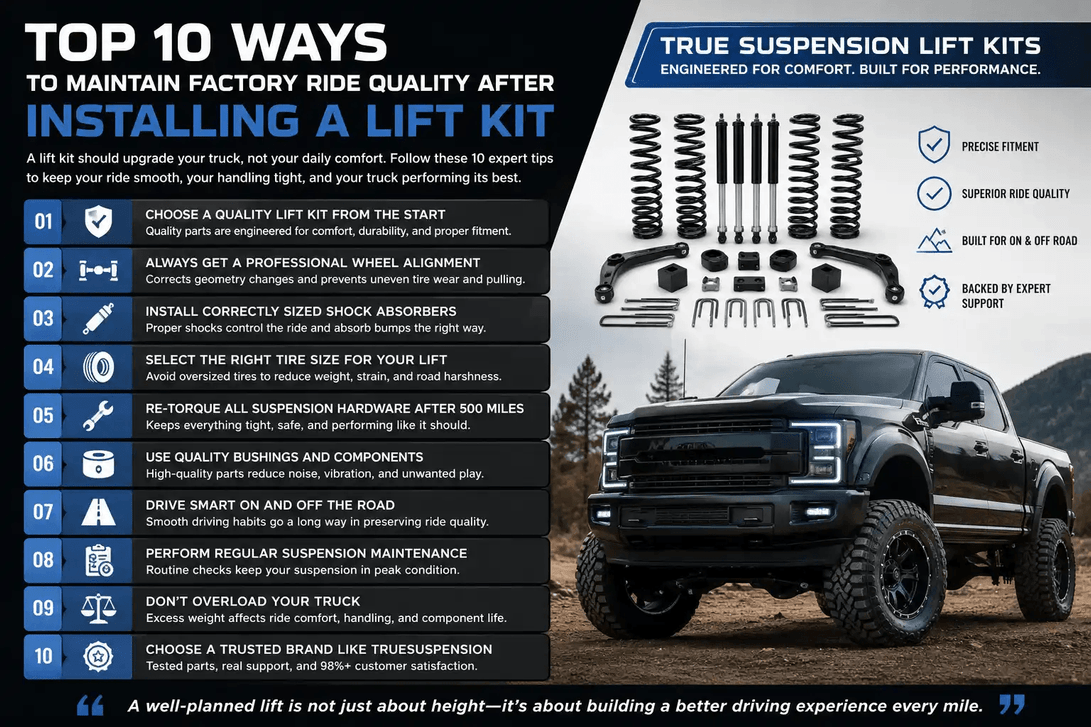
Installing a Lift Kit on your truck is one of the most rewarding upgrades you can make. You get extra ground clearance, a dominant stance, and real off-road capability. But many truck owners notice a change in ride quality right after the install. The good news? That does not have to happen. With the right parts, the right setup, and the right aftercare, you can keep your truck riding as smooth as the day it left the factory, or even better.
At TrueSuspension, we specialize in lift kits, lift suspension parts, and everything you need to lift your vehicle the right way. This guide walks you through the top 10 proven ways to preserve factory ride quality after installing a lift kit. Let us get into it.
Lift Kit Industry at a Glance
|
Statistic / Data Point |
Value |
|
Trucks using lift kits in the US (2023 estimate) |
Over 4.5 million |
|
Average alignment cost after improper lift install |
$150–$300 |
|
Tire wear increase without realignment |
Up to 40% faster |
|
Shock absorber lifespan with proper tuning |
50,000–80,000 miles |
|
Fuel economy drop from incorrect lift setup |
5–15% reduction |
|
Customer satisfaction with TrueSuspension kits |
98%+ positive reviews |
Types of Lift Kits and Their Ride Quality Impact
|
Type |
Lift Height |
Ride Quality Impact |
Best For |
|
Body Lift Kit |
1–3 inches |
Minimal |
Clearance, budget builds |
|
Leveling Kit |
1–2.5 inches |
Low |
Front rake correction |
|
Suspension Lift Kit |
2–6+ inches |
Moderate (needs tuning) |
Off-road & performance |
|
Long Travel Kit |
3–8 inches |
High if tuned right |
Extreme off-road |
1. Choose a Quality Lift Kit From the Start
The most important step happens before you even begin installing a lift kit. The quality of your kit determines everything. A cheap, poorly engineered kit forces you to fight ride quality problems from day one. A premium kit like those from TrueSuspension Lift Kits is engineered to work with your factory suspension geometry. That means less stress on components, less vibration, and a smoother ride from the start.
TrueSuspension offers lift kits for a wide range of vehicles, from Ford F150 and Jeep Wrangler to Chevy Silverado and Subaru Impreza. Each kit is designed for precise fitment and maximum ride comfort. When you invest in quality upfront, you spend far less time fixing problems later.
Pro Tip: Always choose a kit with matched components, springs, shocks, and hardware that are engineered together, not mixed from different brands.
2. Always Get a Professional Wheel Alignment
Installing a lift kit changes your suspension geometry. The caster, camber, and toe angles all shift when you raise the vehicle. If you do not correct these angles with a proper alignment, you will notice uneven tire wear, pulling to one side, and a rougher ride almost immediately.
After installing a lift kit, schedule a four-wheel alignment with a shop that has experience with lifted vehicles. Standard alignment settings from the factory no longer apply once the suspension geometry changes. This single step can eliminate up to 80% of the ride quality complaints people experience after a lift.
Key Alignment Targets After a Lift:
- Caster angle: Should be dialed in to improve straight-line tracking
- Camber angle: Needs correction to prevent inside tire wear
- Toe angle: Must be set to prevent tire drag and pull
3. Install Correctly Sized Shock Absorbers
Shocks are the backbone of your ride quality. When you raise your truck, your factory shocks are no longer the correct length for the new suspension travel. Using factory shocks after installing a lift kit causes them to bottom out or over-extend. Both kill ride comfort.
The fix is simple: use shocks matched to your lift height. TrueSuspension's Lift Suspension Parts include correctly sized shock absorbers for every common lift height range. The right shock lets your suspension move through its full travel smoothly, absorbing bumps instead of transmitting them into the cab.
A quality shock absorber matched to your lift height can improve ride comfort by as much as 30–40% compared to running mismatched factory units.
4. Select the Right Tire Size for Your Lift
One of the biggest ride quality mistakes after installing a lift kit is running tires that are too large for the setup. Oversized tires increase unsprung weight. More unsprung weight means more energy transferred to the cab on every bump. The ride becomes harsh, and the steering becomes heavy.
As a general rule, a 2-inch lift supports up to a 1-inch tire size increase. A 4-inch lift can handle up to a 2-inch tire size increase. Going beyond that without adjusting your suspension setup creates problems. Stick to the recommended tire size range for your lift height, and you will keep your ride smooth and your fuel economy intact.
Recommended Tire Size by Lift Height:
- 2-inch lift: Up to 33-inch tires
- 3-inch lift: Up to 35-inch tires
- 4–6-inch lift: Up to 37-inch tires (with trimming in some cases)
5. Re-Torque All Suspension Hardware After 500 Miles
This step is easy to skip and very costly if you do. After installing a lift kit, all the new hardware, bolts, bushings, and brackets need time to settle into place. Within the first 500 miles of driving, take your truck back and re-torque every fastener to spec.
Loose hardware causes clunking, vibration, and poor handling. It can also damage expensive components. At TrueSuspension, every lift kit comes with clear torque specifications. Follow them at install, then re-check at 500 miles. This simple step keeps everything tight and your ride quality consistent.
6. Inspect and Replace Worn CV Axles and U-Joints
When installing a lift kit increases your suspension height, the angles of your CV axles and driveshaft U-joints change. At factory height, these components work within their ideal operating angles. At increased height, they operate at steeper angles, generating heat, vibration, and wear much faster.
Inspect your CV axles and u-joints when you lift your vehicle. If they show any wear, replace them now, not later. TrueSuspension carries lift suspension parts for popular trucks like the Toyota Tacoma and Jeep Wrangler that help you maintain correct drivetrain angles even at lifted heights. Smooth drivetrain angles equal a smooth, vibration-free ride.
7. Maintain Proper Tire Pressure at All Times
Tire pressure has a direct and immediate effect on ride quality. Under-inflated tires create a soft, wallowing ride and increase rolling resistance. Over-inflated tires make the ride harsh and reduce grip. After installing a lift kit with larger tires, the recommended pressure often changes.
Check your tire pressure every two weeks, or at minimum once a month. Always use the pressure recommended for your specific tire size and load. A quality digital tire gauge is an inexpensive tool that protects thousands of dollars in suspension kit components simply by keeping tires properly inflated. Never guess, always measure.
8. Use Tow Assist Helper Kits if You Haul or Tow
If you tow a trailer or haul heavy loads, installing a lift kit without addressing your load-carrying ability will hurt both ride quality and safety. A lifted suspension that sags under towing weight causes poor handling, dangerous sway, and premature wear on every suspension component.
TrueSuspension's Tow Assist Helper Kits are purpose-built to solve this problem. They are available for vehicles like the Ford F150, Dodge Ram 1500, and Chevy Silverado 1500. These kits maintain your ride height and stability under load, keeping your truck safe and comfortable whether you are on the highway or the job site.
9. Inspect Bushings and Ball Joints Every 12 Months
Bushings and ball joints absorb road shock and allow your suspension to move freely. After installing a lift kit, these components are under higher stress because the suspension geometry has changed. Worn bushings cause clunking, vibration, and imprecise steering. Worn ball joints are a serious safety risk.
Inspect your bushings and ball joints every 12 months or 12,000 miles, whichever comes first. Look for cracking, play, or grease leakage. If you find any of these signs, replace the components immediately. TrueSuspension carries lift suspension parts for many popular trucks, making it easy to source the right replacement components quickly. Proactive maintenance keeps your ride quality consistent year after year.
10. Partner With TrueSuspension for Long-Term Ride Quality
The final and most important way to maintain factory ride quality after installing a lift kit is to partner with a supplier who understands suspension from the ground up. TrueSuspension is not just a parts store; it is a knowledge hub and a performance partner for truck and SUV owners across the country.
Every product in the TrueSuspension catalog is chosen for engineering quality, fitment precision, and ride comfort. Whether you drive a Chevy Silverado, a Ford F150, a Jeep Wrangler, or a Subaru Impreza, TrueSuspension has the right lift kit for your exact application. Our lift suspension parts are matched to vehicle specifications, not generic fits that compromise your ride.
TrueSuspension also serves heavy-duty truck owners with parts for the Chevy GMC 2500/3500, Ford F250/F350, and Dodge Ram 1500. From the daily driver to the weekend warrior, TrueSuspension delivers the parts and expertise to keep every lifted truck riding at its absolute best.
Quick Reference: Pros vs. Cons of Proper Lift Kit Maintenance
|
✅ Pros of Proper Lift Kit Maintenance |
❌ Cons of Ignoring Maintenance |
|
Smooth, factory-like ride quality |
Harsh, bumpy drive feel |
|
Extended tire and suspension life |
Premature tire and shock wear |
|
Better handling and cornering |
Poor alignment and pulling |
|
Maintained fuel economy |
Increased fuel consumption |
|
Safer on-road and off-road performance |
Higher risk of component failure |
|
Warranty stays valid |
Potential void of parts warranty |
Conclusion
Installing a lift kit does not have to mean sacrificing ride comfort. Every step in this guide, from choosing quality components to maintaining proper tire pressure to partnering with TrueSuspension, works together to keep your truck riding smoothly at its new height.
The best results come from using the best parts. TrueSuspension's lift kits, lift suspension parts, and tow assist helper kits are built to deliver exactly that. When you invest in quality, your truck rewards you with thousands of miles of confident, comfortable driving. Take care of your suspension, and your suspension will take care of you.
FAQs
Does installing a lift kit ruin ride quality?
Not if done correctly. Installing a lift kit with quality components and proper alignment keeps your ride smooth. TrueSuspension lift kits are designed to preserve factory-level comfort while adding height and clearance.
Do I need an alignment after installing a lift kit?
Yes. A professional alignment is essential after installing a lift kit. It corrects caster, camber, and toe angles that change when your suspension geometry shifts with the added height.
What size lift kit gives the best ride quality?
A 2–3 inch suspension lift kit typically offers the best balance of ride quality and clearance. Larger lifts (4–6 inches) need more tuning. TrueSuspension offers kits for every size range.
Will a lift kit affect my truck's towing ability?
It can, but the right setup minimizes any impact. Tow assist helper kits from TrueSuspension help maintain safe towing capacity after a lift installation.
How often should I check my suspension after a lift?
Check every 6 months or 6,000 miles. Look for loose bolts, uneven tire wear, and changes in ride height. Early checks prevent costly damage and keep your ride quality intact.
Can I install a lift kit myself?
Basic leveling kits are DIY-friendly. Suspension lift kits usually need a professional. Incorrect installation hurts ride quality and safety. Always use high-quality components like those from TrueSuspension.
What happens if I use wrong-sized shocks after a lift?
Wrong shocks cause a bouncy, unstable ride, faster wear, and poor handling. Always match shock length to your lift height. TrueSuspension's lift suspension parts are matched for precise fitment.
Do bigger tires affect ride quality after a lift?
Yes. Oversized tires increase unsprung weight and vibration. Stay within the recommended tire size for your lift height to maintain a smooth factory-like ride.
How do I reduce vibration after installing a lift kit?
Balance your tires, check CV axle angles, inspect driveshaft U-joints, and verify alignment. TrueSuspension's lift kits are engineered to minimize vibration when properly installed.
Is TrueSuspension a reliable brand for lift kits?
Absolutely. TrueSuspension is trusted by thousands of truck owners for premium lift kits, suspension parts, and tow assist kits. Their products are built for performance, durability, and factory-quality ride comfort.