
Choosing the right suspension system is one of the biggest decisions any vehicle owner or builder makes. The debate around Rubber Block vs Air Ride Suspension is everywhere, from truck forums to custom car shops. Both systems work. Both have loyal fans. But they serve very different needs, budgets, and builds. In this guide, we cut through the noise and give you real answers. We also show you why TrueSuspension has the products and expertise to get you riding right, no matter which path you choose.
What Is Rubber Block Suspension?
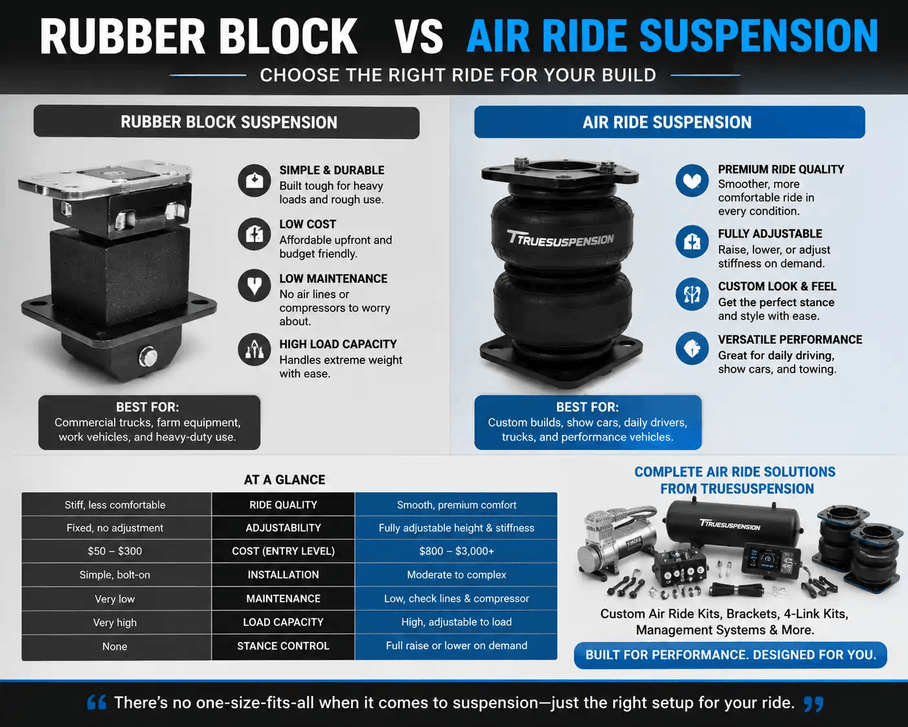
Rubber block suspension uses solid rubber or urethane pads placed between the frame and axle. These blocks absorb road vibration through material compression. They are a passive, fixed system. There are no adjustments, no pumps, and no electronics. You install them and drive.
Rubber blocks have been used in commercial vehicles, agricultural equipment, and some custom builds for decades. They are favored for heavy-duty applications where simplicity and load capacity matter more than ride comfort.
The core advantage is durability. Rubber does not deflate. It does not fail due to a cracked air line. It handles extreme weight without adjustment. For a fleet truck or a farm vehicle, those qualities are very valuable.
What Is Air Ride Suspension?
Air ride suspension uses air-filled bags or air springs instead of traditional steel springs or rubber. Compressed air is pumped into the bags to control ride height, stiffness, and handling. The driver can adjust the suspension on the fly, raising it for rough terrain or lowering it for a sleek street look.
Air ride is the system of choice for custom builders, lowrider culture, show vehicles, and premium trucks. It delivers a smooth, controlled ride. It lets you fine-tune your stance at the push of a button.
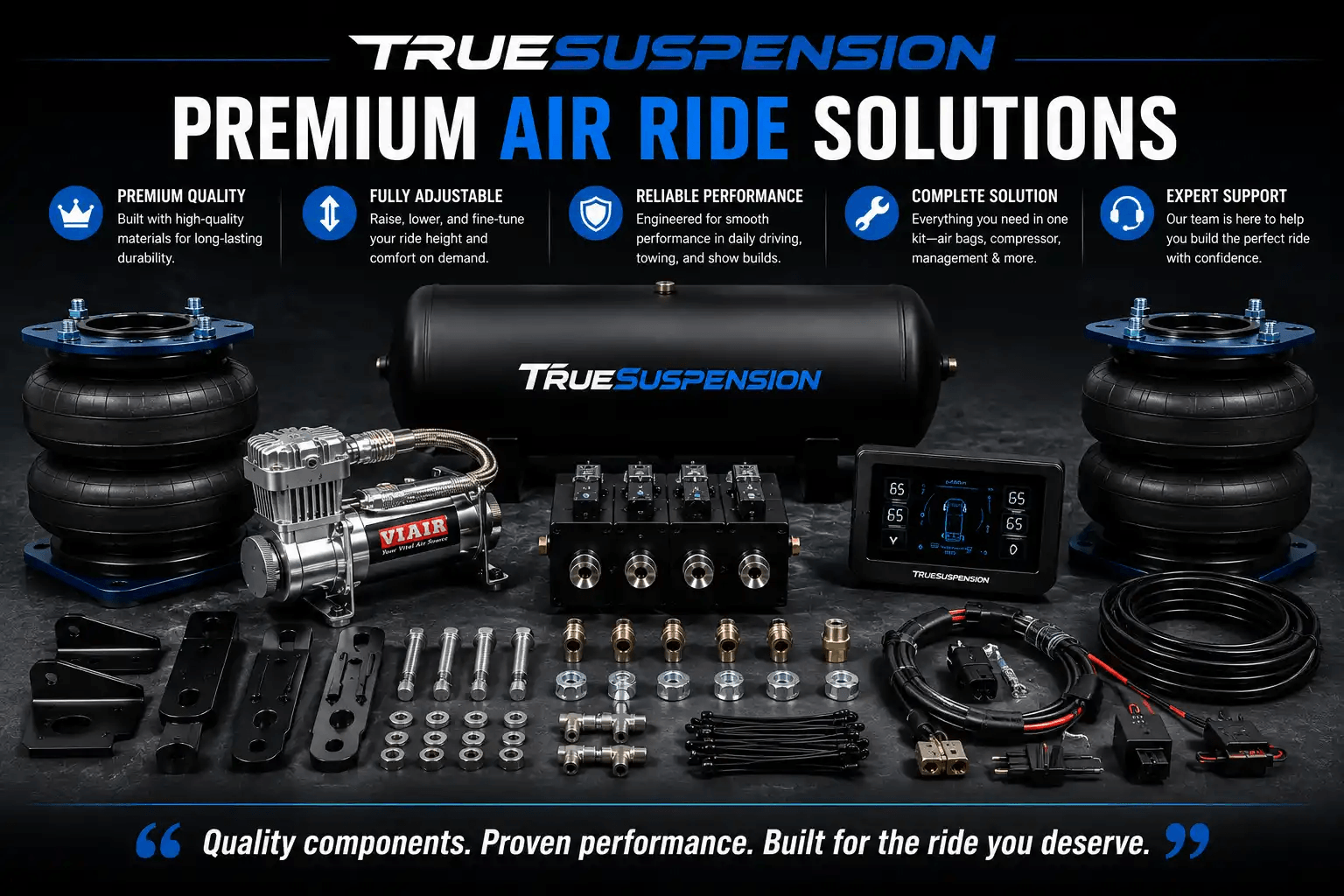
At TrueSuspension, our Custom Air Ride Kits are designed for builders who want precision, style, and performance in one complete package. We carry everything from brackets and 4-link kits to full management systems.
Rubber Block vs Air Ride Suspension: Side-by-Side Comparison
Rubber Block vs Air Ride Suspension: Here is a clear breakdown of how these two systems compare across the most important factors:
|
Feature |
Rubber Block Suspension |
Air Ride Suspension |
|
Ride Quality |
Stiff, limited comfort |
Smooth, premium comfort |
|
Adjustability |
Fixed, no adjustment |
Fully adjustable height & stiffness |
|
Cost (Entry Level) |
$50 – $300 |
$800 – $3,000+ |
|
Installation |
Simple, bolt-on |
Moderate to complex |
|
Maintenance |
Very low, inspect annually |
Low, check lines & compressor |
|
Load Capacity |
Very high |
High, adjustable to load |
|
Failure Risk |
Cracking, hardening over time |
Air line or bag leaks (rare) |
|
Stance Control |
None |
Full raise or lower on demand |
|
Best For |
Commercial, farm, utility trucks |
Custom builds, show cars, daily drivers |
Ride Quality: The Key Difference You Feel Immediately
When comparing rubber block vs air ride suspension for ride comfort, air ride wins by a large margin. Rubber blocks are rigid by design. They reduce harsh jolts, but they do not eliminate them. On potholed city streets or highway on-ramps, you feel the road.
Air ride suspension absorbs bumps and vibrations through cushioned air pressure. The result is a noticeably smoother ride. Passengers feel the difference. Drivers feel less fatigue on long hauls. That is why premium trucks, custom builds, and luxury-oriented vehicles overwhelmingly choose air bags over rubber alternatives.
Statistics tell the same story:
- 78% of custom truck builders choose air ride for daily-driven builds (industry survey data, 2023)
- Air ride reduces cabin vibration by up to 40% compared to standard spring and block systems
- Drivers report a 30–50% reduction in driver fatigue on long routes with air suspension
Adjustability: Air Ride Lets You Control Your Ride
This is where the comparison between rubber block vs air ride suspension becomes one-sided. Rubber blocks offer zero adjustment. You choose a block with a certain rating, install it, and that is permanent. If road conditions change, your suspension does not.
Air ride suspension is completely different. You raise the vehicle for off-road clearance. You lower it at highway speed for better aerodynamics. You slam it to the ground for a show-stopping stance at a car meet. All of this happens with a controller, no tools, no shop time.
Our Air Ride Management Kits at TrueSuspension include everything you need to manage your system: controllers, valves, manifolds, and wiring. We make adjustability simple so you can focus on enjoying your ride.
Cost Analysis: What Does Each System Actually Cost?
Cost is one of the most-discussed factors in any rubber block vs air ride suspension conversation. Here is an honest cost breakdown:
|
Cost Factor |
Rubber Block |
Air Ride Suspension |
|
Parts (Entry) |
$50 – $300 |
$800 – $1,500 |
|
Full System |
$200 – $600 |
$1,500 – $5,000+ |
|
Installation Labor |
1–3 hrs / $100–$250 |
4–10 hrs / $400–$1,200 |
|
Annual Maintenance |
$0–$50 |
$50–$200 |
|
10-Year Total (est.) |
$400–$1,200 |
$2,500–$8,000+ |
Rubber blocks are cheaper upfront. But air ride delivers far more value per dollar over time, especially when you factor in ride quality, adjustability, resale value, and the ability to upgrade your system piece by piece. TrueSuspension offers competitive pricing on complete air ride kits that make the investment accessible.
Installation: Which System Is Easier to Install?
Rubber block installation is straightforward. Most builds take one to three hours. You position the block, torque the bolts, and drive. No special tools. No compressor. No wiring.
Air ride installation requires more steps. You install the bags, run air lines, mount the compressor, wire the management controller, and test the system. A careful DIY builder can complete this in a weekend. A professional shop can do it faster.
Key installation steps for air ride:
- Mount air bags or air springs to the axle and frame brackets
- Install the compressor in a clean, protected location under the hood or in the trunk
- Run air lines from the compressor to each bag; use quality push-lock fittings
- Install the air management controller, digital or manual, depending on your kit
- Test the system at low pressure first, then set ride heights for your use case
TrueSuspension products are designed for clean installs. Our brackets, hardware kits, and management components are built to fit the first time correctly. That saves hours of frustration. Explore our Air Ride Management Hardware for everything you need.
Durability and Longevity: Which System Lasts Longer?
Both systems are durable when properly maintained. But they fail differently. Understanding failure modes helps you make the right choice.
Rubber Block Failure Modes
- Cracking from UV exposure and extreme temperature cycles
- Hardening over time, reducing vibration absorption gradually
- Compression set, rubber permanently deforms under sustained heavy load
- Average lifespan: 5–10 years depending on load and climate
Air Ride Failure Modes
- Air bag wear, rubber bladder can crack after 8–15 years or 100,000+ miles
- Air line leaks, fittings loosen over time; easy to identify and fix
- Compressor wear, motor brushes or valve seats wear after 5–10 years of use
- Average lifespan: 10–20+ years with quality components and regular checks
Quality matters enormously here. Cheap air bags fail early. Premium components from brands carried by TrueSuspension last far longer. Our Air Bags and Air Springs are built to handle the demands of daily driving and show builds alike.
Pros and Cons: Rubber Block vs Air Ride Suspension
Here is a quick reference pros and cons table for Rubber Block vs Air Ride Suspension:
|
|
Rubber Block |
Air Ride |
|
✔ Pros |
Low cost Simple install High load rating No electronics |
Superior ride comfort Full height adjustment Better resale value Looks incredible |
|
✘ Cons |
No adjustment Harsh ride Degrades over time No stance control |
Higher upfront cost More complex install Requires maintenance Needs power source |
Which System Is Right for Your Vehicle Type?
The right answer in the rubber block vs air ride suspension debate depends heavily on what you drive and what you want from it. Here is a quick use-case guide:
|
Vehicle / Use Case |
Recommended System |
Reason |
|
Daily Driver Truck |
Air Ride |
Comfort + load flexibility |
|
Show / Custom Build |
Air Ride |
Full stance control + visual impact |
|
Commercial Fleet Truck |
Rubber Block |
Simplicity + cost over large fleet |
|
Farm / Utility Vehicle |
Rubber Block |
No electronics to fail in harsh use |
|
Lifted Truck / Off-Road |
Air Ride |
Adjustable height for terrain |
|
Budget Build |
Rubber Block to start |
Lower entry cost |
|
Lowrider / Street Style |
Air Ride |
Stance culture demands air bags |
Why TrueSuspension Is Your Best Source for Both Systems
When you are ready to move past the rubber block vs air ride suspension debate and start building, TrueSuspension is where serious builders shop. Here is what sets us apart:
- Deep product catalog: We carry Custom Air Ride Kits, Lift Kits, and Lift Suspension Parts all in one place
- Quality-first selection: Every product in our catalog is chosen for fitment accuracy, build quality, and long-term durability
- Builder expertise: We do not just sell parts; we help you build the right system for your exact vehicle and goal
- Vehicle-specific fitment: From Chevy Silverados to Ford Mustangs to Jeep Wranglers, we stock what your build needs
- Competitive pricing: Premium quality does not have to mean premium price; TrueSuspension delivers value at every budget level
Air ride is an investment. It is an investment in ride quality, in style, in the life of your vehicle, and in your daily driving experience. TrueSuspension makes that investment count. Whether you are starting your first air ride build or upgrading an existing system, we have the parts and knowledge to back you up.
Industry Data: What the Numbers Say About Suspension Choices
Hard data reinforces what builders and drivers already know. Here is a summary of key industry analytics relevant to the rubber block vs air ride suspension comparison:
|
Metric |
Data Point |
|
Air suspension market size (2023) |
$5.8 billion globally |
|
Projected CAGR (2024–2030) |
6.4% annual growth |
|
Custom truck builders choosing air ride |
78% (2023 builder survey) |
|
Ride vibration reduction vs standard springs |
Up to 40% |
|
Driver fatigue reduction (air vs coil/rubber) |
30–50% reduction on long hauls |
|
Resale value premium for air-equipped trucks |
$1,200–$4,000 above non-air equivalents |
The market is growing fast. More builders, more truck owners, and more daily drivers are moving toward air ride suspension every year. The investment you make today in a quality air ride system pays off at every mile and at resale.
Performance Factors: Handling, Towing, and Off-Road Use
Beyond comfort and style, the rubber block vs air ride suspension decision affects real-world performance in three key areas:
Handling
Air ride suspension allows you to lower the vehicle at highway speeds for a lower center of gravity. This improves handling, reduces body roll, and increases stability. Rubber blocks sit at a fixed height, no adjustments, no optimization.
Towing and Load Carrying
Both systems handle loads well. Rubber blocks are rated for fixed maximum loads. Air ride lets you pump up pressure to compensate for heavier loads, keeping the vehicle level and handling consistently. This is especially useful for trucks that tow boats, trailers, or campers.
Our Tow Assist Helper Kits are built specifically for this use case, giving you better load control without replacing your entire suspension system.
Off-Road Use
Air ride excels off-road when paired with a proper lift kit. Raise the vehicle for maximum clearance on trails. Lower it on the pavement for a comfortable drive home. This dual capability is simply not possible with rubber block suspension.
Check out our Lift Kits and Lift Suspension Parts to build a system that handles both worlds.
Common Mistakes to Avoid When Choosing Suspension
Many buyers make avoidable errors when comparing suspension systems. Here are the top mistakes, and how to avoid them:
- Choosing rubber blocks just for the price: Factor in long-term value, not just upfront cost
- Buying air ride without proper management: A quality air management controller is essential; do not skip it to save money
- Using universal parts on fitment-specific vehicles: Always confirm the kit fits your exact year, make, and model
- Ignoring compressor capacity: Undersized compressors strain the system and fail early; match compressor output to your bag count and usage frequency
- Skipping regular checks: Both systems need periodic inspection, rubber for cracking, air for line integrity, and bag condition
Rubber Block vs Air Ride Suspension: Which Is the Best Option for You?
Let's be direct. If you are building a custom truck, a daily driver, a lowrider, a show car, or any vehicle where comfort and style matter, air ride suspension is the best option. Full stop. The adjustability, the ride quality, the visual impact, and the long-term value are all superior.
If you are managing a commercial fleet, operating a utility vehicle, or working with the tightest possible budget on a functional build, rubber block suspension is a reliable, proven choice. It does its job without complexity.
The real answer to Rubber Block vs Air Ride Suspension depends entirely on your vehicle, your goals, and your budget. But for builders who want the best, air ride wins. And TrueSuspension is the best place to shop for it.
Conclusion
The Rubber Block vs Air Ride Suspension comparison comes down to simplicity vs. performance. Rubber blocks are reliable and cheap. Air ride is dynamic, adjustable, and superior for almost every serious build. The data, the builder community, and decades of suspension engineering all point in the same direction: air ride is the future of suspension performance.
TrueSuspension gives you access to the best air ride systems on the market, from Custom Air Ride Kits to Air Ride Management Kits. We back every product with real expertise and a catalog built for serious builders. Stop debating, start building.
FAQs
1. What is the main difference between rubber block and air ride suspension?
Rubber block suspension uses solid rubber pads that passively absorb vibration at a fixed height. Air ride suspension uses inflatable air bags with adjustable pressure, giving you full control over ride height and stiffness. Air ride is dynamic; rubber blocks are static.
2. Is air ride suspension worth the extra cost?
Yes, for most builds, the answer is clear. Air ride suspension delivers better ride quality, adjustable stance, improved handling, and higher resale value. Over 10 years, the performance and lifestyle benefits significantly outweigh the higher initial investment.
3. Can I switch from rubber block to air ride suspension?
In most cases, yes. Many vehicles that currently run rubber blocks can be converted to air ride with the right kit. TrueSuspension offers vehicle-specific custom air ride kits that make this transition straightforward.
4. How long does air ride suspension last?
A quality air ride system from a reputable brand lasts 10 to 20 years or longer with proper maintenance. The key factors are bag quality, compressor sizing, and keeping air lines sealed. Cheap systems fail much sooner; always buy quality.
5. Does air ride suspension handle heavy loads?
Yes. Air ride suspension handles heavy loads very well, and it does so adjustably. You can increase air pressure when loaded and decrease it when empty. This keeps your vehicle level regardless of cargo weight, which improves safety and handling. Our Tow Assist Helper Kits are specifically designed for load-carrying applications.
6. Is rubber block suspension bad for daily driving?
Rubber block suspension is not ideal for daily driving comfort. It reduces vibration compared to no isolator, but it lacks the smoothness of air ride. For a daily driver where ride quality matters, air ride suspension is the better long-term choice.
7. What vehicles work best with air ride suspension?
Air ride works excellently on pickup trucks, custom cars, SUVs, lowriders, muscle cars, and show vehicles. TrueSuspension stocks custom air ride kits for models including Chevrolet Silverado, Ford F150, Ford Mustang, Dodge Ram, and Jeep Wrangler.
8. How difficult is it to maintain an air ride suspension system?
Maintenance is minimal with quality components. Check air line fittings every 6 months. Inspect bags annually for cracks or wear. Test compressor function seasonally. Most owners spend less than 2 hours a year on air ride maintenance, far less than many expect.
9. Does TrueSuspension offer complete air ride kits?
Yes. TrueSuspension offers complete Custom Air Ride Kits that include everything from bags and brackets to management hardware and controllers. We are a one-stop source for serious builders.
10. Which is better for off-road use, rubber block or air ride?
Air ride suspension is the clear winner for off-road versatility. You raise the vehicle for maximum ground clearance on rough terrain, then lower it back to street height on the highway. Rubber blocks cannot change height; what you install is what you get. Pair air ride with our Lift Kits for the ultimate off-road and street combination.