

The Ford F100 Restoration Guide: Why Air Ride Is the Modern Choice?
An F100 air-ride setup is the single biggest upgrade you can make to a classic truck restoration. The Ford F-100 left the factory with stiff springs and a buckboard ride, but modern air ride gives your Ford F-100 adjustable ride quality, a slammed stance at shows, and near-stock comfort on the drive home. For a Ford truck you actually want to drive, nothing transforms the experience like air.
This restoration guide walks through why truck enthusiasts are ditching static drops for air, what a complete F100 air-ride system entails, and what it really costs. Whether your Ford F-100 is a daily driver or a Cars and Coffee standout, air delivers the Ford tough look with modern manners.
Why Air Ride Is the Modern Choice for Your Ford F-100 Restoration
The reason the F100 air ride has taken over the classic truck scene is simple: adjustable ride height with a better ride than any static setup. An air ride suspension lets you air out for a slammed stance at the show, then raise up to a comfortable cruising height for the drive home. No other f100 suspension upgrade offers that flexibility.
Why builders choose air?
- Adjustable ride height on demand, from laid-out to lifted
- Better ride quality than cut springs or stiff lowering coils
- Air bags replace harsh steel springs with progressive, tunable support
- Modern suspension manners for a classic Ford F-100
- Show-winning stance and ride quality in one package
The trade-offs
- Higher cost than a basic static drop
- More components to install and maintain (compressor, tank, valves, lines)
- Requires planning around the air system layout in the chassis
For a restomod restoration meant to be driven and enjoyed, air is simply the modern answer. Static drops look great parked, but they punish you on every mile. Air gives you the stance without the suffering.
Shop TrueSuspension: complete 1965–79 F100 air suspension lowering kit
From the blog: 10 classic truck builds on air ride
F100 Air Ride vs. Static Drop: Ride Quality Your Classic Ford Deserves
If your goal is to improve ride quality without compromise, F100 air ride wins every comparison against a static drop. A static drop locks you into one ride height with stiff springs; air lets you tune softness and height independently for a genuinely smoother ride.
|
Air ride |
Static drop |
|
|
Ride height |
Adjustable on demand |
Fixed |
|
Ride quality |
Tunable, smoother ride |
Stiff, often harsh |
|
Handling and ride balance |
Best of both |
Compromised |
|
Load capacity |
Maintained with air pressure |
Reduced |
|
Cost |
Higher |
Lower |
|
Complexity |
Compressor, tank, valves |
Springs and shocks |
A complete suspension overhaul with air does more than lower the truck: it modernizes how the truck behaves. Where a static drop can bottom out and beat you up, air absorbs bumps progressively and keeps the tires planted. Truck owners who switch consistently say the same thing: they wish they had skipped the static phase entirely and gone straight to air.
Shop TrueSuspension: 3-inch drop I-beams for the 1965–79 F100
From the blog: air ride suspension for classic cars
How Does an Air Ride Suspension System Transform a Ford Truck?
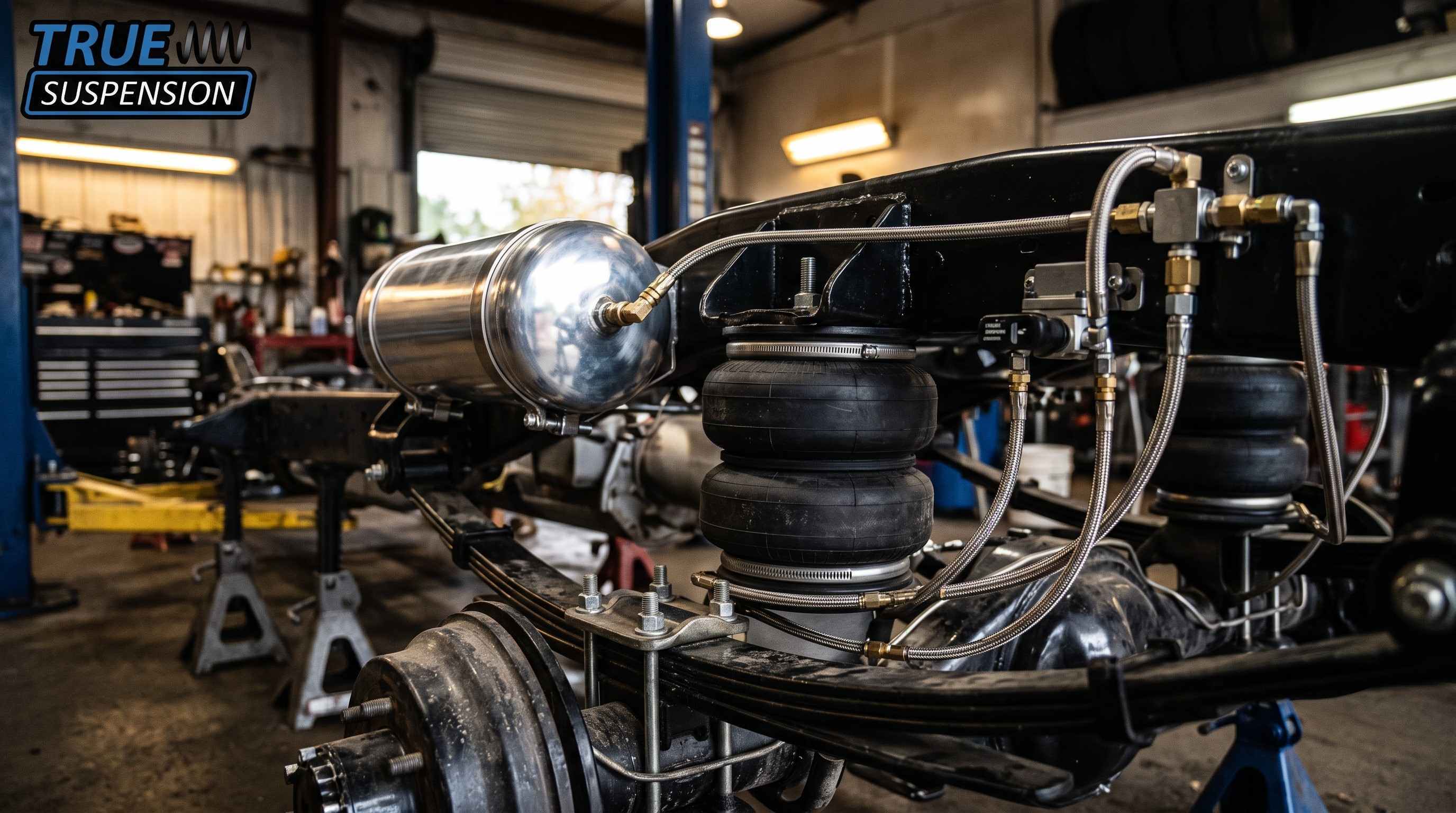
At its core, F100 air ride replaces steel springs with air bags fed by an onboard air system. A compressor fills a tank, valves meter air to each corner, and the bags inflate or deflate to change ride height in seconds. It is the same air suspension principle that luxury new trucks use from the factory, adapted to your classic chassis.
The transformation goes deeper than the springs. Correct suspension geometry is what separates a great air install from a sloppy one, so most builds address the front suspension and rear suspension as a system. Up front, that can mean a new crossmember with modern geometry; out back, ditching the factory leaf springs for a link setup with a c-notch in the frame gives the axle room to travel at laid-out heights. Every piece works together so the Ford truck rides flat, steers true, and lays frame evenly.
Shop TrueSuspension: universal 4-corner air ride kit (2500 series)
From the blog: custom vs. universal air ride kits
Ridetech Suspension Set the Bar, What Ridetech Taught F-Series Builders
Before F100 air ride kits were common, Ridetech showed the aftermarket what a properly engineered air ride suspension could do. RideTech's complete bolt-on systems proved that air could deliver pro-touring handling instead of just show stance, and their Shockwave air spring-and-shock units became the benchmark every serious builder measured against.
That benchmark matters because it taught F-series truck builders to demand complete engineering, not just parts. The lesson the Ford F-series community took from RideTech suspension is simple: quality suspension upgrades are systems, with matched springs, shocks, and geometry.
TrueSuspension follows that same philosophy with its own complete kits and components: matched air bags, proper management hardware, and application-specific fitment, so your F100 air ride build gets engineered parts without the guesswork. You get the benchmark-level approach, from a parts specialist that lives in the classic truck world every day.
Shop TrueSuspension: universal 4-corner air ride kit (2600 series)
From the blog: 10 reasons to switch your classic Chevy to air suspension
Planning Your Ford F-100 Pickup Truck Air Ride Upgrade, Bolt-On Basics
Planning an F100 air ride starts with an honest look at your Ford F-100 pickup truck and your skills. The good news is that bolt-on solutions now cover most of the job, and bolt-in mount designs mean far less cutting than the old days. Ease of installation should be one of your top criteria when comparing any suspension kit.
A smart plan covers the whole truck:
Front suspension: many builders swap to an independent front suspension with tubular upper and lower control arms, modern caster settings, a sway bar, and rack-and-pinion steering for a true modern feel. Every f100 deserves a suspension system engineered as a whole, which is why matched kits beat mix-and-match parts.
Air management: compressor, tank, valves, and lines, controlled by a gauge panel or digital controller in the cab.
Complete kit thinking: buy a matched suspension kit rather than piecing together random parts, so spring rates, shock valving, and brackets all agree with each other.
Start with the end in mind. Decide your target stance, your wheel and tire package, and whether the truck will tow or haul, then choose the complete kit that matches. TrueSuspension's listings spell out exactly what each kit includes and which Ford F-100 years it fits, so planning stays straightforward.
Shop TrueSuspension: FBSS 4-corner manifold with 200 PSI valves
From the blog: air ride management controllers buyer's guide
Ford F-100s Front Suspension, Twin I-Beams to Modern Air Ride
The Ford F-100's Twin I-Beam front end was tough, but it was never refined. Bringing F100 air ride to these trucks usually means leaving the beams behind for a new suspension with modern geometry, and that single change transforms steering feel more than anything else you can bolt on.
The popular path is a Mustang II-style independent front suspension: compact, proven, and designed from the start for airbags and disc brakes. Pair it with quality Wilwood brakes, and the truck stops as well as it rides. The Ford F-Series aftermarket has refined these conversions over decades, soF-100ss builders today benefit from kits with sorted geometry and real-world testing behind them. It is the single most impactful suspension upgrade in a classic Ford restoration.
Shop TrueSuspension: compact 100%-duty-cycle air compressor
From the blog: digital vs. manual air ride controllers
Fabrication vs. Bolt-On, Installing Air Ride on a Classic Ford F100
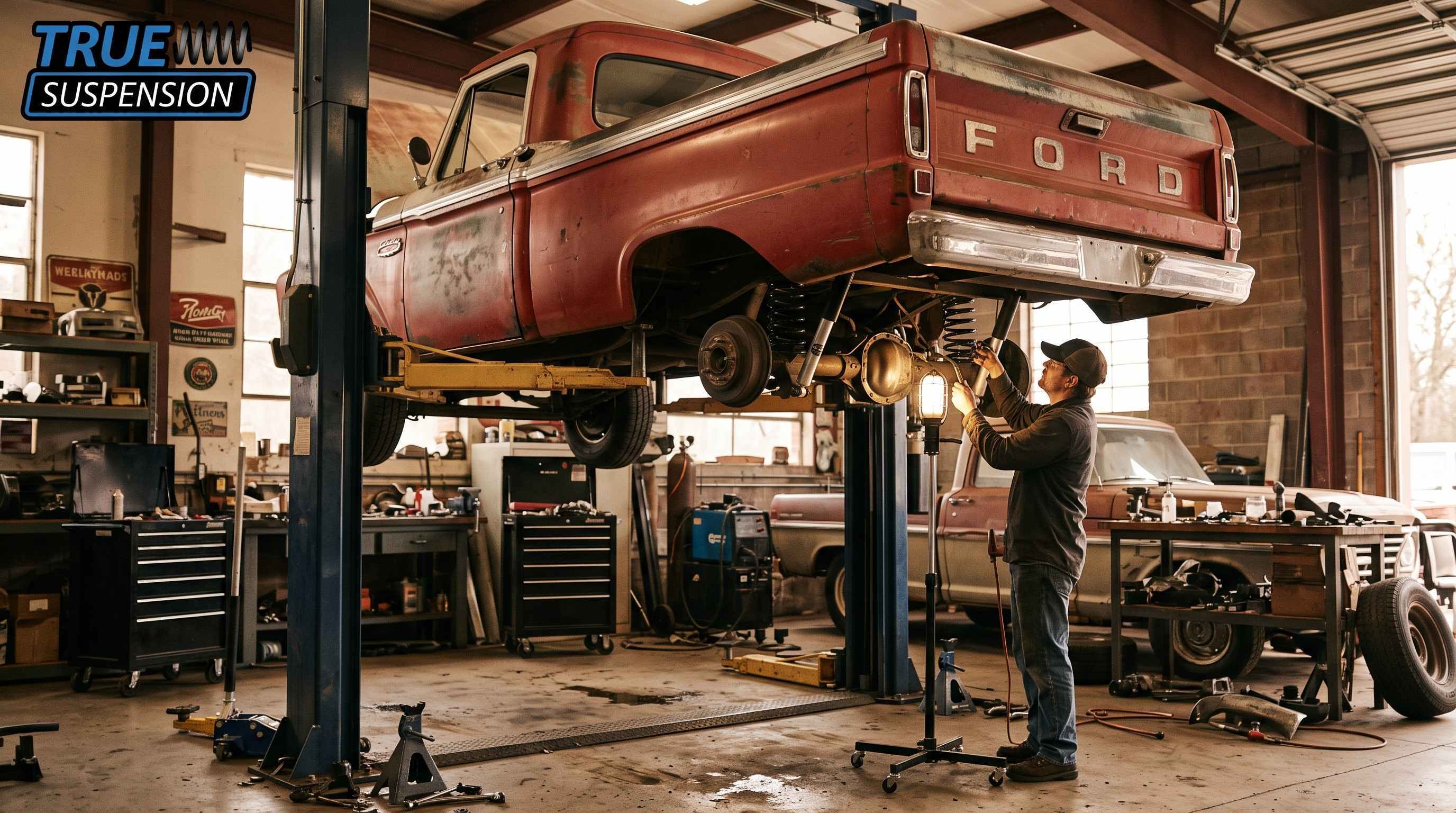
Every F100 air ride install falls somewhere between pure bolt-on and full fabrication, and knowing where your build lands saves headaches. Bolt-on kits handle the front suspension, air bags, and management with hand tools, while fabrication typically shows up out back: notching the frame, building link mounts, and routing the air system cleanly.
Truck owners tackling this for the first time should know that parts available today cover far more than they used to, from complete front clips to weld-in rear kits. Work cab and bed off if you can; a bare chassis makes the fabrication faster, cleaner, and safer. Measure twice, mock everything up before final welding, and keep the compressor and tank serviceable. A tidy install is a reliable install, and reliability is what separates a driver from a trailer queen.
Shop TrueSuspension: double-convoluted 2600-series air springs
From the blog: 10 must-have air ride management parts
Daily Driver Dreams, Coyote Swaps, Vintage Air & Classic Instruments
A daily driver F100 air ride build pairs modern suspension with modern power and comfort. The Coyote V8 is the dream swap for Ford truck enthusiasts: reliable, powerful, and efficient enough that fuel economy stops being a joke. An LS swap is the budget alternative, but for a classic Ford, the Coyote keeps it all in the family.
Comfort matters as much as power. Vintage air climate control makes summer cruising bearable, classic instrument gauges replace the tired stock cluster, and a modern fuel gauge and fuel tank setup ends the guesswork at the pump. These are the details that turn a show truck into a true daily driver, the kind of classic Ford F-100 you reach for on a Saturday morning without thinking twice.
Shop TrueSuspension: rear lowering shackles for the 1965–81 F100 (2WD)
From the blog: front-only vs. full 4-corner air ride
Ford F-Series Parts Support, LMC Truck and the Modern F-150 Connection
F100 air ride is easier than ever because the parts available for these trucks keep growing. LMC Truck stocks the restoration sheet metal, trim, and rubber that every Ford F-Series project needs, while the F-Series aftermarket covers the performance side. That combination means a 50-year-old Ford truck can be restored with new parts instead of junkyard luck.
The modern F-150 connection helps too. Lessons from new trucks, from suspension tuning to brake upgrades, trickle down into the classic scene, and many suspension upgrades developed for newer platforms inspire better classic kits. Build your Ford F-100 with this ecosystem behind you, and the restoration gets simpler every year, not harder.
Shop TrueSuspension: rear lowering shackles for the 1965–81 F100 (4WD)
From the blog: 4-link vs. trailing arm for classic trucks
Air Ride System Costs, Budgeting Your Ford F100 Restoration Upgrade
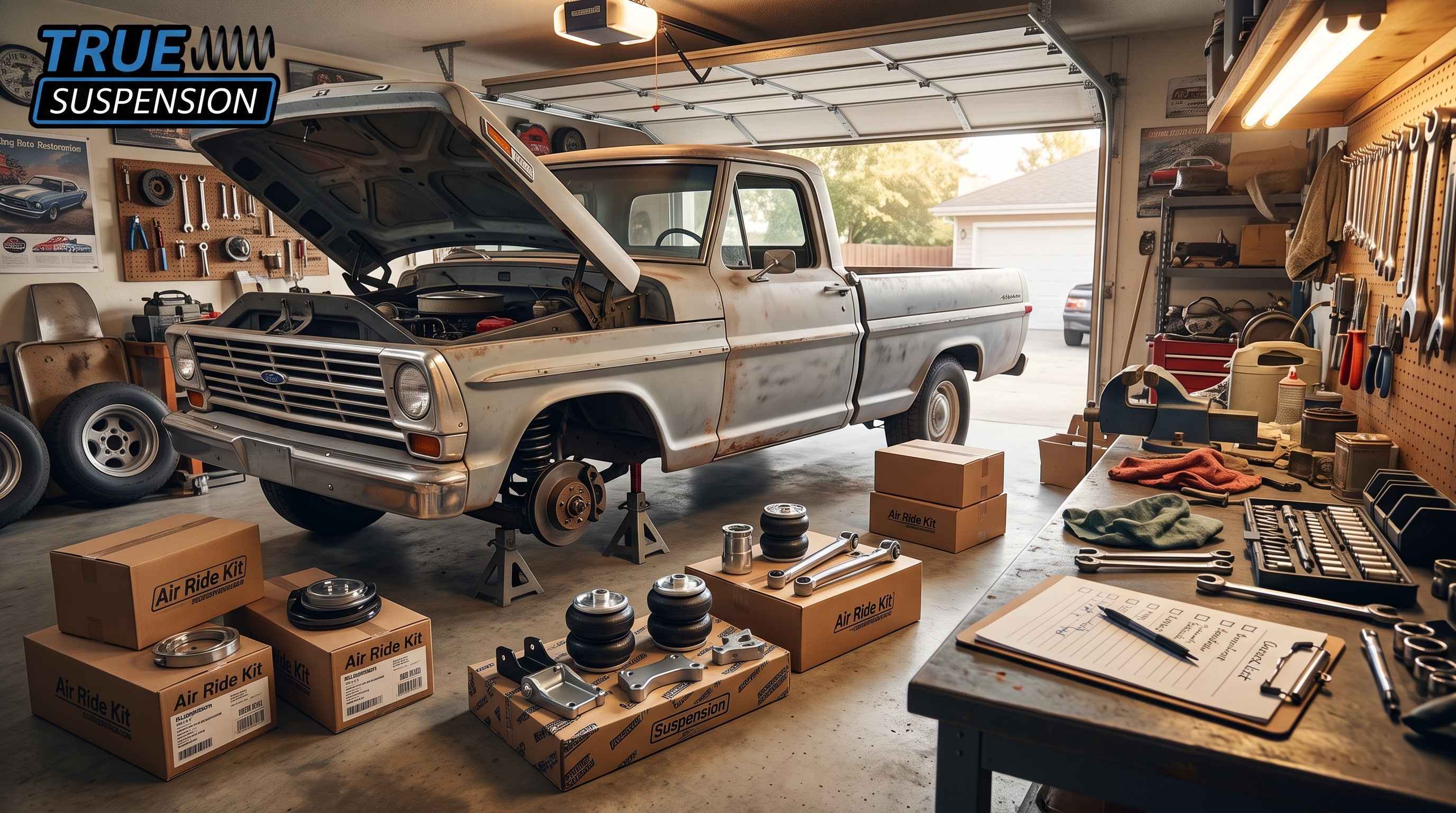
Budgeting F100 air ride means pricing the air ride system in layers, because the suspension is only part of the spend. Here are typical market ranges, not quotes:
|
Build level |
Typical parts cost |
What it includes |
|
Rear-only air ride assist |
1,500–2,500 |
Bags, brackets, basic management |
|
Full 4-corner air ride system |
3,500–7,000 |
Bags, compressor, tank, valves, controller |
|
Front clip + 4-link rear |
7,000–12,000+ |
Complete suspension replacement |
|
Professional installation |
2,000–5,000+ |
Labor, alignment, setup |
Prices move with theFord F-1000 year, the management you choose, and how much fabrication the rear needs. Budget a contingency for the extras every restoration uncovers, and remember that quality management is worth the money: it is the difference between an air ride system you enjoy and one you fight. Buy proven parts from a specialist like TrueSuspension and the numbers stay honest from the start.
Shop TrueSuspension: weld-on 4-link axle brackets with 2600 air springs
From the blog: how to maintain your air ride system
Conclusion
F100 air ride is the modern choice for the Ford F-100 restoration because it refuses every old compromise: show stance and driving comfort, classic looks and modern manners. Plan the system as a whole, buy proven parts, and build the Ford tough daily driver these trucks always deserved to be.
FAQs
What is F100 air ride?
It replaces your truck's steel springs with adjustable air bags, letting you change ride height on demand for show stance or driving comfort.
How much does an air ride setup cost?
A basic rear-only kit starts around $1,500; a complete four-corner system with management typically runs 3,500–7,000 before installation.
Is air ride bolt-on for an F100?
Many kits are largely bolt-on, but most builds need some fabrication such as a C-notch or crossmember work. Check the kit contents first.
Does air ride improve ride quality?
Yes. Adjustable air springs absorb bumps better than stiff static springs, giving a smoother ride you can tune for comfort or handling.
Can I still haul with air ride?
Yes. Air springs let you add pressure under load, so load capacity stays strong, and the truck sits level when towing or hauling.