
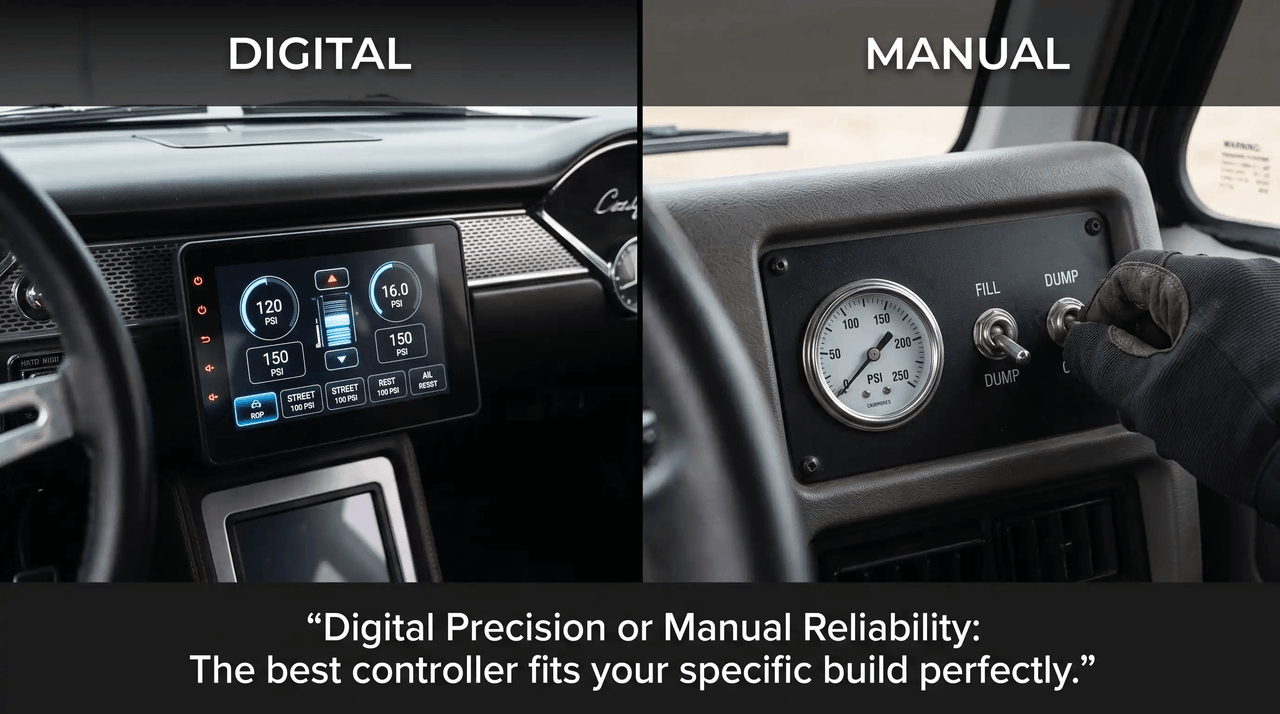
Choosing between digital vs. manual air ride management controllers is one of the first real decisions you face when building or upgrading an air suspension system. Get it right, and every ride feels dialed. Get it wrong, and you spend your time chasing pressure inconsistencies instead of enjoying the road.
At True Suspension, we help truck owners, classic car builders, and off-road enthusiasts cut through the noise and make confident choices. This guide covers how each controller type works, which setup fits your goals, real trade-offs, and exactly why our air ride suspension control systems stand apart from everything else on the market.
What Is an Air Ride Management Controller?
An air ride management controller is the brain of your air suspension system. It regulates airflow to your air springs, controls ride height, and manages pressure, all in real time. Without a reliable controller, even the best air bags and compressors underperform.
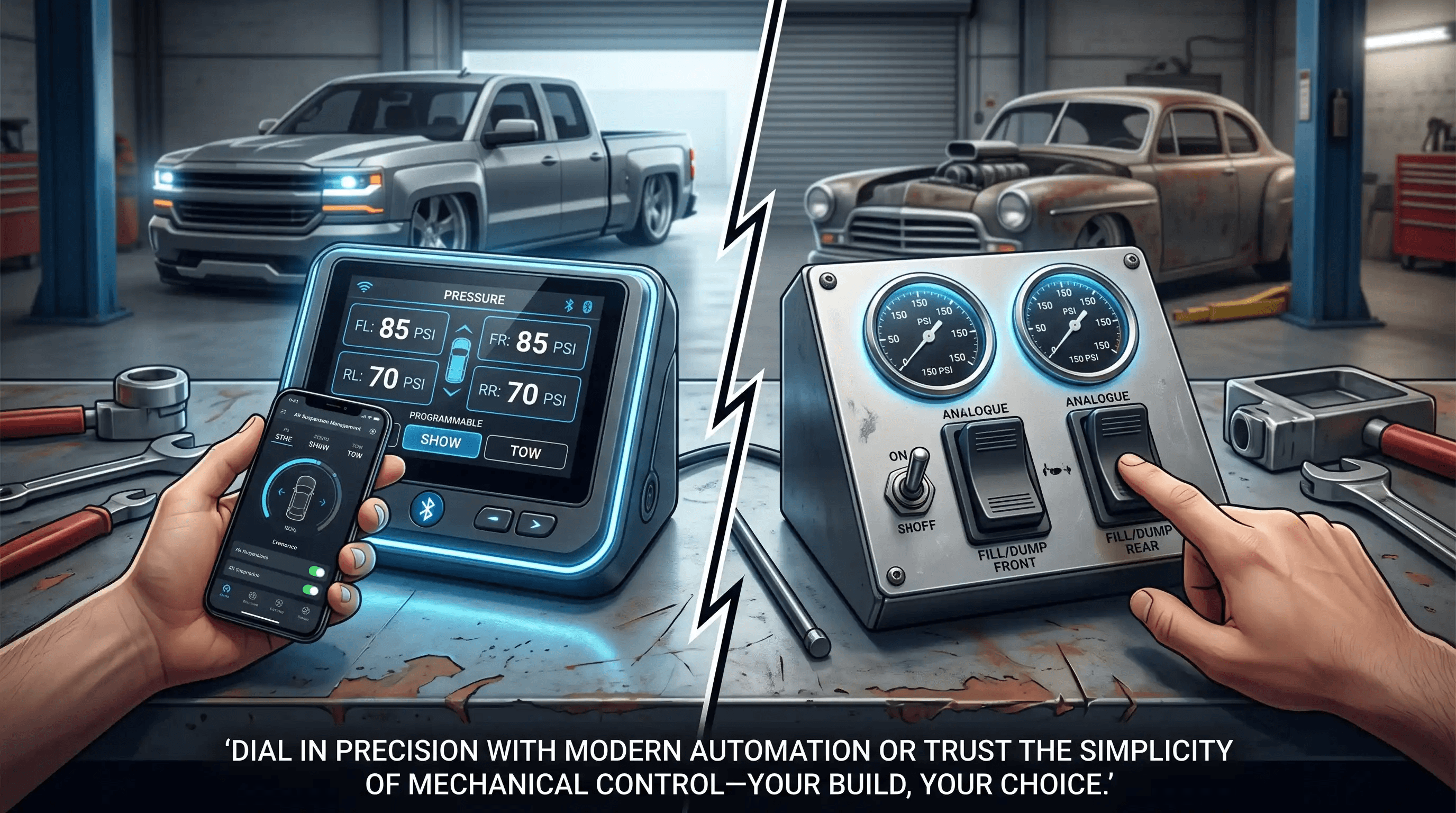
Controllers come in two primary formats: digital air ride controllers with electronic displays and programmable presets, and manual air ride controllers that use paddle switches, toggle switches, or gauge panels to manage airflow directly. Both approaches work, but they work differently, and the right choice depends on your build.
Every controller connects to your air springs, your compressor, and your in-cab panel. True Suspension's active air compact compressor is purpose-built to pair with both digital and manual control systems, with a 100% duty cycle, 1/3 HP, and ready for serious builds.
How Do Digital Air Ride Controllers Work?
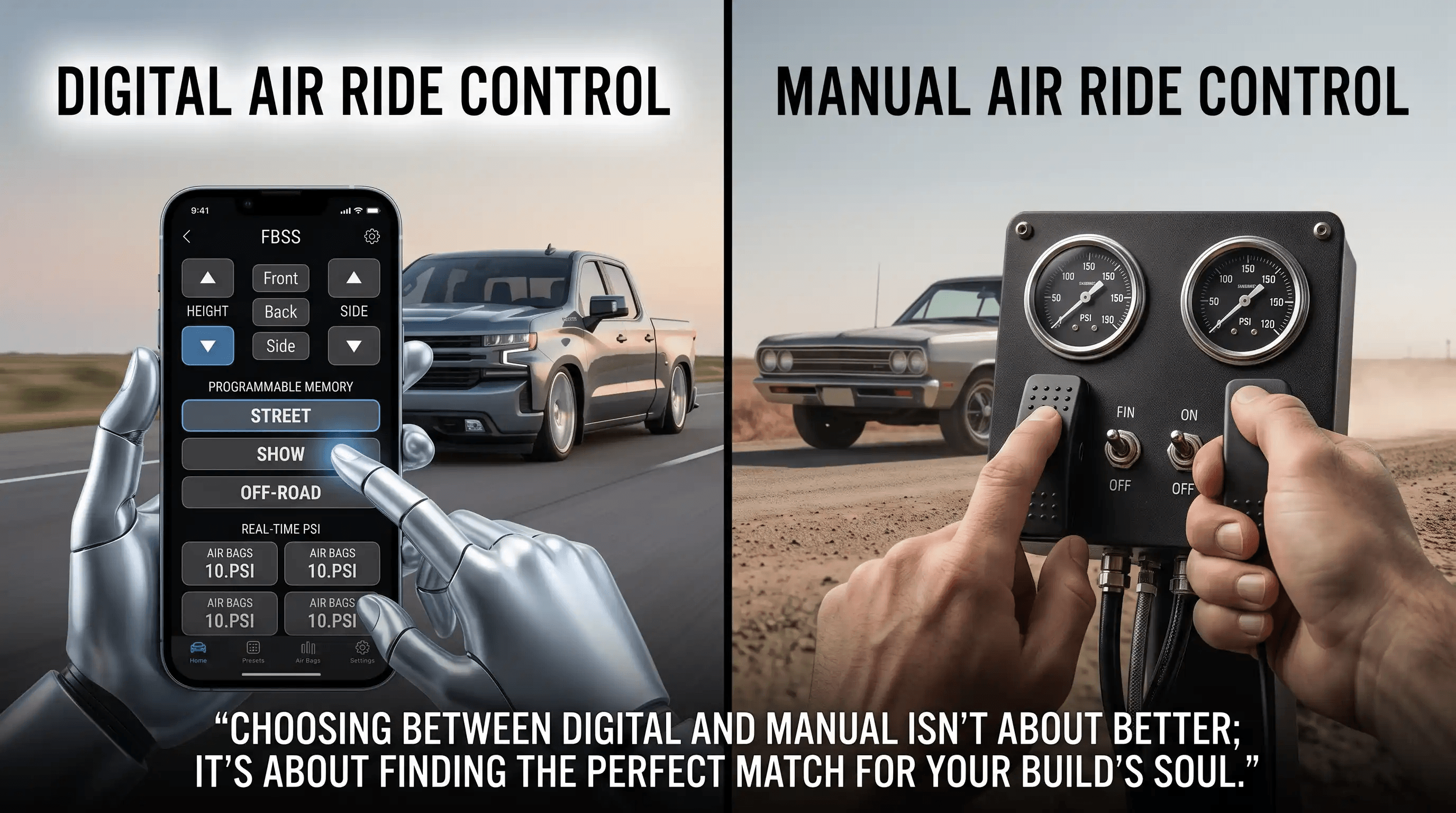
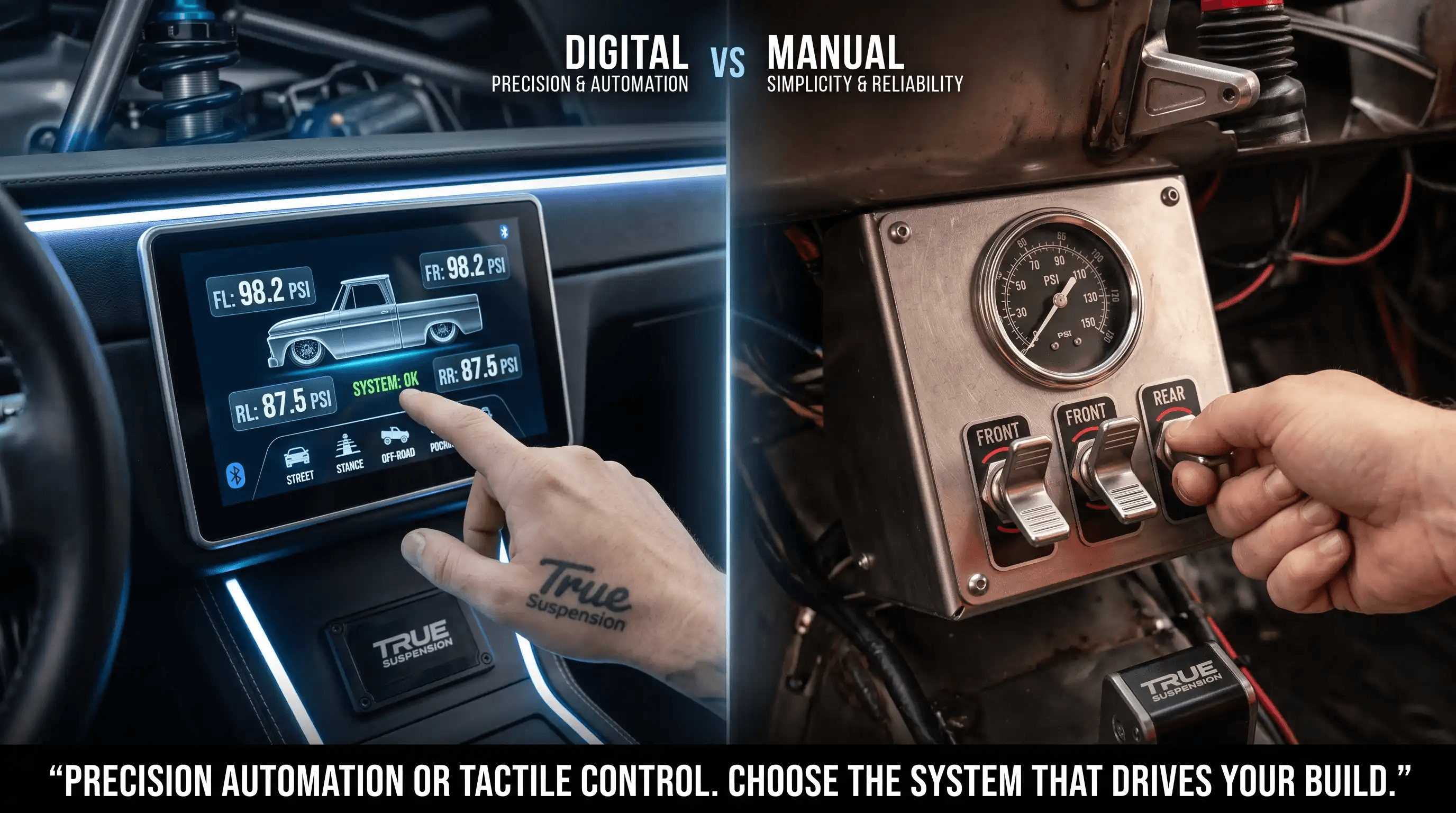
Digital air ride management controllers use onboard electronics to monitor pressure, adjust airflow via solenoid valves, and display live data on a screen or app. Many high-end systems include Bluetooth connectivity, memory presets for different ride heights, and automated leveling logic.
Key features of digital controllers include:
- Programmable ride height presets, save your street, stance, and off-road settings
- Real-time PSI readouts, see exact pressure on every corner
- Automated leveling, the system adjusts itself when load shifts
- Bluetooth or app control, adjust from your phone or a remote
- Data logging, track pressure history and system health
These systems suit builds where precision and automation matter most: FBSS show cars, long-haul tow rigs with variable loads, or drivers who want a set-it-and-forget-it experience. Our complete FBSS active air ride suspension kit for Dodge Ram 1500 is a perfect example of where digital air ride management truly shines.
How Do Manual Air Ride Controllers Work?
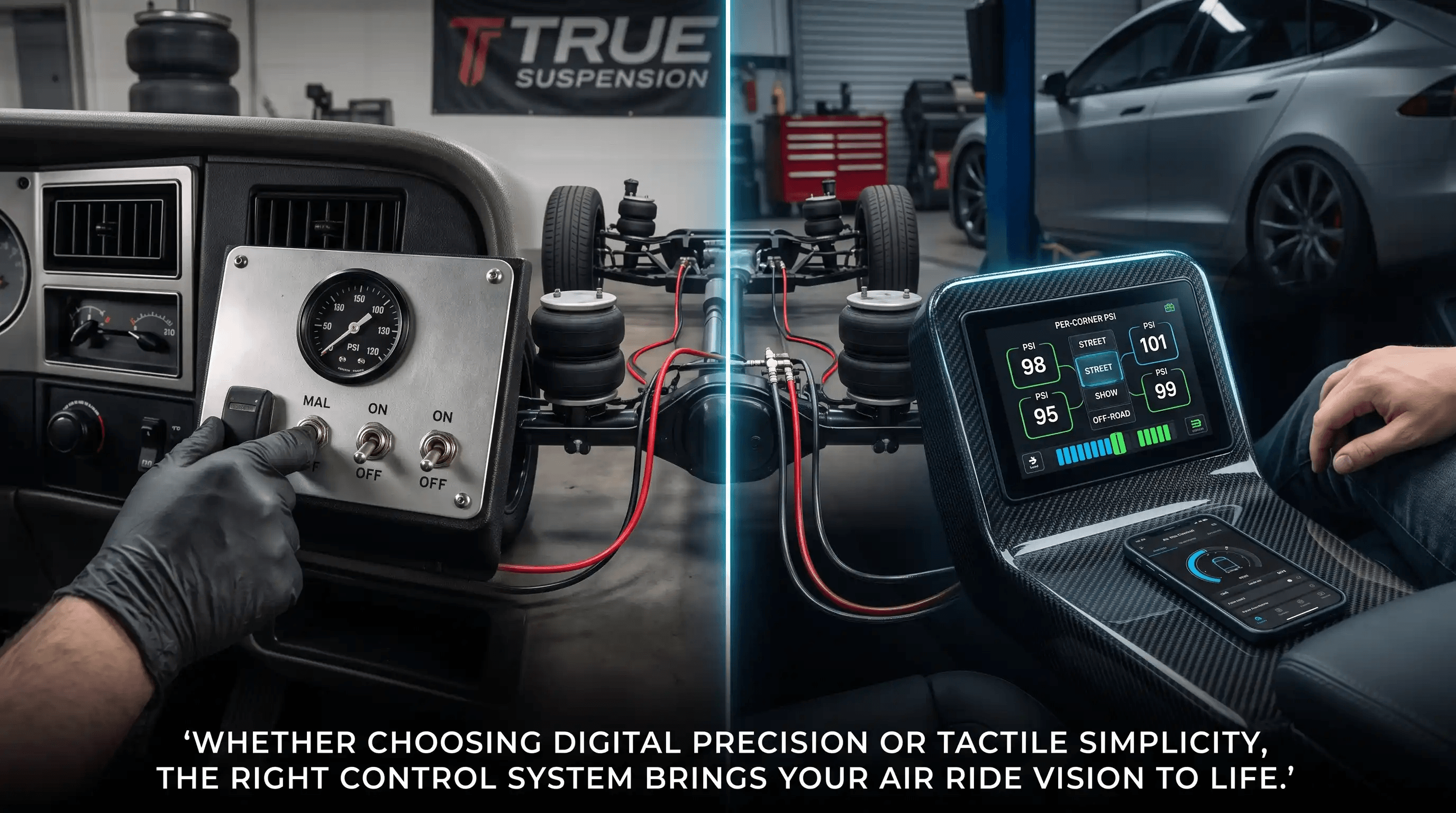
Manual air ride management controllers put direct, tactile control in your hands. You fill or dump air using paddle switches, toggle switches, or Schrader valves- no screens, no apps, no complicated setup. Pressure gauges show you current PSI at a glance.
Manual control systems are built for simplicity and reliability:
- Paddle switches, single or dual, for precise momentary fill/dump
- Toggle switches, old-school, rock-solid, easy to wire
- Gauge panels, 150 PSI analog gauges mounted in-cab
- Schrader valve fill, fill at any air source, zero electronics needed
- Straightforward install, less wiring, fewer failure points
Manual setups are ideal for towing assist builds, weekend trucks, and anyone who wants reliable performance without complexity. True Suspension's universal dual paddle switch panel with 150 PSI gauge is one of our best sellers for exactly this reason; it works every time, with zero fuss.
Digital vs. Manual Air Ride Management Controllers: Side-by-Side Comparison
|
Feature |
Digital Controller |
Manual Controller |
|
Ease of Use |
Moderate (learning curve) |
High (plug-and-play feel) |
|
Precision |
Very high (PSI to the decimal) |
Good (gauge-based) |
|
Automation |
Full auto-leveling available |
Manual only |
|
Install Complexity |
Complex (wiring, programming) |
Simple (switches & hose) |
|
Cost |
Higher ($300–$1,000+) |
Lower ($80–$300) |
|
Reliability |
Good (more electronics) |
Excellent (fewer parts) |
|
Best Use Case |
Show cars, FBSS builds |
Tow assist, daily trucks |
|
Failure Points |
Software, solenoids, ECU |
Minimal |
|
In-Cab Presence |
Screen or app interface |
Panel with gauge & switches |
This comparison makes one thing clear: neither system is universally better. The best air ride controller is the one that fits your specific build. For FBSS builds needing per-corner control, True Suspension's active air 4-valve manifold block handles 200 PSI digital systems perfectly. For towing, a simple dual-switch panel is all you need.
Pros and Cons: Digital Air Ride Controllers
Pros
- Unmatched precision: PSI control to the decimal keeps your stance consistent every time
- Automation: hands-free leveling under load changes, critical for tow rigs hauling variable weight
- Presets: switch between ride heights instantly- street, show, off-road, in seconds
- Modern aesthetics: clean digital interface looks great in any custom interior build
- System monitoring: catch pressure leaks or compressor faults early before they become expensive
Cons
- Higher cost: quality digital management systems run $300 to over $1,000
- Complex install: more wiring, solenoids, and programming add hours to installation
- More failure points: electronics and software can fail; troubleshooting requires know-how
- Overkill for basic builds: if you only need towing assist, digital is unnecessary expense
For serious four-corner builds, pair a digital controller with our universal 4-corner air ride suspension system (2600 series); it unlocks the full precision potential of digital air ride management and is engineered for the most demanding custom builds.
Pros and Cons: Manual Air Ride Controllers
Pros
- Simplicity: fewer parts mean fewer breakdowns, especially important on work trucks
- Affordable: quality manual panels start well under $150 from True Suspension
- Fast install: most manual kits wire up in a single afternoon
- Intuitive operation: press a switch, hear the bag fill, zero learning curve
- Battle-tested: manual toggle and paddle switch controllers have been trusted by builders for decades
Cons
- No automation: you manage pressure manually, not ideal if loads change constantly
- Less precision: gauge-based readings are good but not as fine as digital PSI readouts
- No presets: you re-dial your pressure every time conditions change
- Monitoring limits: analog gauges won't alert you to a slow leak the way a digital system can
For towing assist builds, True Suspension's single paddle switch control panel (black face, round) gives you everything you need: a 150 PSI gauge, clean switch action, and a compact footprint that fits any in-cab install.
Key Industry Statistics on Air Ride Suspension Adoption
|
Metric |
Data Point |
|
U.S. air suspension market size (2023) |
$6.8 billion |
|
Expected CAGR (2024–2030) |
~7.2% annually |
|
Truck owners using air assist for towing |
~38% of aftermarket suspension buyers |
|
Average install time, manual controller |
3–5 hours (DIY-friendly) |
|
Average install time, digital controller |
8–16 hours (professional recommended) |
|
Manual vs digital controller price gap |
60–75% cost savings with manual |
|
Customer satisfaction, True Suspension kits |
4.8/5 average across verified reviews |
These numbers confirm what seasoned builders already know: manual controllers dominate real-world truck builds for good reason. If you're still deciding whether air ride suspension is right for your truck overall, our in-depth guide on rubber block vs. air ride suspension breaks down every trade-off so you can commit with confidence.
Which Builds Benefit Most From Digital Controllers?
Digital air ride management earns its premium price tag in specific use cases. If your build falls into one of these categories, the investment makes sense:
- Full-body air ride show cars: four-corner digital control with presets lets you lay frame at shows and raise back to street height in seconds
- Classic car restoration builds: pair digital management with a complete air ride lowering kit for flawless stance control
- Hauling variable heavy loads: automated leveling keeps your truck flat under changing weight, no driver input needed
- Performance-focused builds: drivers who want precise corner-by-corner height control for handling optimization
- Long-range commercial use: monitoring and data logging help fleets track suspension health across high-mileage routes
If you're planning a classic build, see exactly how it comes together in our roundup of the top 10 classic cars on air ride that look incredible; each one showcases what digital air ride management can achieve on a well-executed build.
Which Builds Benefit Most From Manual Controllers?
Manual air ride controllers are the workhorse choice, and they dominate the market for good reason. These are the builds where manual wins every time:
- Pickup truck towing assist: add air to your rear bags before hitching a trailer, dump it after, no electronics required
- Daily drivers: simple, reliable operation without the complexity that can leave you stranded
- Budget builds: put your money into quality air bags and a compressor, not expensive electronics
- First-time air suspension installs: manual controllers flatten the learning curve significantly
- Work trucks: construction, agriculture, and fleet vehicles need rugged simplicity that survives abuse
Our Ford F-150 towing assist air ride suspension kit (2015–2019) pairs perfectly with a manual dual-switch panel. Thousands of F-150 owners trust this exact combination for hauling, towing, and everyday driving comfort.
True Suspension's Air Ride Controller Lineup, Built for Real Builders
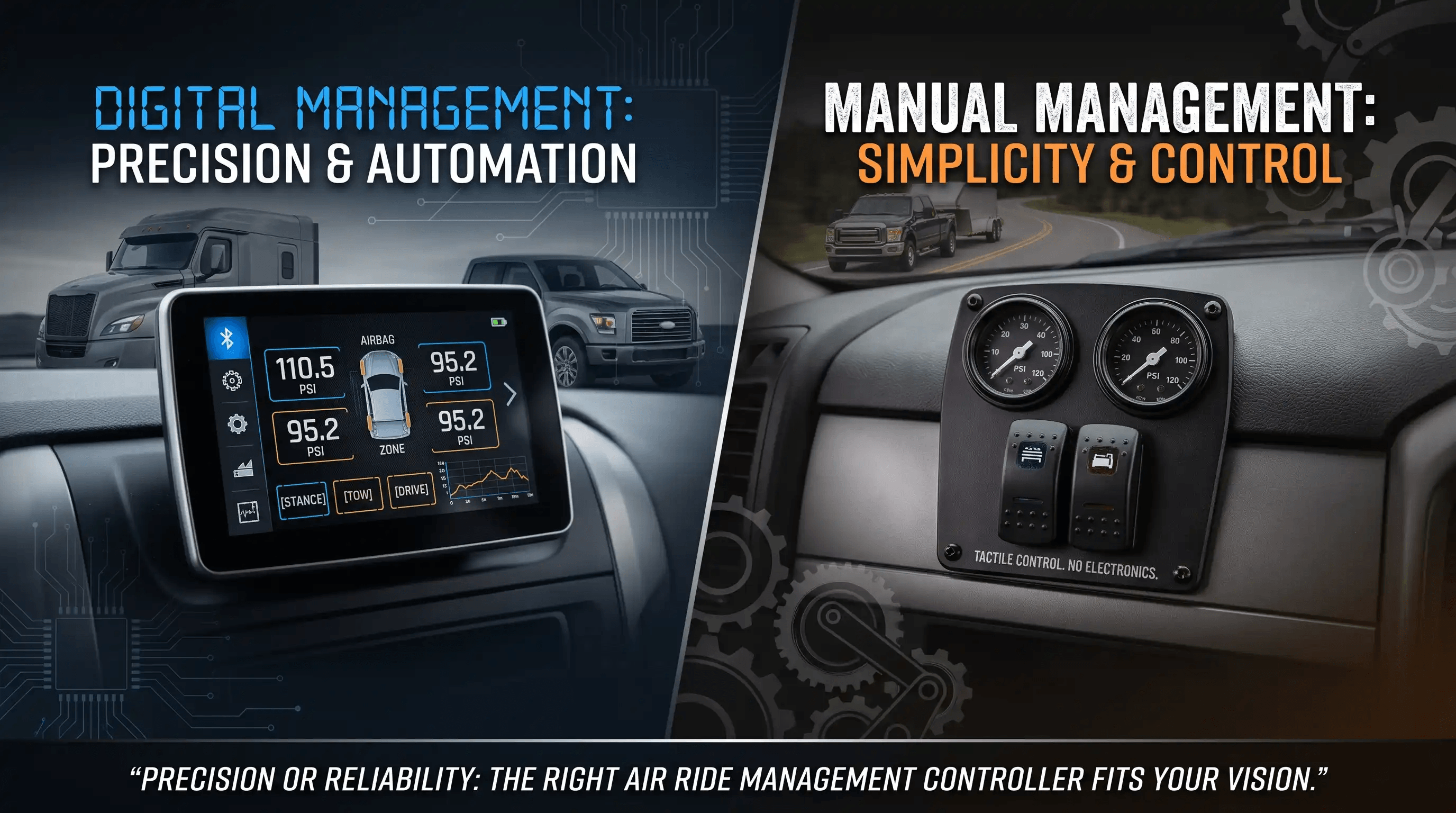
Every air ride management controller in our lineup is tested, purpose-built, and backed by real product knowledge. Here's what we offer across both controller categories:
Manual Control Panels
- Dual Paddle Switch Panel, White Face (Round), 150 PSI gauge, dual paddles, clean round design
- Dual Paddle Switch Panel, Black Face (Round), same great function, blacked-out style
- Single Paddle Switch Panel, White Face (Round), compact, single-zone control
- Old School Toggle Switch Panel, classic look, timeless reliability
- Dual Switch Universal Control System, dual-zone management for two-bag setups
- Single Switch Universal Control System, clean and simple for single-bag rear setups
Advanced Control Solutions
- Premium Dual Switch Management System, upgraded electronics for demanding tow applications
- Tankless Tow Assist Management System, no reserve tank required, ultra-clean install
- 4-Corner Quad Switch Panel (Round), full four-corner control with individual zone management
- 4-Corner Helper Suspension Panel (Round), white face four-corner helper suspension panel
- FBSS Handheld Controller, 4-Corner, wireless four-corner control for complete FBSS builds
- 8-Valve Manifold Block (200 PSI), 200 PSI rated, designed for serious FBSS air management
From a basic toggle switch panel to a full digital FBSS management system, True Suspension has the exact controller your build needs, and the technical knowledge to back every recommendation.
Installation Considerations: Digital vs. Manual Air Ride Controllers
Installation complexity is often the deciding factor, especially for DIY builders. Here's an honest breakdown of what each digital vs. manual air ride management controller system requires:
Manual Controller Install: What to Expect?
- Mount the panel in-cab (under dash or center console area)
- Run ¼" air hose from the panel to your air springs
- Connect power leads to a switched 12V source
- Connect air supply from your compressor to the panel inlet
- Test fill and dump function, done in an afternoon
For a tank-free install, True Suspension's active air manual fill Schrader valve kit lets you fill your air springs at any standard valve stem, the simplest possible manual air ride setup with zero compressor wiring.
Digital Controller Install: What to Expect?
- Mount the display unit and control module in-cab
- Wire solenoid valves to each air spring independently
- Connect height sensors if using auto-leveling
- Run power, ground, and signal wiring (significantly more harness work)
- Program presets and calibrate height sensors
- Test each zone individually, then as a system
The manual air ride controller wins on install simplicity by a wide margin. After install, read our guide on top 10 ways to maintain factory ride quality after a lift kit install; the post-install checks covered there apply equally to air ride builds.
Air Ride Controller Compatibility: What You Need to Know
Not every air ride management controller works with every suspension setup. Compatibility depends on your air spring type, compressor capacity, hose sizing, and the number of zones. True Suspension makes this easy; our product pages clearly list compatible vehicles and configurations.
Key compatibility factors to check before buying:
- Air spring port size: match your hose size to the controller's inlet, ¼" or 3/8"
- Number of zones: single-zone (rear only), dual-zone (rear split), or four-corner (full FBSS)
- Compressor output: digital systems often require higher CFM compressors than manual setups
- PSI rating: tow assist builds run 80–100 PSI; FBSS systems may need 150–200 PSI capacity
- Power requirements: digital controllers draw more current; verify your electrical system
True Suspension's ¼" push-in air hose union fittings (2-pack) and 3/8" push-in fittings (2-pack) make connections clean, leak-free, and tool-free, a small detail that makes a big difference in a system that holds pressure 24/7.
Understanding the Bigger Picture: Rubber Block vs. Air Ride vs. Coilovers
Before committing to a controller type, confirm that air ride suspension is the right foundation for your build. The controller is only as good as the system it manages. There are three main suspension approaches to understand:
- Rubber block/leaf spring: passive, no adjustment, reliable for heavy work but zero ride height control
- Coilovers: adjustable spring rate and height but fixed once set, no on-the-fly changes
- Air ride suspension: fully adjustable on demand, the only system that justifies a dedicated controller
Our comparison guide on air ride suspension vs. coilovers for classic cars digs into the full trade-off. The short answer: if you want adjustable air ride management, True Suspension has the kit and the controller for every platform, including complete classic car lowering systems like our 1958–1964 Chevy Bel Air complete air ride lowering system.
Best Air Ride Controller Setups by Vehicle Type
|
Vehicle Type |
Recommended Controller |
True Suspension Kit |
|
Ford F-150 (tow assist) |
Manual dual paddle switch |
F-150 Towing Assist Kit (15–19) |
|
Chevy Silverado 1500 (tow assist) |
Manual single or dual switch |
Silverado 1500 Rear Air Ride Kit (07–18) |
|
Dodge Ram 2500/3500 HD |
Manual or premium dual switch |
Ram 2500/3500 HD Towing Kit |
|
Toyota Tundra |
Manual in-cab panel |
Tundra Rear Air Ride Kit (07–21) |
|
Classic muscle car (lowered) |
Digital 4-corner FBSS |
Universal 4-Corner 2600 Series Kit |
|
Chevy C10 (custom build) |
Digital or premium manual |
C10 Active Air Ride 4-Link Kit |
|
Ford Mustang (air ride) |
Digital FBSS controller |
Mustang Complete Air Ride Kit |
|
Work van (G2500/G3500) |
Manual single switch |
Chevy G2500/G3500 Towing Assist Kit |
True Suspension covers every platform in this table. Whether you drive a Toyota Tundra (07–21) or a Chevy G2500/G3500 van (96–18), we have a purpose-built air ride suspension kit paired with the right controller, ready to ship.
Lift Kits, Leveling Kits, and Air Ride: How Controllers Fit the Bigger Picture?
Many truck owners combine a lift kit or leveling kit with a towing assist air ride suspension kit. The lift kit raises ride height for off-road clearance; the air bags handle rear squat under load. Understanding the difference is key; our guide on lift kits vs. leveling kits is the starting point for every hybrid build like this.
In these hybrid setups, a manual air ride controller is almost always the right call. You're not managing four corners; you're compensating for rear bag pressure for load. A digital air ride management controller would be overkill and add unnecessary wiring complexity.
True Suspension carries complete lift and air suspension combos, like the Chevrolet Silverado/GMC Sierra 1500 (07–17) lift kit with rear blocks and ProComp shocks, everything in one order, no compatibility guessing.
Why True Suspension Is the Right Choice for Your Air Ride Controller?
There are dozens of air suspension suppliers online. Most sell the same generic parts with zero real-world context. True Suspension is built differently; here's exactly why thousands of builders trust us:
- Deep product knowledge: we know which controller works for which build, and we'll tell you if you're overcomplicating it
- Widest compatible lineup: from the Ford F-150 to the Chevy C10 to the Dodge Ram 3500, our inventory covers virtually every platform
- Honest specs: our product pages list actual PSI ratings, hose sizes, and compatibility, no vague marketing claims
- Value engineering: professional-grade performance at prices that don't punish builders on a budget
- Complete kits: our kits ship with everything needed for a clean install, no hunting for missing hardware
- Content that educates: our blog and product descriptions treat you like the capable builder you are
For builders who want to go all-in on digital air ride management, our complete 4-corner FBSS air ride management control system delivers everything: compressor control, solenoid management, PSI monitoring, and four-corner automation in one purpose-built package. This is what True Suspension looks like when it goes all-out.
Conclusion
The debate between digital vs. manual air ride management controllers comes down to one question: what does your build actually need? Digital systems deliver automation, precision, and programmability for complex FBSS builds and show cars. Manual systems deliver reliability, simplicity, and outstanding value for truck owners, tow rigs, and daily drivers.
True Suspension gives you both, and the expertise to choose correctly. Whether you need a simple dual-switch panel for tow assists on your Chevy Silverado or a full digital FBSS management system for your classic car build, we have it. And it ships ready to install, no guesswork, no missing parts.
Start with the right kit for your truck. Our Chevrolet Silverado 1500 rear towing assist air ride kit (07–18) is one of our most popular complete setups, includes the air bags, compressor, and manual control panel, all matched and ready to go. Browse the full True Suspension lineup and build with confidence.
Frequently Asked Questions
Q1: What is the main difference between digital vs. manual air ride management controllers?
A: Digital controllers offer automation, presets, and PSI precision via electronics. Manual controllers use switches and gauges for direct, simple airflow control. Manual wins on cost and simplicity; digital wins on automation and precision.
Q2: Can I use a manual air ride controller for a four-corner air ride system?
A: Yes. True Suspension's quad paddle switch panel manages all four corners manually. It works well for builders who want full control without digital complexity. It's a popular choice for custom classic builds.
Q3: How long does it take to install a manual air ride management controller?
A: Most DIY builders complete a manual controller install in 3–5 hours. Digital systems typically take 8–16 hours and often require professional installation for solenoid wiring and sensor calibration.
Q4: Are True Suspension air ride controllers compatible with all truck makes and models?
A: True Suspension controllers are compatible with most major platforms including Ford, Chevy, GMC, Dodge, Toyota, and Nissan. Always check the product page for specific year and drivetrain compatibility before purchasing.
Q5: Is a digital air ride management controller worth the extra cost for towing assist?
A: For basic towing assist, a manual controller is more cost-effective and equally reliable. Digital systems are worth the investment in full FBSS builds, show cars, or applications needing automated load-leveling under variable heavy loads.