
You load up your truck, hitch a trailer, and suddenly the rear end sags. Steering gets vague. The ride gets rough. This is exactly the problem that air ride management controllers solve. These systems let you adjust air pressure in your suspension bags right from inside the cab, no tools, no guesswork, no stops.
At True Suspension, we have spent years building and refining towing-assist air-ride suspension kits for trucks, pickups, and heavy-duty haulers. We know what works, what fails, and what you actually need. This guide walks you through everything, from how these systems work to what features matter most, so you can buy with confidence.
What Are Air Ride Management Controllers?
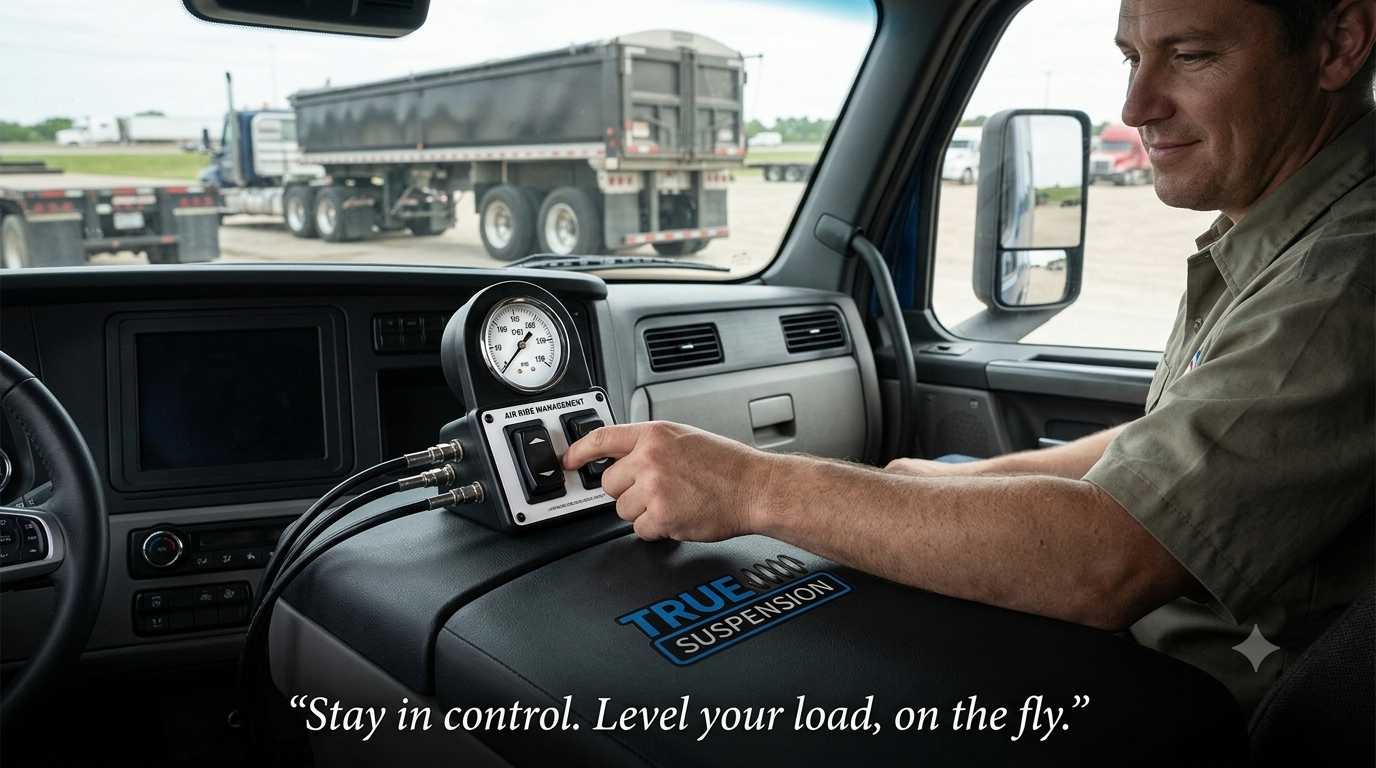
Air ride management controllers are the brain of your air suspension system. They control the flow of air into and out of your suspension air bags (also called air springs or helper springs). You press a button or flip a switch, and air pressure rises or falls, leveling your truck, stiffening your ride under load, or softening it when running empty.
Think of it this way: the air bags do the heavy lifting, but the air management system is what gives you control. Without a quality controller, you are stuck adjusting air pressure manually, a slow, messy process nobody wants on a job site or trailhead.
Our in-cab air management controls put that power right on your dashboard or centre console. You adjust on the fly. You stay level. You stay in control.
Why the Controller Choice Matters More Than You Think?
Most buyers focus on the airbags themselves. That is understandable; the bags are doing the physical work. But the air ride controller determines how well you can use that capability.
A cheap or mismatched controller creates real problems: slow air fill times, inaccurate pressure readings, switches that fail after a season, and panels that look thrown together. A quality suspension control panel gives you instant response, clear gauges, and the durability to handle years of hard use.
At-a-Glance: Controller Quality Impact
|
Factor |
Budget Controller |
True Suspension Controller |
|
Fill Speed |
Slow (30–60 sec) |
Fast (under 15 sec) |
|
PSI Gauge Accuracy |
±10–15 PSI |
±2–3 PSI |
|
Switch Lifespan |
1–2 seasons |
5+ years |
|
Panel Finish |
Plastic, basic |
Black or white face, clean finish |
|
Mounting Options |
Limited |
Round or side mount |
Types of Air Ride Management Controllers We Offer
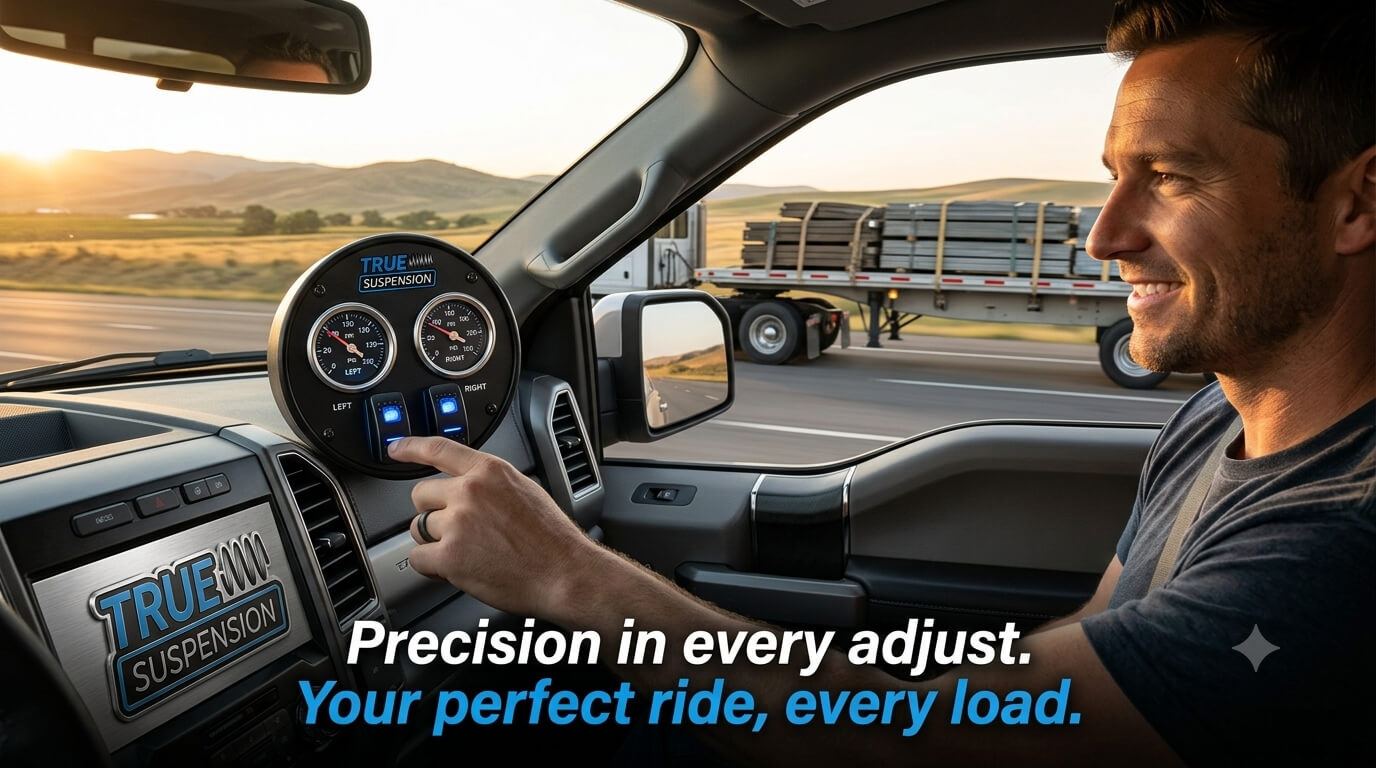
Not every truck or application needs the same controller. True Suspension offers a wide range of air suspension control systems to precisely match your setup's demands. Here is a breakdown of the main types:
Single-Switch Controllers
These are the most straightforward option. One switch, one air circuit. You press to inflate, release to stop. These work perfectly for single-axle towing assist helper air ride suspension setups where you only need to control rear bag pressure.
Our Universal Towing Assist Helper Air Ride Suspension Control System, Single Switch is built for exactly this job. It features a quality 150 PSI gauge, a clean paddle switch, and ¼" air hose, everything you need, nothing you do not.
Dual-Switch Controllers
Dual-switch panels give you independent control over two air circuits, typically left bag and right bag, or front and rear. This is the most popular choice for truck owners who want precise, side-to-side leveling. If your load is uneven, you can correct it without over-inflating one side.
Our dual-switch panels come in multiple face styles: black face, white face, round mount, and side mount. The Universal Towing Assist Helper Air Ride Suspension Control System, Dual Switch is one of our best sellers for a reason: it works, it lasts, and it looks great in any cab.
Four-Corner (FBSS) Controllers
For full four-corner air ride suspension setups, common in custom builds, classic car air bags, and complete FBSS systems, you need a quad-switch or handheld controller. These manage all four corners independently.
True Suspension offers the Active Air Universal Air Ride Suspension FBSS Handheld Switch Controller, 4 Corner Control for builds that demand that level of precision. This is the tool serious builders use.
Key Features to Look for in an Air Ride Controller
Buying the right air management controller comes down to matching features to your actual use case. Here are the six features that matter most:
- PSI Gauge Quality: Look for a 150 PSI gauge with a clear face. You need accurate readings at a glance, especially while driving. Our panels use quality gauges in white face and black face options.
- Switch Type: Paddle switches are more reliable than old-school toggle switches for repeated daily use. Toggle switches suit certain custom and classic builds where aesthetics matter.
- Air Hose Size: Most quality systems use ¼" air hose. Some setups benefit from 3/8" for faster fill times on larger air springs.
- Single vs. Dual Circuit, Match the number of switches to your number of independent air circuits. Do not buy a dual-switch panel if your kit only has one air circuit.
- Mount Style, Round mount panels fit standard gauge pods. Side mount panels work in dash cutouts or centre consoles. Know your cab layout before ordering.
- Tank vs. Tankless, Some complete air ride management systems include a reserve air tank for faster inflation. Tankless systems rely on a compressor alone and are simpler but may inflate more slowly under heavy demand.
Complete Kits vs. Standalone Controllers, Which Should You Buy?
This is one of the most common questions we get. The answer depends on what you already have.
If you are starting fresh, no air bags, no compressor, no lines, go with a complete towing assist air ride suspension kit with in-cab management controls. Everything is matched, everything fits, and installation is straightforward. For example, our Chevy Silverado / GMC Sierra 1500 (2007–2018) in-cab towing assist kit comes with the air bags, lines, and full in-cab air management already included.
If you already have air bags installed but want to upgrade your control panel, a standalone air ride management controller is the smarter buy. Just match the switch count to your existing circuits and confirm hose size compatibility.
Complete Kit vs. Standalone Controller, Pros & Cons
|
|
Complete Kit |
Standalone Controller |
|
Pros |
All components matched; easier install; one-stop purchase |
Lower cost; upgrade existing bags; choose preferred style |
|
Cons |
Higher upfront cost; may include parts you already have |
Must verify compatibility; need existing air spring install |
|
Best For |
New builds or first-time air ride buyers |
Upgrading or replacing an existing control panel |
How True Suspension's Controller Panels Stand Apart?
We do not just resell generic parts. Every air ride management controller in our lineup is selected, tested, and matched to real truck applications. Here is what that means for you:
Built to Spec, Not to Price: Our panels use quality 150 PSI gauges, not the 100 PSI gauges that budget systems sneak in. You need headroom above your operating pressure, and we build it in.
Multiple Style Options: We offer black face and white face panels, round mount and side mount configurations, single and dual switches, paddle and toggle styles. You pick what fits your cab.
Matched Air Hose Included: Every panel includes the correct ¼" air hose. Our r hose fittings (2-pack) make connections clean and fast, no hunting for compatible fittings after the install.
Designed for Truck Owners: We focus exclusively on trucks and pickups. That focus means our kits are dialed in for the loads, the vibration, and the use patterns that truck owners actually deal with.
Comprehensive Vehicle Coverage: From Ford F-150 towing assist kits to Dodge Ram 2500/3500 air ride suspension kits, we cover the trucks people actually tow with.
Understanding PSI Ratings and What They Mean for Towing
PSI, pounds per square inch, is the number you watch when you adjust your air suspension helper springs. Getting it right is the difference between a stable ride and a dangerous one.
General PSI Guidelines for Towing Applications
|
Load Condition |
Typical PSI Range |
Notes |
|
Empty / Light Load |
5–20 PSI |
Minimum to maintain bag shape |
|
Moderate Load / Camper |
30–55 PSI |
Most common daily towing range |
|
Heavy Trailer / Max Load |
60–100 PSI |
Do not exceed bag max rating |
Always start at the low end and add pressure gradually. Check your truck's level at each step. The beauty of a quality air ride management controller is that you can fine-tune this while you drive, something manual systems simply cannot do.
Tank vs. Tankless Air Management, What's Right for Your Truck?
One of the most common points of confusion when shopping for a complete air ride suspension kit with management control is whether you need an air reserve tank. Here is the honest breakdown:
Tankless systems rely entirely on the onboard compressor to fill your air springs. They are lighter, simpler, and more affordable. Most towing assist setups work perfectly fine without a tank because you typically set your pressure before you drive and leave it there.
Tank-equipped systems store pressurized air for faster on-demand inflation. They are ideal for four-corner air ride setups where you are raising and lowering the vehicle frequently. If you are adjusting air pressure a dozen times a day, a tank keeps fill times fast without burning out your compressor.
True Suspension offers both. Our Toyota Tundra 4WD in-cab tankless kit is popular with towing customers who want simplicity. For those who need faster fill, our Silverado / Sierra 1500 kit with reserve tank includes everything pre-matched.
How to Install an In-Cab Air Management Controller?
Installation is straightforward when you follow the steps. Most of our customers install their in-cab air management controls in two to four hours without professional help. Here is the general process:
- Mount the air springs (if not already installed) following your vehicle-specific kit instructions.
- Run the ¼" air hose from each air spring through the firewall into the cab.
- Mount the control panel in your preferred location, dash, centre console, or A-pillar.
- Connect the air hose to the panel's inlet ports using push-in fittings.
- Wire the panel to a switched 12V power source and ground.
- Connect the compressor to the panel (if included in your kit).
- Test inflation and deflation on each circuit before driving.
Our kits include detailed instructions and all the correct fittings. If you want to understand how lift kits and leveling kits compare to air assist setups, our blog post Lift Kits vs. Leveling Kits: What Truck Owners Must Know is a great starting point before you decide.
Vehicle Compatibility, Finding the Right Kit for Your Truck
True Suspension covers more trucks than any comparable supplier in our price range. Whether you drive a Ford, GM, Dodge, Toyota, or Nissan, we have a kit built specifically for your truck, with the correct air bags, bracketry, and air ride management controller matched to your suspension geometry.
|
Vehicle |
Years |
Kit Link |
|
Ford F-150 |
2004–2019 |
|
|
Ford F-250 |
2005–2021 |
|
|
Ford F-350 |
2005–2021 |
|
|
Chevy Silverado / GMC Sierra 1500 |
2007–2018 |
|
|
Chevy Silverado / GMC Sierra 2500/3500 |
2001–2016 |
|
|
Dodge Ram 1500 |
2009–2017 |
|
|
Dodge Ram 2500/3500 |
2003–2021 |
|
|
Toyota Tundra |
2007–2021 |
|
|
Nissan Frontier |
2005–2020 |
Air Ride vs. Rubber Block vs. Coilover, Why Air Wins for Towing?
Truck owners often debate between rubber bump stops, coilover helper springs, and air suspension. Our blog covers the rubber block vs. air ride suspension debate in depth, but here is the short version:
|
Feature |
Rubber Blocks |
Coilovers |
Air Ride (with Controller) |
|
Adjustability |
None |
Limited |
Full, on the fly |
|
Ride Quality (Empty) |
Harsh |
Firm |
Soft, comfortable |
|
Ride Quality (Loaded) |
Better |
Good |
Excellent |
|
Level Control |
No |
No |
Yes, from cab |
|
Towing Stability |
Moderate |
Moderate |
High |
|
Install Complexity |
Simple |
Moderate |
Moderate |
For classic car builds, we also cover the air ride suspension vs. coilovers decision in a dedicated blog post. If you are building a classic or custom, that is worth reading before you choose a suspension path.
Our Most Popular Air Suspension Control Products
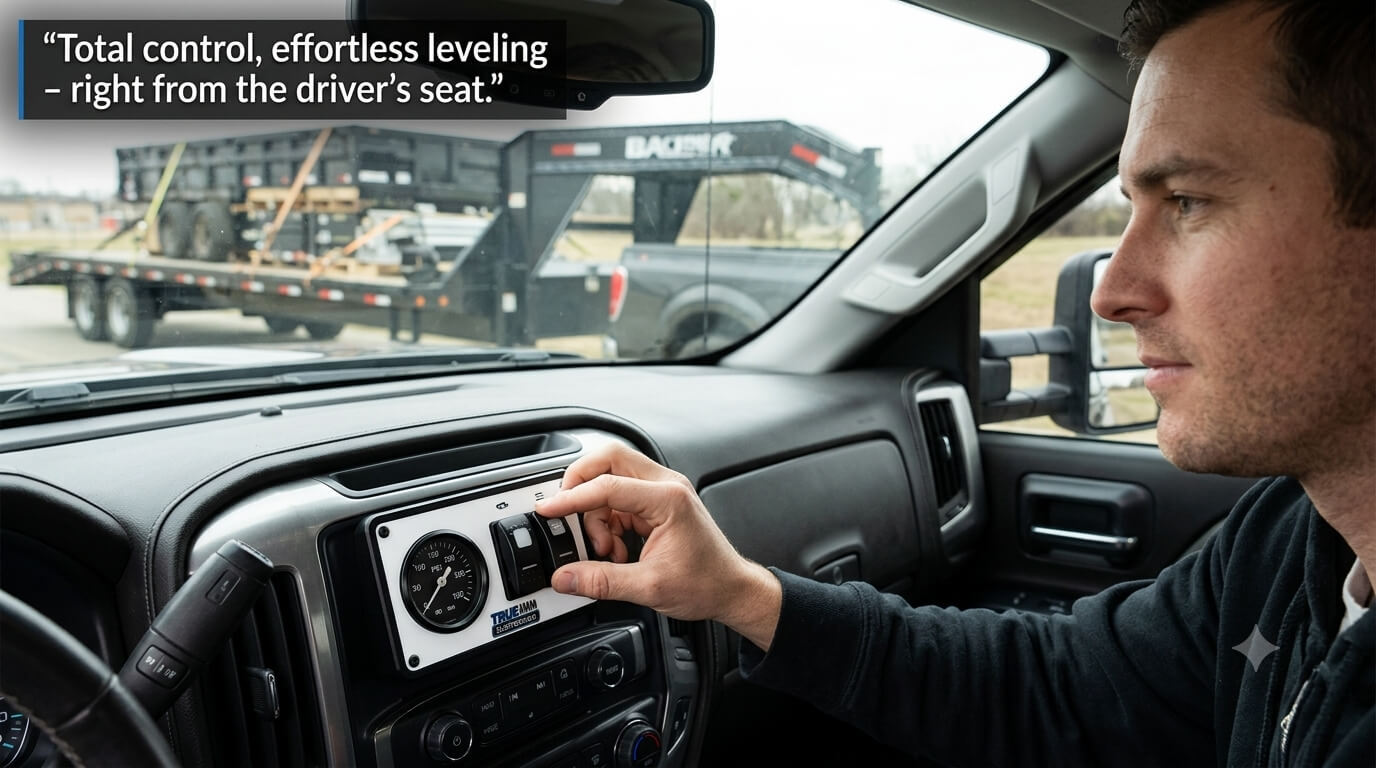
Below are the standout air ride management controllers and kits from the True Suspension lineup, with direct links so you can check fitment and specs immediately:
- Universal Towing Assist Control Panel, Dual Paddle Switch, White Face (Round Mount), Our cleanest-looking dual-switch panel with 150 PSI gauge, ¼" hose included.
- Universal Towing Assist Control Panel, Dual Paddle Switch, Black Face (Round Mount), Same great spec in a blacked-out finish for darker cab interiors.
- Universal Towing Assist Control Panel, Single Paddle Switch, White Face, Ideal for single-circuit rear towing assist setups. Simple and effective.
- Universal 4-Corner Air Ride Control Panel, Quad Paddle Switches, White Face (Round), Built for full FBSS four-corner setups with quad gauges and four independent circuits.
- Active Air Universal Towing Helper Assist Control Management System, Dual Switch (Premium), Our premium dual-switch management system for serious towing applications.
- Active Air Tankless Tow Assist Air Ride Management Control System, Complete tankless management system. Install it and forget the compressor worries.
Complete System Kits With Built-In Air Management
If you want the easiest path to a controlled, level truck, buy a complete kit. Every kit below includes air bags, lines, fittings, compressor, and a full in-cab air management control system matched and ready to install:
- Ford F-150 (2015–2019) Towing Assist Kit with In-Cab Controls, No Tank (4WD/2WD)
- Ford F-250 (2017–2021) Towing Assist Air Ride Kit with Management Control (4WD)
- Ford F-350 (2017–2021) Towing Assist Air Ride Kit with Management Control (4WD)
- Chevy Silverado / GMC Sierra 2500/3500 HD (2011–2016) Complete In-Cab Rear Towing Kit
- Dodge Ram 2500 4WD (2003–2013) Towing Assist Kit with Full Air Management Control
- Toyota Tundra (2007–2021) Rear Towing Assist Kit with In-Cab Management Controls (2WD)
- Ford F-250/F-350 Super Duty (2005–2010) Towing Assist Kit, In-Cab Controls, No Tank (4WD)
- Dodge Ram 1500 (2009–2017) Complete FBSS Active Air Ride Suspension Kit (2WD/4WD)
Why Truck Owners Trust True Suspension?
We are not a general auto parts store. We specialise in suspension, specifically in making trucks tow better, ride better, and handle better under load. That focus means every product we sell has been thought through from a truck owner's perspective.
Our air ride management controllers are sold as part of complete, matched kits or as standalone upgrades, and in both cases, they are tested to work with the air springs, compressors, and hose fittings in our lineup. When you buy from True Suspension, you are not gambling on compatibility. You are getting a system that was designed to work together.
We also share knowledge freely. Our blog covers everything from maintaining factory ride quality after installing a lift kit to the top 10 classic cars that look incredible on air ride. We want you to make the right call for your truck and your budget, every time.
For custom builders working with classic trucks or cars on a 4-link setup, our Universal 4-Corner Air Ride Suspension System Kit (2600 Series) is a popular starting point. And for compressor needs, our Active Air Compact Compressor (1/3 HP, 100% Duty Cycle) is the go-to match for most of our controller setups.
Conclusion
Choosing the right air ride management controller is not complicated when you know what to look for. Match the switch count to your circuits. Get the right PSI gauge range. Pick a panel style that fits your cab. And buy from a supplier who knows trucks.
True Suspension checks every one of those boxes. We offer the widest selection of towing assist air suspension control systems in the market, built for real trucks doing real work. Whether you need a simple single-switch panel or a full FBSS four-corner air ride controller, we have the right product at the right price, and the knowledge to help you install it right.
Browse our full range of air ride management controllers and complete suspension kits at truesuspension.com. Your truck deserves to tow level, ride smooth, and stay in control, every mile.
Frequently Asked Questions
- What does an air ride management controller do?
It controls air pressure in your suspension air springs from inside the cab. You inflate or deflate the bags to level your truck and improve stability when towing or hauling heavy loads.
- How many switches do I need on my air management panel?
One switch for a single-circuit system (both bags together). Two switches for independent left/right control. Four switches for full four-corner air ride setups with independent corner management.
- Can I install an air management controller myself?
Yes. Most truck owners complete the install in two to four hours. Our kits include instructions, matched hose, and all fittings. Basic hand tools are all you need.
- What PSI gauge rating should my controller have?
A 150 PSI gauge is standard and gives adequate headroom above typical operating pressures of 5–100 PSI. Avoid 100 PSI gauges; they leave no safety margin for pressure spikes.
- Do True Suspension kits work without an air tank?
Yes. Our tankless kits use a compressor to fill bags directly. Tank-equipped kits inflate faster and suit frequent adjusters, but tankless systems handle daily towing applications perfectly.