
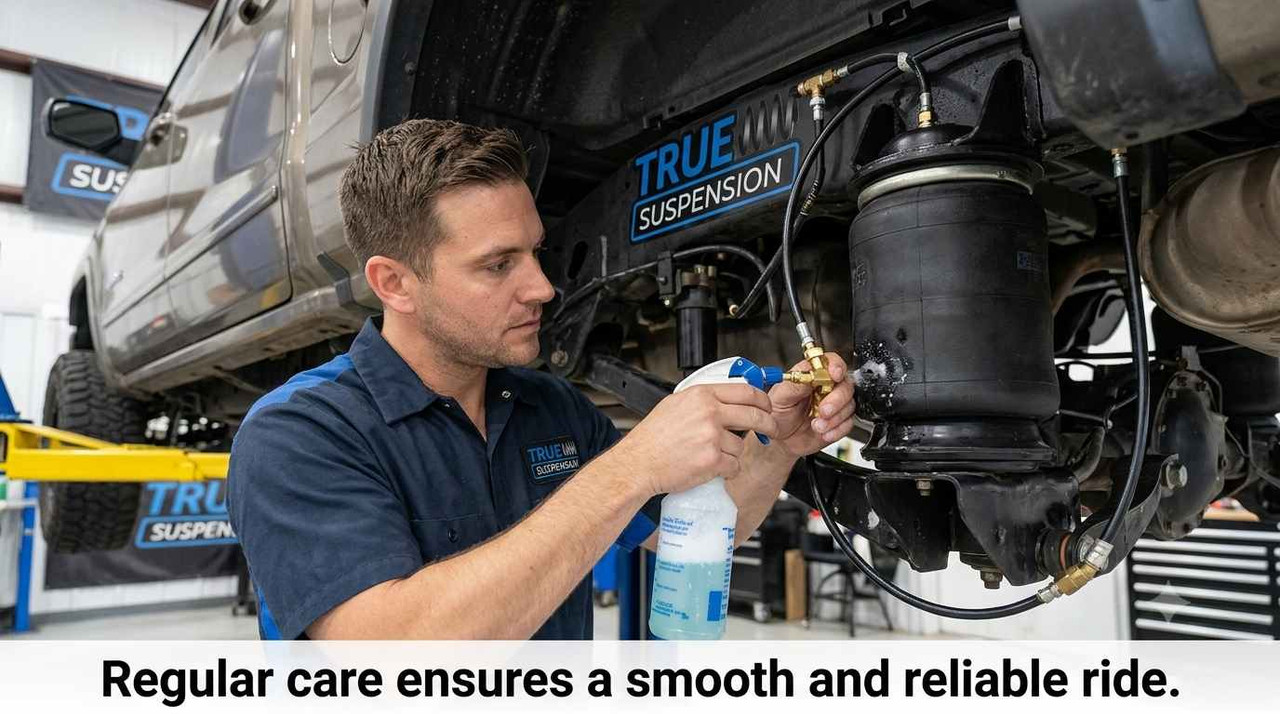
How to Maintain Your Air Ride Suspension System for Long-Lasting Performance?
Your air ride suspension system is one of the most sophisticated upgrades you can add to your truck or classic car. It delivers a smooth, adjustable ride. It boosts towing confidence. It transforms how your vehicle handles every road condition. But like any precision system, it only performs its best when you take care of it.
At True Suspension, we've helped thousands of truck owners and car enthusiasts install, upgrade, and get the most out of their suspension systems. We know what separates a system that lasts 10+ years from one that fails at the worst possible moment, and the answer is consistent, smart maintenance.
This guide covers everything you need to know about how to maintain your air ride suspension, from daily checks to seasonal deep dives. Whether you have a towing assist helper kit on your pickup or a full 4-corner air ride setup on a classic, these tips will keep your system running at peak condition.
Why Maintaining Your Air Ride Suspension Matters More Than You Think?
Most truck owners install their air ride suspension system and then forget about it until something goes wrong. That's a mistake that costs time and money.
A neglected air ride system can develop slow leaks, corroded fittings, clogged air lines, and worn air bags. Each of these issues compounds over time. What starts as a minor air loss becomes a failed compressor. What starts as a stiff fitting becomes a cracked line.
Here's a quick look at what happens when you skip maintenance vs. when you stay on top of it:
|
Maintenance Status |
System Lifespan |
Common Issues |
Performance Level |
|
No maintenance |
2–4 years |
Leaks, compressor burnout, bag failure |
Declining quickly |
|
Basic annual check |
5–7 years |
Minor leaks, fittings wear |
Moderate |
|
Regular scheduled maintenance |
10–15+ years |
Minimal, caught early |
Consistently excellent |
|
True Suspension maintenance plan |
15+ years |
Near zero with proper care |
Peak at all times |
The data is clear: consistent maintenance is the single biggest predictor of how long your air ride suspension will perform.
At True Suspension, our kits are engineered for durability. Our components use high-quality materials designed to last. But even the best parts need care. That's the truth, and we believe in giving you the full picture.
Understanding Your Air Ride Suspension System Components
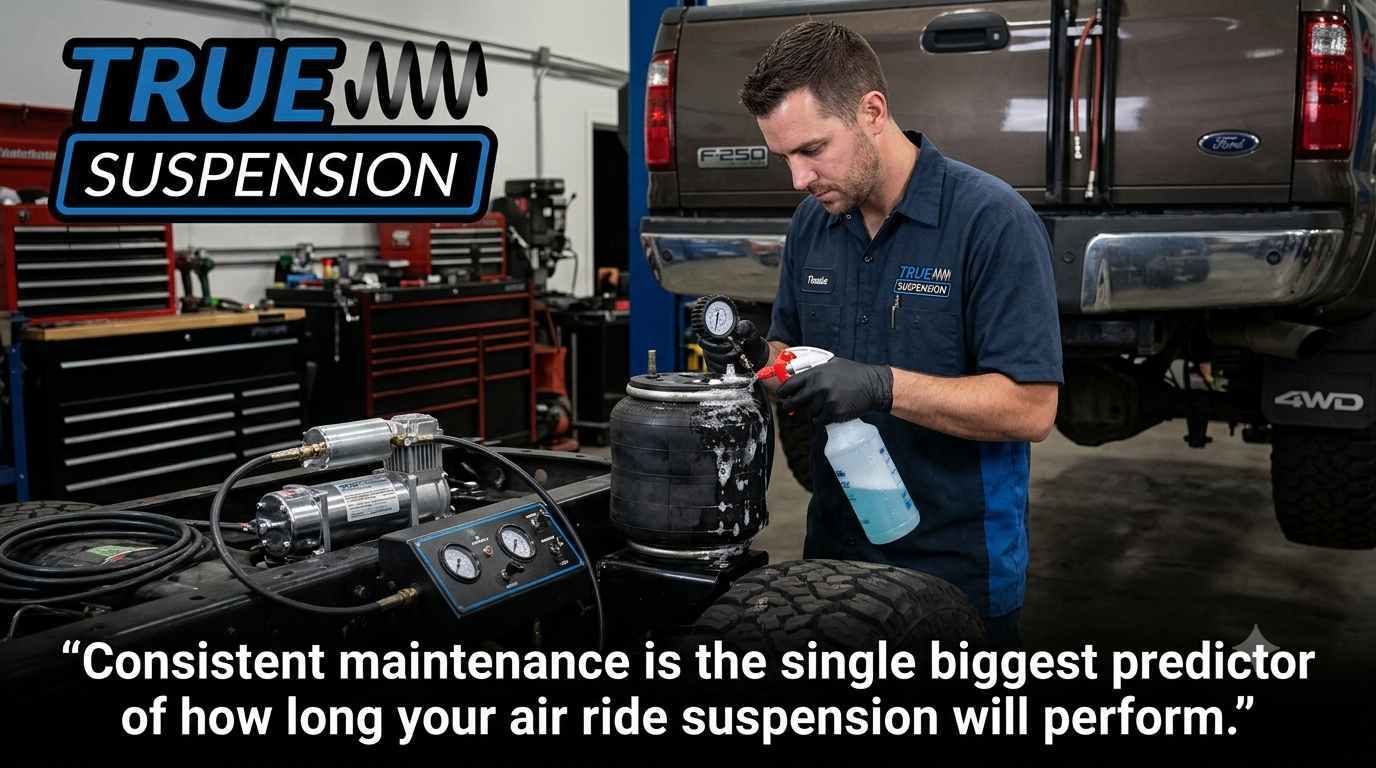
Before you can maintain your air ride suspension, you need to understand what you're working with. A complete system includes several key components, each with its own maintenance needs.
The Core Components
- Air springs (air bags): These replace traditional coil or leaf springs. They inflate and deflate to adjust ride height and load capacity.
- Air compressor: Pumps air into the system. This is the heart of the system; if the compressor fails, nothing works.
- Air lines and fittings: Carry compressed air from the compressor to the air springs. Push-in fittings make connections simple and secure.
- Air management system: The control panel, switches, and valves that let you adjust pressure from inside the cab.
- Pressure gauges: Show you real-time PSI readings so you always know what's happening in the system.
- Reserve air tank (optional): Stores compressed air for faster adjustment response.
True Suspension's towing assist air ride suspension kits include all the essential components in one complete package, designed to work together from day one. You're not sourcing parts from five different brands and hoping they're compatible. Everything is matched, tested, and ready to go.
Step-by-Step Monthly Maintenance Checklist
Monthly checks take less than 20 minutes. They catch small problems before they become expensive ones. Follow this checklist every 30 days, or every 1,000 miles, whichever comes first.
Monthly Air Ride Suspension Checklist
- Visual Inspection of Air Bags
- Look for cracks, abrasions, or bubbling on the air bag surface
- Check for signs of rubbing against frame or suspension components
- Inspect the mounting hardware; bolts should be tight and rust-free
- Check All Air Line Connections
- Run your hand along every air line while the system is pressurized
- Feel for air escaping at any connection point
- Listen for hissing sounds near fittings and push-in connectors
- Test the Compressor
- Inflate the system from empty and time how long it takes to reach full pressure
- A compressor that takes longer than usual may be losing efficiency
- Listen for unusual sounds; grinding or excessive heat are warning signs
- Inspect the Control Panel and Switches
- Test every switch position, inflate, deflate, and hold
- Check gauge accuracy against a known-good gauge
- Make sure all indicator lights work properly
- Check Pressure at Rest
- Set your pressure, turn off the compressor, and wait 30 minutes
- If pressure drops more than 3–5 PSI, you have a slow leak
- Identify and address the leak source immediately
This kind of routine is what separates casual owners from those whose systems last decades. It takes less time than an oil change, and it protects a far more complex investment.
Seasonal Maintenance: What to Do Every 6 Months?
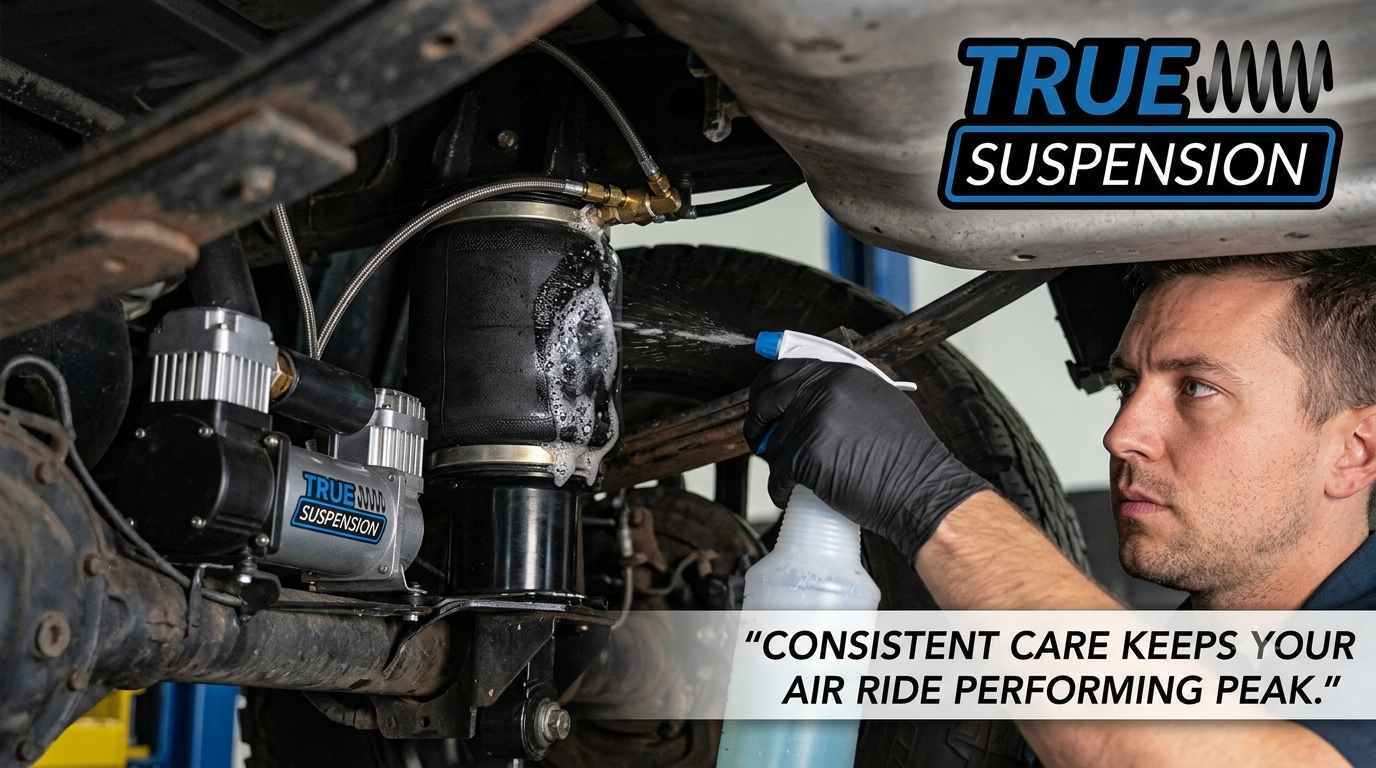
Every six months, or twice per year, go deeper. Seasonal changes put different stresses on your air ride suspension system. Cold contracts rubber and plastic. Heat accelerates wear. Moisture from humid summers or snowy winters corrodes metal fittings.
Spring Maintenance Tasks
Clean and lubricate air bag surfaces. Winter road salt and grime can accelerate rubber degradation. Wipe down all air bag surfaces with a rubber-safe cleaner. Apply a UV-protective conditioner to prevent cracking from sun exposure.
Inspect all metal fittings for corrosion. Push-in fittings are typically brass or nickel-plated. Check for green oxidation or white mineral buildup. Clean with a wire brush and apply a light coating of corrosion inhibitor.
Flush the air lines. Moisture builds up inside air lines over winter. Disconnect lines at the lowest points and blow them out with compressed air. This prevents moisture from reaching your compressor and damaging internal components.
Check U-bolts and mounting hardware. Freeze-thaw cycles can cause metal to expand and contract, loosening bolts over time. Torque all mounting hardware to spec.
Fall Maintenance Tasks
Drain and inspect the compressor. Before cold weather hits, drain any moisture from the compressor and tank. Some compressors have a built-in drain valve, use it. If yours doesn't, consider adding a moisture separator inline.
Inspect rubber components for cold-weather cracks. Rubber becomes less pliable in cold temperatures. Inspect every rubber component for micro-cracks that will worsen in freezing temps. Apply rubber conditioner now, before winter arrives.
Test your in-cab control system. Cold can affect electronic switches and gauge accuracy. Test every function of your in-cab air management controls before winter driving season starts.
Check air bag pressure at cold temperatures. Pressure drops in cold weather. Set your baseline pressure on a cold morning so you know what's normal for your climate.
How to Identify and Fix Air Leaks Fast?
Air leaks are the most common issue in any air ride suspension system. The good news: most leaks are easy to find and fix when you catch them early.
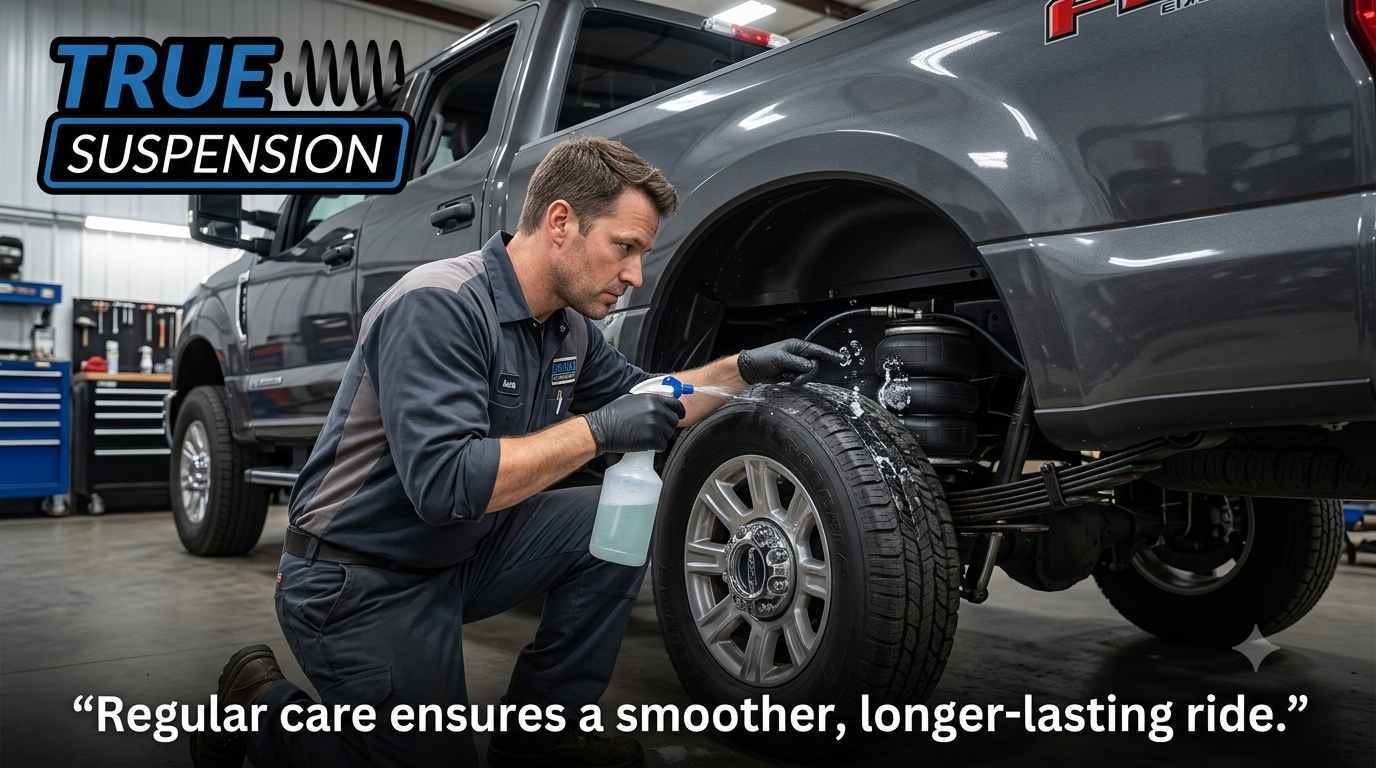
The Soapy Water Test
This is the most reliable method for finding leaks in a pressurized system:
- Mix dish soap with water in a spray bottle (50/50 ratio)
- Pressurize your system to normal operating pressure
- Spray the soapy solution on every fitting, connection, and air bag surface
- Watch for bubbling; even tiny bubbles indicate a leak
- Mark each leak location with tape before depressurizing
Common Leak Locations and Fixes
|
Leak Location |
Likely Cause |
Fix |
|
Push-in fitting |
Tubing not fully seated |
Push tube in firmly until it clicks |
|
Push-in fitting |
Tubing cut at an angle |
Cut tubing square, reinsert |
|
Air bag surface |
Abrasion or pinhole |
Replace air bag |
|
Air bag mount |
Loose hardware |
Re-torque to spec |
|
Valve ports |
Worn valve seat |
Replace valve |
|
Air line mid-span |
Crack or kink |
Replace the affected section of line |
True Suspension offers replacement 1/4" push-in fittings and 3/8" push-in fittings as standalone parts. You don't need to buy a whole new kit just because one fitting is worn. That's the advantage of working with a supplier who stocks individual components; maintenance stays affordable.
The Most Overlooked Part of Maintenance
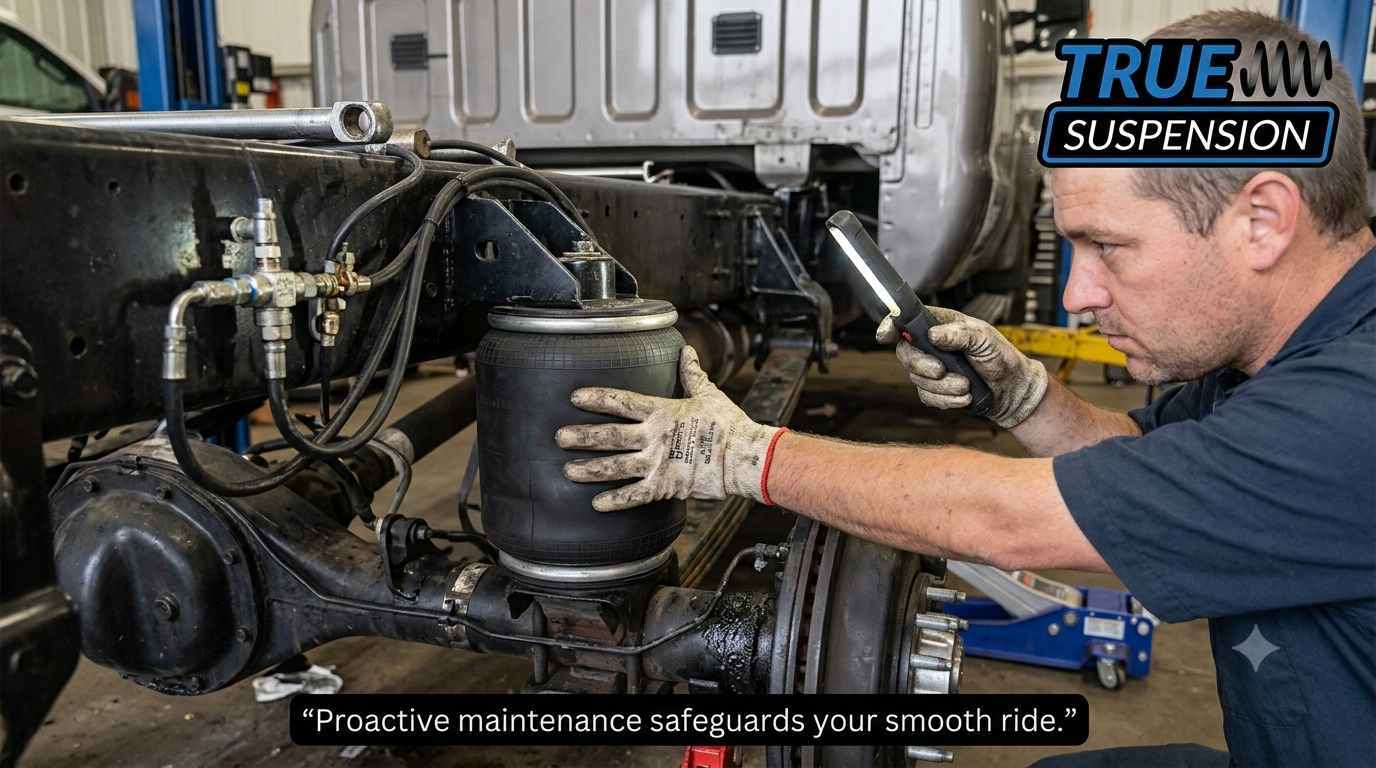
Your compressor is the engine of your air ride suspension system. Neglect it, and everything else becomes useless. Most air ride compressor failures are preventable with simple, consistent care.
Compressor Maintenance Best Practices
Keep intake air clean. Install an inline air filter on the compressor intake. Dust, debris, and moisture entering the compressor cause accelerated wear. Replace the filter element every 6 months or sooner if you drive in dusty conditions.
Manage duty cycle. Compressors have a rated duty cycle, the percentage of time they can run continuously. A 100% duty cycle compressor can run constantly. Lesser-rated compressors need cool-down time. Exceeding the duty cycle burns out the motor. Always match your compressor to your use case.
True Suspension's Active Air compact compressor operates at a 100% duty cycle, which means it handles constant use without overheating. That's the kind of specification that matters in real-world towing situations, not just in a brochure.
Monitor operating temperature. If your compressor runs hot to the touch after normal operation, it may be working too hard, either from a slow leak forcing it to constantly compensate, or from poor mounting location with inadequate airflow. Relocate or address the root cause.
Drain moisture regularly. Compressors produce condensation as a byproduct of compression. This moisture collects in the tank and lines. Drain it monthly, or install an automatic moisture separator.
Compressor Performance Benchmarks
|
Compressor Condition |
Time to Fill (from 0 PSI to 150 PSI) |
Signs to Watch |
|
New / Excellent |
Per manufacturer spec |
Quiet, runs cool |
|
Good |
Up to 20% slower than spec |
Minor, acceptable |
|
Fair |
20–50% slower than spec |
Investigate cause |
|
Poor |
50%+ slower, runs hot |
Replace soon |
If your compressor is filling slower than its original baseline, start by checking for leaks. If no leaks exist, the compressor itself is degrading.
Air Line and Fitting Maintenance, Small Parts, Big Impact
Your air lines and fittings carry every pound of pressure that makes your air ride suspension system work. They're simple components, but they fail in predictable ways, and maintenance prevents most of those failures.
Air Line Best Practices
Protect lines from heat sources. Route air lines away from exhaust components. Sustained heat causes polyurethane and nylon lines to harden and crack. Use heat-resistant sleeves where routing near exhaust is unavoidable.
Prevent chafing. Anywhere an air line touches a metal edge, it will eventually chafe through. Use grommets at any point where a line passes through metal. Use foam wrap or split loom tubing to protect lines running near moving components.
Check for kinks. Kinked lines restrict airflow and stress the line material at the kink point. Straighten any kinks you find. If a line has been kinked and held that shape, replace it, the material is compromised at that point.
Use proper line length. Lines that are too long bunch up and are prone to kinking. Lines that are too short put tension on fittings. Trim to proper length with a clean, square cut.
Fitting Maintenance
Push-in fittings are designed for simple installation and reliable service. They don't require tools to connect, push the tube in, and it locks. But they do require care:
- Never pull a line out without releasing the collet first. Push in on the collet ring while pulling the tube to release properly. Pulling without releasing damages both the fitting and the tube end.
- Inspect the collet ring periodically. If the collet teeth are worn, the fitting won't grip tubing securely. Replace worn fittings promptly.
- Check thread-in fittings for proper sealant. Threaded fittings should use PTFE tape or thread sealant. Inspect these annually and re-seal if you detect any air loss.
Pressure Management, Operating Your System the Right Way
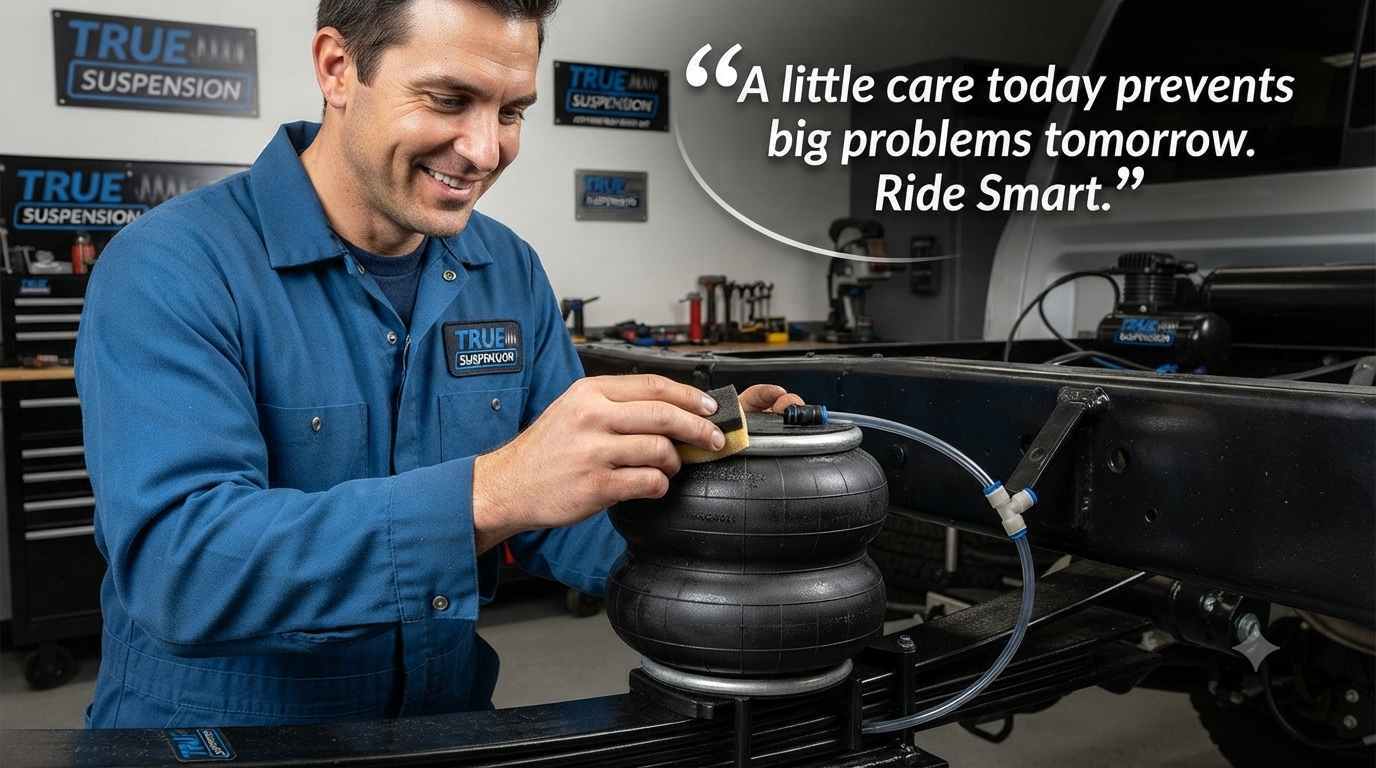
Knowing how to operate your air ride suspension correctly is itself a form of maintenance. Improper pressure management causes premature wear throughout the system.
Recommended Operating Pressures
Operating pressure varies by application. Always follow the specific guidelines for your kit. As a general reference:
|
Application |
Typical Operating Range |
Notes |
|
Rear tow assist (unloaded) |
5–15 PSI |
Never run below 5 PSI |
|
Rear tow assist (loaded) |
25–65 PSI |
Adjust to level the truck |
|
4-corner air ride (show stance) |
5–20 PSI |
Minimum for bag protection |
|
4-corner air ride (driving) |
45–100 PSI |
Road speed appropriate |
Never run air bags fully deflated. Running bags at zero PSI causes the bag to fold and pinch, leading to premature failure. Always maintain a minimum of 5 PSI even when unloaded.
Don't overpressurize the system. Each component has a rated maximum pressure. Exceeding it causes stress that shortens service life. True Suspension's universal control panels include 150 PSI gauges that give you precise, real-time pressure visibility so you never have to guess.
Air Ride Suspension vs. Other Suspension Types
Understanding why air ride suspension is worth maintaining, versus simply replacing with a different system, helps motivate consistent care.
|
Feature |
Air Ride Suspension |
Rubber Block / Spacer Lift |
Coilover System |
|
Adjustability |
✅ Full, on-the-fly |
❌ Fixed height |
⚠️ Limited, requires tools |
|
Towing capacity boost |
✅ Significant |
⚠️ Minor |
❌ None |
|
Ride quality |
✅ Excellent |
⚠️ Stiffer |
✅ Good but firm |
|
Load leveling |
✅ Automatic |
❌ None |
❌ None |
|
Maintenance complexity |
⚠️ Moderate |
✅ Minimal |
✅ Minimal |
|
Lifespan with proper care |
✅ 10–15+ years |
✅ 10+ years |
✅ 8–12 years |
|
Cost over 10 years |
✅ Low (with maintenance) |
✅ Very low |
⚠️ Moderate |
If you want to explore how air ride suspension compares in specific contexts, True Suspension's blog covers the topic in depth. Read our article on air ride suspension vs. coilovers to understand which system makes the most sense for your application.
The conclusion most experienced truck owners reach: the adjustability and towing assist capability of air ride suspension is worth the slightly higher maintenance commitment. Especially when maintenance is as simple as we've outlined here.
True Suspension Products That Make Maintenance Easier
One of the biggest advantages of choosing True Suspension for your air ride suspension system is the completeness and quality of our kits. Every component is designed to work together. That means maintenance is simpler, replacement parts are compatible, and you're never hunting for odd-sized fittings or proprietary hardware.
Our Most Popular Towing Assist Kits by Truck
Ford F-250 / F-350 Owners: True Suspension offers dedicated towing assist air ride kits for Ford F-250 4WD trucks, including complete in-cab management systems. These kits are vehicle-specific, not generic adapters that require extensive modification.
Chevy Silverado / GMC Sierra Owners: Our Silverado 1500 rear towing assist kits are engineered for the specific geometry of GM trucks. They install without cutting or welding and include everything needed for a complete installation.
Dodge Ram Owners: The Dodge 1500 4WD towing assist kit is built for Ram trucks with demanding towing and hauling needs. It levels your truck under load and improves braking stability when pulling a trailer.
Toyota Tundra Owners: Our Tundra rear towing assist kit with in-cab controls makes the Tundra's capable platform even more versatile. Adjust pressure from the driver's seat without ever leaving the cab.
Standalone Maintenance Parts
True Suspension stocks the individual components you need for upkeep:
- 1/4" push-in tube fittings (2-pack), for air line repairs and replacements
- 3/8" push-in tube fittings (2-pack), for larger diameter lines
- Universal air fill valve (Schrader), for manual inflation backup
- Dual paddle switch control panels, upgrade or replace your existing controls
- Active Air 8-valve manifold block, for full FBSS 4-corner systems
Having these parts available means your maintenance and repairs never have to wait for long shipping delays. True Suspension ships quickly, and our parts are designed to fit our kits exactly.
Annual Deep Inspection, The Full System Audit
Once per year, do a complete system audit. This is more thorough than your monthly or seasonal checks. Block out 2–3 hours. Here's what to cover:
Annual Air Ride Suspension Audit Checklist
Structural Components
- Remove air bags and inspect mounting points for rust or cracks
- Inspect U-bolts for corrosion, stretching, or thread damage
- Check frame mounting brackets for cracks or weld failures
- Inspect bump stops, replace if compressed more than 30%
Air System Components
- Remove and bench-test compressor, check amperage draw
- Replace compressor intake filter
- Drain and flush air tank completely
- Inspect and replace any discolored or stiff air lines
- Replace any fittings showing corrosion or wear
Control System
- Test all switches for smooth operation
- Verify gauge accuracy against a calibrated gauge
- Inspect wiring for chafing, corrosion, or loose connections
- Check all solenoid valves for proper operation
Final Pressure Test
- Pressurize system to maximum operating pressure
- Hold for 60 minutes with compressor off
- Acceptable loss: less than 5 PSI in 60 minutes
- Greater loss: find and address leak before returning to service
This annual audit is essentially the maintenance equivalent of a full vehicle inspection. It takes time, but it's the reason True Suspension customers consistently report their systems lasting well beyond the 10-year mark.
Signs Your Air Ride Suspension Needs Immediate Attention
Some problems can't wait for your next scheduled maintenance. Know these warning signs and act on them immediately:
Stop Driving, Address Now
- Visible air bag damage: Cracks, tears, or bulging on the bag surface. A failed bag can cause sudden loss of ride height.
- Rapid pressure loss: System drops to zero within minutes of pressurizing. You have a major leak.
- Compressor runs continuously: If the compressor never shuts off, it's trying to compensate for a significant leak. It will burn out quickly.
- Vehicle significantly lower on one side: Indicates a failed bag or major leak on that corner.
Address Within One Week
- Slow pressure loss: More than 10 PSI overnight is a problem that will worsen.
- Compressor running more frequently than usual: Usually indicates a slow leak somewhere in the system.
- Gauge reading differently than expected: Could be a gauge issue or a true pressure issue. Verify with a secondary gauge.
Monitor Closely
- Slight pressure variation with temperature: Normal, but monitor the magnitude. More than 10 PSI variation per 30°F temperature change may indicate a minor issue.
- Slightly longer compressor cycle times: Worth noting and trending over time.
Understanding these warning signs keeps small problems from becoming catastrophic failures. And if you need to reference what a healthy system looks like, True Suspension's blog post on rubber block vs. air ride suspension gives you a clear baseline comparison.
Classic Car Air Ride Maintenance, Special Considerations
If your air ride suspension system is on a classic car rather than a modern truck, a few additional considerations apply.
Classic vehicles often have older chassis with different flex characteristics. They may sit unused for extended periods. And they're often exposed to show environments where appearance matters as much as function.
Classic Car Specific Tips
Protect bags from ozone and UV. Classic cars often sit in garages where ozone from electrical equipment can degrade rubber over time. Keep bags treated with a rubber conditioner that includes UV and ozone protection.
Operate the system regularly. Even if you don't drive the car, cycle the air ride suspension through its range of motion every 30 days. This keeps seals lubricated and prevents flat spots on bags from prolonged compression.
Check for rodent damage. Stored classics are prime targets for rodents nesting in wheel wells and engine compartments. Rodents chew air lines. Inspect thoroughly after any storage period.
Use correct fitment kits. True Suspension offers vehicle-specific classic car kits, including systems for the 1958–1964 Chevy Bel Air, 1958–1964 Chevy Impala, 1965–1970 Chevy Impala, and multiple Ford Galaxie, Fairlane, and Falcon applications. Using a kit designed for your specific car eliminates fitment guesswork and ensures every maintenance procedure is clean and straightforward.
For inspiration on what proper air ride care makes possible, check out our feature on top 10 classic cars on air ride that look incredible.
Maintenance Schedule Summary Table
Use this table as your reference guide. Print it, save it, or bookmark this page.
|
Interval |
Task |
Time Required |
|
Monthly / 1,000 miles |
Visual inspection of bags and lines |
15–20 min |
|
Monthly / 1,000 miles |
Soapy water leak test |
20–30 min |
|
Monthly / 1,000 miles |
Compressor cycle time check |
5 min |
|
Monthly / 1,000 miles |
Overnight pressure retention test |
5 min setup |
|
Every 3 months |
Lubricate air bag surfaces |
15 min |
|
Every 6 months (Spring) |
Flush air lines of moisture |
30 min |
|
Every 6 months (Spring) |
Inspect and clean metal fittings |
20 min |
|
Every 6 months (Fall) |
Drain compressor and tank |
15 min |
|
Every 6 months (Fall) |
Inspect rubber for cold-weather cracks |
20 min |
|
Annually |
Full system audit |
2–3 hours |
|
Annually |
Replace compressor filter |
10 min |
|
Annually |
Torque all mounting hardware to spec |
30 min |
|
As needed |
Address leaks, worn fittings, damaged lines |
Varies |
This schedule works for the vast majority of air ride suspension systems. If you tow frequently, operate in extreme climates, or use your system for show/competition, increase the frequency of your checks accordingly.
Why True Suspension Is the Right Partner for Your Suspension Journey
We've covered a lot of technical ground in this guide. Let's take a moment to talk about why it matters where you buy your air ride suspension system, and why True Suspension customers consistently recommend us.
We engineer for your specific vehicle. True Suspension doesn't sell generic air bag kits and hope they fit. Every kit is designed around the specific geometry, weight ratings, and installation requirements of your truck or car. That means better fitment, easier installation, and simpler maintenance.
We provide complete systems. Our towing assist kits include everything: air bags, lines, fittings, compressor, control system, and hardware. You don't have to source components from multiple suppliers and figure out compatibility. It all works together because it was designed together.
We stock maintenance parts. Individual fittings, control panels, valves, compressors- we carry the parts you need to keep your system running long after the initial installation. That commitment to long-term support is something discount kit sellers simply don't offer.
We share knowledge. This guide is one example. True Suspension's blog is another. We believe informed customers make better decisions and get better results. Our blog on maintaining factory ride quality after a lift kit and our lift kit vs. leveling kit comparison are resources designed to help you, whether or not you've bought from us yet.
Our customers trust us with serious work. Whether it's a work truck that tows 10,000 lbs weekly, a weekend show truck, or a meticulously restored classic, True Suspension customers trust our products in high-stakes situations. That trust is earned through quality, reliability, and honest guidance.
Conclusion
Maintaining your air ride suspension system is not complicated. It requires consistency, attention, and the right knowledge. With monthly checks, seasonal maintenance, and an annual audit, your system will perform reliably for 10 to 15 years or more.
The key takeaways:
- Check monthly: visual inspection, leak test, compressor cycle check
- Go deeper every 6 months: flush lines, lubricate rubber, drain moisture
- Audit annually: full system inspection, pressure test, hardware torque check
- Act fast on warning signs; small issues become expensive ones when ignored
- Use quality components, True Suspension kits are built for long service life and easy maintenance
Your air ride suspension is one of the best upgrades you can make to a truck or classic car. Protect that investment with the care it deserves. And when you're ready to upgrade, replace a component, or find the perfect kit for your vehicle, True Suspension is here, with the right product, the right support, and the right knowledge to back it all up.
Frequently Asked Questions
Q1: How often should I maintain my air ride suspension system?
Perform a basic inspection monthly and after any heavy towing. Do a deeper seasonal check every six months. Run a complete system audit once per year to catch any developing issues early.
Q2: What is the most common cause of air ride suspension failure?
Neglected slow leaks are the leading cause. A small leak forces the compressor to run constantly, burning it out. Regular soapy water leak tests catch leaks before they cause secondary damage.
Q3: Can I maintain my air ride suspension system myself?
Yes. Most maintenance tasks require basic tools and about 20–30 minutes. Leak detection, lubrication, pressure testing, and fitting replacement are all straightforward DIY tasks for most truck owners.
Q4: How long do air bags last with proper maintenance?
High-quality air bags last 10–15 years or more with proper care. Key factors include UV protection, avoiding minimum pressure operation, and keeping bags clean and conditioned seasonally.
Q5: What PSI should I run in my towing assist air ride suspension when unloaded?
Maintain a minimum of 5 PSI even when completely unloaded. Running bags fully deflated causes pinching and premature failure. Adjust upward when hauling or towing to level your vehicle.