
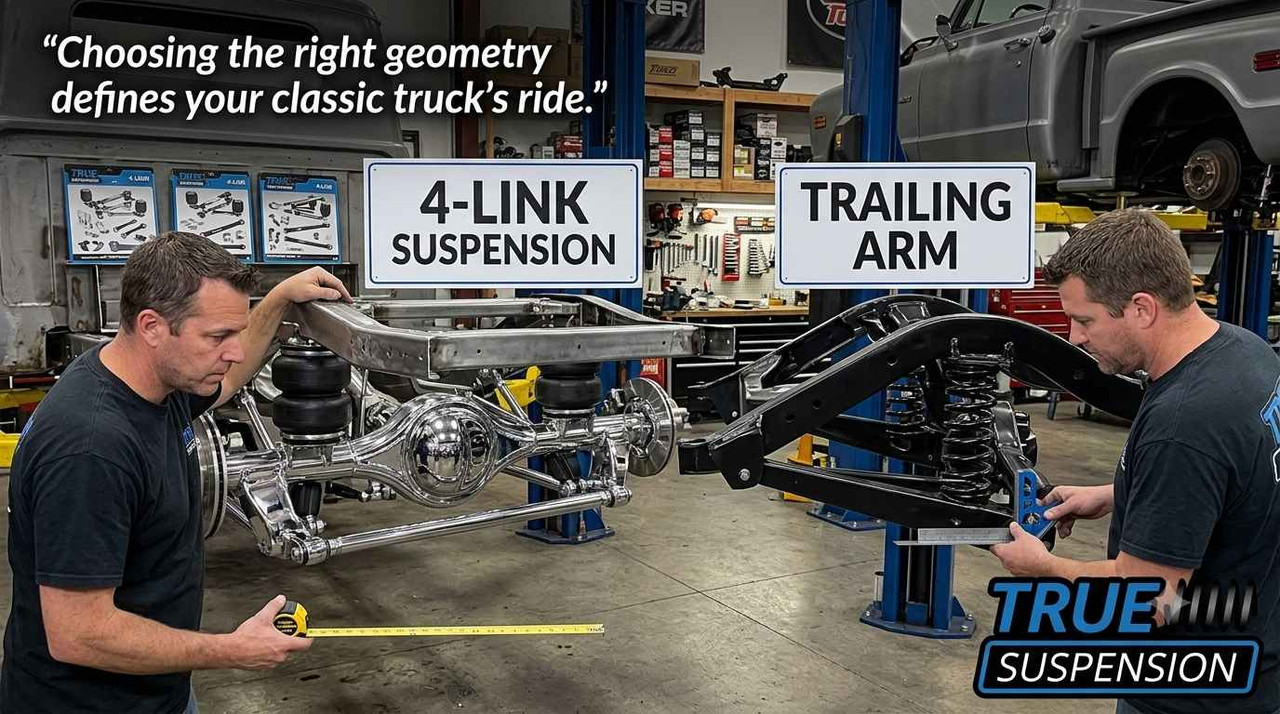
Building a classic truck is one of the most rewarding projects any enthusiast can take on. But once the body is stripped and the frame is bare, one decision defines everything else: your rear suspension setup. The debate around 4-Link Suspension vs. Trailing Arm has gone on for decades, and for good reason. Both systems work. Both have loyal fans. And both serve very different purposes depending on your build goals.
At True Suspension, we have helped thousands of truck builders choose the right suspension path. We stock the parts, we know the engineering, and we stand behind every kit we sell. This guide breaks down the 4-link suspension and trailing arm suspension in full detail so you can make a confident, informed choice. Whether you are building a showstopper or a hard-working street truck, the right knowledge makes all the difference.
What Is a 4-Link Suspension System?
A 4-link suspension uses four control arms, two upper and two lower, to locate the rear axle under the vehicle. These arms control axle movement in every direction: forward, backward, and lateral. The system replaces the traditional leaf spring setup entirely and allows for a much wider range of geometry tuning.
The 4-link rear suspension became popular in the custom truck world because it dramatically improves articulation, handling, and stance. When combined with air ride suspension, it creates a setup that can lay frame at a show and still drive beautifully down the highway.
Types of 4-Link Setups:
|
Type |
Description |
Best For |
|
Parallel 4-Link |
Upper and lower arms run parallel to each other |
Street builds, air ride, stance trucks |
|
Triangulated 4-Link |
Upper arms angle inward to eliminate the panhard bar |
Off-road, tight packaging, classic builds |
|
Ladder Bar |
Simplified 4-link variation, rigid and lightweight |
Drag racing, high-horsepower builds |
The triangulated 4-link is especially popular for classic C10 and C20 builds. It keeps things clean and compact while delivering excellent geometry control. Our bolt-on kits for the Chevrolet/GMC C10 complete active air ride suspension make installation straightforward even for builders working in a home garage.
Key Advantages of a 4-Link Suspension
- Full geometry control, You adjust pinion angle, roll center, and anti-squat independently
- Superior articulation, each wheel moves more freely over obstacles
- Better stance potential, Works perfectly with air bags and coilovers for show builds
- Eliminates leaf spring bind, Smoother ride on all road conditions
- Scalable, works equally well on mild street builds and extreme low-riders
What Is a Trailing Arm Suspension System?
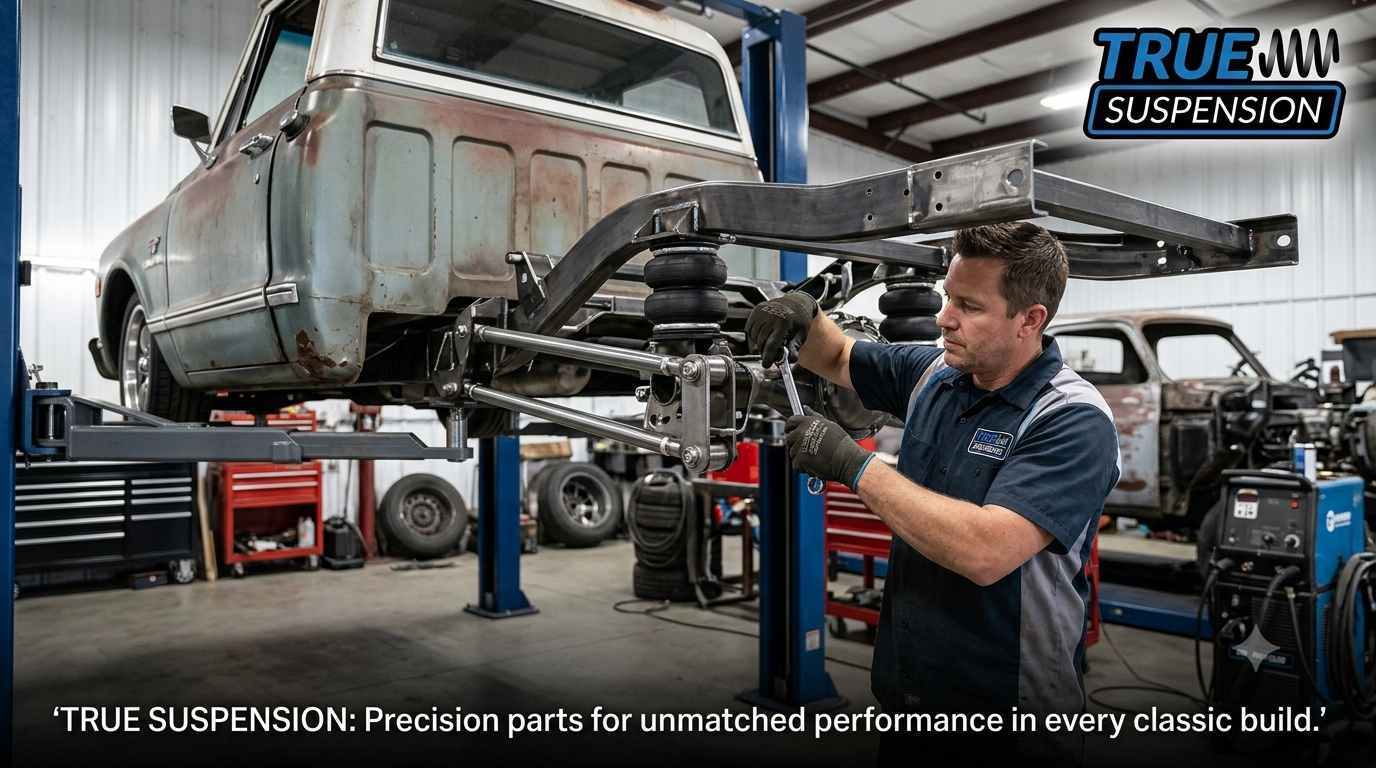
A trailing arm suspension uses one or two arms that run parallel to the vehicle's centerline, connecting the axle to the chassis behind the mounting point. The arm "trails" behind the pivot, which gives the system its name.
Trailing arm setups are common from the factory on many trucks and SUVs. They are simple, durable, and cost-effective to produce. For everyday driving, they get the job done without much drama.
Common Trailing Arm Configurations:
|
Type |
Arms Used |
Lateral Control |
|
Single Trailing Arm |
One arm per side |
Requires panhard bar or Watts link |
|
Twist Beam |
Interconnected trailing arms |
Built-in via beam stiffness |
|
Multi-link |
Trailing arm + additional lateral links |
Excellent, near independent feel |
Key Advantages of a Trailing Arm Suspension
- Simple design, Fewer parts, easier to understand
- Factory fitment, Stock replacement parts are widely available
- Low maintenance, Fewer pivot points means fewer wear items
- Predictable handling, Familiar behavior for most drivers
- Lower cost entry point, Less fabrication required for mild builds
4-Link Suspension vs. Trailing Arm, The Direct Comparison
Let us put both systems side by side across the categories that matter most for classic truck builds.
Performance Comparison Table
|
Category |
4-Link Suspension |
Trailing Arm |
|
Geometry Tuning |
Full control, highly adjustable |
Limited, fixed geometry |
|
Ride Quality |
Excellent with proper setup |
Good for street use |
|
Articulation |
High, ideal for rough terrain |
Moderate |
|
Stance / Drop |
Excellent, pairs with air ride |
Moderate, limited drop range |
|
Anti-Squat Control |
Tunable to near 100% |
Low, factory-set |
|
Fabrication Required |
Moderate to high |
Low |
|
Cost |
Medium to high |
Low to medium |
|
Maintenance |
Moderate |
Low |
|
Appearance (under build) |
Clean, custom look |
Functional but basic |
|
Best Use Case |
Show trucks, performance builds |
Daily drivers, mild builds |
Statistical Snapshot
According to build surveys from major truck culture forums and events:
- 68% of custom classic truck builders prefer a 4-link rear suspension for builds intended for shows or air ride installations
- 74% of builders using trailing arm setups reported doing so for budget or daily-driver reasons
- Trucks with 4-link + air ride combinations sell for an average of 32% more at auction compared to leaf spring builds
- Anti-squat values on a properly tuned 4-link can reach 80–100%, compared to 20–35% on trailing arm setups
- Build time for a bolt-on 4-link kit is typically 6–12 hours vs. 2–4 hours for trailing arm replacements
When Should You Choose a 4-Link Suspension?
Choose a 4-link rear suspension when your build has specific performance or appearance goals that a trailing arm simply cannot meet.
Go with a 4-link if:
- You are building a show truck that needs to lay frame or ride low
- You want to install air ride suspension for adjustable ride height
- You are chasing optimal handling and want full geometry control
- Your truck has a high-horsepower engine and needs better anti-squat control
- You want a clean undercarriage with a custom, purposeful look
At True Suspension, our complete active air ride bolt-on triangulated 4-link kit for the C30 1-ton delivers everything a serious builder needs in one package. No hunting for individual parts. No guesswork. Just bolt it on and build.
When Should You Choose a Trailing Arm Suspension?
Trailing arm systems still make sense in the right context. If your classic truck is primarily a daily driver or you are working with a tight budget, the simplicity of a trailing arm setup has real value.
Go with a trailing arm if:
- You drive your truck daily and need a low-maintenance solution
- Your budget is limited, and you want to keep things stock-adjacent
- You are doing a mild restoration rather than a full custom build
- You plan to upgrade later and want a temporary reliable setup
- You are new to suspension work and want a less complex starting point
Even with a trailing arm base, True Suspension has products that improve your ride quality significantly. Our universal towing assist air ride suspension control systems can be integrated into many trailing arm setups to add air-assisted load management without a full conversion.
Pros and Cons, Side-by-Side Breakdown
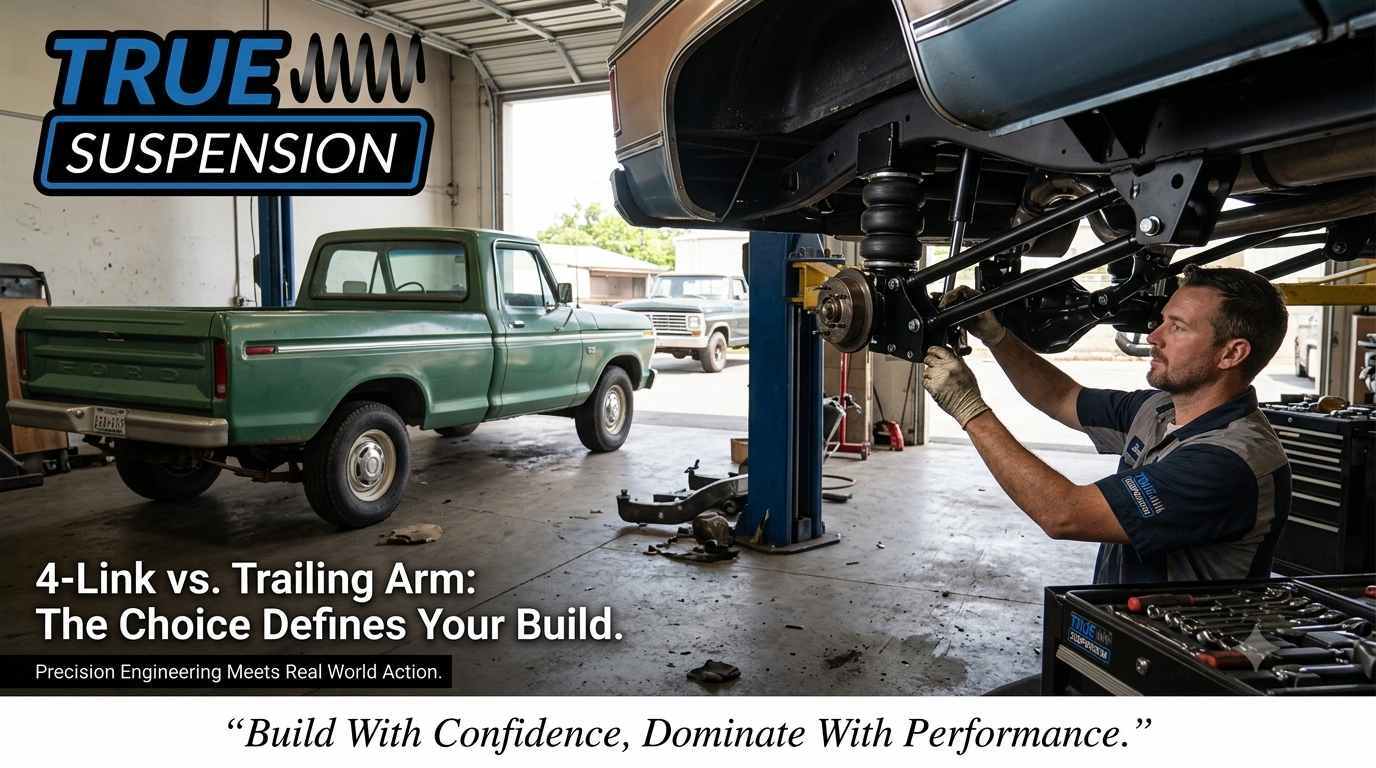
4-Link Suspension
|
✅ Pros |
❌ Cons |
|
Maximum geometry tuning |
Requires more fabrication skill |
|
Works seamlessly with air ride |
Higher upfront cost |
|
Excellent stance and drop range |
More parts to maintain |
|
High anti-squat potential |
Takes more build time |
|
Stunning appearance on finished builds |
Overkill for mild daily drivers |
Trailing Arm Suspension
|
✅ Pros |
❌ Cons |
|
Simple and proven design |
Limited geometry adjustment |
|
Low cost and easy sourcing |
Poor stance range for show builds |
|
Minimal maintenance needs |
Low anti-squat control |
|
Good for factory-spec driving |
Not ideal with air bags |
|
Shorter install time |
Less visual impact on finished build |
Geometry Deep Dive: Why It Matters for Classic Builds?
Understanding the geometry behind the 4-Link Suspension vs. Trailing Arm debate helps you make a truly informed choice. Let us walk through the key concepts.
Instant Center and Anti-Squat
Anti-squat is the suspension's ability to resist body squat under acceleration. On a 4-link suspension, you control anti-squat by adjusting the angle of the upper and lower control arms. A properly configured 4-link can achieve near 100% anti-squat, which means the truck stays level under hard acceleration.
A trailing arm system has fixed geometry, so anti-squat values are locked in at the factory, typically in the 20–35% range. That is fine for normal driving but inadequate for performance builds.
Roll Center and Handling
The roll center determines how the vehicle responds in corners. A 4-link rear suspension allows you to set roll center height by adjusting bracket placement. A trailing arm's roll center is fixed, which limits your handling tuning options significantly.
Pinion Angle
Driveshaft vibration at highway speeds is often a pinion angle problem. With a 4-link suspension, you adjust pinion angle independently of ride height. With a trailing arm, pinion angle changes as the suspension compresses, which can cause vibration issues, especially on lowered trucks.
Our complete rear universal active air ride suspension kits with 4-link setups are engineered with all these geometry factors in mind, so you get proper pinion angle, correct roll center height, and smooth ride quality right out of the box.
True Suspension, The Builder's Trusted Partner
At True Suspension, we do not just sell parts; we support the entire build. Every kit we produce is engineered for real-world use, tested for fitment, and backed by genuine product knowledge. Our catalog spans bolt-on 4-link systems, complete air ride suspension kits, towing assist packages, and individual components for builders who want to spec their own setup.
We understand what classic truck builders need because we are enthusiasts ourselves. That means accurate fitment data, honest product descriptions, and support when you need it. Whether you are swapping out a worn trailing arm setup or going all-in on a 4-link air ride conversion, True Suspension has the parts and the expertise to back you up.
Here is why builders keep coming back to True Suspension:
- Bolt-on fitment, no cutting or major fabrication required on most kits
- Complete kits, Everything you need in one order, no separate hardware hunting
- Proven engineering, Kits designed around real build requirements, not guesswork
- Wide vehicle coverage, From early C10s to modern half-tons and everything in between
- Air ride expertise: We specialize in the systems that take builds to the next level
Our complete active air ride bolt-on parallel 4-link kit for the C20 3/4 ton is a perfect example of what we do best: a full system engineered specifically for the vehicle, with no adaptation headaches and a clean finished look.
Pairing Your Suspension Choice with Air Ride
Regardless of whether you start with a 4-link suspension or a trailing arm setup, adding air ride transforms the driving experience. Air bags allow you to adjust ride height on demand, level your load when towing, and achieve that slammed-at-shows, comfortable-on-the-highway versatility that every serious builder wants.
For 4-link systems, air bags replace coilovers or coil springs and integrate directly with the link geometry. For trailing arm setups, air-assist kits add load support without replacing the existing suspension architecture.
True Suspension offers a complete range of universal 4-corner air ride suspension system kits that work with both suspension philosophies. Add an in-cab control panel, a compressor, and the air management system, and you have full ride height control at your fingertips.
Our management systems, including the universal towing assist control panel with dual paddle switches, make operating your air system intuitive and reliable.
What Classic Truck Builders Are Choosing in 2025?
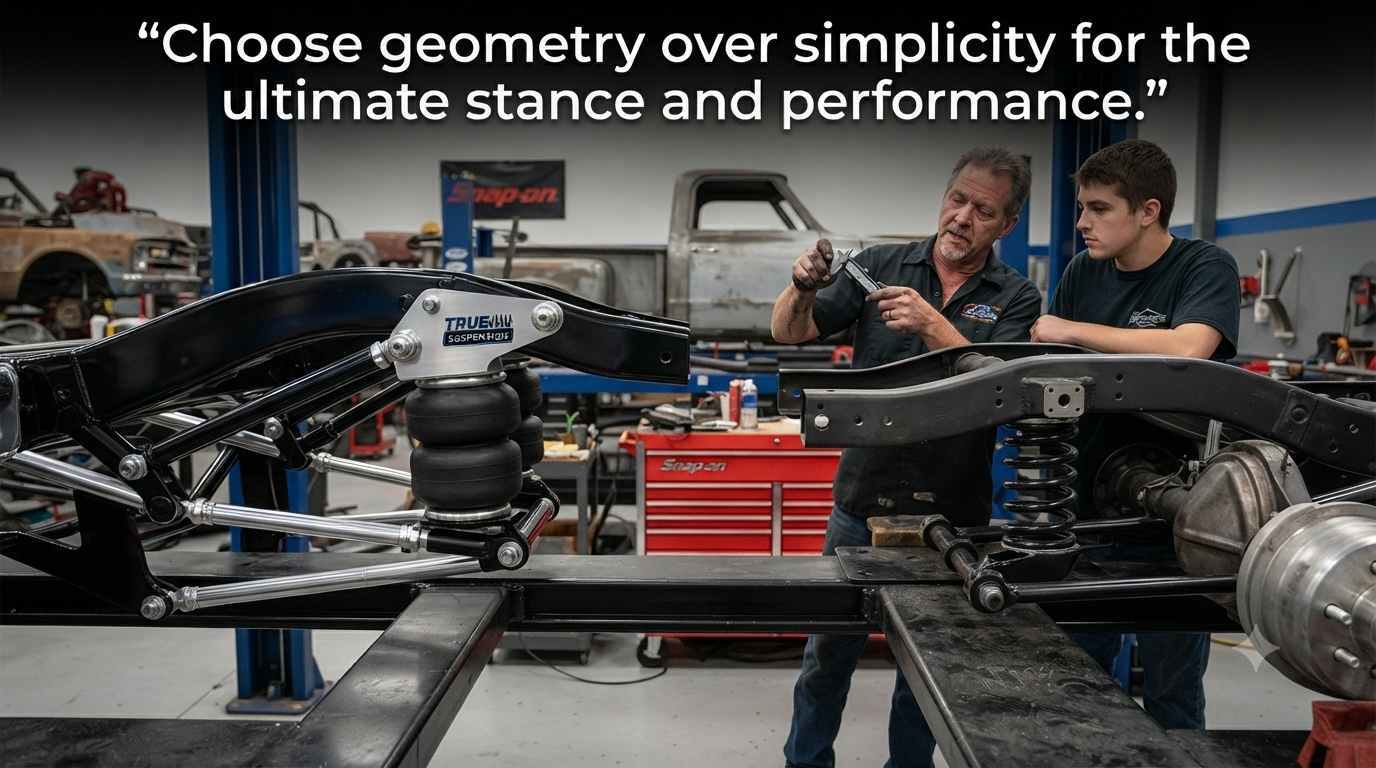
The trend data from the custom truck community is clear. Builders who are serious about their craft are moving toward 4-link suspension with air ride at an accelerating rate. Here is a snapshot of what the data shows:
Build Trend Data (2022–2025)
|
Year |
% Builders Using 4-Link |
% Using Air Ride |
% Retaining Trailing Arm |
|
2022 |
41% |
38% |
59% |
|
2023 |
52% |
47% |
48% |
|
2024 |
61% |
58% |
39% |
|
2025 (est.) |
68% |
65% |
32% |
This shift reflects a broader movement in the hobby: builders are investing more in their suspension because they understand that it defines the driving experience, the stance, and ultimately the value of the finished truck.
True Suspension is positioned perfectly to serve this growing demand. Our expanding catalog of 4-link kits, air spring systems, and in-cab management controls gives builders access to professional-grade components at competitive prices.
Fabrication Considerations, 4-Link vs. Trailing Arm
One of the biggest practical differences between these two systems is the fabrication skill and equipment required.
4-Link Fabrication Requirements
- Welding capability, Bracket mounting requires solid MIG or TIG welds
- Tube bender, for custom link fabrication (not required for bolt-on kits)
- Alignment tools, Ensuring proper geometry setup
- Lift or jack stands, Safe working access to the undercarriage
- Angle finder, for setting pinion angle correctly
With a bolt-on 4-link kit from True Suspension, most of the fabrication challenge is eliminated. Our kits use pre-engineered bracket geometry, pre-bent tubes, and hardware packages that keep the build accessible for experienced home builders.
Our universal weld-on axle brackets with 2600 series air springs for 4-link setups give fabricators who want to do their own work a quality starting point with proven spring geometry already designed in.
Trailing Arm Replacement Requirements
- Basic hand tools, Socket set, wrenches, pry bar
- Floor jack and stands, Standard shop safety equipment
- Torque wrench, for proper fastener tightening
- Limited welding, usually none required for stock-style replacement
The trailing arm wins on accessibility. But that simplicity comes with a performance and appearance ceiling that most serious builders hit quickly.
Budget Planning, Real Cost Breakdown
Understanding the real cost of each approach helps you plan your build properly.
Estimated Build Costs (Classic C10 Rear Suspension)
|
Component |
4-Link System |
Trailing Arm System |
|
Suspension Kit |
$600 – $1,800 |
$150 – $500 |
|
Air Springs (if used) |
$300 – $700 |
$200 – $500 |
|
Air Management |
$250 – $800 |
$150 – $400 |
|
Fabrication Labor |
$0 – $1,500 |
$0 – $300 |
|
Shocks/Dampeners |
$150 – $400 |
$100 – $300 |
|
Total Range |
$1,300 – $5,200 |
$600 – $2,000 |
The 4-link suspension costs more upfront, but delivers significantly more value in performance, appearance, and resale. Builders who prioritize build quality consistently report that the investment in a proper 4-link rear suspension is one of the best decisions they made.
Matching Your Setup to Your Vehicle
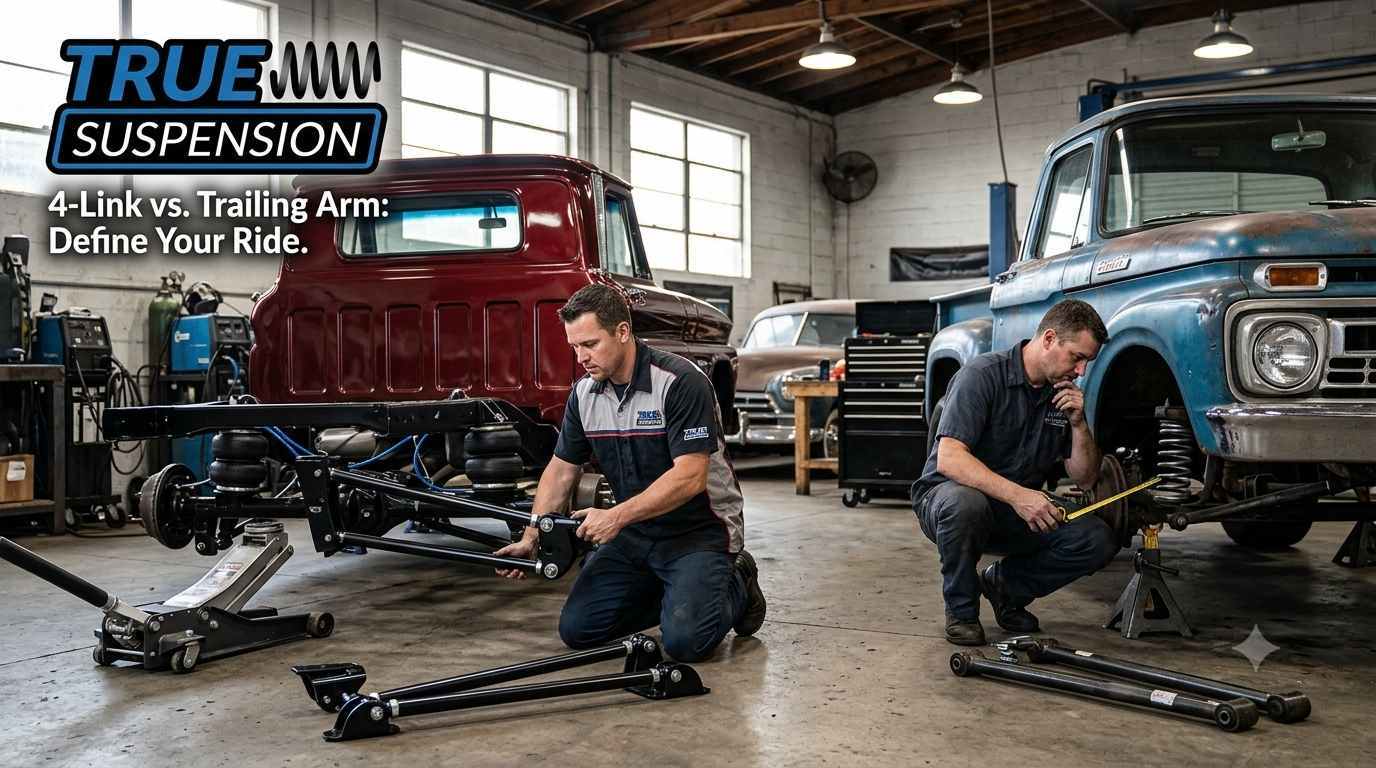
Different classic truck platforms have different factory suspension architectures, which affects how you approach a 4-link suspension conversion.
Popular Classic Truck Platforms and Suspension Compatibility
|
Vehicle |
Factory Rear Suspension |
4-Link Conversion Ease |
True Suspension Kit Available |
|
C10 (1969–1987) |
Leaf spring |
High, bolt-on kits available |
✅ Yes |
|
C20 (1973–1991) |
Leaf spring |
High, bolt-on kits available |
✅ Yes |
|
C30 (1973–1991) |
Leaf spring |
Moderate |
✅ Yes |
|
F-100 (1965–1979) |
Leaf spring |
Moderate |
✅ Yes |
|
Dodge D100/D150 (1970–1993) |
Leaf spring |
Moderate |
✅ Yes |
For the classic Chevrolet and GMC platform specifically, our complete C10 FB active air ride bolt-on suspension with 4-link kit takes the guesswork out of the conversion entirely. Everything is engineered for that specific chassis, and the results speak for themselves.
If you are working on an early Ford platform, check out our resources on classic Ford suspension lowering kits which pair beautifully with custom 4-link setups.
How True Suspension Kits Outperform Generic Parts?
Not all suspension kits are created equal. Generic or no-name parts may be cheaper upfront, but they often lead to fitment issues, premature wear, and rebuild headaches. True Suspension kits are engineered differently.
What separates True Suspension products,
- Vehicle-specific geometry: Each kit is designed for the exact mounting points of the target chassis
- Quality materials: heavy-duty steel construction, proper wall thickness, quality hardware
- Complete packages, No partial kits that leave you hunting for missing components
- Air ride integration, Our 4-link kits are designed from the start to work with air springs
- Proven in real builds, our kits are used by working builders in shops and garages across the country
When you read through the 4-Link Suspension vs. Trailing Arm debate online, you will find plenty of opinions. What you will not find from most parts suppliers is the depth of product knowledge and build-specific engineering that True Suspension brings to every kit in our catalog.
For builders looking at the broader context of suspension decisions, our blog on lift kits vs. leveling kits offers the same level of practical, no-nonsense guidance.
Air Ride Suspension Integration, Making the Most of Your 4-Link
Once you commit to a 4-link suspension, the natural next step is integrating air ride. The combination of proper link geometry and adjustable air springs creates the most versatile rear suspension setup available for classic trucks.
Here is how the system works together:
- 4-link locates the axle. The four control arms keep the axle positioned correctly through the full range of motion
- Air springs provide support, replacing coil springs or coilovers; air springs adjust to support any load
- Compressor fills the bags. An onboard compressor maintains system pressure and responds to control inputs
- Management system controls everything. In-cab controls let you raise, lower, or level the truck with a switch
True Suspension offers a complete range of in-cab air management controls that make operating your system as simple as flipping a switch. The round-face panel with dual paddle switches is a customer favorite for its clean, classic look that fits right in with any era of build style.
Our compact 100% duty cycle compressor is another cornerstone of a reliable air ride system. Rated for continuous use, it keeps your bags filled quickly and quietly.
Common Mistakes to Avoid in Classic Truck Suspension Builds
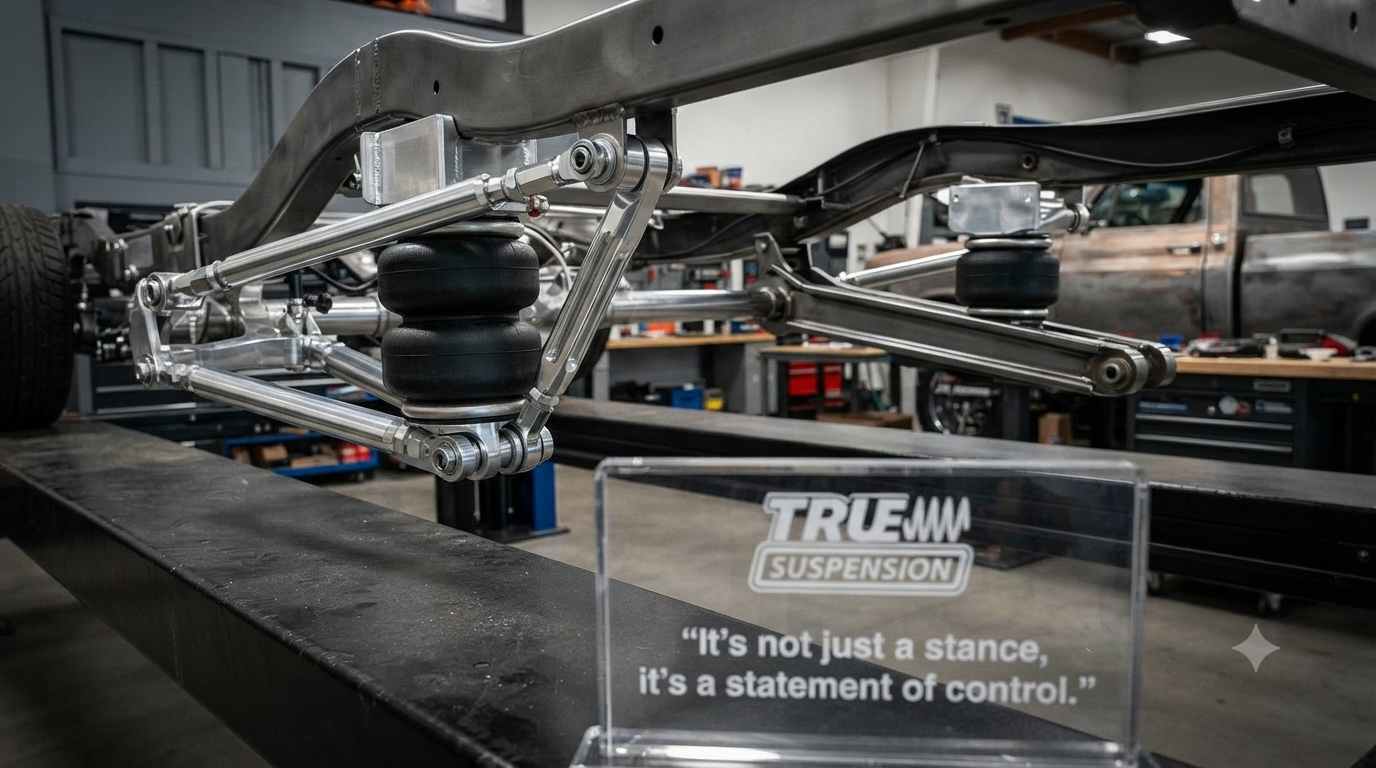
Understanding the 4-Link Suspension vs. Trailing Arm decision is the first step. Avoiding common build mistakes is the second.
Mistakes builders make with 4-link setups:
- Incorrect upper arm angle leading to driveshaft vibration
- Mounting brackets that are not parallel, causing binding through suspension travel
- Choosing spring rate without considering the vehicle's final weight
- Skipping the bumpstop setup, leading to axle contact at full drop
- Not accounting for driveshaft length changes with ride height adjustment
Mistakes builders make with trailing arm setups:
- Using worn factory bushings on a fresh build
- Ignoring pinion angle changes when lowering the vehicle
- Not upgrading shocks when changing ride height
- Assuming factory geometry works at lower-than-stock ride heights
True Suspension kits include the hardware, geometry, and instructions to help you avoid every one of these mistakes. And our product team is available to help you spec the right kit for your build.
Conclusion
The 4-Link Suspension vs. Trailing Arm decision ultimately comes down to your goals. If you want maximum control, a stunning stance, air ride capability, and a suspension system that performs as good as it looks, the 4-link suspension is the clear winner. If you want simplicity, lower cost, and a reliable daily-driver setup, the trailing arm is a practical choice.
What never changes is the value of using quality parts from a supplier who knows what builders need. True Suspension delivers exactly that: engineered kits, complete packages, and the product knowledge to help you build with confidence. From bolt-on 4-link systems to complete air ride suspension kits, we have everything your classic truck build needs to go from bare frame to show-stopper.
Browse our full catalog and find the kit that is right for your build today. For more insight into related suspension topics, check out our blog post on rubber block vs. air ride suspension to further refine your build strategy.
Frequently Asked Questions
- What is the main difference between 4-Link Suspension vs. Trailing Arm for classic trucks?
A 4-link suspension offers full geometry control, better stance, and air ride compatibility. A trailing arm is simpler and cheaper. For show builds or performance, the 4-link suspension wins clearly.
- Can I install a 4-link suspension on my classic C10 without major fabrication?
Yes. True Suspension offers bolt-on 4-link kits for the C10 that require no major cutting or custom fabrication. The kits mount to existing frame locations and include all needed hardware.
- Is a trailing arm suspension good enough for a mild classic truck build?
Yes. For a daily driver or mild restoration, a trailing arm setup works fine. You can still add air ride assist kits to improve load management without a full conversion.
- What is anti-squat and why does it matter in a 4-link rear suspension?
Anti-squat is resistance to body squat under acceleration. A properly tuned 4-link suspension can achieve 80–100% anti-squat, keeping your truck level under power, far better than any trailing arm system.
- Does True Suspension offer complete kits that include both the 4-link and air ride components?
Yes. True Suspension provides complete 4-link air ride suspension kits that include control arms, air springs, brackets, and hardware, everything in one package for a clean, no-compromise build.