
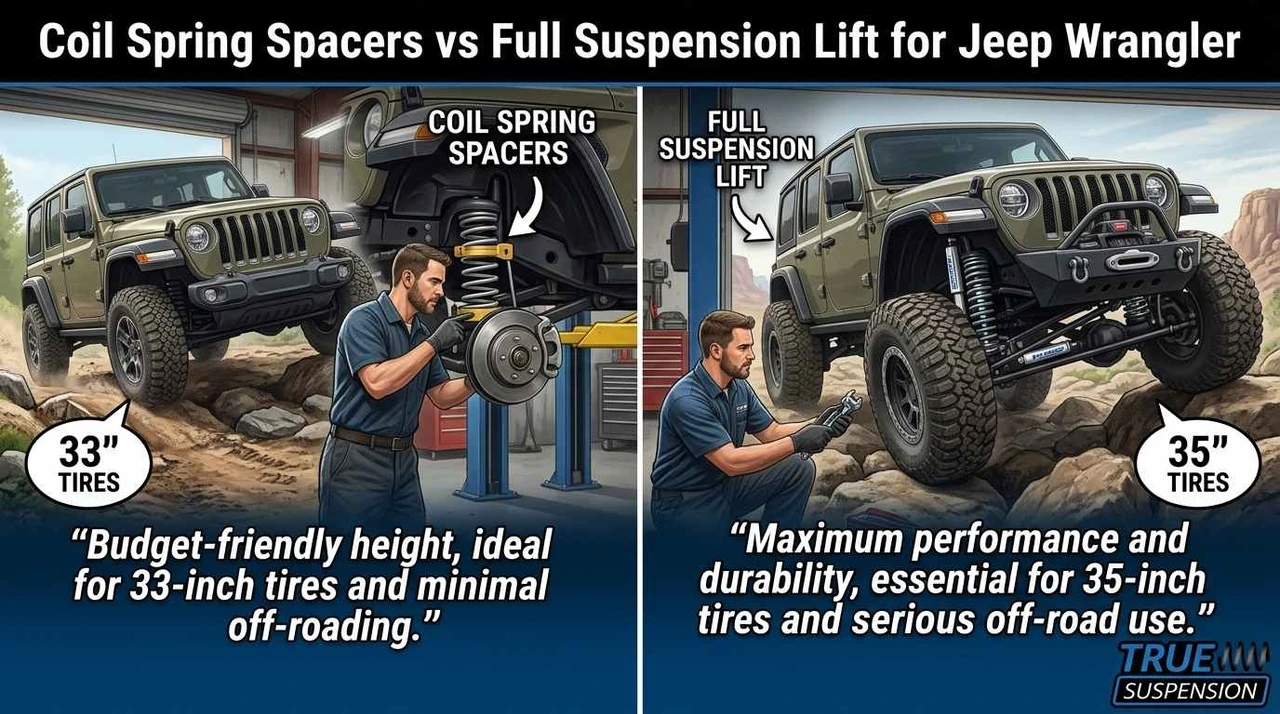
Most Jeep Wrangler owners ask the same question the moment they decide to size up their tires: coil spring spacers vs full suspension lift, which one do I actually need?
Most guides online just throw out a quick answer without explaining the real-world trade-offs. That is not what this is.
This guide breaks down every critical difference between coil spring spacers and a full suspension lift for Jeep Wranglers running 33s and 35s. We cover ride quality, axle angle, alignment specs, drivetrain stress, cost, and the long-term effect on your CV axle, wheel alignment, and vehicle suspension system. We also tell you exactly what True Suspension recommends, and why our kits are built differently from everything else on the market.
Let's get into it.
What Are Coil Spring Spacers and What Do They Actually Do?
Coil spring spacers are simple, bolt-on suspension components that sit on top of your existing coil springs to push the body upward. They do not replace your factory springs. They simply add height.
A spacer lift on a Jeep Wrangler typically gives you 1 to 2.5 inches of lift depending on the spacer thickness. That is usually enough clearance to run 33-inch tires without rubbing. It is a clean, reversible modification.
Here is what makes a spacer lift appealing:
- Low cost: spacer kits are a fraction of the cost of a full lift
- Fast installation, most experienced DIYers can fit them in under two hours
- Reversible, you can return to stock without replacing anything major
- Minimal effect on geometry: at 1 to 2 inches, the axle angle and CV axle stress stay within acceptable limits
But here is where it gets important. Coil spring spacers do not improve your suspension system parts. They do not add control arm drop brackets. They do not recenter your front suspension geometry. At lifts beyond 2 inches, you start putting your CV axle under stress it was not designed to handle.
That is where the CV axle failure conversation begins. More on that shortly.
At True Suspension, our Subaru strut spacer lift kits are precision-engineered for correct fitment. Our 1-inch front and rear strut spacer kit and 2-inch lift kit are made from high-grade materials that maintain your factory vehicle alignment geometry, so your tires wear evenly, and your alignment specs stay dialed in.
What Is a Full Suspension Lift and Why Does It Cost More?
A full suspension lift replaces or upgrades your suspension components, control arms, shocks, springs, and sometimes differential drop brackets. It is a complete redesign of your car suspension system.
For Jeep Wranglers, a quality full suspension lift runs anywhere from $800 to $3,000+ depending on the brand, components included, and whether you need new CV axle shafts or extended brake lines.
Here is why a full suspension lift costs more, and why it is worth it in specific scenarios:
Geometry Is Corrected at Every Point
When you lift a Jeep Wrangler more than 2.5 inches, your front suspension geometry shifts. The control arms run at a steeper angle. Your CV joint operates at an extreme angle. Your Subaru alignment specs, or in this case your Wrangler alignment specs, go out the window without drop brackets or adjustable arms.
A proper full suspension lift recalculates all of this. It brings the front axle assembly geometry back to near-factory angles. This protects your CV axle, reduces vibration while driving, and keeps your wheel alignment dialed in correctly.
Better Shock Performance
Coil spring spacers leave your factory shocks in place. Those shocks are calibrated for stock ride height. Once you raise the vehicle, the shocks are now operating in a compressed position they were not designed for. Over time, this kills shock absorber performance and creates a bouncy, unpredictable ride.
A full suspension lift includes longer, properly valved shocks designed for the new ride height. Our complete lift kits include Pro Comp ES9000 nitrogen-charged shocks, built specifically for lifted applications. The difference in high-performance suspension ride quality is immediately noticeable.
Extended Brake Lines and Bumpstops
A full suspension lift accounts for the increased droop your vehicle suspension system now has. Without longer brake lines, a hard articulation cycle can stretch and snap your factory lines. Without updated bumpstops, your tires can contact the fenders mid-flex.
Coil spring spacers do not address either of these issues. That is not a knock on spacers; it is simply outside their scope.
For deeper reading on how lift types differ at the component level, check out our guide on lift kits vs leveling kits, a must-read before you buy anything.
Coil Spring Spacers vs Full Suspension Lift, Head-to-Head Comparison
|
Feature |
Coil Spring Spacers |
Full Suspension Lift |
|
Typical Cost |
$80–$350 |
$800–$3,000+ |
|
Lift Height Range |
1–2.5 inches |
2–6+ inches |
|
Installation Time |
1–3 hours |
4–10+ hours |
|
Tire Size Supported |
33s (in most cases) |
33s and 35s comfortably |
|
Geometry Correction |
Minimal to none |
Comprehensive |
|
Shock Replacement Needed |
No (but recommended) |
Yes (usually included) |
|
CV Axle Stress |
Moderate at 2+ inches |
Low (with drop brackets) |
|
Alignment Required After |
Yes |
Yes |
|
Reversible |
Yes |
Partial |
|
Best For |
Mild lift / 33s on tight budget |
35s, serious off-road, long-term build |
Running 33s on a Jeep Wrangler, Can a Spacer Lift Handle It?
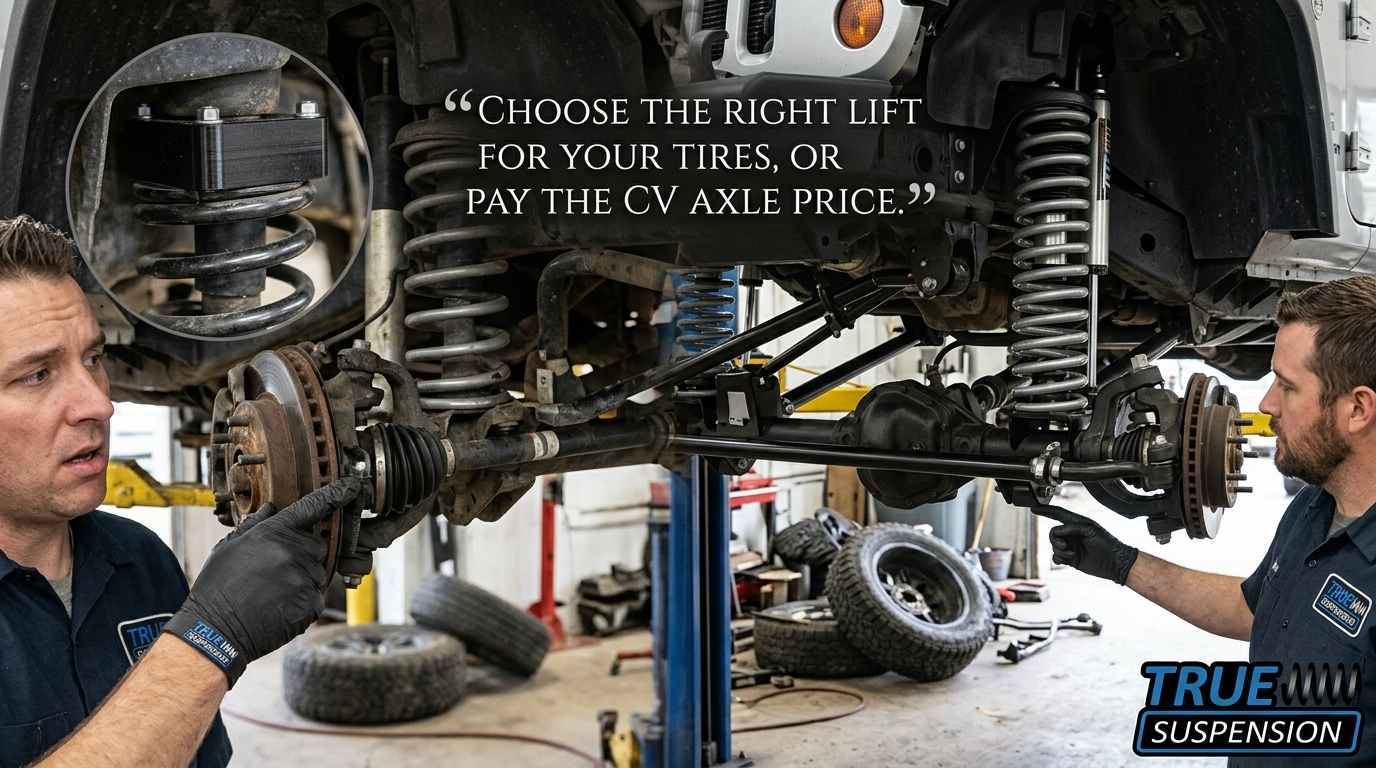
Yes. A well-made spacer lift of 2 to 2.5 inches will typically clear 33-inch tires on a Jeep Wrangler JK or TJ without any fender trimming. The front suspension geometry stays within acceptable limits at this lift height, and CV axle bind risk remains manageable.
That said, there are conditions where even a modest spacer lift causes problems:
- If your Subaru CV axle (or in this case Jeep axle) is already worn, the additional angle will accelerate CV axle failure
- If you run a 2.5-inch spacer without an alignment, your wheel alignment will pull, and your tires will wear unevenly
- If you skip new bumpstops, your front suspension may contact the fender on flex
The fix for all three is straightforward: use quality spacers, get a fresh wheel alignment after installation, and replace any worn CV joint before lifting.
Our Jeep Wrangler TJ complete lift kit with 2.5-inch coil spring spacers and Pro Comp shocks is engineered precisely for this scenario. You get the height for 33s, you get proper shocks for the new ride height, and you get a kit designed around correct suspension arm angles.
Running 35s on a Jeep Wrangler, Why You Need a Full Suspension Lift?
Here is the honest answer: 35-inch tires on a Jeep Wrangler require at least 3.5 inches of lift to clear properly. Spacers alone cannot give you that lift without serious CV axle angle problems.
At 3.5 inches from spacers only, here is what happens to your vehicle suspension system:
CV Axle Bind and Failure
Your CV axle is designed to operate within a specific angle range. The constant velocity joint relies on smooth articulation within that range to transfer power from the drive shaft to the wheel without vibration.
At 3.5+ inches of spacer lift, the axle angle becomes extreme. The CV joint is now fighting geometry every time you turn or articulate. CV axle failure symptoms- vibration while driving, clicking on turns, grease leaking from CV axle boots- show up faster than expected. Eventually, the broken CV axle symptoms become impossible to ignore: the joint snaps and you are stranded.
This is not hypothetical. Signs of a bad CV axle appear within months of running extreme spacer lifts without corrected geometry.
Alignment Issues and Tire Wear
A 3.5-inch spacer lift without drop brackets or adjustable control arms throws your Subaru alignment specs (or Jeep alignment specs) far outside factory tolerances. The front and rear alignment cannot be corrected to spec without the proper geometry correction hardware.
The result? Your front tires wear in weeks. You go through CV joint repair and tire replacement on an accelerating cycle. The money you saved on spacers disappears into tires and alignment visits.
What You Should Use Instead for 35s
For 35-inch tires, invest in a proper full suspension lift with:
- New coil spring spacers or replacement coil springs at the correct rate
- Drop brackets for the differential and control arms
- Extended CV axle shafts or corrected geometry arms
- Long-travel shocks designed for the new ride height
- Updated rear suspension components including bumpstops
Our Jeep Wrangler JK complete lift kit with 3-inch coil spring spacers and Pro Comp ES9000 shocks is built for exactly this application. It delivers proper lift geometry, real shock performance, and the clearance you need for 35s without destroying your drivetrain.
For a broader perspective on this decision, read our breakdown of top suspension upgrades that improve towing safety; many of the geometry principles carry directly across to the Wrangler platform.
CV Axle, The Hidden Cost Nobody Talks About
Let us talk about CV axle replacement costs, because this is where the "cheap spacer lift" often becomes an expensive mistake.
CV axle replacement on a Jeep Wrangler typically runs $200 to $600 per side including labor. If you push an axle to failure with an extreme spacer lift, you are looking at:
|
Repair Item |
Typical Cost |
|
CV axle replacement (per side) |
$200–$600 |
|
CV joint repair (if applicable) |
$150–$400 |
|
Wheel alignment post-repair |
$80–$150 |
|
CV axle boot replacement (if caught early) |
$100–$250 |
|
Alignment issues correction with drop brackets |
$300–$800 |
Signs of a bad CV axle to watch for after any lift:
- Clicking or popping sound on tight turns, classic CV joint wear indicator
- Vibration while driving at highway speed, often CV axle failure related
- Grease on the inside of your wheel or around the CV axle boot, seal failure
- Clunking noise when accelerating from a stop, drive shaft or CV joint stress
How to tell if CV axle is bad after a lift: park on a flat surface, turn your steering wheel to full lock, and drive slowly in a circle. A clicking or grinding sound almost always points to a failing constant velocity joint.
The smartest way to avoid CV axle failure is to choose the right lift for your tire size from day one. Do not lift 3.5 inches on spacers and hope your CV axle survives.
Wheel Alignment After a Lift, Non-Negotiable
Whether you run coil spring spacers or a full suspension lift, you need a fresh wheel alignment afterward. No exceptions.
Here is what happens to your vehicle alignment when you lift without aligning:
- Front alignment goes out of spec; camber and caster shift with the new ride height
- Uneven tire alignment causes accelerated outer or inner tread wear
- Alignment issues create pull to one side, especially on highway driving
- Front and rear alignment imbalance increases stress on your steering rack and suspension arm
How much does alignment cost after a lift? Expect $80 to $150 for a standard wheel alignment. For a 4-wheel alignment on a lifted Jeep, budget closer to $120 to $180.
Worth every dollar. A proper car wheel alignment after your lift keeps your tires lasting years instead of months, protects your front suspension geometry, and gives you a straight, stable driving experience.
For more on keeping your vehicle suspension system in top shape after modifications, our guide on how to maintain your air ride suspension system covers the principles that apply across all suspension types.
True Suspension Kits, Why Ours Are Built Differently?
Here is where we want to be direct with you. There are dozens of lift kit brands on the market. Most of them source generic components and slap a label on them. We do not do that.
At True Suspension, every kit is designed around the specific vehicle platform it fits. Our Jeep Wrangler TJ 2-inch lift kit with Pro Comp ES9000 shocks uses nitrogen-charged shocks that are valved specifically for the added lift height, not a universal shock that happens to fit.
Our Jeep Wrangler JK 2-inch lift kit and JK 2.5-inch lift kit both include everything you need to run the lift correctly: springs, shocks, and hardware. No hunting for missing pieces. No compatibility surprises.
What separates our kits:
- Platform-specific engineering, not universal fitment guesswork
- Pro Comp ES9000 nitrogen-charged shocks, tested and rated for lifted ride heights
- High-grade coil spring spacers, machined to precise tolerances for correct seat fitment
- Complete hardware packages, every bolt, bracket, and fitting included
- Proven real-world geometry, tested on actual vehicles, not just on paper
- Full technical support, our team knows these kits because we build them
We do not cut corners to compete on price. We build kits that protect your drivetrain components, maintain correct axle angle, and let you run 33s or 35s without destroying your CV joint or burning through tires in 10,000 miles.
Before you buy any lift kit, read our guide on the top 10 questions to ask before buying a lift kit; it will save you from the most common and expensive mistakes Jeep owners make.
Pros and Cons, Coil Spring Spacers for Jeep Wrangler
Pros
- Affordable entry point, ideal for owners on a budget who want 33s
- Easy DIY installation, no specialized tools required in most cases
- Reversible modification, back to stock is simple
- Maintains most factory geometry at 1 to 2-inch lift heights
- Immediate tire clearance without a full suspension system overhaul
Cons
- Limited lift ceiling, beyond 2.5 inches, CV axle angles become problematic
- No shock upgrade, factory shocks perform poorly at new ride heights
- No geometry correction, alignment issues require additional hardware to fix properly
- Not suitable for 35s, inadequate clearance and drivetrain stress at required height
- Increased wear on CV joint, wheel bearing, and related drivetrain components
Pros and Cons, Full Suspension Lift for Jeep Wrangler
Pros
- Supports 35-inch tires comfortably with correct geometry
- Corrected suspension geometry, protects your CV axle and front axle assembly
- Purpose-built shocks, significantly better vehicle suspension system performance
- Handles articulation properly without stress on CV joint or drive axle
- Long-term investment, protects tires, wheel alignment, and drivetrain components
Cons
- Higher upfront cost, full kits run $800 to $3,000+
- More complex installation, typically requires a lift and more time
- Alignment still required; you will need a fresh wheel alignment after install
- May require additional mods, brake line extensions, bumpstop updates on some builds
Statistics and Data, What the Numbers Tell Us
Here is what real-world data tells us about lift height, tire size, and drivetrain longevity:
|
Lift Type |
Max Recommended Tire |
CV Axle Life Impact |
Alignment Correction Required |
Average Total Cost |
|
0–1.5" Spacer |
33s |
Minimal impact |
Basic alignment |
$100–$250 |
|
1.5–2.5" Spacer |
33s (some 35s) |
Moderate, monitor regularly |
Full 4-wheel alignment |
$200–$450 |
|
2.5–3.5" Spacer Only |
35s (not recommended) |
High, CV axle failure risk increases significantly |
Often cannot be corrected to spec |
$300–$500 + repair costs |
|
3.5–4" Full Lift |
35s comfortably |
Low with correct geometry |
Full 4-wheel alignment |
$900–$2,500 |
|
4–6" Full Lift |
35s–37s |
Low with extended CV axle shafts |
Full alignment + geometry check |
$1,500–$3,500+ |
Key insight: The most expensive lift option is not a full suspension kit; it is a spacer lift pushed beyond its design limits. CV axle replacement, CV joint repair, and accelerated tire wear add up fast.
For additional context on how suspension choices affect long-term vehicle cost, see our full breakdown on rubber block vs air ride suspension; the cost-vs-performance analysis translates directly to the spacer vs full lift debate.
What About the Jeep Wrangler TJ vs JK, Does Platform Matter?
Yes. The platform absolutely matters when choosing between coil spring spacers and a full suspension lift.
Jeep Wrangler TJ (1997–2006): The TJ uses a solid front axle with coil springs at all four corners. Geometry correction is slightly more forgiving than the JK at modest lift heights. A 2.5-inch spacer lift on a TJ is a well-understood, proven combination for 33s.
Jeep Wrangler JK (2007–2017): The JK has a solid front axle but uses more complex suspension components and a longer wheelbase. At 3.5 inches or more, the JK needs control arm corrections to keep front suspension geometry within safe limits. The CV axle on a JK is under more stress at lifted heights than a TJ.
Our kits are built platform-specifically:
- Wrangler TJ 2.5-inch complete lift kit, optimized for TJ geometry
- Wrangler JK 3-inch complete lift kit, built around JK-specific suspension angles
- Wrangler TJ 3-inch complete lift kit, for TJ owners going bigger
Do not use a generic kit on either platform. Suspension components designed for one platform can create serious alignment issues and CV axle stress on another.
Vibration While Driving After a Lift, Causes and Fixes
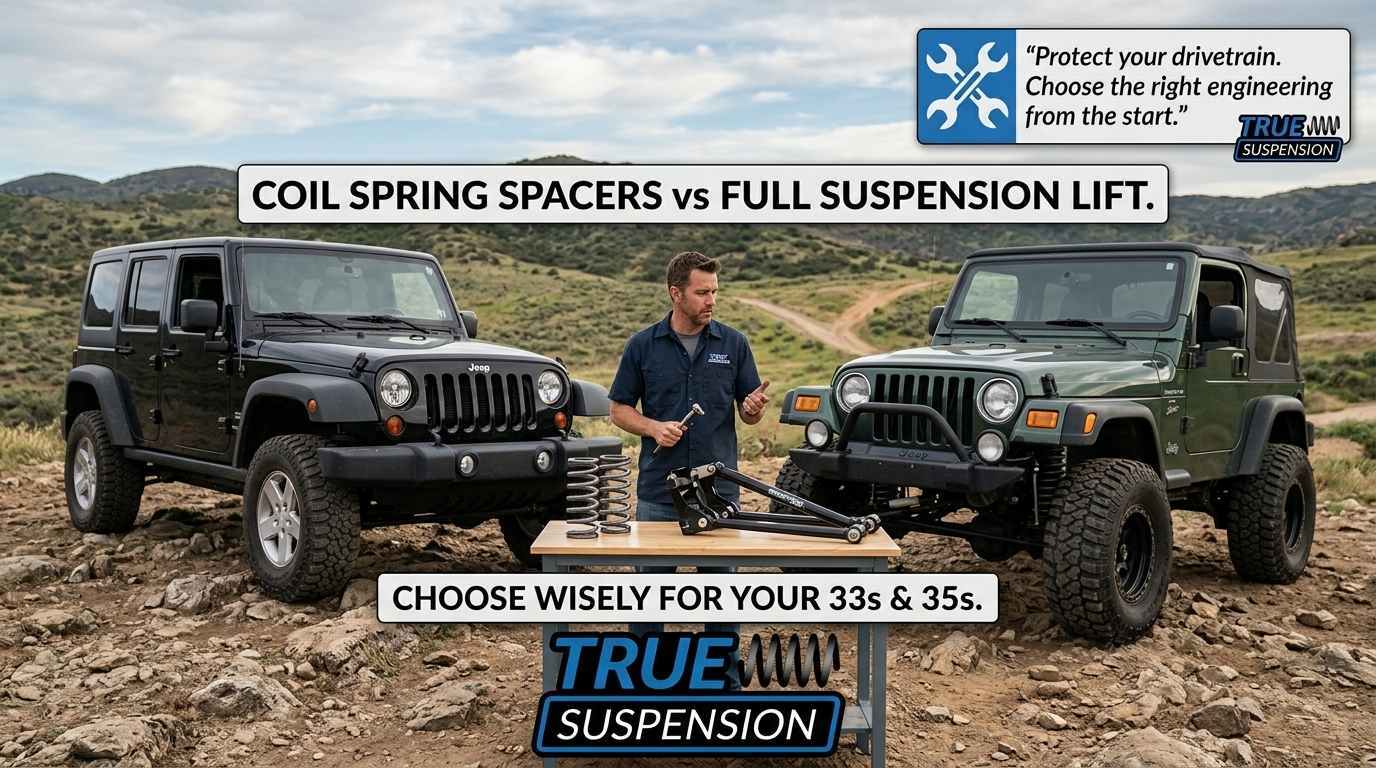
Vibration while driving after installing a lift is one of the most common complaints we hear. Here is the breakdown of causes and fixes:
Cause 1: Unbalanced Tires After Fitment
New tires on new wheels need balancing after installation. A wheel alignment is not the same as tire balancing. If you skip balancing, vibration while driving starts almost immediately at highway speed.
Fix: Balance all four tires after fitting them on your lifted Wrangler.
Cause 2: CV Axle Angle Issues
At lifts beyond the design limit for your CV joint, the constant velocity joint creates vibration while driving, especially under load or acceleration. This is CV axle failure starting to manifest.
Fix: Correct your lift height, add drop brackets, or replace with extended CV axle shafts rated for your lift height.
Cause 3: Wheel Alignment Out of Spec
Improper car wheel alignment after a lift causes uneven tire contact with the road, which creates vibration at speed. Front alignment and rear suspension both need to be checked.
Fix: Full 4-wheel alignment after any suspension modification.
Cause 4: Factory Shocks at Wrong Ride Height
Your factory shocks operating at a compressed position cause harsh, choppy feedback, which feels like vibration while driving over rough surfaces.
Fix: Replace with shocks designed for your lift height. Our Pro Comp ES9000 shocks are nitrogen-charged and valved for lifted applications.
Quick Decision Guide, Which Lift Is Right for You?
Use this quick decision guide to cut through the noise:
Choose coil spring spacers if:
- You want to run 33-inch tires and keep costs under $400 all-in
- You need a reversible modification
- Your CV axle and suspension components are in good health
- You are lifting 1 to 2.5 inches maximum
- You are not doing serious off-road articulation regularly
Choose a full suspension lift if:
- You want to run 35-inch tires and beyond
- You do regular off-road driving with significant articulation
- You want long-term drivetrain protection for your CV axle and constant velocity joint
- You want correct vehicle suspension system geometry, not a workaround
- You are building a Wrangler for performance, not just street appearance
For more guidance on choosing the right suspension upgrade, our guide on the top 10 ways to maintain factory ride quality after installing a lift kit is essential reading for any Jeep owner.
Why True Suspension Is the Right Partner for Your Wrangler Build?
We have been in the suspension business long enough to know what fails and why. Our kits exist because we got tired of seeing Jeep owners ruin their drivetrain components with undersized, incorrectly engineered lifts.
Every True Suspension kit for the Jeep Wrangler platform is:
- Tested on real vehicles, not just modeled on paper
- Platform-matched, TJ kits for TJ, JK kits for JK
- Complete, no missing hardware, no return trips to the parts store
- Backed by technical support, from a team that actually knows these kits
When you order from True Suspension, you are not getting a generic suspension parts kit rebadged from a warehouse catalog. You are getting a kit designed to clear your tires, protect your CV joint, keep your wheel alignment in spec, and make your Wrangler perform the way you intended.
Our customers run 33s on our spacer kits and 35s on our full lift kits with zero CV axle failure issues when they follow our installation guidelines. That is not luck. That is engineering.
Check out our guide on the top 10 mistakes people make when lowering their truck; many of the same geometry principles apply when lifting a Wrangler.
Suspension Components You Should Inspect Before Any Lift
Before you install coil spring spacers or a full suspension lift, do a full inspection of your existing suspension parts. Installing a lift on worn automotive suspension components accelerates every failure point.
What to Check?
CV Axle and CV Joint: Look at your CV axle boots first. If they are cracked, torn, or leaking grease, the constant velocity joint inside is already contaminated. A lift will accelerate that failure dramatically. Replace any compromised CV joint before lifting.
How long do CV axles last?
On an unmodified Wrangler with good maintenance, CV axles last 70,000 to 130,000 miles. On a lifted Wrangler with uncorrected geometry, that number can drop to under 30,000 miles.
Wheel Bearings:
Wheel bearing replacement is often overlooked before a lift. A bad wheel bearing under a stock Wrangler becomes a failing wheel bearing under load after a lift. How to tell if a wheel bearing is bad: listen for a humming or growling noise that changes with vehicle speed. How long can you drive on a bad wheel bearing? Not far, and definitely not far after a lift.
Control Arms and Suspension Arm Bushings:
Worn suspension arm bushings allow movement they should not. Under a lifted ride height with increased axle angle stress, those worn bushings fail faster. Inspect every suspension component for play before you lift.
Alignment Specs, Current State:
Get a pre-lift alignment check done. Know your baseline Subaru alignment specs (or Jeep alignment specs). If you are already outside factory alignment specs before the lift, address it first. Lifting a misaligned vehicle compounds every existing problem.
Pre-Lift Inspection Checklist
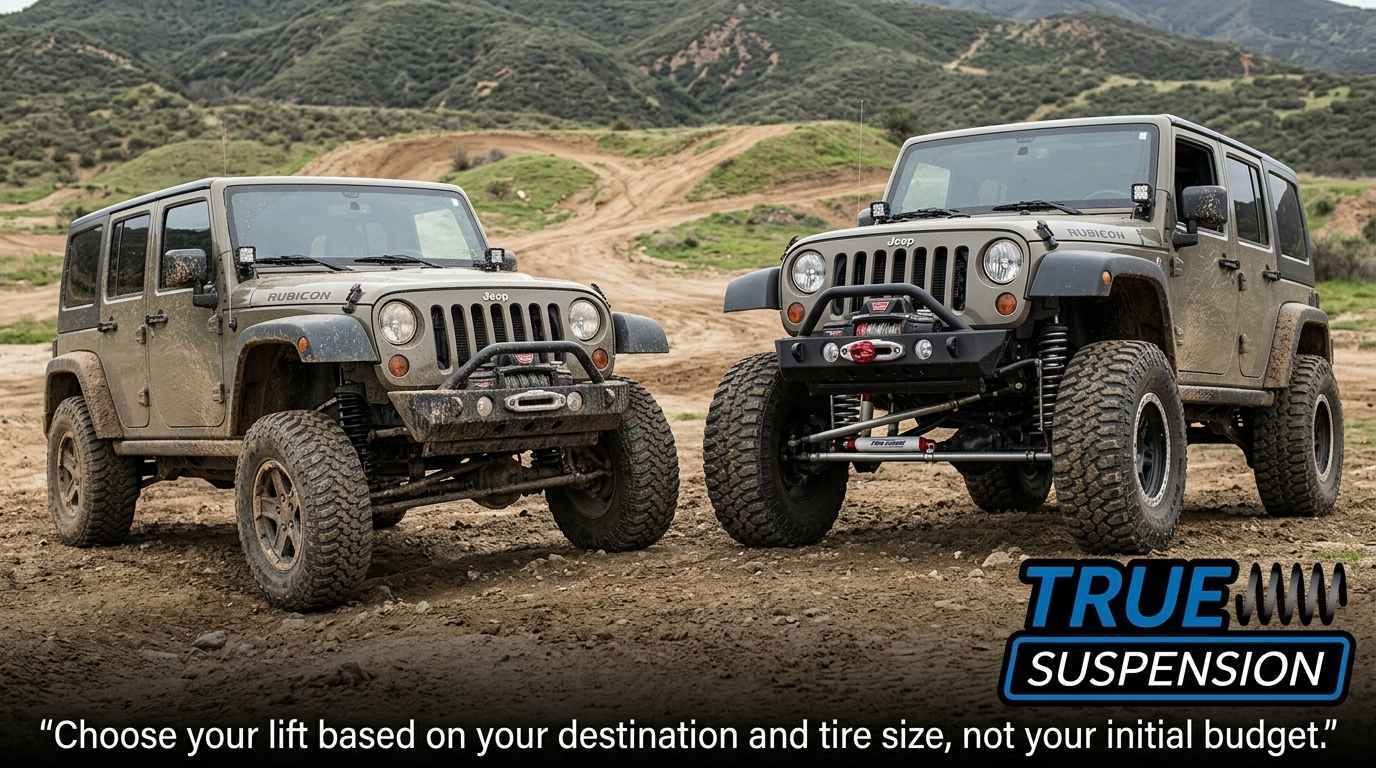
|
Component |
What to Check |
Replace If |
|
CV axle boots |
Cracks, tears, grease leakage |
Any damage visible |
|
CV joint |
Clicking on turns |
Any noise on articulation |
|
Wheel bearing |
Humming noise, wheel play |
Any play or consistent noise |
|
Control arm bushings |
Cracked rubber, play under load |
Visible cracks or movement |
|
Coil springs |
Cracks, sag, uneven ride height |
Sag of more than 0.5 inches |
|
Shock absorbers |
Leaking, bottoming out |
Any fluid leakage |
|
Drive shaft |
U-joint play, vibration under load |
Any clunk or play in joint |
Running through this checklist before your lift install saves you from discovering these issues mid-build, or worse, after 500 miles on a new lift when parts start failing in sequence.
Our team at True Suspension has seen this enough times to make it a standing recommendation: inspect before you lift. A quality lift kit deserves a healthy foundation.
For guidance on how our products perform in full build scenarios, read our classic car builder's guide; the pre-build inspection principles apply directly to any suspension modification project.
Conclusion
The coil spring spacers vs full suspension lift debate has a clear answer once you know your tire size and driving goals.
For 33-inch tires on a budget with minimal off-roading, a quality spacer lift of 2 to 2.5 inches works well. For 35-inch tires and serious off-road performance, a full suspension lift with corrected geometry is the only responsible choice.
At True Suspension, we build kits for both paths. Every kit is engineered to protect your cv axle, maintain correct alignment specs, and deliver real performance without shortcuts.
Do not let the wrong lift choice cost you a CV axle replacement, a set of tires, and months of frustration. Start with the right kit. Start with True Suspension.
Frequently Asked Questions
Q1: Can coil spring spacers support 35-inch tires on a Jeep Wrangler?
Technically possible above 3 inches, but not recommended. The required height puts your CV axle at dangerous angles. A full suspension lift is the correct choice for 35s.
Q2: How much does a full suspension lift cost for a Jeep Wrangler?
Quality full suspension lift kits range from $800 to $3,000+ depending on components. Our True Suspension Wrangler kits include Pro Comp shocks and all hardware for complete fitment.
Q3: Do I need a wheel alignment after installing coil spring spacers?
Yes, always. Any change to your vehicle suspension system ride height affects your car's wheel alignment. Skip it, and you will burn through tires in months.
Q4: What are the signs of a bad CV axle after a lift?
Clicking on turns, vibration while driving, grease around the CV axle boot, and clunking under acceleration are all signs of a bad CV axle. Inspect immediately after any suspension modification.
Q5: What is the difference between a leveling kit and a full lift for a Jeep Wrangler?
A leveling kit corrects the factory rake by raising the front slightly. A full suspension lift raises all four corners with corrected geometry. For tire sizes beyond 33 inches, a full lift is required.