
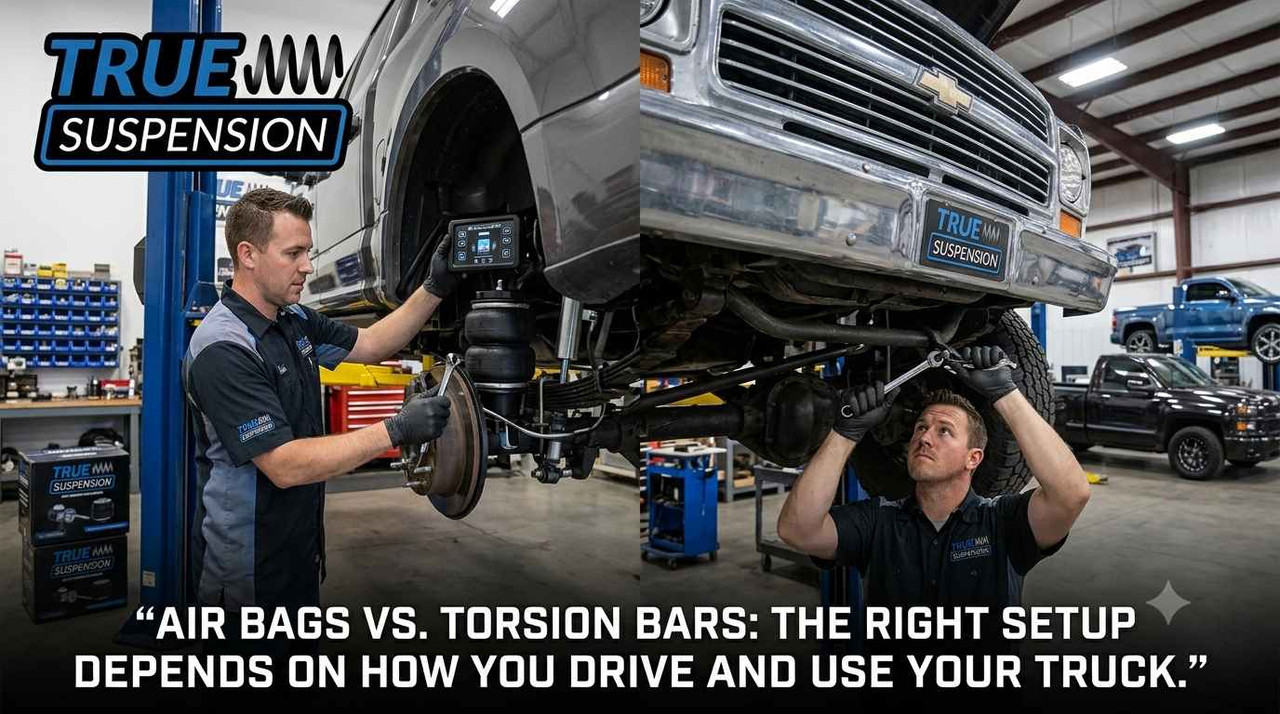
Truck owners face a real choice every day: stick with the tried-and-true torsion bar setup or upgrade to a modern air bag suspension system. Both systems level your truck and improve load-carrying ability. But they work in completely different ways, and the right pick depends on how you use your vehicle.
At True Suspension, we have helped thousands of truck owners make this decision. We carry a full catalog of towing assist helper air ride suspension kits and leveling solutions built to match every driving style, budget, and truck type. This guide breaks down both systems clearly so you can choose with confidence.
What Are Torsion Bars and How Do They Work?
Torsion bars are steel rods that run lengthwise along the front of the truck frame. They twist under load and spring back, providing front suspension support. Many older half-ton and three-quarter-ton trucks from manufacturers like GM, Dodge, and Ford used torsion bar suspension as a standard setup from the factory.
You adjust torsion bar height by turning a bolt on the anchor. Crank it tighter, and the front of the truck rises. This is sometimes called a torsion key leveling method.
Key Features of Torsion Bar Systems
|
Feature |
Details |
|
Adjustment Range |
Typically 1–3 inches of lift |
|
Setup Type |
Factory or aftermarket torsion keys |
|
Vehicles Supported |
Many 4WD trucks from the 1980s–2010s |
|
Typical Cost |
$80–$350 for a torsion key kit |
|
Ride Change |
Stiffer as height increases |
Torsion bar leveling is popular because it uses existing hardware. You are not replacing major components. You are simply changing the preload on a bar that is already there.
True Suspension carries adjustable front torsion key lift kits for Chevy/GMC Silverado Sierra trucks that let you dial in up to 4 inches of front lift while maintaining proper geometry. Our kits include Pro Comp ES9000 nitrogen-charged shocks to keep the ride smooth even after you raise the front end.
What Is an Air Bag Suspension System and How Does It Work?
An air bag suspension system replaces or supplements your factory leaf springs with inflatable rubber bags. You pump air into the bags using a compressor, either manually or via an in-cab control panel. More air means more support and more height. Release air, and the truck lowers.
Air bag systems are most popular for:
- Towing heavy trailers
- Hauling heavy payloads in the bed
- Leveling a truck under load automatically
- People who want ride adjustability on demand
True Suspension specializes in complete rear towing assist air ride suspension kits that come with everything you need to install an adjustable air system at the rear axle.
Key Features of Air Bag Suspension Systems
|
Feature |
Details |
|
Adjustment Method |
In-cab controls or manual valve |
|
Range |
Variable from factory height to fully aired up |
|
Vehicles Supported |
Nearly all trucks, vans, SUVs |
|
Typical Cost |
$300–$1,200 for a complete kit |
|
Ride Change |
Smoother under load, adjustable on demand |
Air Bags vs. Torsion Bars, A Direct Head-to-Head Comparison
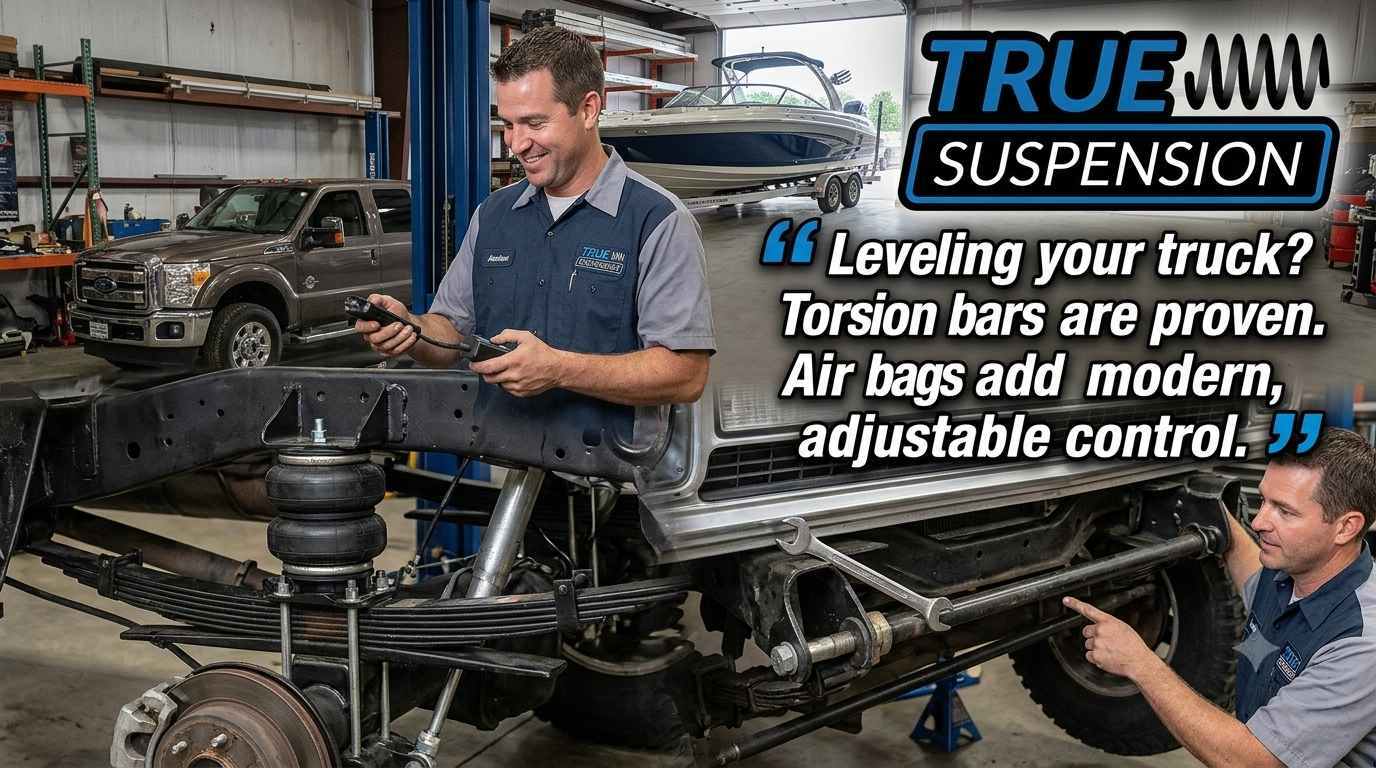
This is the comparison most truck owners actually want. Let's put the two systems side by side across the most important factors.
Performance Comparison Table
|
Category |
Air Bags |
Torsion Bars |
|
Load Support |
Excellent, adjustable by air pressure |
Good, fixed preload |
|
Towing Stability |
Outstanding |
Moderate |
|
Ride Quality Adjustment |
Yes, inflate or deflate instantly |
No, requires manual wrench work |
|
Installation Complexity |
Moderate |
Easy to moderate |
|
Cost (Entry Level) |
~$300–$500 for basic kits |
~$80–$200 for keys only |
|
Cost (Full Management) |
~$600–$1,200 with in-cab controls |
Not applicable |
|
On-Road Adjustability |
Yes |
No |
|
Compatibility |
Rear suspension focused |
Front suspension focused |
|
Longevity |
5–10+ years with proper care |
10–20+ years (simpler system) |
Pros and Cons: Air Bags
Pros:
- Instantly adjustable with no tools
- Dramatically improves towing stability and sag control
- In-cab controls let you react to changing loads
- Works with in-cab control panels, gauges, and dual-switch setups
- Restores factory ride height under heavy load
Cons:
- Higher upfront cost than a basic torsion key swap
- Requires an air compressor (unless tankless system)
- More components to maintain over time
- Needs proper sealing and line care
Pros and Cons: Torsion Bars
Pros:
- Very affordable entry point
- Simple design with few failure points
- Uses existing factory hardware
- Long service life with zero maintenance
Cons:
- No on-the-fly adjustment
- Stiffer ride as preload increases
- Limited to front-end leveling only
- Does not help with rear sag under heavy loads
Who Should Choose Air Bags?
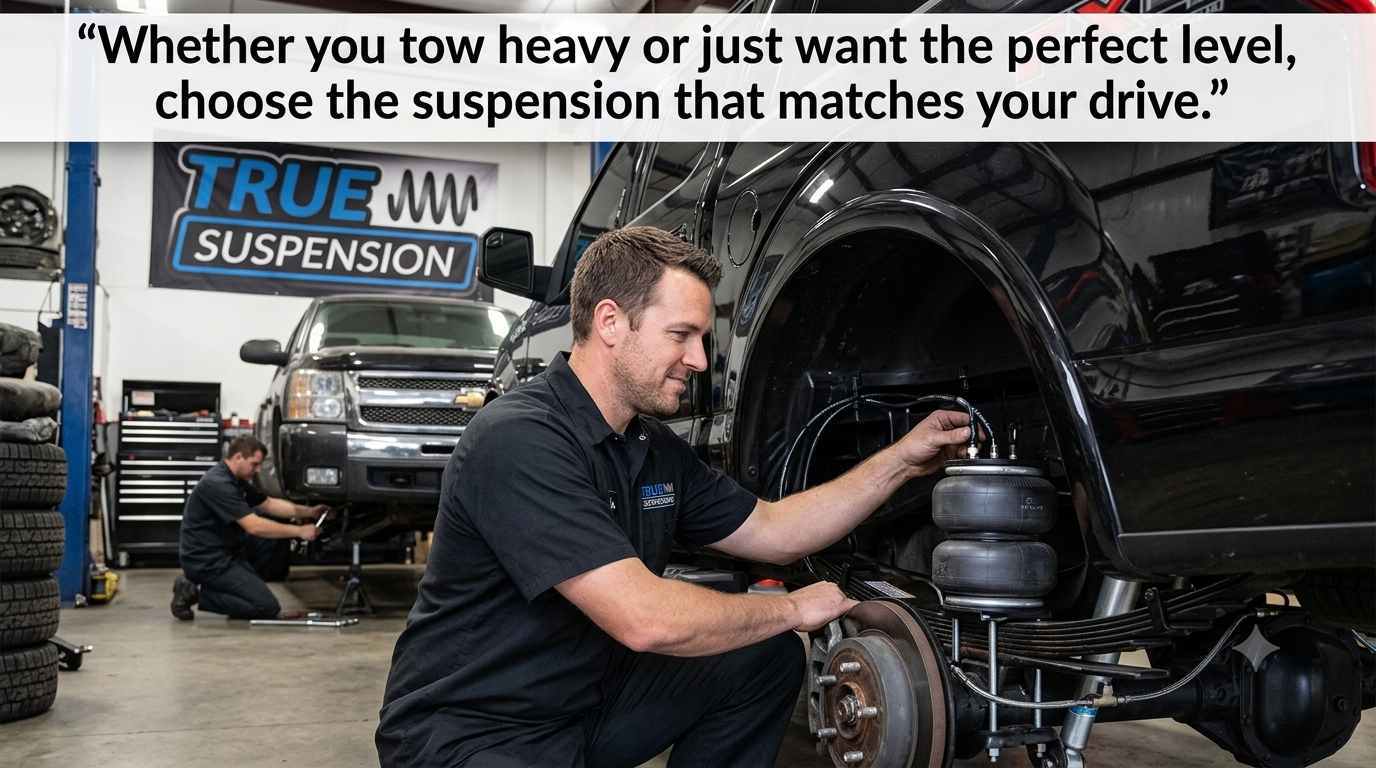
Air bag suspension wins for drivers who tow regularly, carry heavy payloads, or want dynamic control over their truck's height and load response. If you back up to a trailer two or three times a week, load your bed with equipment, or drive with varying cargo weights, air bags make every drive safer and more predictable.
Consider air bag systems if you:
- Tow a fifth wheel, camper, or boat trailer frequently
- Drive a work truck with inconsistent bed loads
- Want in-cab control panel management
- Own a newer truck with a coil-spring rear suspension
- Haul heavy landscaping, construction, or agricultural loads
True Suspension offers purpose-built kits for dozens of popular trucks. The Ford F-150 towing assist air ride suspension kit is one of our best sellers for a reason; it eliminates rear sag instantly and gives the driver complete control from inside the cab.
For Ford Super Duty owners, our F-250 4WD towing assist air ride suspension kit delivers heavy-duty support with full air management control included.
Who Should Choose Torsion Bars?
Torsion bar leveling is an excellent choice for drivers who want a simple, affordable front-end level on a truck that already came with torsion bar suspension. If you drive a 4WD truck from the late 1980s through mid-2010s and just want to level the nose without spending a lot, a torsion key kit is your fastest, cleanest path.
Choose torsion bar leveling if you:
- Own a compatible 4WD GM, Dodge, or Ford truck
- Want a simple weekend install
- Do not tow or haul heavy loads regularly
- Are on a tight budget
- Want to maintain a mostly stock look with a subtle level
True Suspension carries adjustable torsion key kits for multiple platforms. Our Chevy/GMC Silverado Sierra K1500 torsion key lift kit gives you 1–4 inches of adjustable front lift and comes paired with Pro Comp nitrogen-charged shocks for a balanced result.
For Suburban and Tahoe owners, our Suburban Tahoe Yukon torsion key lift kit delivers the same clean level look for SUVs on the same platform.
The Air Management Difference, Old School vs. New School
This is really the heart of the air bags vs. torsion bars debate. It is not just about components; it is about how you interact with your truck.
Old school torsion bars require you to crawl under the truck, locate the adjustment bolt, count the turns, and then check the ride height. If you adjust too far, the ride gets harsh. If you do not adjust enough, the front droops. There is no feedback loop. You do it once and live with it.
New school air bag systems put total control in your hands. With in-cab management, you press a button, and the truck rises or lowers in seconds. You can inflate the bags to full pressure before hooking up a heavy trailer, then bleed some air off when you detach it. The truck always sits at the right height for the right load.
True Suspension's universal towing assist air ride suspension control panel with dual paddle switch and 150 PSI gauge brings this new-school convenience to any truck. It is one of the cleanest, most driver-friendly control setups on the market.
We also offer tankless air ride management control systems for drivers who want the simplicity of no air tank, a great option for daily drivers with limited under-bed space.
Why Truck Owners Are Switching to Air Bags
Here is what the data tells us about air bag suspension adoption:
|
Statistic |
Finding |
|
% of tow-vehicle owners reporting rear sag as a problem |
~62% |
|
Average load capacity improvement with air bag helper suspension |
15–25% increase in effective payload stability |
|
Driver satisfaction improvement after air bag install |
Reported by over 80% of users in aftermarket surveys |
|
Cost savings vs. damaged suspension from chronic overloading |
Average of $1,200–$2,500 in avoided repair costs |
|
Vehicles compatible with True Suspension air bag kits |
100+ truck, van, and SUV models across all major brands |
These numbers reflect why air bags are no longer a niche upgrade. They are a mainstream tool for any truck owner who works their vehicle hard.
Air Bags and Leaf Springs, An Important Distinction
Many people assume air bags replace leaf springs. In most truck applications, they do not. Air bag helper suspension systems sit inside or alongside the existing leaf spring pack. The leaf springs carry the baseline load. The air bags supplement that support and allow you to dial in extra firmness when needed.
This is an important distinction because it means:
- Your factory warranty is usually not affected
- The install does not require cutting or major fabrication
- You keep the durability of steel leaf springs
- You add the adjustability of air ride suspension on top
True Suspension's complete kits are bolt-on designs. No welding, no cutting, no professional shop required for most installations.
If you want to understand more about how different suspension systems compare, check out our detailed blog post on rubber block vs. air ride suspension; it covers the trade-offs between passive and active systems in plain language.
Why We Stand Above the Competition
At True Suspension, we do not just sell parts. We solve problems. Every kit we design is engineered for a specific vehicle, a specific load range, and a specific driver. Here is what separates us from generic online retailers:
What Makes True Suspension Different
- Vehicle-Specific Engineering: Every kit in our catalog is matched to an exact make, model, and year range. We do not sell universal-fit parts and hope for the best. Our Dodge Ram 1500 air ride suspension kits are engineered specifically for the Ram platform, not adapted from a generic template.
- Complete Kits, Everything Included: We bundle everything into one box. Air springs, mounting hardware, air lines, fittings, and controls all ship together. No hunting for missing components from three different suppliers.
- In-Cab Management Options: Most of our kits come in both standard and in-cab control versions. Whether you want a simple manual valve or a full dual-switch control panel with a 150 PSI gauge, we have the option.
- Tankless Options Available: Our tankless air ride systems are perfect for daily drivers who do not want the complexity of an onboard air tank. Clean, simple, and effective.
- Broad Compatibility: From a 1988 GMC pickup to a 2021 Ford F-350, our catalog covers the trucks people actually drive. We also carry systems for Chevy G2500/G3500 vans, Nissan Frontier, Toyota Tundra, and many more.
Lift Kits and Leveling, The Broader Picture
The air bags vs. torsion bars debate is really part of a larger conversation about how you want your truck to perform. Many truck owners combine both approaches, using a torsion key lift at the front alongside a rear air bag helper kit to achieve a level stance under all load conditions.
True Suspension makes this combination easy. Our front lift kits and rear air ride kits are designed to work together. Pair a front torsion key lift with a rear air bag system, and you get the best of both worlds: a leveled truck that stays level under load.
If you are just starting your research, our blog on lift kits vs. leveling kits walks through the key differences and helps you decide which approach fits your goals.
We also cover advanced topics like ride quality after installation; see our post on top 10 ways to maintain factory ride quality after installing a lift kit for practical advice you can use immediately after your install.
Popular Truck Applications
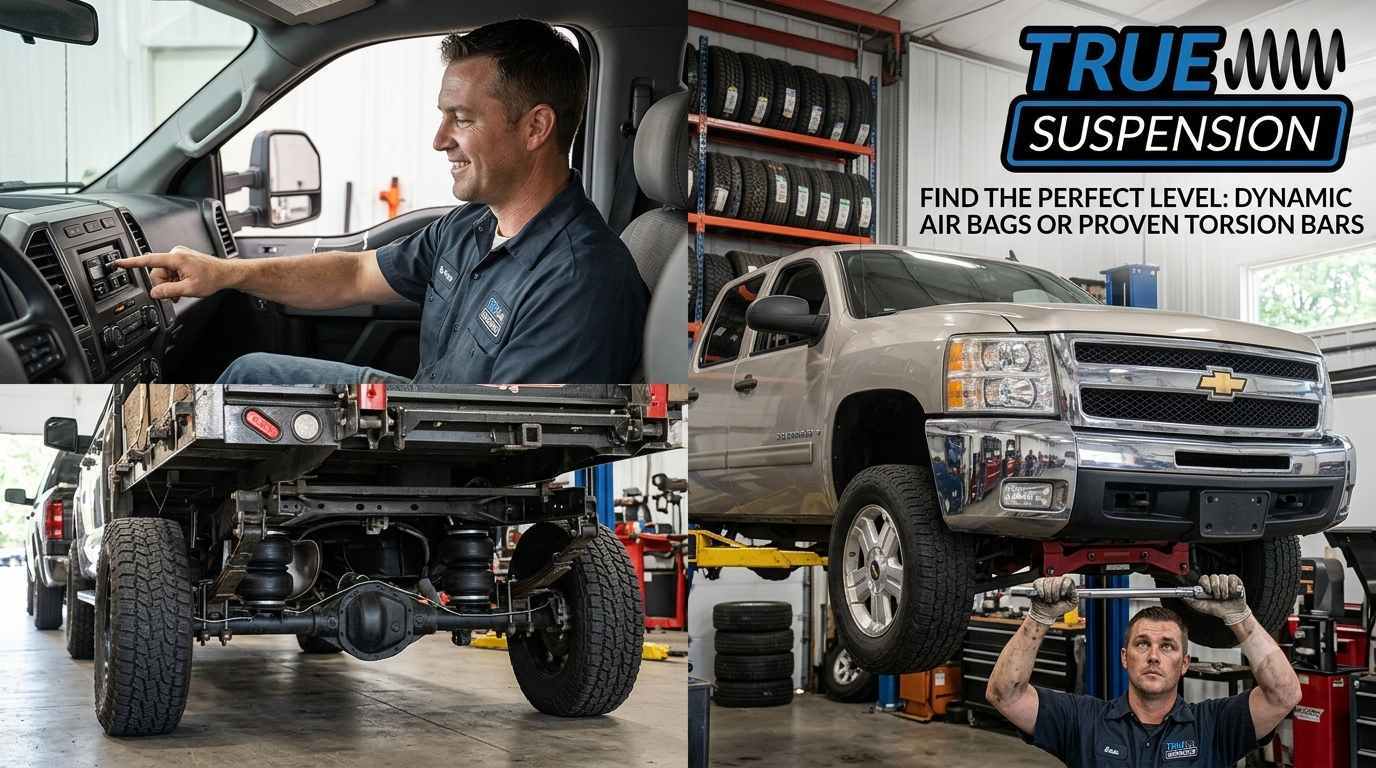
Here is a snapshot of some of our most popular air bags vs. torsion bars relevant kits across common truck platforms:
|
Truck |
Kit Type |
Link |
|
Toyota Tundra 07–21 (4WD) |
Air Ride In-Cab, No Tank |
|
|
Ford F-250 17–21 (4WD) |
Air Ride with Management |
|
|
Chevy Silverado 07–18 (2WD) |
In-Cab Tankless Air Ride |
|
|
Dodge Ram 2500 (4WD) 14–19 |
Coil Spring Air Ride |
|
|
GMC Sierra 2500 11–16 |
Towing Assist Air Ride |
|
|
Chevy/GMC 2500 HD (Torsion) |
1–3 Torsion Key Front Lift |
|
|
Ford F-350 (4WD) 17–21 |
Air Ride with Management |
The Cost Breakdown, What You Actually Pay
Cost is one of the biggest factors in the air bags vs. torsion bars decision. Here is a realistic breakdown of what each system costs at different levels:
Torsion Bar Cost Tiers
|
Tier |
What You Get |
Estimated Cost |
|
Basic torsion keys only |
Pair of adjustable torsion keys |
$80–$150 |
|
Keys + lift blocks |
Front level + rear lift block |
$150–$300 |
|
Full kit with shocks |
Keys, blocks, Pro Comp shocks |
$250–$450 |
Air Bag Suspension Cost Tiers
|
Tier |
What You Get |
Estimated Cost |
|
Basic air helper kit |
Air springs, brackets, manual valve |
$300–$500 |
|
In-cab control kit |
Springs, lines, in-cab dual switch |
$500–$800 |
|
Complete management system |
Full FBSS/4-corner with gauge |
$800–$1,500+ |
The True Suspension advantage is that we do not charge hidden fees for hardware. Everything listed in our product descriptions is included in the box.
How Hard Is Each System to Install?
Most experienced DIY mechanics can complete a torsion key swap in 2–4 hours. You need basic hand tools, a floor jack, jack stands, and a torque wrench. The hardest part is safely lowering and removing the factory torsion bar keys without damaging the crossmember.
True Suspension includes detailed installation guidance with every kit. Our adjustable torsion key kits for Chevy/GMC 1500 trucks are consistently praised for clean fitment right out of the box.
Air Bag Suspension, Difficulty Moderate
A rear air bag helper kit typically takes 3–6 hours for a confident DIY installer. You need to route air lines from the rear axle area to the cab or a valve location. The mechanical work is straightforward. The line routing is the part that takes patience.
Our universal towing assist air ride control systems come with pre-assembled control panels that minimize wiring and plumbing complexity. Many customers complete the install in an afternoon.
Air Ride Beyond Trucks, Classic Cars and More
The air ride suspension conversation extends beyond pickup trucks. True Suspension also supplies complete air ride kits for classic cars, vans, and SUVs.
If you are building a show car or daily driver with a slammed or lowered stance, check out our classic car air ride options. We carry systems for the 1958–1964 Chevrolet Bel Air, 1965–1970 Impala, and more.
For context on how air ride transforms the classic car world, see our blog on the top 10 classic cars on air ride that look incredible. It is a great read for anyone curious about what modern airbag systems can do for vintage metal.
The blog on air ride suspension vs. coilovers for classic cars is equally worth reading if you are deciding between adjustable suspensions for a restoration project.
Air Bags vs. Torsion Bars
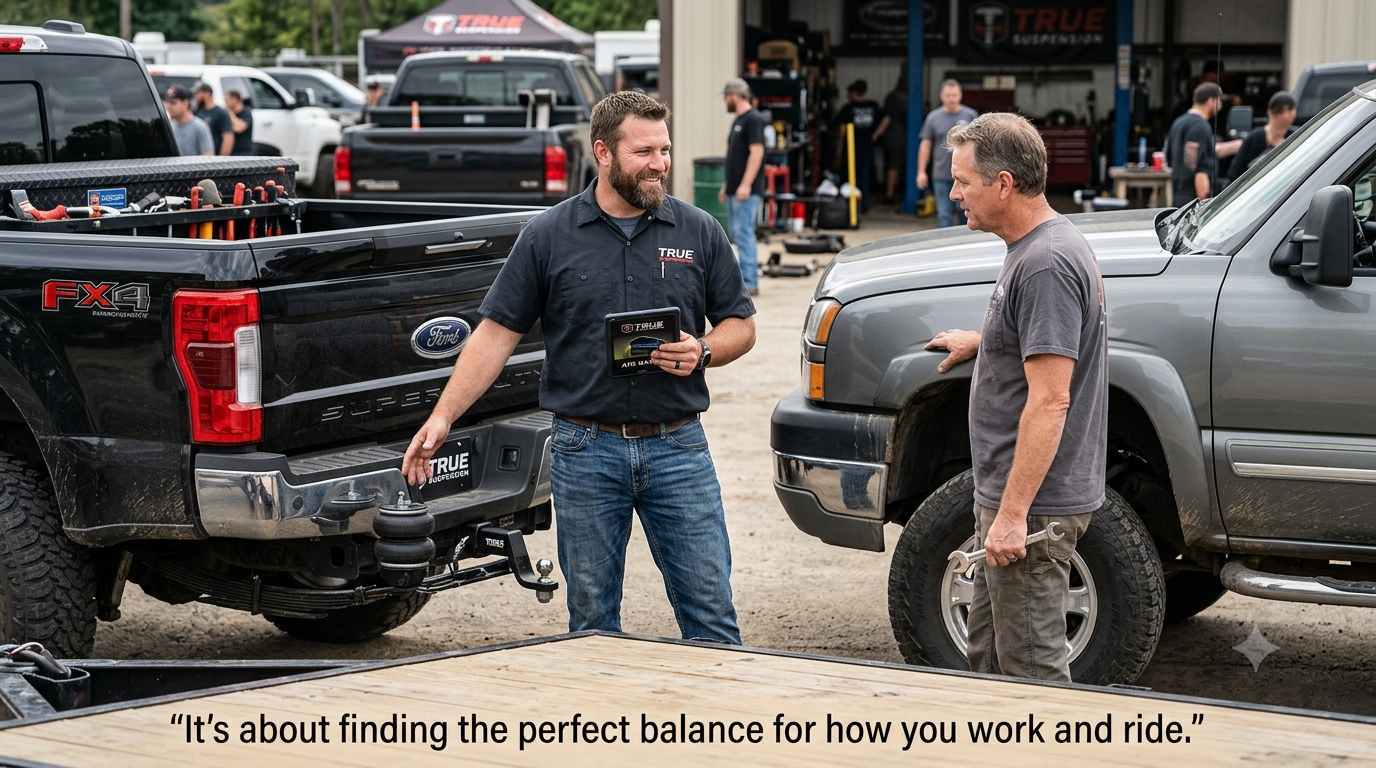
Here is the honest summary:
Choose torsion bars if:
- You have a compatible 4WD truck
- You want a simple, affordable front level
- You do not tow or haul heavy loads
- You want long-term, low-maintenance leveling
Choose air bags if:
- You tow or haul heavy loads regularly
- You want on-demand, in-cab adjustability
- You want to eliminate rear sag under load
- You are willing to invest in a complete, capable system
For most working truck owners, air bag suspension delivers a clear performance edge. The adjustability alone makes it worth the investment. For light-duty leveling on a budget, torsion bar kits remain a smart and practical solution.
True Suspension has the right kit for both paths. Our product engineers, detailed fitment guides, and broad catalog make us the go-to source for truck owners who want the right system installed right the first time.
Conclusion
The air bags vs. torsion bars debate does not have one single answer; it has two good ones, depending on your truck and your needs. Torsion bars are simple, affordable, and proven. Air bag suspension systems are dynamic, powerful, and built for the demands of modern truck ownership.
At True Suspension, we are proud to offer both solutions, backed by expert fitment matching and complete kit packaging that makes installation straightforward. We are not here to push a product; we are here to help you find the right one.
Browse our full catalog at TrueSuspension.com and find the kit that fits your truck, your load, and your lifestyle.
Frequently Asked Questions
- What is the main difference between air bags and torsion bars for truck leveling?
Torsion bars provide a fixed front-end level using a steel rod and key adjustment. Air bags are inflatable rear suspension aids that adjust pressure on demand, ideal for towing and hauling. Both level your truck, but differently.
- Can I use both air bags and torsion bar leveling on the same truck?
Yes. Many truck owners combine a front torsion key lift with a rear air bag helper system. This gives you a level stance front to rear and dynamic rear support under load. True Suspension sells kits compatible with this combination.
- Are air bag suspension kits hard to install on a pickup truck?
Most True Suspension air bag kits are bolt-on designs installable in 3–6 hours with basic hand tools. No cutting or welding is required. In-cab control kits take slightly longer due to line routing but remain DIY-friendly.
- Do air bag helper kits replace my factory leaf springs?
No. Air bag helper kits work alongside your existing leaf springs. The bags sit inside or beside the leaf pack and supplement load support. Your factory springs stay in place, preserving OEM durability and ride baseline.
- Which system is better for towing a heavy trailer, air bags or torsion bars?
Air bag suspension is significantly better for towing. It eliminates rear sag, keeps the truck level under tongue weight, and lets you adjust pressure instantly. Torsion bars only address the front end and offer no towing-specific support.