
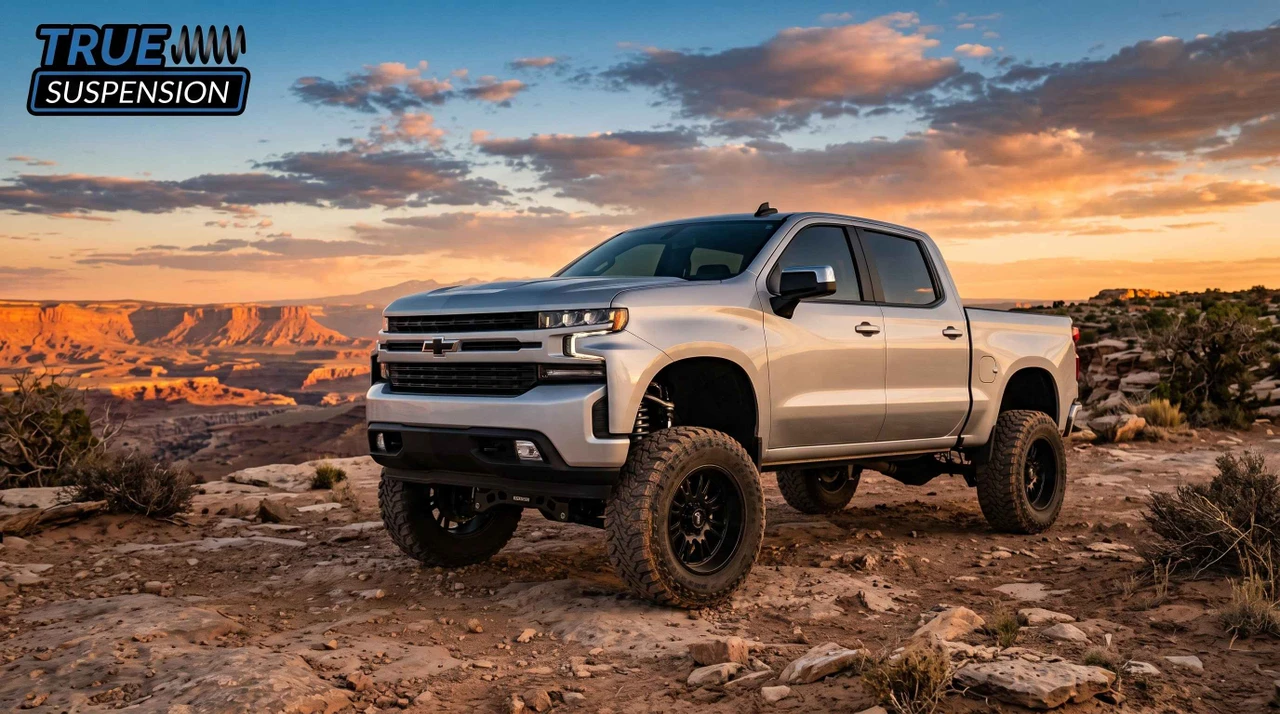
How to Lift Your Truck? Choosing the Right Lift with a Truck Leveling Kit or Lift Kit
A truck leveling kit is the simplest suspension modification most truck owners ever make, and for good reason. A factory pickup truck leaves the assembly line with a nose-down stance called rake, so the rear sits higher to handle payload. A leveling kit raises the front to match the rear, giving the truck a level stance, extra tire clearance, and room for slightly larger tires without a full suspension lift.
Truck enthusiasts often start here because the job is affordable, the parts are simple, and the change in factory ride feel is minimal. If you only want a tougher look and a bit more ground clearance, a truck leveling kit may be all you ever need. If you want serious off-road ability and much bigger rubber, you will want to step up to a complete lift kit.
What a Truck Leveling Kit Does: A Small Lift for Your Truck's Suspension
A leveling kit is a small lift for the front of your truck's suspension. Most kits use a spacer that sits on top of the front strut or coil spring, and the use of spacers is what makes these kits so affordable and easy to install. Other designs use adjustable torsion keys or replacement coil springs, but the goal is always the same: bring the front ride height up to match the rear.
Here is what changes when you level a truck:
Pros
- Levels the nose-down factory rake for a tougher, even stance
- Adds tire clearance for bigger tires, usually one size up from stock
- Keeps most of the factory ride comfort, since factory suspension components stay in place
- Costs far less than a full suspension lift kit
- Simple bolt-on parts with no cutting or welding
Cons
- Only raises the front, so total ground clearance gains are modest
- Very tall spacers can strain ball joints and CV angles
- Does not transform off-road ability the way a full lift does
Compared with stock height, even a 2-inch level makes your truck look and feel completely different. It is the classic first modification because it delivers visible results with minimal risk, and the aftermarket offers a leveling option for nearly every make and model on the road.
TrueSuspension's catalog is built around exactly these bolt-on parts, so you can shop by your specific truck and get hardware that fits the first time.
Shop TrueSuspension: 2-inch front coil-spring spacer leveling kit for the classic C10 ·
From the blog, lift kits vs. leveling kits: what every truck owner must know
Leveling Kit vs Suspension Lift Kit, Lift Height and Off-Road Differences
The terms get mixed up constantly, so here is the clean distinction. A leveling kit only raises the front of the truck to eliminate rake. A suspension lift raises the whole vehicle by replacing or extending suspension system parts, and a suspension lift kit typically includes taller springs, longer shocks, and corrected steering and driveline geometry.
A truck leveling kit gives you roughly 1 to 2.5 inches of lift in the front only. A suspension lift kit gives you 3 to 6 inches or more at all four corners, with new control arm geometry, an extended track bar, longer springs and shocks, and every bracket needed to keep alignment angles sane.
That is why suspension parts quality matters so much in a real lift kit: the taller you go, the more of the suspension you are re-engineering.
|
Leveling kit |
Suspension lift kit |
Body lift kit |
|
|
Typical lift height |
1–2.5 in (front only) |
3–6+ in (all corners) |
1–3 in (body only) |
|
What changes |
Front stance |
Full suspension geometry |
Body position on frame |
|
Off-road gain |
Small |
Large |
Minimal |
|
Typical kit price |
100–300 |
400–2,500+ |
150–400 |
|
Best for |
Looks + slightly larger tires |
Clearance + big tires + trails |
Looks on a budget |
If your goal is a level stance and one tire size up, the leveling route wins on price and simplicity. If your goal is real trail capability, only a suspension lift delivers the clearance and articulation you need.
Some full kits even replace the strut with a taller coilover assembly for better damping control, which is worth knowing when you compare kit contents side by side.
Shop TrueSuspension: complete 3-inch front / 2-inch rear F-150 lift kit with Pro Comp ES9000 shocks ·
From the blog: 10 lift kit myths debunked
Choosing the Right Lift, Match Lift Height to Your Tire Size
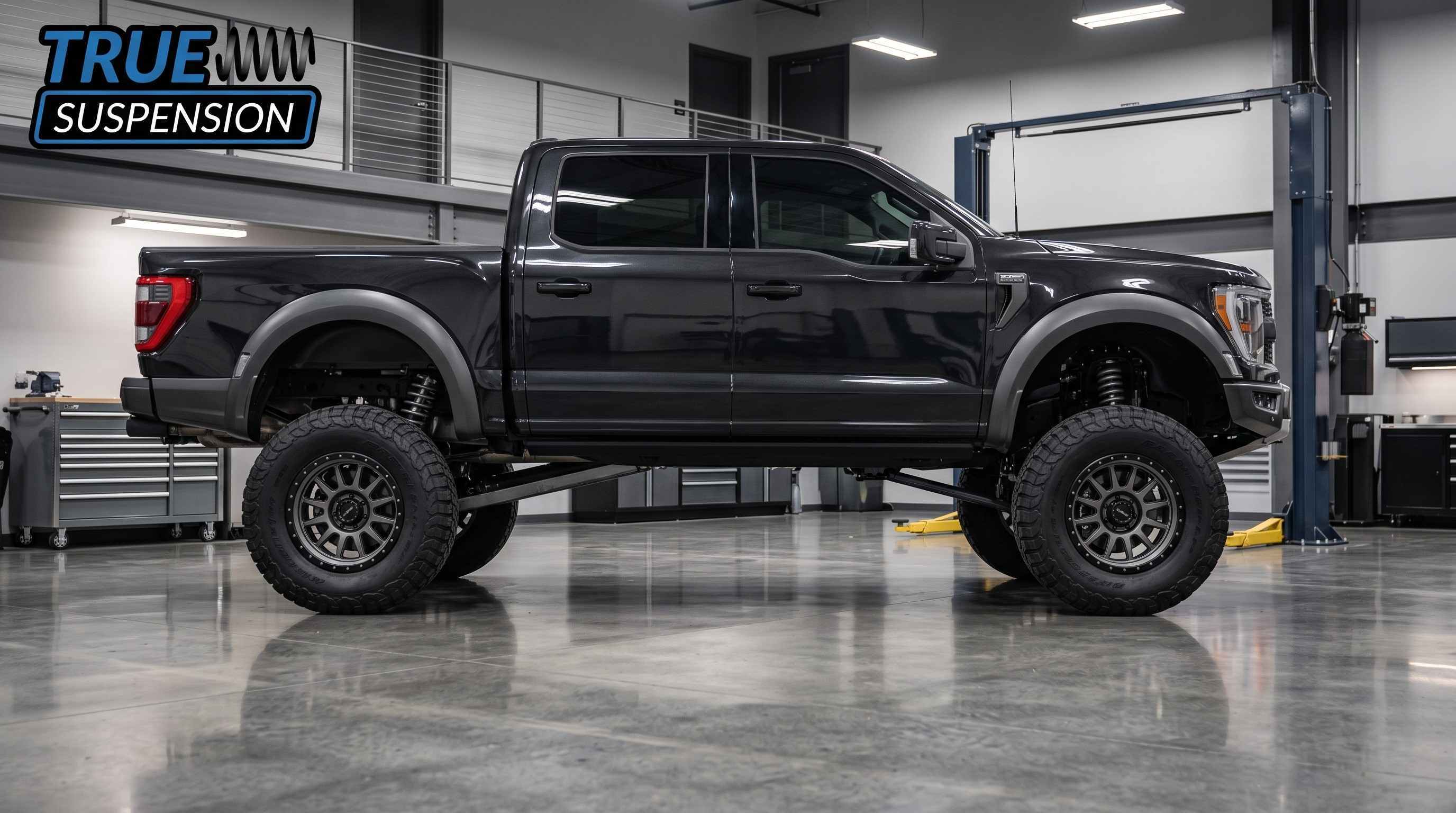
Choosing the right lift starts with an honest question: what tire size do you actually want to run? The tire dictates the lift height, not the other way around. Pick the rubber first, then buy only as much lift as you need to clear it.
As a rule of thumb, truck builders work from pairings like these:
|
Desired tire size |
Typical lift height needed |
|
33-inch all-terrains |
Leveling kit (1–2.5 in front) |
|
35-inch all-terrains |
3–4 in suspension lift |
|
37-inch mud-terrains |
6 in suspension lift |
These are typical ranges, not guarantees, because every make and model has different wheel wells, offsets, and bumper shapes. Always check the front and rear clearance at full steering lock and full suspension compression before committing. Your wheel and tire combination matters as much as diameter: a wide tire and wheel package with aggressive offset needs more room than a narrow one of the same height.
A truck leveling kit is the sweet spot when your dream setup is one size above stock. Going two sizes up means stepping into suspension lift territory, with the taller springs, longer shocks, and geometry correction that a real lift kit provides. TrueSuspension lists each kit with its intended lift height and application, so choosing the right lift is a matter of matching their listings to your tire size goal.
Shop TrueSuspension: 3-inch front / 1.5-inch rear Ram 1500 lift kit with Pro Comp ES9000 shocks ·
From the blog: choosing the right lift kit for F-150 vs. Ram vs. Silverado
Tire Clearance and Bigger Tires After You Lift Your Truck
Tire clearance is the whole point of lifting. When you lift your truck, the added height creates room in the wheel wells for bigger tires, and bigger tires are what actually raise your differentials and improve off-road capability. Remember: the lift raises the body, but only taller rubber raises the axles.
A leveled truck usually clears one tire size above stock with no trimming. A 3-inch lift typically clears 35s, and a 6-inch lift opens the door to 37s. For many daily drivers, a truck leveling kit delivers exactly the tire clearance they want without paying for a full suspension lift. Along the way y, you also gain better approach and departure angles, which are the angles at which the truck can climb or descend without scraping the bumpers. That single change transforms how confidently a lifted truck tackles ledges, ruts, and steep trail entries.
Watch tire wear after any height change. Altered suspension geometry changes camber and toe, and even small misalignments chew through expensive rubber fast. A professional alignment immediately after the install protects your investment and keeps the truck tracking straight. If you notice uneven tire wear a few thousand miles later, get the alignment rechecked before it costs you a set of tires.
Shop TrueSuspension: 3-inch front / 2-inch rear Silverado/Sierra lift kit with Pro Comp shocks ·
From the blog: the 10 trucks that benefit most from a lift kit
Truck Leveling Kit Installation: What Kit Installation Involves
Kit installation for a leveling kit is one of the friendliest jobs in the aftermarket. The installation of a lift kit at this level usually means supporting the truck, unbolting the front struts, sliding the spacer on top, and reassembling everything with the included hardware. Most competent home mechanics finish the installation process in an afternoon with basic hand tools.
A few honest notes before you start:
- The job is bolt-on. No cutting and no weld work are required for a typical spacer or torsion-key kit, which is exactly why TrueSuspension focuses on bolt-on heavy-duty hardware.
- You will need a spring compressor for strut-style kits. Respect the tool; compressed springs store serious energy.
- Get an alignment immediately afterward. Skipping it is the most common cause of improper installation complaints, and it is completely avoidable.
- Taller kits may need longer shocks, extended brake lines, or a dropped control arm bracket. Read the kit contents before you buy.
Professional installation is the smart call if you lack tools, time, or confidence. A shop charges for labor, but the work is done right, the alignment is included, and your warranty position stays clean. TrueSuspension is a parts specialist, so you buy the kit from their Scottsdale team and have it installed by your trusted local shop. Either way, a truck leveling kit install is straightforward enough that most owners are driving their leveled truck the same day.
Shop TrueSuspension: 4-inch torsion-key lift kit for the 1988–98 K1500 ·
From the blog: 10 questions to ask before buying a lift kit
Off-Road Capability: How a Lifted Truck Handles Off-Road Use?
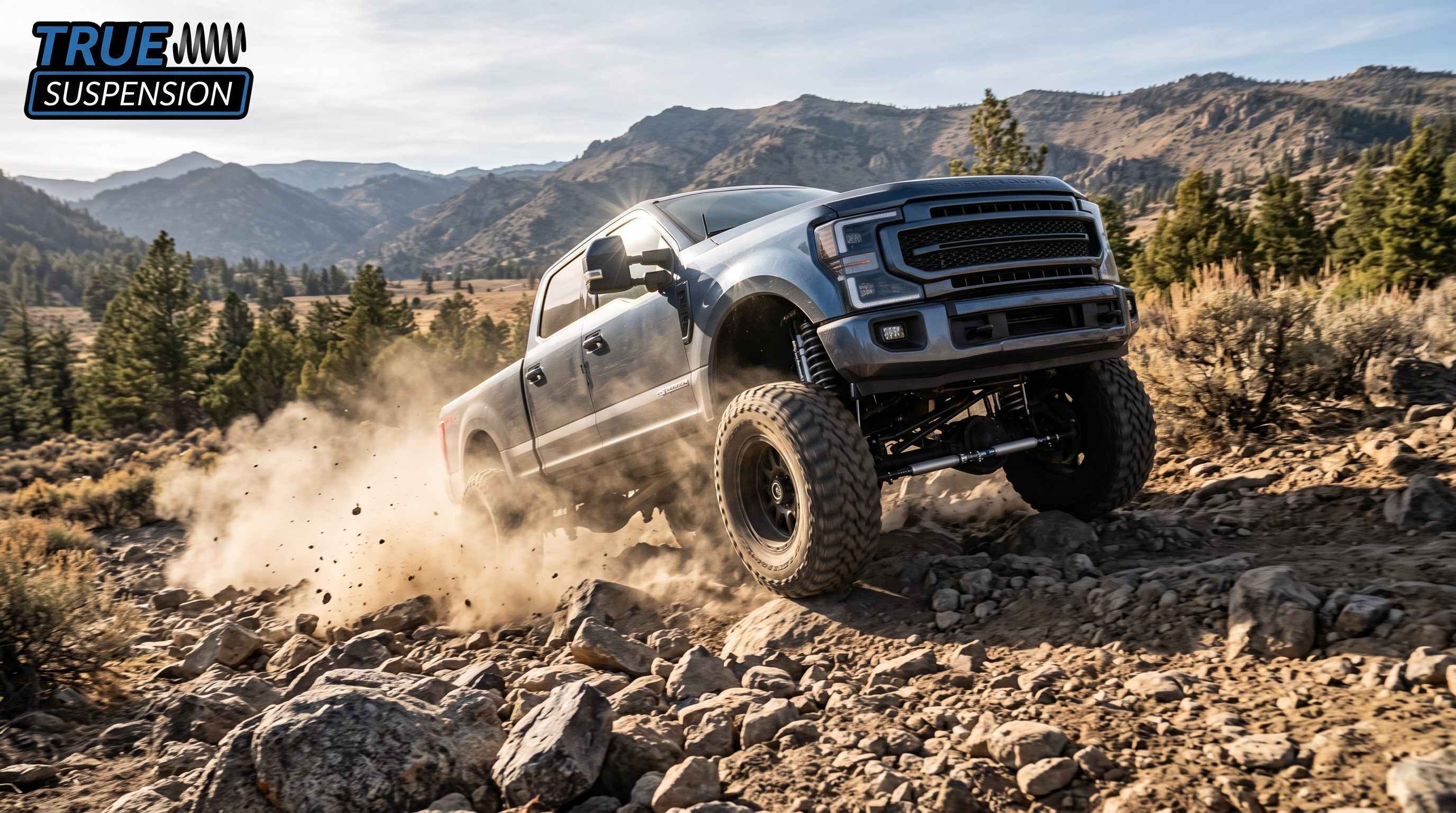
A lifted truck earns its keep the moment the pavement ends. Real off-road capability comes from three things the lift provides: ground clearance for the chassis, room for taller tires that raise the axles, and suspension travel that keeps rubber on the ground over uneven terrain. Off-road use punishes weak parts, so this is where kit quality shows.
Off-road enthusiasts will tell you that off-road performance is about the complete system, not just height. For weekend trail rigs, a truck leveling kit is often just the starting point before owners graduate to taller suspension lift kits with longer-travel shocks. Longer-travel shocks, corrected steering geometry, and proper bump stops matter as much as the inches of lift. A tall truck on stock shocks rides worse and articulates less than a moderately lifted truck with quality dampers and full-travel suspension components.
Your driving experience changes in daily traffic too. A lifted truck has a higher center of gravity, so cornering feels different and crosswinds push harder. Quality off-road equipment, matched springs and shocks, and a careful alignment keep the truck composed. That is why seasoned builders buy complete kits from specialists like TrueSuspension instead of stacking random spacers: every part in the box was chosen to work together at the advertised height.
Shop TrueSuspension: 2-inch Wrangler JK lift kit with Pro Comp ES9000 shocks
From the blog: 10 suspension upgrades that improve towing safety
Suspension Lift vs Body Lift Kit: Which Lift Kit Suits Your Truck?
A body lift kit takes a completely different approach from a suspension lift. Instead of changing the suspension, a body lift unbolts the cab and bed from the frame and inserts spacers between the body mounts and the chassis. The truck looks taller and clears bigger tires, but the frame, axles, and suspension stay exactly at stock height.
That distinction decides everything:
- Suspension lift: raises everything, improves real ground clearance and off-road capability, costs more, changes ride quality and handling.
- Body lift: raises only the body, adds tire clearance for looks, leaves a visible gap between body and frame, keeps the factory ride untouched.
For a daily-driven truck where looks are the priority, a body lift kit is a legitimate budget move. If the choice comes down to a truck leveling kit or a body lift kit, pick the leveling kit for better handling and the body lift for maximum tire size per dollar. For a truck that works hard or plays hard, a suspension lift is the honest answer, because only it moves the suspension and drivetrain away from the ground.
Lift kits in TrueSuspension's catalog focus on the suspension side of that equation, with complete kits that include the shocks, spacers, and hardware a real lift demands.
Shop TrueSuspension: complete 3-inch Frontier lift kit with Pro Comp ES9000 shocks
From the blog: 10 mistakes people make when lowering their truck
Lift Kit Brands and Choosing the Right Lift for Your Budget
Lift kit brands matter because a lift is only as good as its weakest bracket. When you are choosing the right lift for your money, compare what is actually in the box: spacers versus full spring packs, generic shocks versus name-brand dampers, and whether steering and driveline correction parts are included or sold separately.
Brands like Bilstein set the benchmark that the whole aftermarket is judged against, and TrueSuspension builds its kits around proven damper pairings like Pro Comp ES9000 nitrogen-charged shocks and TS Nitro Control shocks. That is the practical way to read any kit listing: quality shocks and complete hardware separate a kit you will love from one you will replace.
A few budget truths worth remembering:
- A lift kit may look complete in photos but skip the shock upgrades. Check the parts list.
- Lift kits offer wildly different values at the same price. Compare bracket thickness, hardware grade, and shock specs, not just the advertised height.
- Lift kits raise the truck, but only complete kits preserve alignment geometry. Cheap kits cost more later in tires and alignments.
- The price of the kit is only half the story. Budget for alignment, and possibly gears or calibration, on taller builds.
Whether your rig is a truck or SUV, buy from a specialist that lives and breathes suspension. Most owners begin with a truck leveling kit, then upgrade shocks and tires as their needs grow. TrueSuspension's team in Scottsdale deals in lift kit hardware all day, so their listings tell you exactly which truck each kit fits and what is in the box. That clarity is what makes choosing the right lift a confident decision instead of a gamble, and it is how a smart modification starts.
Shop TrueSuspension: complete 3-inch F-150 lift kit with TS Nitro Control shocks
From the blog: air bags vs. torsion bars for truck leveling
Ride Quality, Fuel Economy, and Tire Wear After a Suspension Lift
Every lift is a trade, so go in with open eyes. Ride quality after a small level barely changes, because the factory springs and shock absorbers keep doing their job. That is one reason a truck leveling kit is so popular: it preserves the springs and shocks your truck was tuned with. Taller lifts change spring rates and shock angles, which firms up the driving experience and can introduce new vibrations if the driveline angles are not corrected.
Fuel economy takes a hit for two reasons: the truck punches a bigger hole in the air, and larger tires are heavier and effectively re-gear the axles taller. Expect a noticeable drop at highway speeds, especially with aggressive mud-terrains. It is the price of the look and the capability, and an honest builder's budget for it.
Tire wear is the silent budget killer. Any height change alters alignment geometry, and improper installation or a skipped alignment will feather expensive rubber in a few thousand miles. The fix is simple: align immediately after the install, recheck it after the suspension settles, and rotate on schedule. Pair that discipline with quality shock absorbers that control the heavier tire and wheel package, and your truck will ride straight and true for years. To make your truck feel as good as it looks, never treat the alignment as optional.
Shop TrueSuspension: adjustable rear lift shackle leveling kit for the 1996–04 Tacoma
From the blog: how to maintain factory ride quality after installing a lift kit
What a Truck Leveling Kit Costs, Kit Price and Professional Installation
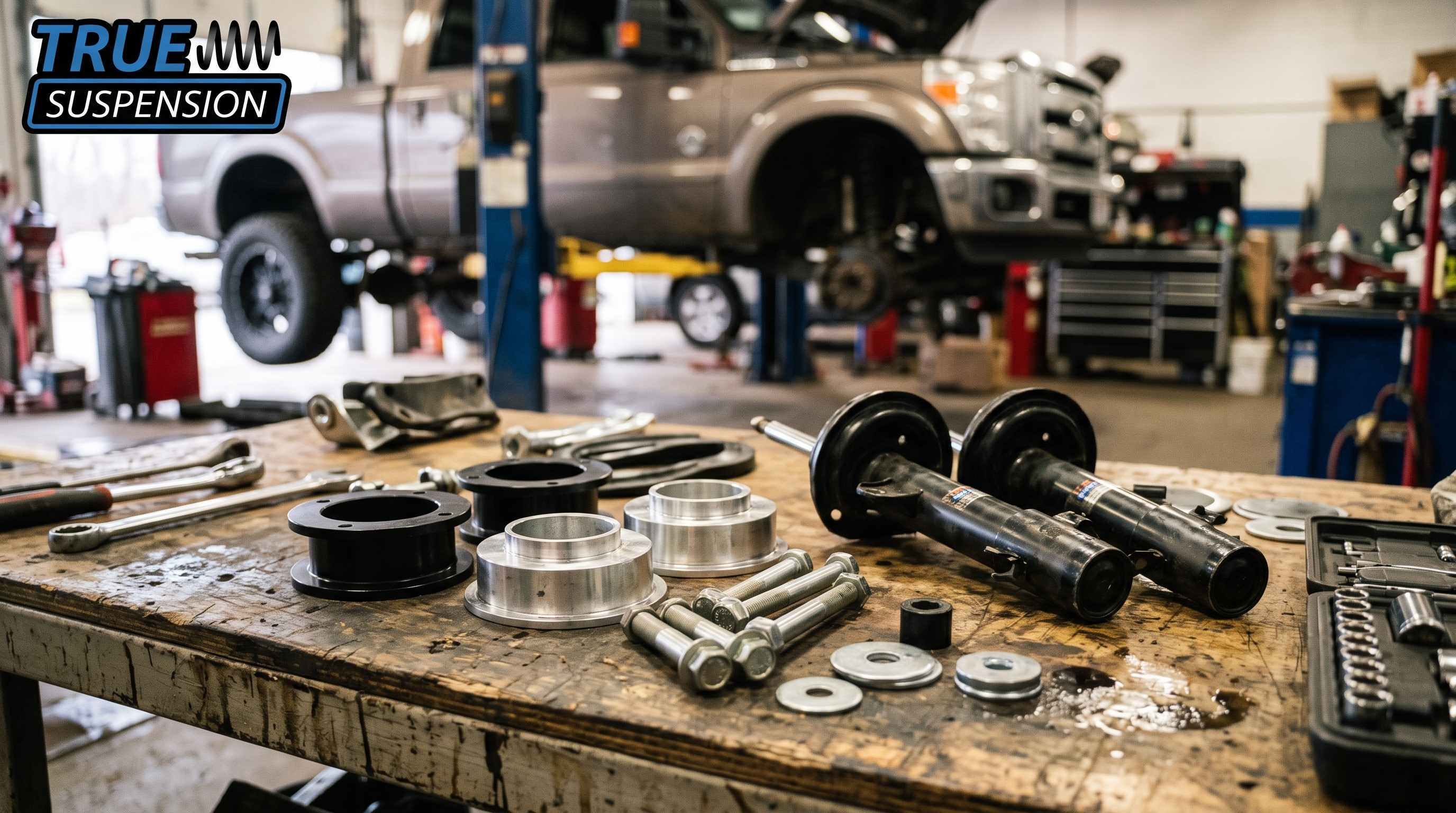
The price of the kit depends on how much lift you are buying. A basic truck leveling kit with front spacers typically runs 100–300. A complete 3-inch suspension lift kit with shocks usually lands between $400 and $1,200, while tall 6-inch systems with full geometry correction can pass $2,500 before labor.
|
Kit type |
Typical kit price |
Typical professional installation labor |
|
Front leveling kit |
100–300 |
300–500 |
|
3–4 in suspension lift kit |
400–1,200 |
500–1,000 |
|
6 in full suspension lift kit |
1,500–2,500+ |
1,000–2,000+ |
|
Body lift kit |
150–400 |
400–800 |
These are typical market ranges, not quotes, and they move with the make and model of your truck. Heavy-duty diesels and newer trucks with complex driver-assist sensors often cost more to lift correctly. If you tow regularly, budget for helper air bags or a tow-assist setup on top of the lift, because a tall truck with a loaded trailer needs the extra support to stay level and safe.
Buy the parts from a specialist and the labor from a shop you trust. TrueSuspension's Scottsdale team stocks the kits, the replacement shocks, and the hardware for thousands of applications, so the price of the kit you see is the price of parts that actually fit. Add professional installation and an alignment, and you will know the full cost before a single wrench turns.
Shop TrueSuspension: 4-inch torsion-key lift kit for the 1999–06 Silverado/Sierra 1500
From the blog: tow-assist air bag kits: the ultimate guide
Conclusion
A truck leveling kit remains the smartest first modification for most truck owners: it levels the stance, adds useful tire clearance, and keeps the factory ride you paid for. When your ambitions grow to serious trails and much larger tires, step up to a complete suspension lift kit with quality shocks and full geometry correction. Either way, buy proven parts, align immediately, and enjoy the truck you always wanted.
FAQs
What does a truck leveling kit do?
It raises the front of your truck to match the rear, removing factory rake. That gives a level stance, better tire clearance, and room for slightly larger tires.
How much does a leveling kit cost?
A basic spacer kit costs 100–300; full suspension lift kits run 400–2,500+. Professional installation usually adds 300–1,000 depending on the kit.
Will a leveling kit hurt ride quality?
A small spacer leveling kit barely changes ride quality. Taller lifts can stiffen the ride, so match your kit to your driving needs.
Leveling kit vs lift kit, which should I choose?
Choose a leveling kit for looks and slightly bigger tires. Choose a full lift kit for serious off-road clearance and much larger tires.
Do I need an alignment after installing a leveling kit?
Yes. Any change to ride height alters suspension geometry, so get a professional alignment right after installation to prevent uneven tire wear.