
If you own a truck or SUV, you have probably heard a dozen opinions about lift kits. Some sound convincing. Most are flat-out wrong. Lift kit myths spread fast, especially online, and they cost truck owners real money. At True Suspension, we have helped thousands of drivers get the right setup. We know what works, what does not, and what is simply bad advice repeated too many times.
This guide busts the Top 10 Lift Kit Myths with facts, data, and clear reasoning. Whether you are planning your first lift or upgrading an existing setup, read this before you spend a single dollar.
Why Lift Kit Myths Are So Dangerous
Bad information leads to bad decisions. Truck owners who believe lift kit myths end up:
- Buying the wrong kit for their vehicle
- Voiding warranties unnecessarily
- Paying for repairs that proper installation would have prevented
- Missing out on performance gains they deserve
True Suspension exists to cut through the noise. Our kits are engineered for real trucks, real towing needs, and real roads. We do not sell guesswork. We sell results.
|
Problem Caused by Myths |
Real Cost to Truck Owners |
|
Wrong kit size |
$300–$800 in returns and reinstalls |
|
Skipping alignment after lift |
$150–$400 in early tire wear |
|
Assuming all lifts void warranty |
Missing out on legal upgrades |
|
Ignoring towing capacity changes |
Unsafe loads and accidents |
|
Buying cheap components |
$500–$2,000 in premature failures |
Myth #1, All Lift Kits Are the Same
This is one of the most common lift kit myths debunked by every serious suspension expert. Lift kits are not the same. They differ in design, materials, compatibility, and purpose.
There are three main types:
- Body lift kits raise the body off the frame using spacers
- Leveling kits correct front-to-rear rake, typically 1–3 inches
- Suspension lift kits raise the entire vehicle by modifying the suspension system
Each serves a different goal. A leveling kit on a Ford F-150 works very differently than a full suspension lift on a Dodge Ram 2500. Choosing the wrong type means poor performance, increased wear, and wasted money.
At True Suspension, every kit is designed specifically for your make, model, and year. Check our lift kits vs leveling kits guide to understand the real difference before you buy.
Key stat: According to industry data, over 40% of lift kit returns happen because buyers chose the wrong type, not because the product was defective.
Myth #2, Lifting Your Truck Always Voids the Warranty
This lift kit myth has scared off thousands of truck owners from upgrades they are fully entitled to make. The truth is more nuanced.
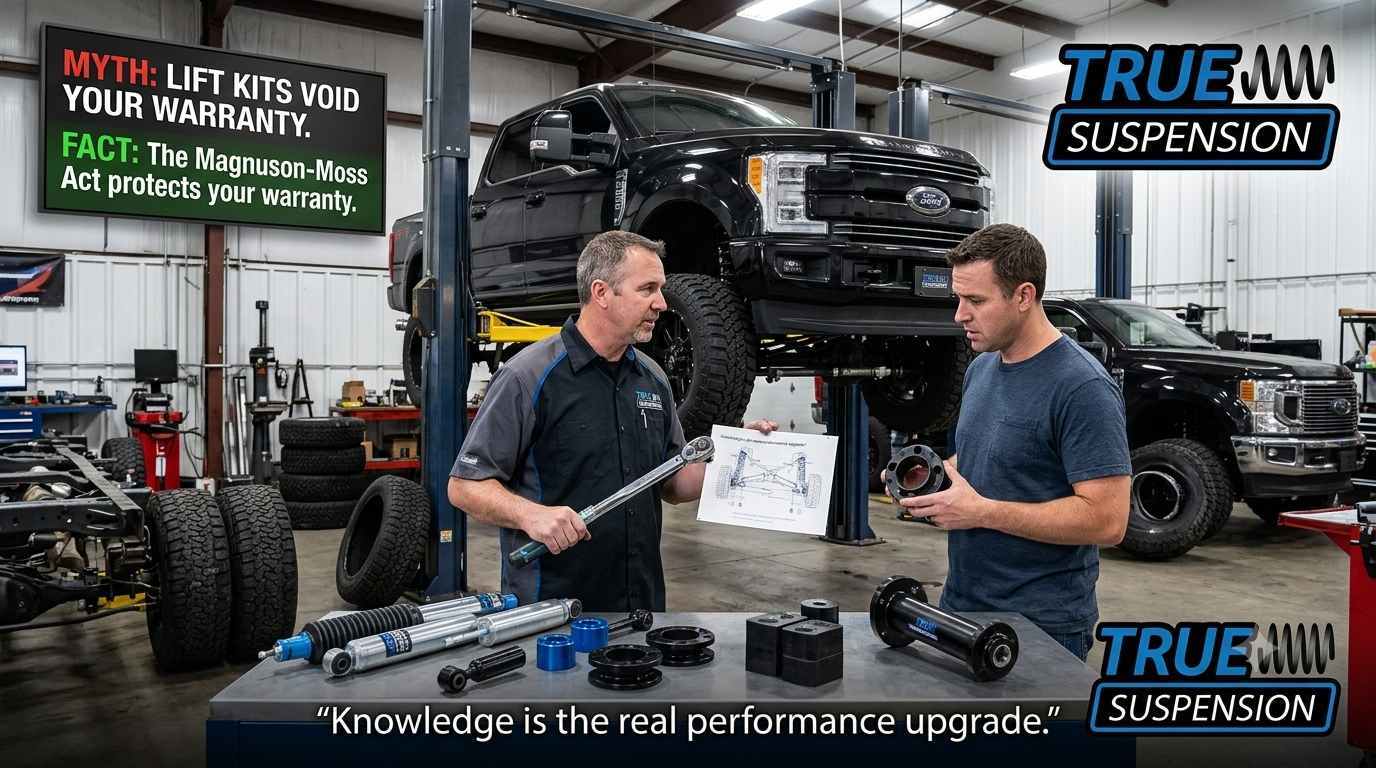
In the United States, the Magnuson-Moss Warranty Act protects consumers. A manufacturer cannot void your entire vehicle warranty simply because you added a lift kit. They can only deny warranty claims on parts that are directly damaged by the modification.
This means:
- Your engine warranty stays intact
- Your transmission warranty stays intact
- Only suspension-related warranty claims could be affected, and only if the lift caused the issue
True Suspension kits are designed to work within safe parameters. They are engineered to minimize stress on OEM components, so your other warranties remain protected.
Pro tip: Always document your installation with photos and keep your receipts. If a dealer tries to deny a warranty claim, you have evidence that the modification was done correctly.
Myth #3, A Bigger Lift Always Means Better Performance
More is not always more. This lift kit myth leads truck owners to over-lift their vehicles and ruin an otherwise capable setup.
Here is what actually happens with excessive lift height:
|
Lift Height |
Impact on Handling |
Impact on Towing |
Best For |
|
1–2 inch |
Minimal change |
No impact |
Leveling, slight clearance |
|
2–3 inch |
Slight increase in body roll |
Minor effect |
Light off-road, appearance |
|
4–6 inch |
Noticeable handling changes |
Requires tow assist kit |
Serious off-road |
|
6+ inch |
Significant center-of-gravity shift |
Requires full suspension overhaul |
Extreme off-road only |
A 2-inch lift on a Chevy Silverado 1500 often delivers better results than a 6-inch lift because it keeps the geometry closer to factory spec. You get the look you want without sacrificing drivability.
True Suspension carries lift options from 1 inch to full suspension overhauls. We help you pick the right height, not just the biggest one on the shelf.
Myth #4: You Do Not Need an Alignment After Installing a Lift Kit
This might be the most expensive lift kit myth you can believe. Skipping a post-install alignment is one of the top causes of early tire wear and handling problems after a lift.
When you raise a vehicle, the angles of your wheels change. Specifically:
- Camber, the vertical tilt of the tire
- Caster, the angle of the steering axis
- Toe, whether tires point inward or outward
Even a 1.5-inch leveling kit changes these angles enough to cause uneven tire wear within 5,000 miles if alignment is skipped.
True Suspension always recommends a 4-wheel alignment immediately after installation. This is not optional. It is a basic step that protects your investment.
Cost comparison:
- Alignment after install: ~$80–$150
- New set of tires from skipping alignment: $600–$1,200
The math is simple. Get the alignment done.
Myth #5, Lift Kits Ruin Ride Quality Forever
This lift kit myth has some truth buried in it, but only when kits are installed incorrectly or poor-quality components are used. A properly installed lift kit from a reputable brand does not have to ruin your ride.
In fact, True Suspension kits are engineered to maintain, and in many cases improve, ride quality. Our kits use:
- Pro Comp ES9000 nitrogen-charged shocks, designed for smooth performance after lift
- Polyurethane strut spacers, flexible and vibration-absorbing
- Forged and machined steel components, precision-made to reduce road harshness
Read our detailed guide on how to maintain factory ride quality after installing a lift kit to see exactly how this is done.
Pros and Cons of Lift Kits on Ride Quality:
|
Factor |
Cheap/Wrong Kit |
True Suspension Kit |
|
Road noise |
Increased |
Minimal change |
|
Body roll |
Increased |
Controlled |
|
Shock absorption |
Reduced |
Maintained or improved |
|
Highway comfort |
Degraded |
Near-factory or better |
|
Off-road performance |
Inconsistent |
Significantly improved |
Myth #6, You Can Install a Lift Kit With No Mechanical Experience
Lift kit myths debunked time and again by real-world installation disasters. Some truck owners assume installing a lift kit is like swapping an air filter. It is not.
A suspension lift involves:
- Removing and reassembling critical safety components
- Torquing fasteners to exact specifications
- Understanding vehicle geometry
- Managing compressed springs safely
- Routing brake lines correctly after height changes
That said, True Suspension kits come with thorough instructions and are designed to minimize complexity for experienced DIYers. Many of our customers install our leveling kits and block kits successfully at home.
Our honest guidance:
- Leveling kits and block kits, manageable for confident DIYers with the right tools
- Full suspension lift kits, strongly recommended to use a professional shop
- Air ride suspension kits, always use a qualified installer
The bottom line: know your limits. A $200 shop installation bill is far cheaper than a $2,000 mistake.
Myth #7, Lift Kits Hurt Towing Capacity
This is a lift kit myth that keeps truck owners from optimizing their rigs for actual work. The truth depends entirely on the type of kit and how it is installed.
A poorly matched lift kit can affect towing geometry and stability. But the right kit, specifically a towing assist air ride suspension kit, actually improves your towing performance.
True Suspension offers a full range of towing-specific air ride kits designed to:
- Prevent rear sag under heavy loads
- Maintain level vehicle stance while towing
- Improve braking stability with a trailer attached
- Reduce wear on rear suspension components
For example, our Toyota Tundra rear towing assist air ride suspension kit is built specifically to handle heavy trailer loads without sacrificing handling.
Similarly, our Ford F-250 towing assist kit gives Super Duty owners genuine hauling confidence.
Towing performance comparison,
|
Scenario |
Stock Suspension |
With True Suspension Tow Kit |
|
Rear sag under 5,000 lb load |
Significant |
Minimal to none |
|
Trailer sway risk |
Elevated |
Reduced |
|
Brake distance loaded |
Longer |
Shorter |
|
Driver confidence |
Reduced |
High |
Myth #8, All Lift Kits Work on Any Truck
This lift kit myth is spread by discount sellers who try to push "universal" kits as one-size-fits-all solutions. They are not.
Suspension geometry varies dramatically between:
- 2WD vs 4WD vehicles, different control arm angles and axle positions
- Coil spring vs leaf spring setups, require completely different components
- Independent front suspension vs solid front axle, different geometry and hardware
- Model year variations, even the same truck model changes significantly year to year
A Dodge Ram 2500 4WD from 2014 has different suspension geometry than a 2003 model. A kit designed for one will not fit the other properly.
True Suspension catalogs every kit by make, model, year, and drivetrain. We do not guess. Our Dodge 2500 4WD towing assist kit is built specifically for 2014–2019 models with coil spring rear suspension, not for every Dodge ever built.
Vehicle-specific fit matters because:
- Incorrect bracket placement creates binding and premature wear
- Wrong spring rates cause handling instability
- Mismatched shock lengths reduce travel and damage components
- Improper geometry causes uneven tire wear and alignment drift
Myth #9, Cheap Lift Kits Work Just as Well as Premium Ones
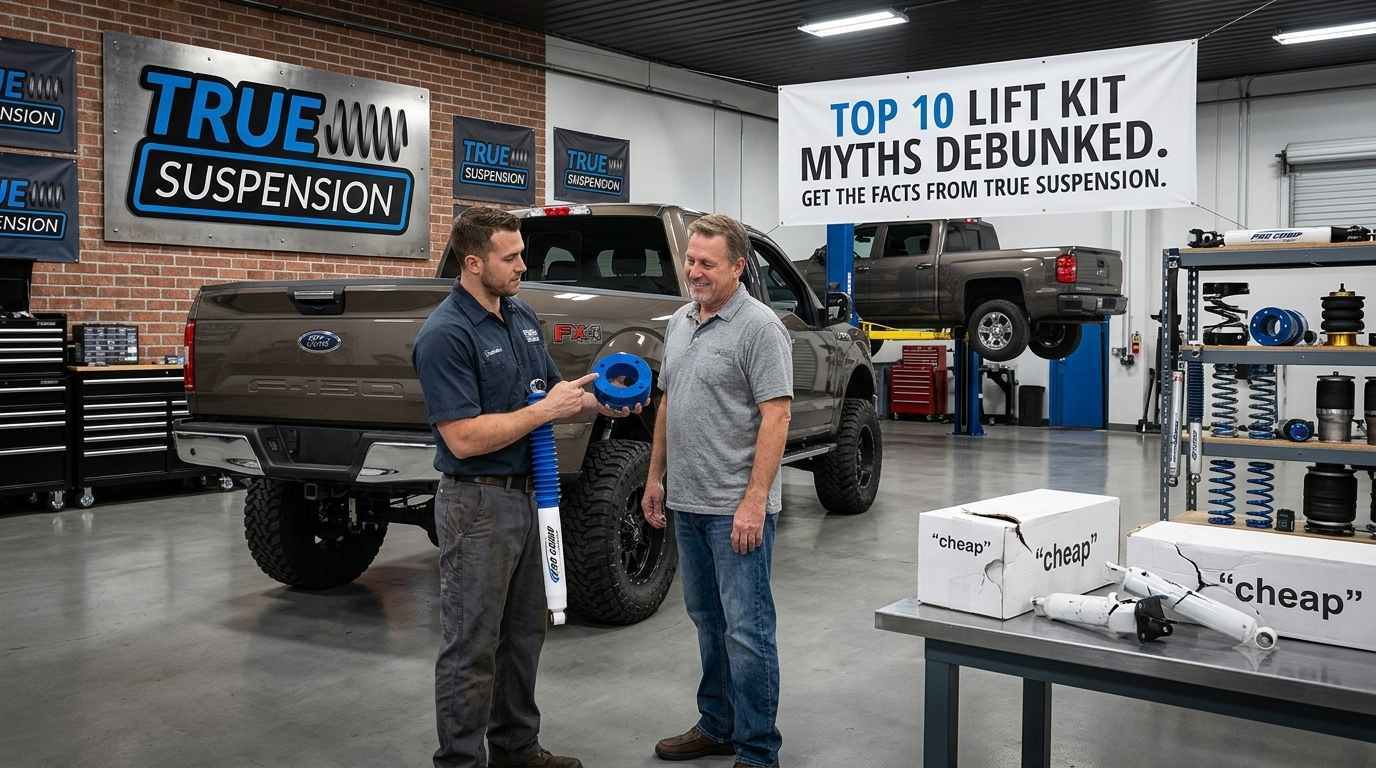
This lift kit myth is perhaps the most costly one to believe. Budget lift kits cut corners in materials, engineering, and quality control. The results show up within the first few thousand miles.
True Suspension uses premium materials and rigorous testing. Here is how our kits compare to budget alternatives:
|
Component |
Budget Kit |
True Suspension Kit |
|
Spacer material |
Low-grade plastic or cast aluminum |
Aircraft-grade polyurethane or billet aluminum |
|
Shocks |
Basic hydraulic, no gas charge |
Pro Comp ES9000 nitrogen-charged |
|
Hardware |
Standard grade bolts |
Grade 8 or equivalent, zinc-coated |
|
Engineering |
Generic design |
Vehicle-specific geometry |
|
Warranty |
Limited or none |
Backed by True Suspension |
|
Expected lifespan |
12–24 months |
5+ years with normal use |
The short-term savings of a cheap kit typically disappear within a year. You end up paying for:
- Premature shock replacement
- Spacer cracking or deforming
- Alignment drift from poor geometry
- Vibration damage to other components
True Suspension kits cost more upfront because they are built to last. Our customers do not come back complaining about failures; they come back for their next vehicle's kit.
Myth #10, Air Ride Suspension Is Only for Show Vehicles
This is one of the lift kit myths that frustrates us most at True Suspension. Air ride suspension is not just for lowriders and car shows. It is one of the most practical suspension technologies available for working trucks, daily drivers, and tow rigs.
Air ride suspension kits from True Suspension are designed for real-world performance:
- Towing assist, inflate to level the rear under heavy loads, deflate when empty
- On-road comfort, adjustable pressure means tunable ride quality for any surface
- Payload management, protect your suspension when hauling heavy cargo
- Long-term durability, reduces fatigue on factory leaf and coil springs
Read our full breakdown of air ride suspension vs coilovers to understand why air ride is a serious performance choice.
Our Chevy Silverado 1500 rear towing assist air ride kit is used by contractors, farmers, and fleet operators who need reliable load support every single day. This is not a show truck accessory. It is a work tool.
Air ride suspension by the numbers:
- Up to 5,000 lb of additional load support with proper air spring kits
- Pressure adjustable from 5 PSI to 100 PSI depending on load
- Average installation time: 3–5 hours for most truck applications
- Lifespan: 10+ years with basic maintenance on quality systems
Why We Know What We Are Talking About?
We are not a generic parts warehouse. True Suspension is a suspension specialist. Every product we carry is tested and validated for the vehicles it is listed on. Our catalog spans:
- Ford F-150, F-250, F-350, from leveling kits to full towing assist systems
- Chevy Silverado and GMC Sierra, 1500, 2500, and 3500 HD variants
- Dodge Ram 1500, 2500, and 3500, including coil spring and leaf spring configurations
- Toyota Tundra and Tacoma, purpose-built towing and lift solutions
- Nissan Frontier and Xterra, off-road focused lift kits
- Jeep Wrangler TJ and JK, complete lift systems for serious trail rigs
- Classic cars, air ride lowering systems for Ford, Chevy, and Cadillac platforms
We also produce educational content to help you make smart decisions. Our rubber block vs air ride comparison gives you the real-world breakdown that dealers will not.
Top 10 Lift Kit Myths at a Glance
|
# |
Myth |
Truth |
|
1 |
All lift kits are the same |
They differ massively by type, design, and fit |
|
2 |
Lifts always void your warranty |
Only affects directly modified components |
|
3 |
Bigger lift = better performance |
Optimal lift height depends on your use case |
|
4 |
No alignment needed after install |
Alignment is mandatory after any lift |
|
5 |
Lifts ruin ride quality forever |
Quality kits maintain or improve ride quality |
|
6 |
Anyone can install a lift kit |
Skill level matters; complex installs need pros |
|
7 |
Lifts hurt towing capacity |
Tow-specific kits improve towing performance |
|
8 |
Any kit fits any truck |
Vehicle-specific fit is critical for safety |
|
9 |
Cheap kits work as well as premium |
Budget kits fail faster and cost more over time |
|
10 |
Air ride is only for show trucks |
Air ride is a practical tool for work trucks |
What to Look for in a Quality Lift Kit?
Before you buy, check these five things:
- Vehicle compatibility: Is this kit made specifically for your year, make, model, and drivetrain?
- Material quality: Does it use billet aluminum, high-grade polyurethane, or forged steel?
- Shock quality: Are shocks included, and are they nitrogen-charged?
- Warranty and support: Does the brand back their product?
- Installation documentation: Are instructions clear and complete?
True Suspension scores well on all five. Our kits include hardware, shocks where applicable, and full instructions. Our catalog descriptions are detailed so you know exactly what you are getting before you order.
What Our Customers Say?
True Suspension kits are trusted by:
- Contractors hauling equipment daily
- Overlanders building capable rigs for long-distance travel
- Weekend off-roaders who need reliable trail performance
- Classic car enthusiasts upgrading to modern air ride comfort
- Fleet operators managing multiple vehicles across demanding routes
Our top 10 classic cars on air ride list shows you what these systems look like in the real world, and why so many enthusiasts trust air ride for performance, not just appearance.
Conclusion
Lift kit myths cost truck owners money, time, and sometimes safety. The Top 10 Lift Kit Myths we debunked in this guide are some of the most widespread and harmful ideas in the suspension world. Armed with the right information, you can make a smarter decision, get a better outcome, and enjoy your truck the way it was meant to be driven.
True Suspension is here to back you up at every step. We build kits for real trucks doing real work. Whether you need a simple leveling kit, a full suspension lift, or a towing assist air ride system, we have the right product for your vehicle and your use case.
Shop with confidence. Drive with confidence. That is the True Suspension promise.
Frequently Asked Questions
Q1: Will a lift kit affect my truck's fuel economy?
Yes, larger tires and increased aerodynamic drag from a lifted truck can reduce fuel economy by 1–3 MPG. A properly sized lift with stock tire width minimizes this effect considerably.
Q2: How long does it take to install a leveling kit?
Most leveling kits take 2–4 hours to install with basic tools. Full suspension lift kits can take 6–10 hours and may require professional installation for best results.
Q3: Can I install a lift kit on a leased truck?
Leasing agreements vary. Most leases prohibit permanent modifications. A leveling kit may be reversible, but confirm with your leasing company before making any changes to the vehicle.
Q4: Do I need new shocks when I install a lift kit?
For lifts over 2 inches, new shocks are strongly recommended. Stock shocks cannot travel correctly at raised heights, causing poor ride quality and accelerated wear on suspension components.
Q5: Are True Suspension kits compatible with aftermarket wheels?
Yes, in most cases. However, wheel offset and backspacing may need adjustment with larger lifts. We recommend confirming wheel fitment alongside your kit selection before ordering.