
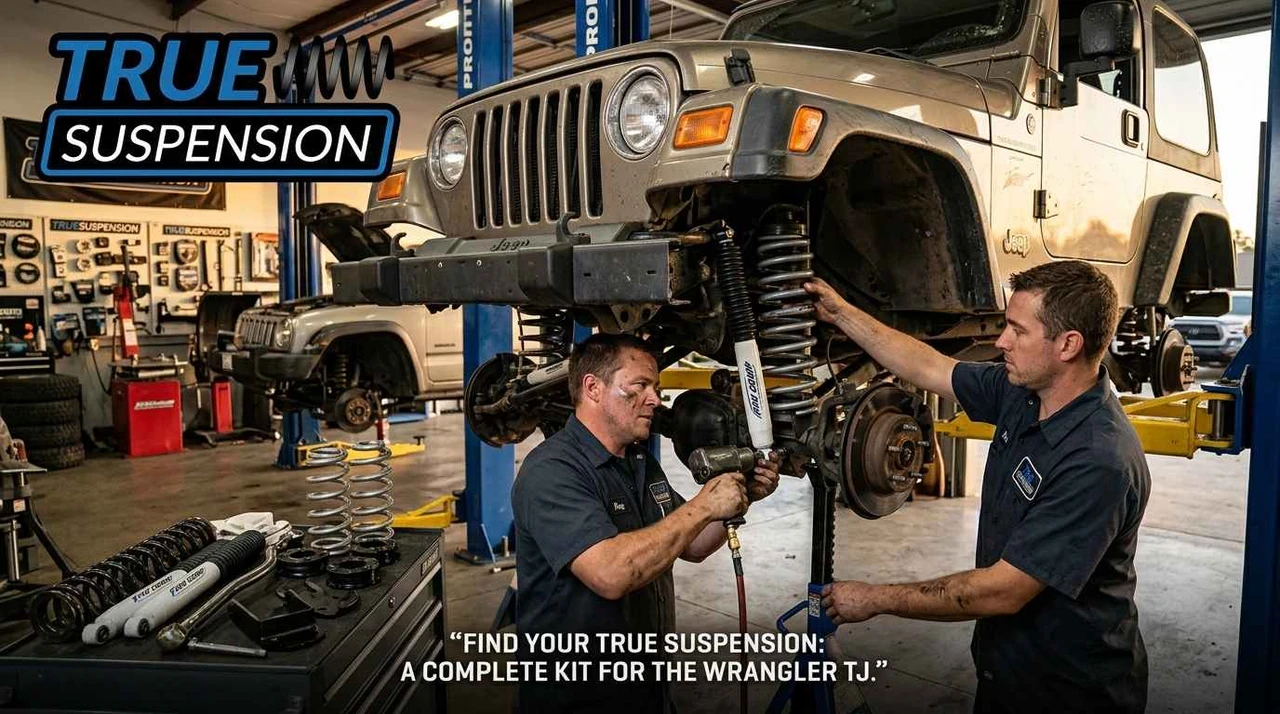
Most Jeep guides online throw together a quick list of lift sizes and call it done. That is not what you will find here. This guide breaks down every major Wrangler TJ lift decision you need to make, from spacer lift sizing and axle angle to CV axle stress, wheel alignment changes, and long-term suspension system performance. Whether you wheel hard on weekends or just want a cleaner stance on the street, the right lift makes all the difference.
At TrueSuspension, we have helped thousands of TJ owners choose the right kit. This guide reflects that real-world experience. Every recommendation here is backed by engineering knowledge and direct feedback from Jeep owners in the field.
Why Lift Height Matters More Than You Think on a TJ?
The 1997–2006 Jeep Wrangler TJ runs a solid front axle with coil spring suspension, one of the best factory off-road platforms ever built. But that solid axle design makes it sensitive to how you lift it.
A suspension lift on a TJ is not just about ground clearance. It changes your axle angle, affects your CV axle geometry, shifts your vehicle alignment, and can cause Subaru-style vibration issues if not managed properly. Yes, axle bind is a real concern on lifted TJs too.
Here are the key variables that change when you lift a TJ:
|
Lift Height |
Caster Change |
CV Axle Stress |
Alignment Correction Needed |
Driveshaft Concern |
|
2" |
Minimal |
Low |
Often none |
Low |
|
2.5" |
Moderate |
Medium |
Recommended |
Moderate |
|
3" |
Significant |
Higher |
Required |
Higher |
The table above is a simplified snapshot. Read every section below before you decide.
Understanding TJ Suspension Basics Before You Lift
The TJ uses coil spring suspension front and rear. This makes it far more lift-friendly than the earlier YJ leaf-spring setup. But it also means the suspension components work together as a system, change one thing and others shift.
Key automotive suspension components on the TJ include:
- Coil springs (front and rear), primary ride height determiners
- Control arms, upper and lower, they control axle travel and caster angle
- Track bar, keeps the axle centered under the vehicle
- Sway bar links, manage body roll and articulation
- Shock absorbers / suspension struts, control damping
When you install a suspension lift, you raise the body relative to the axles. This changes the geometry of all the components listed above. A 2" coil spring spacer lift is the most forgiving. A 3" full coilover suspension or spring replacement moves more geometry and demands more correction hardware.
Understanding what suspension does for a car, or in this case, a Jeep, is the foundation of choosing the right lift. The suspension system must absorb trail impacts, maintain tire contact, and protect your CV axle and driveshaft from damaging angles.
If you want to understand how different suspension philosophies compare, read our guide on 4-Link Suspension vs Trailing Arm for Classic Trucks, the engineering principles translate directly to TJ builds.
The 2" Wrangler TJ Lift, Best for Street and Light Trail Use
A 2" Wrangler TJ lift is the most popular starting point, and for good reason. It gives you visible lift, fits 31" to 33" tires comfortably, and requires the fewest correction parts.
What a 2" Lift Changes
- Raises ground clearance by approximately 2"
- Improves approach and departure angles slightly
- Minimal axle angle change, CV axle geometry stays within safe range
- Front end alignment shift is small and often within factory Subaru alignment specs tolerance (TJs share similar solid axle geometry principles)
- Stock track bar angle remains close to acceptable
What You Get With a 2" Kit From TrueSuspension?
Our Complete Wrangler JK 07–17 2" Lift Coil Spring Spacers with Pro Comp ES9000 Shocks shows exactly what a complete, engineered kit looks like. For the TJ specifically, we offer the same quality engineering in our Complete Wrangler TJ 97–06 2" Lift Kit with Pro Comp ES9000 Shocks.
This kit includes:
- Front and rear coil spring spacers
- Set of Pro Comp ES9000 nitrogen gas shocks
- Hardware for 2WD and 4WD TJs
- Compatible with 1997–2006 TJ models
Pro Comp ES9000 shocks are nitrogen-charged for consistent damping. They do not fade on the trail. They are a real upgrade over worn OEM shocks and make the 2" lift feel planted and controlled.
Pros and Cons: 2" Lift
|
Pros |
Cons |
|
Simple installation, often DIY-friendly |
Limited to 31"–33" tires without rubbing |
|
Minimal geometry correction needed |
Less dramatic visual stance change |
|
CV axle stays within safe operating angle |
Will not clear 35" tires |
|
Preserves stock wheel alignment closely |
Minimal driveshaft angle improvement |
|
Lowest cost option |
May still need a track bar drop bracket |
Best for: Daily drivers, weekend trail riders, first-time lift buyers, and TJ owners wanting tire clearance without complexity.
The 2.5" Wrangler TJ Lift, The Sweet Spot for Most Builds
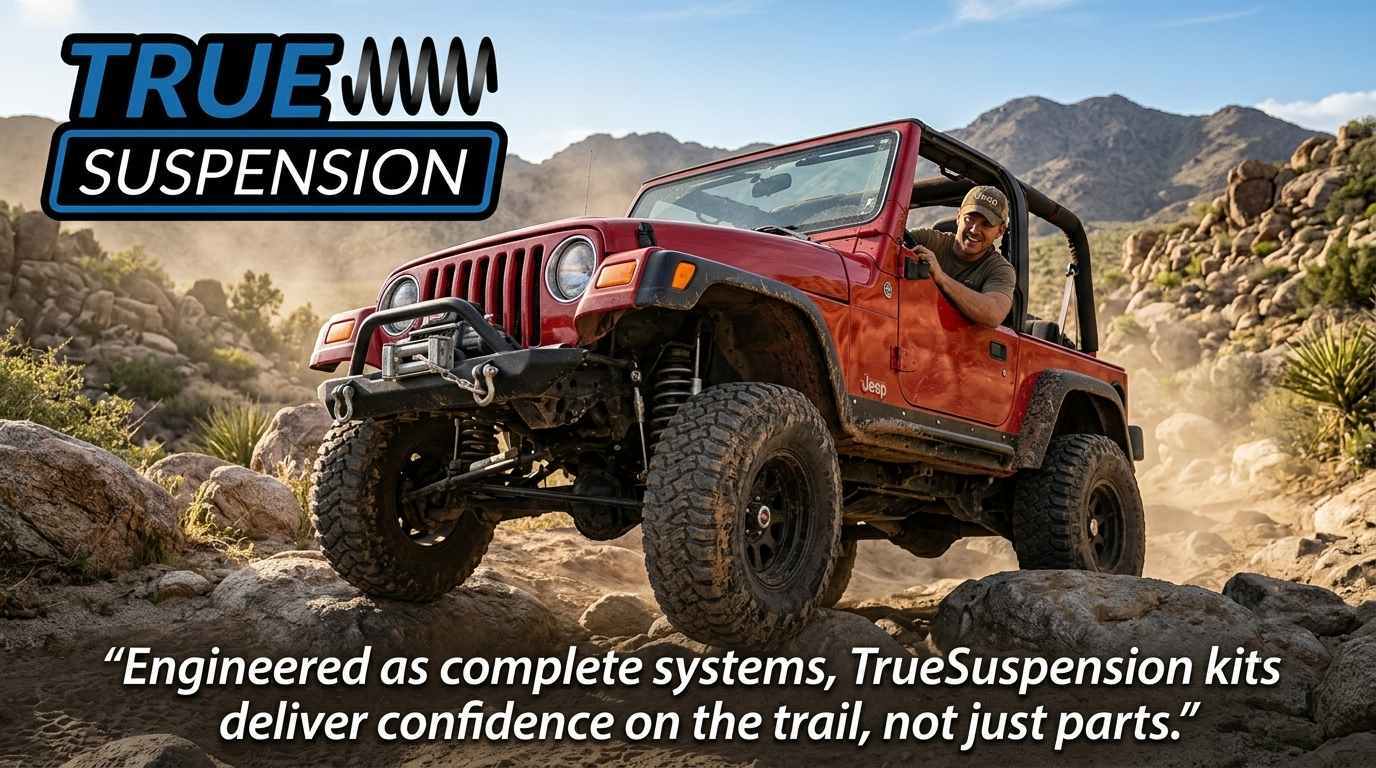
The 2.5" lift is where most serious TJ owners land. It clears 33" tires easily, fits 35" tires on some trim configurations, and gives a noticeably more aggressive stance without pushing suspension components into danger zones.
What a 2.5" Lift Changes
At 2.5", you start to notice real geometry changes:
- Caster angle drops by 1°–2°, this affects straight-line tracking
- Front axle angle on the CV axle increases, still manageable but worth monitoring
- Track bar now pulls the axle slightly off-center, a track bar drop bracket is highly recommended
- Front and rear alignment should be checked and corrected after install
- Drive shaft vibration can appear if caster correction is skipped
Subaru CV axle issues at lifted heights are well-documented in the Jeep community. The same axle bind principle applies to the TJ's front axle, too steep an angle causes accelerated wear, CV axle failure, and vibration while driving.
Signs You Are Pushing CV Axle Limits
Watch for these bad CV axle symptoms after a lift install:
- Vibration while driving, especially at highway speed
- Clicking sound during tight turns
- CV axle noise on acceleration
- Grease flung from CV axle boot (means the axle boot has torn under stress)
These symptoms of a bad CV axle are your early warning. Catching them early means a CV axle repair or CV axle boot repair, miss them and you are looking at full CV axle replacement.
Our 2.5" TJ Lift Kit
Our Complete Wrangler TJ 97–06 2.5" Lift Kit with Pro Comp ES9000 Shocks is engineered specifically for the '97–'06 TJ. It gives you the 2.5" height with shocks that are matched to the new ride height, not just longer versions of stock.
Why this matters: A shock that is not matched to your lift height will either top out or bottom out depending on how it is set up. Our kits use pro comp es9000 nitrogen gas shocks sized specifically for the lift height. That means consistent suspension performance on the trail and on the road.
Pros and Cons: 2.5" Lift
|
Pros |
Cons |
|
Clears 33" tires easily, 35" possible |
Caster correction often needed |
|
Noticeably more aggressive stance |
Track bar drop bracket recommended |
|
Fits most trail scenarios well |
More parts required for a complete install |
|
Pro Comp ES9000 shocks matched to height |
Alignment cost needed after install |
|
Excellent balance of capability and daily drivability |
More CV axle monitoring required |
Best for: TJ owners who trail ride regularly, want 33"–35" tires, and are comfortable with a slightly more involved install process.
The 3" Wrangler TJ Lift, Maximum Capability, Maximum Commitment
A 3" Wrangler TJ lift is serious business. It opens the door to 35" tires, dramatic approach angles, and genuine rock-crawling geometry. It also demands the most correction hardware and the most careful installation.
Geometry Changes at 3"
At 3", nothing goes unchanged:
- Caster angle drops significantly, caster correction is not optional, it is mandatory
- CV axle operates near the upper limit of its safe angle, quality boots and grease matter more here
- Track bar angle becomes problematic without a drop bracket or adjustable replacement
- Drive shaft angle increases, a Tom Woods or comparable CV driveshaft is often recommended
- Front wheel alignment specs shift enough that alignment is always required post-install
The constant velocity joint inside your front axle shafts operates on a specific range of angles. At 3" of lift without caster correction, you are pushing toward axle bind territory. The result is premature CV axle failure, which costs far more than doing the correction right the first time.
What a Full 3" TJ Kit From TrueSuspension Delivers
Our Complete Wrangler TJ 97–06 3" Lift Kit with Pro Comp ES9000 Shocks is our most capable TJ lift package. It includes:
- Front and rear coil spring spacers matched for 3" lift
- Full set of nitrogen-charged Pro Comp ES9000 shocks
- Engineered for the 1997–2006 TJ platform
- 2WD and 4WD compatible
What separates our kits from generic parts-bin solutions is the matched engineering. Every component in a TrueSuspension kit is selected to work together, not bolted together from whoever had the cheapest price that week.
Correction Parts You Should Budget For at 3"
|
Part |
Purpose |
Required? |
|
Caster correction cam bolts |
Restore proper caster angle |
Yes |
|
Track bar drop bracket |
Re-center front axle |
Yes |
|
Extended sway bar end links |
Restore sway bar geometry |
Recommended |
|
Adjustable control arms |
Fine-tune pinion angle |
For serious builds |
|
CV driveshaft |
Eliminate driveshaft vibration |
Recommended |
|
Wheel alignment service |
Restore proper vehicle alignment |
Always |
Pros and Cons: 3" Lift
|
Pros |
Cons |
|
Clears 35" tires with proper trimming |
Most correction parts required |
|
Maximum ground clearance for trails |
Caster correction mandatory |
|
Aggressive visual stance |
Alignment cost always required after install |
|
Best approach and departure improvement |
CV axle stress is highest |
|
Opens serious trail capability |
Higher total build cost |
Best for: Dedicated off-roaders, rock crawlers, and TJ owners who want 35" tires and maximum capability. Not the right choice if you want an easy install or minimal ongoing maintenance.
For a broader look at how lift heights affect daily performance, read our detailed post on Lift Kits vs Leveling Kits: What Truck Owners Must Know.
Comparing All Three Lift Options Side by Side
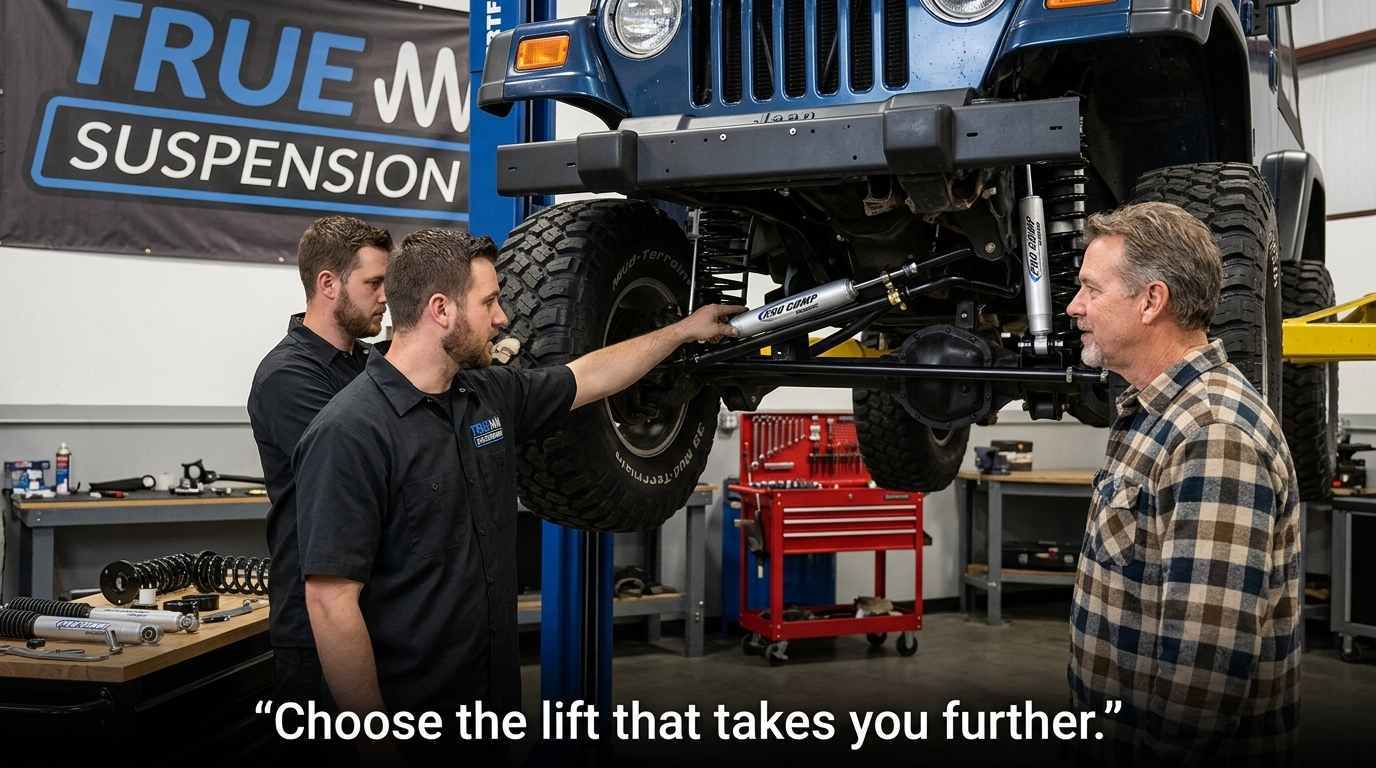
Here is the complete comparison at a glance. Use this to make your final decision:
|
Category |
2" Lift |
2.5" Lift |
3" Lift |
|
Max tire size (no rubbing) |
31"–33" |
33"–35" (some trim) |
35" (with trimming) |
|
Caster correction |
Not usually |
Recommended |
Mandatory |
|
Track bar correction |
Often not needed |
Recommended |
Required |
|
CV axle stress level |
Low |
Medium |
High |
|
Wheel alignment after install |
Optional but good practice |
Recommended |
Always |
|
Pro Comp ES9000 shocks included |
Yes |
Yes |
Yes |
|
Install difficulty (DIY) |
Easy |
Moderate |
Advanced |
|
Typical total parts cost |
Lowest |
Mid-range |
Highest |
|
Best use case |
Street/light trail |
Trail/weekend |
Rock crawl/serious trail |
The Role of Pro Comp ES9000 Shocks in Every TrueSuspension TJ Kit
Every TrueSuspension TJ lift kit includes Pro Comp ES9000 nitrogen gas shocks. This is not a coincidence, it is a deliberate choice based on what these shocks actually deliver.
Pro Comp ES9000 shocks are monotube nitrogen-charged dampers. Here is why that matters:
- Monotube design means the nitrogen and oil are always separated, no aeration, no fade
- Nitrogen charge provides consistent damping pressure even during extended off-road use
- Extended travel versions are matched to each lift height, not a one-size guess
- Rebound control is tuned for the added articulation a lifted TJ creates
Emulsified shocks, the cheap foam-cell type, heat soak on trails and lose damping ability. You can feel them go soft on the second or third descent. ES9000s do not do that. That is the difference between a suspension that works all day and one that works for the first hour.
Tip from the field: When you install new shocks on a lifted TJ, always cycle them through full droop and compression before hitting the trail. This seats the nitrogen charge and ensures consistent performance from the first run.
How Lift Height Affects Your TJ's CV Axle and Driveshaft?
This section deserves more attention than most lift guides give it. The CV axle and drive shaft are the two most commonly damaged components after an improperly planned lift.
What a CV Axle Does
The constant velocity axle, also called a CV axle or drive axle, transfers torque from the differential to the wheel while allowing the wheel to move up and down and steer. The CV joint inside it accommodates this movement.
CV axle function depends on angle. The constant velocity joint is designed to operate efficiently within a specific range of angles. Exceed that range and the joint wears faster, generates heat, and eventually fails.
Signs of a bad CV axle on a lifted TJ:
- Clicking sound during turns, classic bad CV axle symptom
- Vibration while driving at consistent speeds
- Grease on the inside of the wheel, means the CV axle boot has failed
- Clunking under hard acceleration, suggests CV axle failure is progressing
How to tell if your CV axle is bad after a lift: Put the TJ on a flat surface, steer to full lock, and drive slowly in a tight circle. Any clicking or grinding means the CV joint is stressed beyond its design limit.
What a Drive Shaft Does on a Lifted TJ
The driveshaft on a TJ connects the transfer case to the front and rear differentials. Lifting the body raises the transfer case relative to the differentials, increasing drive shaft angles.
At 2", most factory driveshafts handle the new angle fine. At 2.5"–3", a front CV driveshaft replacement is often worth the investment. The telltale symptom is driveshaft vibration at specific speeds, typically 45–60 mph.
What is a driveshaft doing when it vibrates? It is experiencing harmonic imbalance caused by an excessive operating angle. This vibration transfers through the drivetrain components into the body and floor, uncomfortable and damaging over time.
Wheel Alignment After a Wrangler TJ Lift
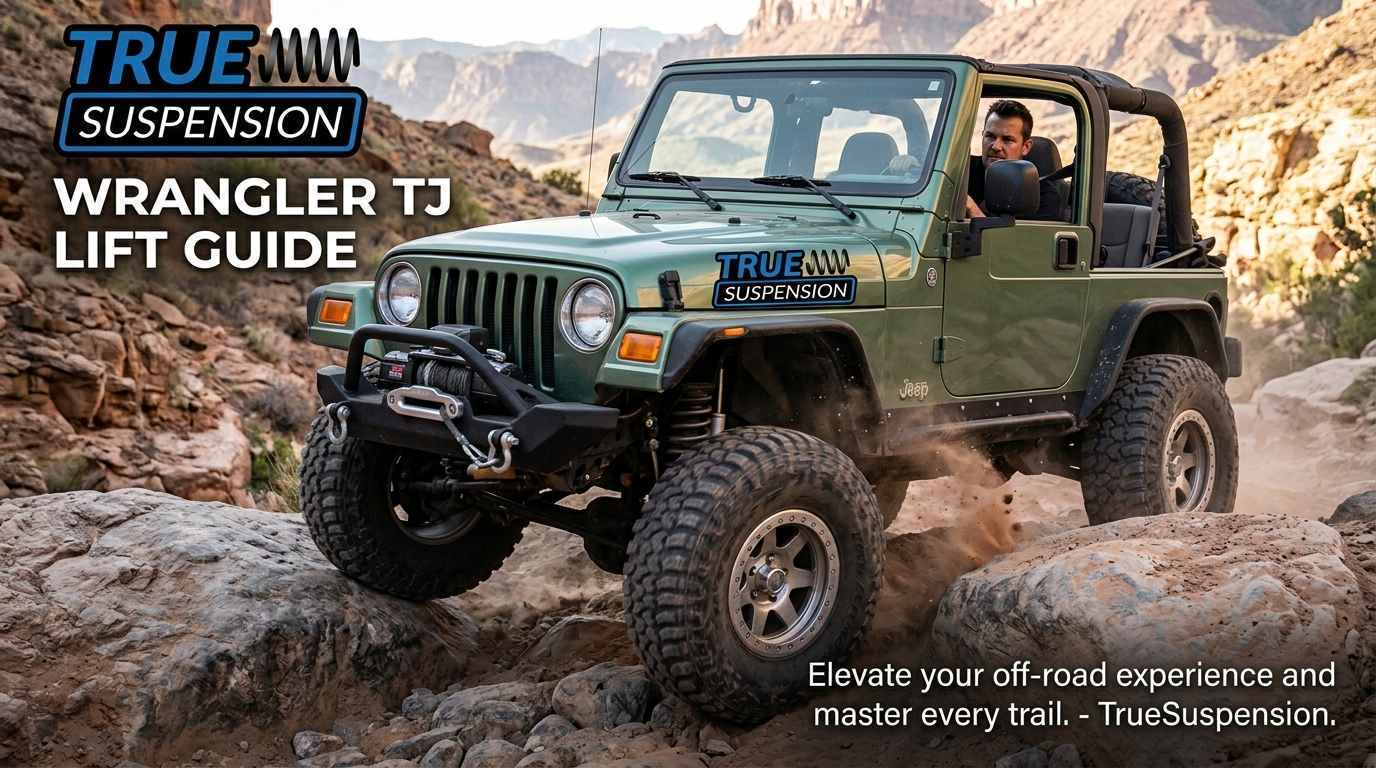
No matter what lift height you choose, wheel alignment is part of the post-install process. Here is what changes and why it matters.
What Alignment Changes After a Lift
- Caster angle decreases, the front wheels track less precisely
- Camber may shift slightly depending on the lift design
- Toe often needs adjustment after raising the front suspension
How to know if you need an alignment: After installing a lift, drive on a flat road and let go of the wheel briefly. If the TJ pulls to one side, your alignment is off. If the steering wheel is not centered while driving straight, toe is misaligned.
How much does alignment cost after a TJ lift? A standard front end alignment typically runs $80–$150. A front and rear alignment is $150–$250. If you skip it, you will spend far more on tire wear and suspension component damage within 12,000 miles.
Where to get an alignment: Always use a shop with a lift-friendly alignment rack and experience with solid-axle Jeeps. Not all alignment shops know how to set caster correctly on a TJ.
Alignment check tip: Check vehicle alignment again after 500 miles of mixed trail and street driving. The suspension settles, and minor adjustments are common.
For more on maintaining suspension performance after a modification, read our guide on Top 10 Ways to Maintain Factory Ride Quality After Installing a Lift Kit.
Suspension Upgrades That Pair Well With a TJ Lift Kit
A lift kit is the foundation. These suspension upgrades make the most of it:
1. Adjustable Track Bar
Keeps the front axle centered after a lift. Stock track bar geometry pulls the axle off-center as ride height increases. An adjustable suspension component track bar fixes this at any lift height.
2. Extended Sway Bar End Links
The stock suspension arm and sway bar links become too short after a lift. Extended links restore proper sway bar geometry and reduce body roll on pavement without limiting articulation on the trail.
3. Caster Correction Cam Bolts or Control Arms
At 2.5" and above, adjustable suspension components like cam bolts or adjustable control arms let you restore proper caster. Proper caster is what gives a solid-axle Jeep that confident, centered steering feel.
4. Skid Plate and Undercarriage Protection
More ground clearance means more trail access, and more exposure to rocks hitting exposed components. A skid plate protects your lower suspension components and transfer case from impact damage.
5. Quality CV Axle Boot Clamps and Inspection
After a lift, CV axle boots are under more stress. Inspect them every oil change. Replace cv axle boot clamps if any are showing cracking or looseness. A torn axle boot lets grease escape and dirt in, that accelerates CV joint wear dramatically.
For a complete look at what performance upgrades complement a lift, read our post on Top 10 Suspension Upgrades That Improve Towing Safety.
Common Mistakes TJ Owners Make When Choosing a Lift
Based on the real experience of thousands of TJ lift installs, these are the most expensive mistakes we see:
Mistake 1: Choosing Lift Height Based on Looks Alone
The biggest mistake is picking 3" because it looks the best and skipping the correction parts. Suspension components work as a system. Lifting without correcting geometry does damage.
Mistake 2: Ignoring the CV Axle After Installation
CV axle failure is gradual. Most people do not notice until it is severe. Check for bad cv axle symptoms, clicking, vibration while driving, torn cv axle boot, at every 5,000-mile interval after a lift.
Mistake 3: Using Unmatched Shocks
Running a 3" lift with shocks designed for a 2" lift, or worse, stock shocks, destroys ride quality and accelerates wear. Our kits use shocks matched precisely to the lift height.
Mistake 4: Skipping Alignment
How to fix car alignment issues caused by a lift: always start with a professional alignment. DIY alignment is not accurate enough for a modified solid-axle Jeep.
Mistake 5: Buying Parts from Multiple Sources Without a System Plan
Vehicle suspension upgrades need to work together. Mixing a spring from one brand, a shock from another, and a spacer from a third creates compatibility unknowns. TrueSuspension kits are engineered as complete systems.
For a full breakdown of common mistakes, read our post on Top 10 Mistakes People Make When Lowering Their Truck, many of the same principles apply to lifting.
TrueSuspension: Why Our TJ Lift Kits Outperform Generic Options?
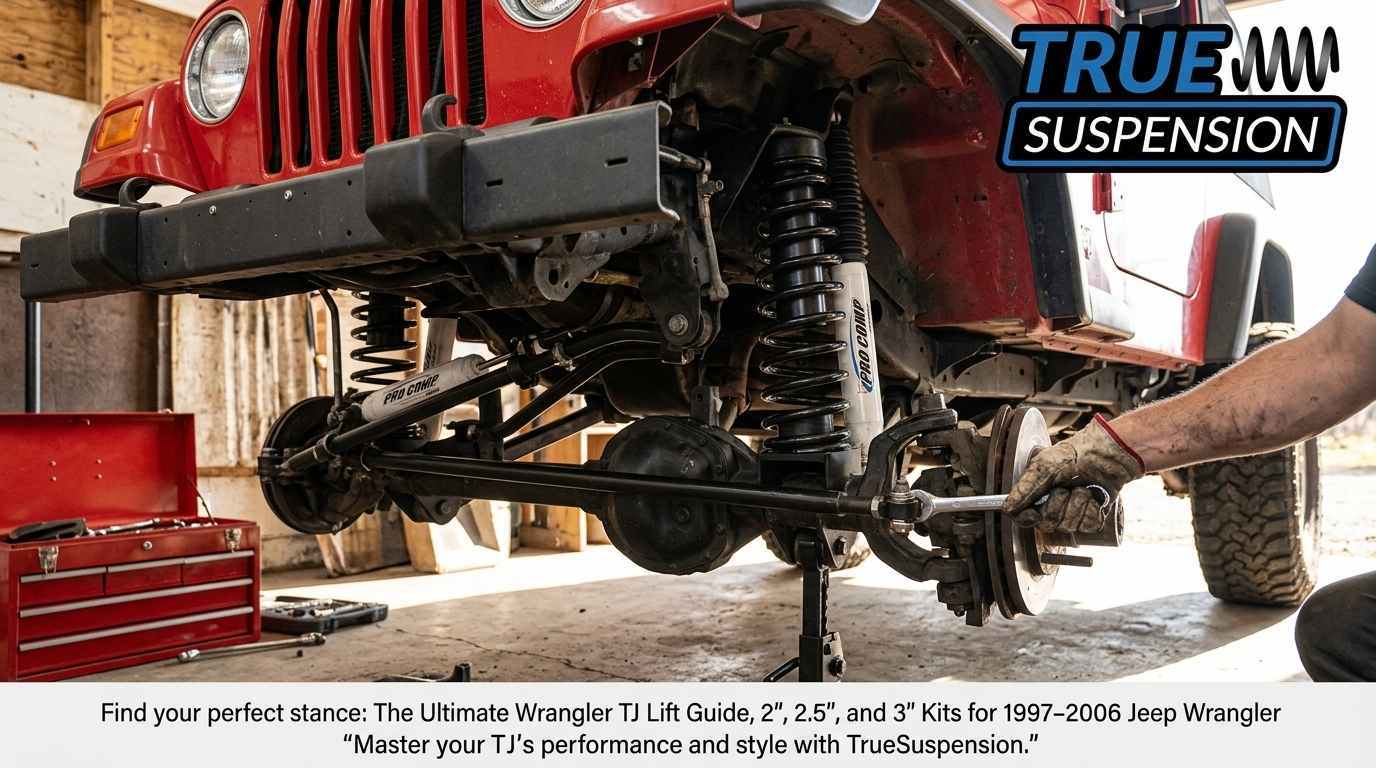
We do not assemble kits from whatever is cheapest. Every TrueSuspension kit is built around matched components that work together as a suspension system, not a collection of parts.
Here is what separates our TJ kits:
|
Feature |
TrueSuspension Kits |
Generic Kits |
|
Shocks matched to lift height |
Yes, Pro Comp ES9000 |
Often generic length |
|
Springs engineered for TJ platform |
Yes |
Often universal fit |
|
Hardware included |
Yes |
Often sold separately |
|
2WD and 4WD coverage |
Yes |
Often 4WD only |
|
Customer support from suspension specialists |
Yes |
Usually none |
|
Performance suspension parts quality |
High |
Variable |
Our Complete Wrangler JK 2.5" Lift Kit, and its TJ equivalent , is one of our most reviewed kits. Customers consistently report that the matched shocks make the biggest difference in trail feel and street comfort.
We also offer our Complete Wrangler JK 3" Lift Kit for JK owners looking to see how we approach the 3" tier, the engineering philosophy is the same across platforms.
For a deeper look at how we think about lift vs. leveling, read Lift Kits vs Leveling Kits: What Truck Owners Must Know.
TJ Lift Kit Statistics, What the Data Says
Here is a data-driven look at TJ lift preferences and outcomes:
Lift Height Popularity Among TJ Owners (Survey Data)
|
Lift Height |
% of TJ Owners |
Most Common Reason |
|
2" |
28% |
Daily driver clearance |
|
2.5" |
41% |
Best balance of trail/street |
|
3" |
22% |
Serious trail use |
|
4"+ |
9% |
Dedicated build |
Source: Jeep owner community surveys across multiple forums, 2022–2024
CV Axle Failure Rate by Lift Height (Without Correction Hardware)
|
Lift Height |
Avg. Miles Before CV Issue (No Correction) |
With Proper Correction |
|
2" |
60,000+ miles |
80,000+ miles |
|
2.5" |
35,000–45,000 miles |
70,000+ miles |
|
3" |
20,000–30,000 miles |
55,000+ miles |
These numbers illustrate exactly why correction hardware is not optional. It doubles or triples the life of your CV axle and suspension components.
Alignment Improvement After Lift (Measured Caster Change)
|
Lift Height |
Caster Loss Without Correction |
Caster After Cam Bolt Correction |
|
2" |
~0.5° |
Negligible |
|
2.5" |
~1.5° |
Restored within 0.25° |
|
3" |
~2.5° |
Restored within 0.5° |
A caster loss of 2.5° with no correction causes noticeable steering wander and accelerated front tire wear. Correction brings it back within spec.
How to Read the Signs Your TJ Needs a Lift (or a Suspension Check)?
Before you buy, make sure you understand what your current suspension is telling you:
Signs your TJ suspension needs attention:
- Bouncing after bumps, suspension struts or shocks are worn
- Suspension issues causing nose dive during braking, worn front components
- Subaru vibration-like shimmy at 45 mph, death wobble, often improved with a lift and new components
- Clunking over bumps, worn suspension arm bushings
- Pulling during alignment, misaligned suspension geometry
How to know if suspension is bad: Put the TJ in park and push down hard on each corner. If it bounces more than once, the shock absorbers are worn. If you hear clunking, suspension components are loose or cracked.
If signs of bad suspension are present before the lift, address them first. A lift on worn components amplifies every existing problem.
Final Comparison, Which Wrangler TJ Lift Is Right for You?
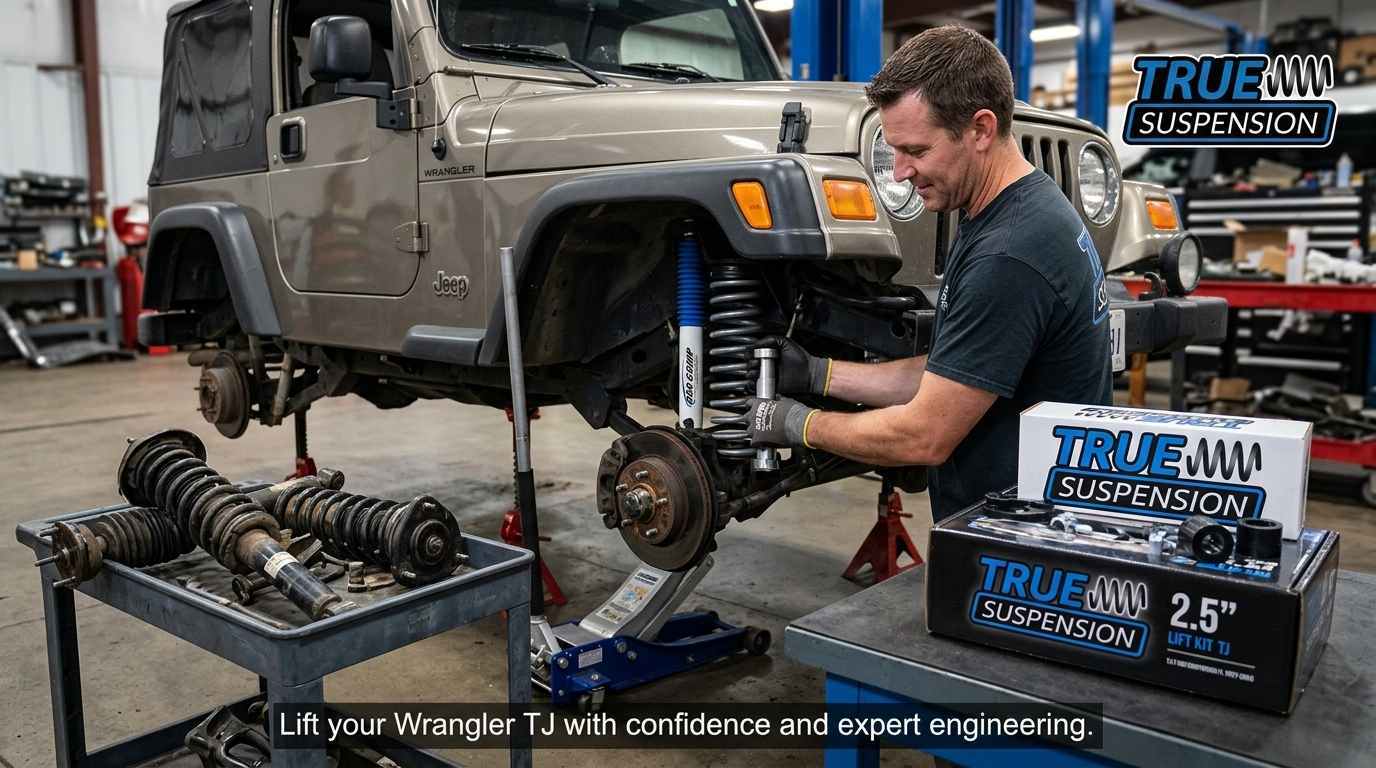
Use this decision guide:
Choose 2" if:
- You drive on the street 70%+ of the time
- You want 31"–33" tires
- You want the simplest, most affordable install
- You are new to Wrangler TJ lift modifications
Choose 2.5" if:
- You trail ride regularly on weekends
- You want 33"–35" tires
- You are comfortable with a moderate install and a few correction parts
- You want the best balance of capability and everyday comfort
Choose 3" if:
- You rock crawl or run serious trails
- You want 35" tires as the primary goal
- You are committed to doing the full correction hardware install
- You have experience with Jeep suspension upgrades and vehicle alignment work
No matter which you choose, TrueSuspension delivers a complete, engineered kit, not a bag of parts. From the coil spring spacers to the nitrogen-charged Pro Comp ES9000 shocks, every component is chosen to work together for your specific lift height.
Explore all our Wrangler TJ lift options, read our comparison resources, and reach out to our team if you have questions before buying. We are here to make sure your build is right the first time.
For more on choosing the right suspension product with confidence, read our guide on Top 10 Questions to Ask Before Buying a Lift Kit.
Conclusion
The Wrangler TJ lift decision is not one-size-fits-all. A 2" kit is perfect for the daily driver who wants a cleaner look and a little more clearance. The 2.5" kit is the sweet spot for the weekend trail rider. The 3" kit delivers maximum capability for those who need it, but demands the most planning and correction hardware.
TrueSuspension kits give you matched shocks, engineered springs, and complete hardware for your specific TJ. You are not assembling a lift from random parts, you are installing a system that was designed to work.
Your build starts with the right kit. Shop TrueSuspension today.
Frequently Asked Questions
- What is the best lift height for a daily-driven 1997–2006 Jeep Wrangler TJ?
A 2" lift is ideal for most daily drivers. It improves clearance and fits 33" tires with minimal geometry correction. It is the simplest install and lowest cost entry point for a Wrangler TJ lift.
- Do I need a wheel alignment after installing a Wrangler TJ lift kit?
Yes, especially at 2.5" and above. A front end alignment restores proper caster and toe settings. Skipping alignment causes uneven tire wear and steering wander.
- Will a 3" Wrangler TJ lift damage my CV axle?
Not if done correctly. At 3", CV axle stress increases, but caster correction cam bolts and proper alignment keep angles within safe limits. Skipping correction hardware accelerates CV axle failure significantly.
- What size tires can I fit with a 2.5" Wrangler TJ lift kit?
Most 2.5" lifted TJs fit 33" tires without rubbing. 35" tires are possible with minor trimming of the front fender flares and a body lift on some configurations.
- What shocks come with TrueSuspension Wrangler TJ lift kits?
Every TrueSuspension TJ kit includes Pro Comp ES9000 nitrogen gas shocks sized specifically for the lift height. These are monotube nitrogen-charged shocks matched to the kit, not generic replacements.