
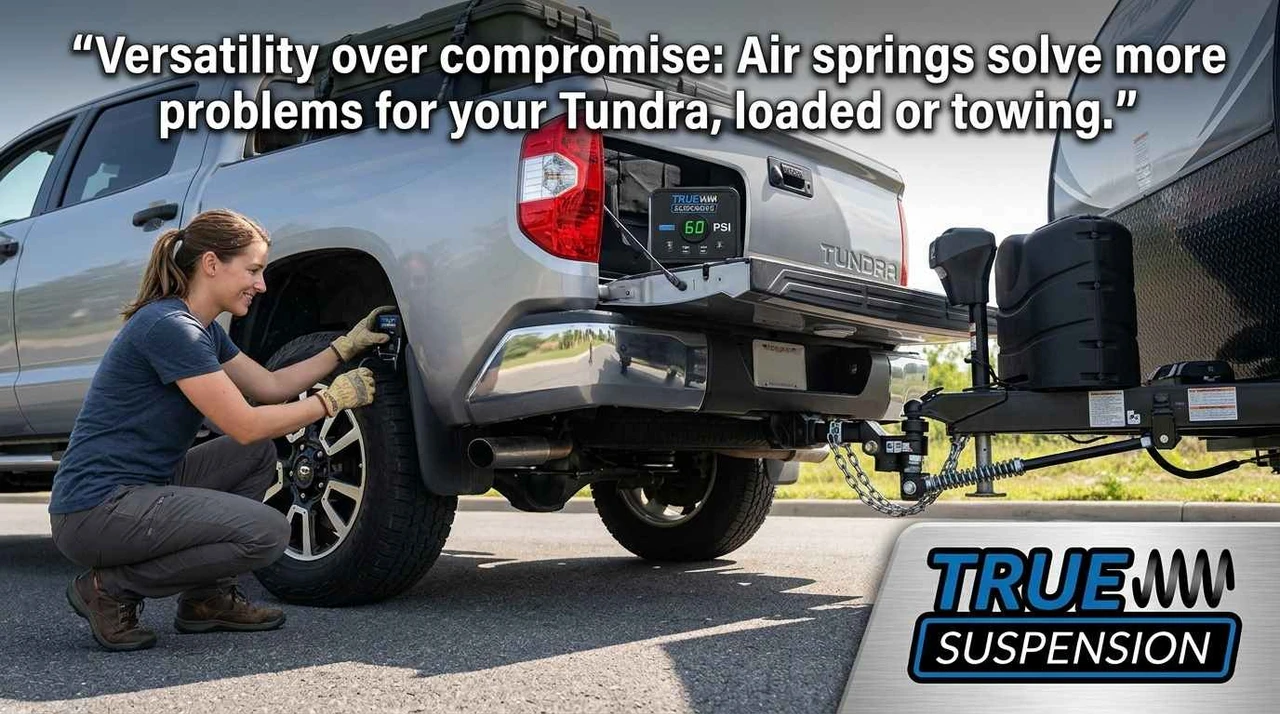
Most articles on Toyota Tundra rear squat just tell you to "add some support" without explaining the real difference between your options. That's not what this guide is. Here, we break down exactly how air helper springs and a weight distribution hitch work, how they compare across every important metric, and which solution gives Toyota Tundra owners the most value, especially when True Suspension has engineer-grade kits built precisely for your truck.
If your Toyota Tundra sags in the rear when you load the bed or hook up a trailer, you're dealing with a rear squat problem. It's more than cosmetic. Rear squat kills your wheel alignment, throws off your headlights, stresses your suspension system, and makes towing genuinely dangerous. You need a fix, but you need the right fix.
Let's walk through everything you need to know.
What Is Toyota Tundra Rear Squat and Why Does It Happen?
Rear squat is when the back of your Toyota Tundra drops down under load. You'll notice the front nose pitches slightly upward. The truck looks unbalanced, because it is.
This happens because the factory rear suspension components on the Tundra are tuned for ride comfort on an empty truck. The suspension spring rate is soft enough for daily driving. But the moment you add 1,000 lbs of cargo or hook a 6,000 lb trailer, those springs compress too much.
Here's what rear squat does to your truck:
- Wheel alignment shifts out of spec; your tires wear unevenly and fast
- Axle angle changes; this puts stress on your CV axle and drive axle
- Headlights point upward, blinding oncoming drivers
- Braking distance increases because weight transfers forward
- Suspension components fatigue faster under constant overload stress
- Tongue weight becomes unstable, increasing sway risk
The 2007–2021 Toyota Tundra is especially known for this issue. It's a capable truck, but its factory rear suspension setup was not designed for consistent heavy towing or payload. That's not a flaw; it's an engineering trade-off. The solution is adding the right aftermarket suspension upgrade.
You have two main paths: air helper springs (air bags) or a weight distribution hitch. Each works differently. Each has a different cost. And each is right for a different type of Tundra owner.
How Air Helper Springs Work (And Why Tundra Owners Love Them)?
Air helper springs, also called tow assist air bag kits or helper air bags, install inside or alongside your existing rear suspension components. They add an adjustable air cushion between the frame and the axle. When you air them up, they resist compression and keep the rear of your truck level under load.
The keyword is adjustable. You control the air pressure. More pressure equals more support. Less pressure returns the truck to factory-soft ride quality. That's the core advantage over every static solution.
At True Suspension, our Toyota Tundra Rear Towing Assist Helper Air Ride Suspension Kits are designed specifically for the 2007–2021 Tundra platform. We offer 2WD/RWD and 4WD/4x4 versions, with and without in-cab management controls, and tankless options for clean installs. These aren't generic universal bags bolted on with adapters. They're vehicle-specific kits engineered for your exact Tundra configuration.
What Makes True Suspension Air Kits Stand Out
Our air helper spring kits for the Tundra include:
- Heavy-duty air springs rated for consistent heavy loads
- Stainless steel air line hardware for corrosion resistance
- In-cab management controls so you adjust pressure without leaving the cab
- Clear installation instructions with all mounting hardware included
- Compatibility across 2WD, 4WD, and 4x4 Tundra configurations
When you're learning how an air ride suspension system works vs other options, the adjustability factor keeps coming up as the top reason truck owners choose air over everything else. Static solutions can't match it.
Pros of Air Helper Springs for the Toyota Tundra
|
Benefit |
Details |
|
Adjustable support |
Set exact pressure for each load, 5 psi empty, 60 psi fully loaded |
|
Maintains ride quality |
Run low pressure when unloaded for a comfortable daily drive |
|
In-cab control option |
True Suspension offers management control panel kits for instant adjustments |
|
Works on all load types |
Bed cargo, fifth wheel, gooseneck, bumper pull, handles any weight |
|
No hitch required |
Works when towing AND when carrying payload in the bed |
|
Long service life |
Quality air springs last 100,000+ miles with proper maintenance |
Cons of Air Helper Springs
- Requires periodic pressure checks (especially with temperature changes; cold air loses pressure)
- Initial installation takes 2–4 hours for first-timers
- Air lines need to be routed cleanly to avoid chafing
These are manageable. And when you read our guide on maintaining your air ride suspension system, you'll see that upkeep is straightforward.
How a Weight Distribution Hitch Works?
A weight distribution hitch (WDH) is a specialized trailer hitch system that uses spring bars to redistribute tongue weight from the rear axle forward to the front axle and trailer axle. Instead of all the tongue weight pressing down on your Tundra's rear, the weight distribution hitch shares that load across more contact points.
The result is a leveled truck, but only when you're towing. That's the critical limitation.
A weight distribution hitch does nothing for:
- Bed cargo payload
- Any load that doesn't go through the hitch
- Situations where you've unhitched the trailer
It also requires setup every time you hook up. You must properly tension the spring bars for the hitch to work. Under-tensioning means you're not actually distributing weight. Over-tensioning causes its own handling problems.
Pros of a Weight Distribution Hitch
|
Benefit |
Details |
|
Reduces trailer sway |
Some WDH systems include sway control built in |
|
Works without modifying suspension |
Bolt-on hitch solution, no frame drilling |
|
Improves front-axle braking |
Weight redistributed forward improves stopping distance |
|
Good for heavy trailers |
Required by most manufacturers over 5,000 lbs GTW |
Cons of a Weight Distribution Hitch
|
Drawback |
Details |
|
Towing-only fix |
Does nothing for bed payload, only addresses tongue weight |
|
Requires setup every time |
Spring bar tension must be set correctly at each hookup |
|
Bulky and heavy |
Adds 50–100 lbs of hardware to your hitch receiver |
|
Can't adjust while driving |
Pressure is static, no on-the-fly correction |
|
Doesn't improve ride quality |
No benefit when driving empty or with cargo only |
|
Expensive premium systems |
Quality WDH systems run $400–$1,200 installed |
Head-to-Head Comparison, Air Helper Springs vs Weight Distribution Hitch
This is the core comparison most guides skip. Let's look at real data side by side.
|
Factor |
Air Helper Springs |
Weight Distribution Hitch |
|
Fixes bed payload squat |
✅ Yes |
❌ No |
|
Fixes towing squat |
✅ Yes |
✅ Yes |
|
Adjustable on the fly |
✅ Yes (with in-cab controls) |
❌ No |
|
Works when unloaded |
✅ Soft ride preserved |
❌ Not applicable |
|
Reduces trailer sway |
Partial (with sway bar combo) |
✅ Yes (built-in on some units) |
|
Installation complexity |
Moderate (2–4 hours) |
Low–Moderate (1–3 hours) |
|
Average cost (parts) |
$250–$650 |
$300–$800 |
|
Long-term value |
High, works for all loads |
Limited, towing only |
|
Improves alignment stability |
✅ Yes |
Partial |
|
Vehicle modification |
Suspension-level upgrade |
Hitch receiver only |
|
Effect on axle angle |
Stabilizes axle angle |
Minimal direct effect |
|
Best for |
All Tundra owners who carry or tow |
Dedicated trailer towers only |
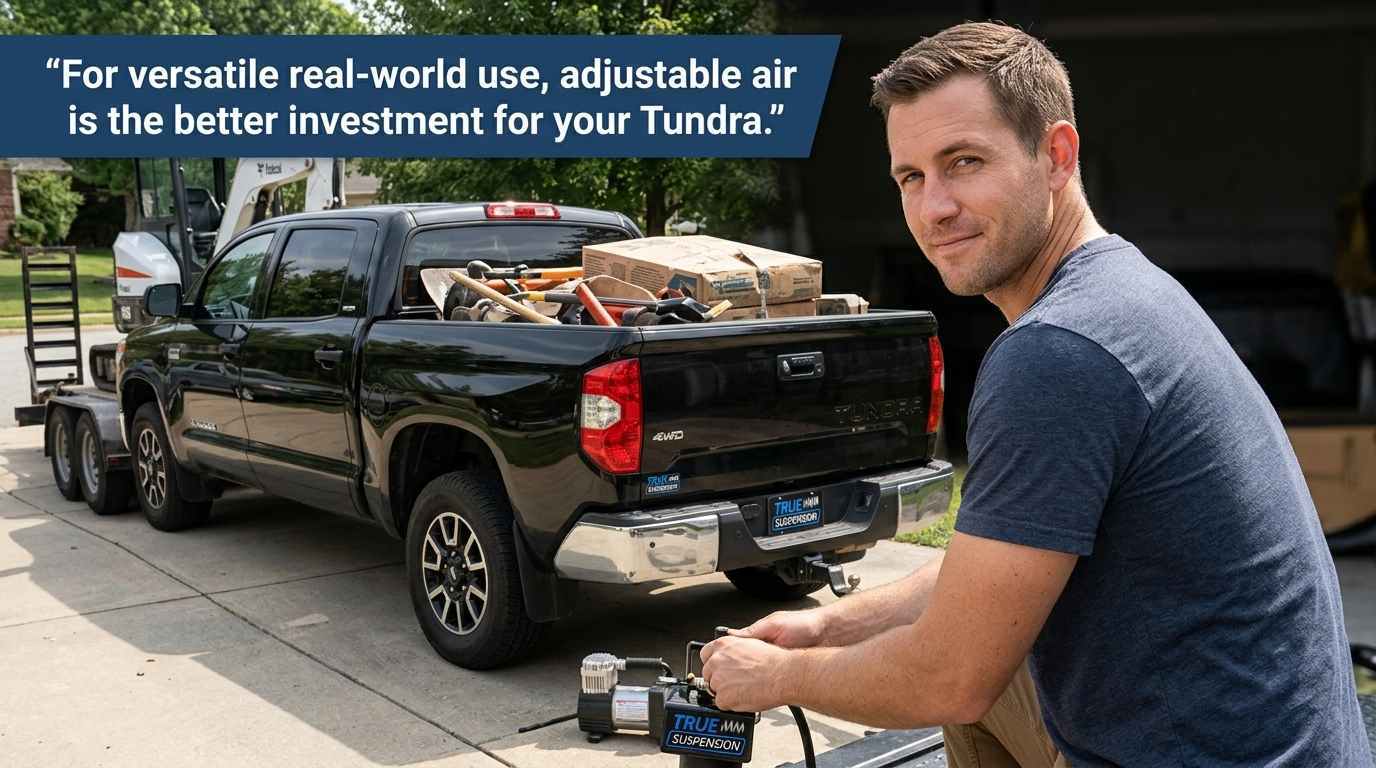
The data is clear. Air helper springs solve more problems for more situations. If you only ever tow one type of trailer at a consistent weight, a weight distribution hitch gets the job done. But for Toyota Tundra owners who use their trucks for everything, hauling mulch on Saturday and towing a boat on Sunday, air helper springs are the more versatile, better long-term investment.
What Happens to Your Suspension When You Ignore Rear Squat?
This section matters because rear squat isn't just an aesthetic problem. Ignoring it causes real mechanical damage over time.
CV Axle and Drive Axle Stress
When your rear drops under load, the axle angle changes. The CV axle on Tundras with independent rear suspension wasn't designed to operate at extreme angles under load. Extended time at these angles causes CV axle failure faster. The signs of a bad CV axle- clicking on turns and vibration at speed- are expensive to fix. CV axle replacement costs between $300–$600 per axle at a shop.
An air helper spring kit keeps your drive axle at the correct operating angle even under heavy loads. That's not just a comfort improvement; it's protecting expensive drivetrain components.
Wheel Alignment Consequences
Rear squat throws your rear wheel alignment out of spec. When the rear drops, your vehicle alignment geometry shifts. Your rear tires develop a different camber angle than intended. This causes accelerated and uneven tire wear. A front and rear alignment after any suspension change is always recommended, but the goal of a good air helper spring install is that your geometry stays close to factory specs at all loaded heights.
The alignment cost for a four-wheel alignment runs $80–$175 depending on your market. That's money you can save by keeping your rear level in the first place.
Vibration and Ride Quality
Subaru vibration articles often reference axle bind as a cause of driveline vibration; the same physics apply to Toyota Tundras under extreme squat. When the drive axle operates outside its designed range, you get vibration while driving that gets worse over time. Keeping your rear suspension at the correct ride height eliminates this risk.
True Suspension's Tundra Air Ride Lineup, A Complete Look
We built our Tundra-specific kits because we know Tundra owners don't want a universal bag with a pile of adapter brackets. Here's a quick breakdown of our full lineup:
2WD/RWD Tundra Kits (2007–2021)
- Towing Assist Helper Air Ride Kit, 2WD/RWD, no tank
- Towing Assist Helper Air Ride Kit, 2WD/RWD, with in-cab management controls
- Base towing assist kit,2WD/RWD
4WD/4x4 Tundra Kits (2007–2021)
- Towing Assist Helper Air Ride Kit, 4WD/4x4
- Towing Assist Helper Air Ride Kit, 4WD/4x4, no tank, with in-cab management
- Full in-cab management, 4WD/4x4
Every kit in this lineup installs on the existing rear suspension without cutting or welding. Bolt-on. Clean. Reversible.
If you want to read the full breakdown of what a tow assist air bag kit includes, and how to choose the right one, our Tow Assist Air Bag Kits Ultimate Guide covers every detail.
The Cost Breakdown: Which Option Is Actually Cheaper?
Cost is real. Let's break it down honestly.
Air Helper Spring Cost Analysis
|
Item |
Estimated Cost |
|
True Suspension Tundra Air Ride Kit |
$250–$550 |
|
In-cab management control panel (optional) |
$80–$150 |
|
Professional installation (if not DIY) |
$150–$300 |
|
Annual maintenance (air line inspection, valve check) |
$0–$30 DIY |
|
Total first year |
$250–$1,000 |
Weight Distribution Hitch Cost Analysis
|
Item |
Estimated Cost |
|
Entry-level WDH system |
$300–$450 |
|
Premium WDH with sway control |
$600–$1,200 |
|
Professional installation |
$100–$250 |
|
Annual maintenance (grease, inspection) |
$20–$50 |
|
Total first year |
$420–$1,500 |
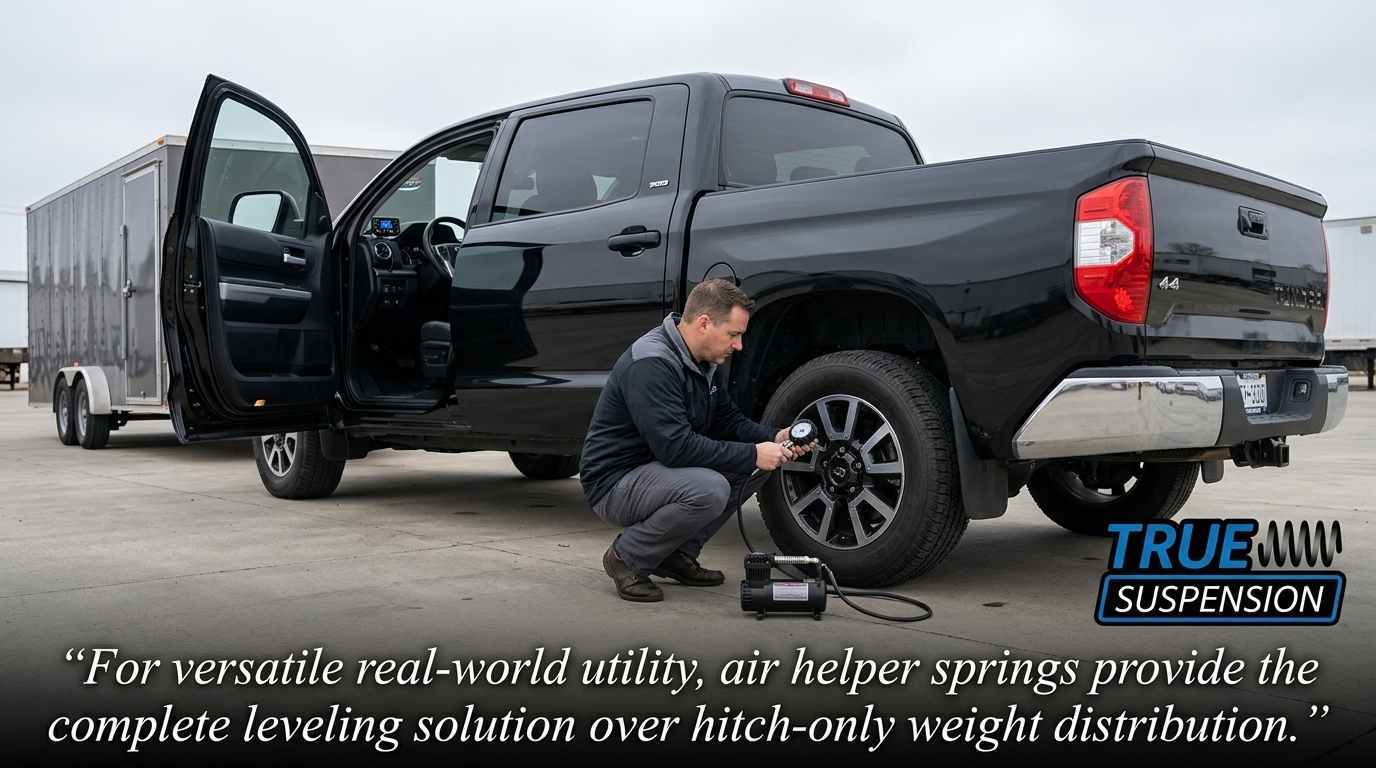
When you factor in that the air helper spring kit works for payload AND towing while the WDH only helps when you're towing, the value per dollar of a quality air kit from True Suspension is significantly higher.
The top 10 suspension upgrades that improve towing safety consistently rank adjustable air support at the top, and cost efficiency is a big reason why.
When a Weight Distribution Hitch Still Makes Sense?
We believe in honest advice. A weight distribution hitch is the right call in a specific scenario:
You should choose a WDH if:
- You only ever tow, no bed payload ever
- You consistently tow trailers over 6,000 lbs GTW
- Your trailer manufacturer requires a WDH for warranty compliance
- You already have air helper springs and want additional sway control
In that last case, running both systems together is actually common among serious towers. The air bags handle your truck's squat. The WDH handles tongue weight distribution and sway. They're not mutually exclusive.
But if you're choosing one solution to solve rear squat on a Toyota Tundra you use for real-world truck duties, air helper springs win on versatility every time.
Installing True Suspension Air Helper Springs on Your Tundra
Our kits are designed for real-world garage installs. You don't need a lift, though it helps. You'll need basic hand tools and about 2–4 hours for your first install.
The general process:
- Support the rear axle with jack stands under the frame
- Locate the mounting positions per the included vehicle-specific instructions
- Install the air spring brackets; these bolt to existing mounting points, no drilling
- Route the air lines cleanly along the frame, away from heat and moving parts
- Install the Schrader valve or management panel in your preferred location
- Inflate to 5 psi and check all connections before loading the truck
- Test under load, inflate to match your payload until the truck sits level
Our kits ship with every bracket, bolt, fitting, and line you need. Nothing to source separately.
For a deeper look at what to expect before you buy, check out our post on the top 10 questions to ask before buying a lift kit; many of the same questions apply to air support kits.
How to Know If Your Tundra Needs Air Helper Springs Right Now?
Here are the clear signs your rear suspension needs help:
- Visible rear sag when loaded; the rear drops more than 1.5 inches under your typical load
- Headlights aim too high when towing or loaded
- Trailer sway that gets worse as you speed up
- Uneven tire wear on the rear tires
- Vibration while driving under load that disappears when unloaded
- Braking feels nose-heavy when you're towing
Any one of these is a signal. More than one means your suspension system is already under stress and working against you. Our top 10 suspension upgrades for towing safety guide explains exactly why each of these symptoms gets worse the longer you ignore them.
Air Helper Springs vs Leaf Spring Helper Kits
Some Tundra owners also consider leaf spring helper kits as a third option. These are add-a-leaf or overload springs that bolt onto your existing leaf spring pack.
Here's how that compares:
|
Factor |
Air Helper Springs |
Leaf Spring Helper Kit |
|
Adjustability |
✅ Full, adjust any time |
❌ Fixed, one stiffness setting |
|
Ride quality unloaded |
✅ Soft and comfortable |
❌ Noticeably stiffer always |
|
Installation ease |
Moderate |
Moderate |
|
Cost |
$250–$550 |
$100–$350 |
|
Longevity |
100,000+ miles |
60,000–100,000 miles |
|
Best for |
Variable loads, sometimes light, sometimes heavy |
Always carrying near max payload |
If you want a deeper read on this topic, our blog on air bags vs leaf spring helper kits breaks it down with side-by-side analysis.
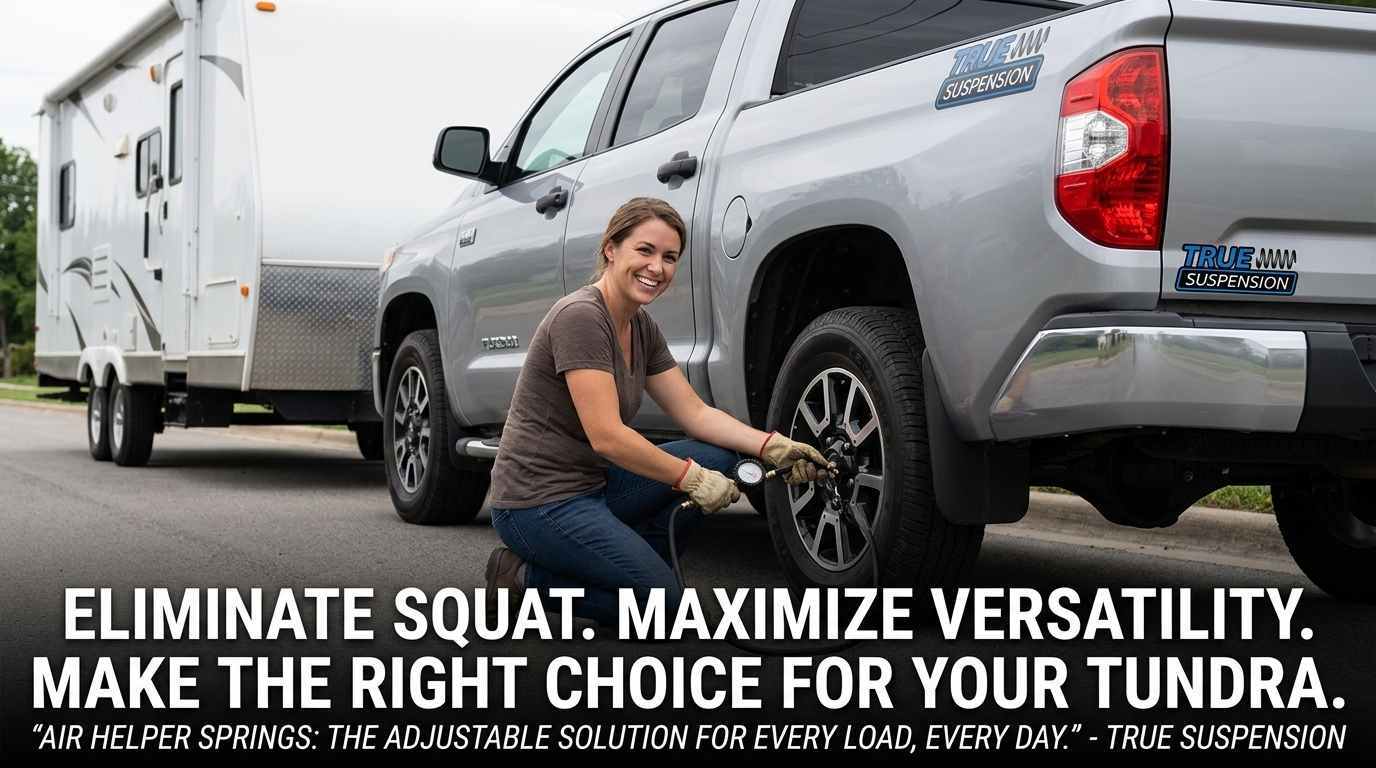
The verdict: if your loads vary, go with air. If you consistently max out your payload and want the lowest-cost solution, leaf spring helpers are acceptable, but you sacrifice all the flexibility.
The True Suspension Advantage, Why Our Kits Are Different?
We've been talking about air helper springs in general. But why choose True Suspension specifically?
Here's what separates our kits from the competition:
1. Vehicle-Specific Engineering
Our Tundra kits aren't adapted from universal brackets. They're designed around the 2007–2021 Tundra's actual frame geometry, spring perch locations, and axle travel. The fitment is precise because the engineering is precise.
2. Full Hardware Inclusion
Every kit ships complete. Air springs, brackets, hardware, air lines, fittings, Schrader valves, everything. No guessing what you need. No extra trips to the hardware store.
3. In-Cab Management Options
We offer in-cab dual paddle switch control panels that let you adjust air pressure from the driver's seat. Gas up, hook up, and inflate without leaving the cab. That's the kind of real-world usability that makes True Suspension kits different.
4. Tankless Options Available
Not everyone wants to find space for an air tank. Our tankless kits fill from a portable compressor or gas station air supply when you need them. Simple, clean, lightweight.
5. Proven Across the Full Tundra Lineup
Whether you're running 2WD, 4WD, or 4x4, we have a dedicated configuration for your Tundra. The guesswork is removed. See our complete Toyota Tundra towing assist lineup here.
Statistics, The Real Performance Data on Air Suspension for Towing
Understanding the numbers helps you make a better decision:
|
Metric |
Data Point |
|
Rear squat reduction with air bags |
Up to 2–3 inches of leveling restored under max load |
|
Typical air spring lifespan |
100,000+ miles (quality brands) |
|
Toyota Tundra max payload (2007–2021) |
1,440–2,060 lbs depending on config |
|
Toyota Tundra max tow rating |
Up to 10,500 lbs (properly equipped) |
|
Headlight aim deviation under squat |
Up to 3–5 degrees upward at 1.5" of rear drop |
|
Average CV axle replacement cost |
$300–$600 per side at a shop |
|
Average wheel alignment cost after suspension changes |
$80–$175 for front and rear |
|
Air bag kits that solve bed payload squat |
100%, all configurations |
|
Weight distribution hitches that solve bed payload squat |
0%, hitch-only solution |
These numbers make the case better than any opinion paragraph can.
Real-World Scenarios, Which Solution Wins?
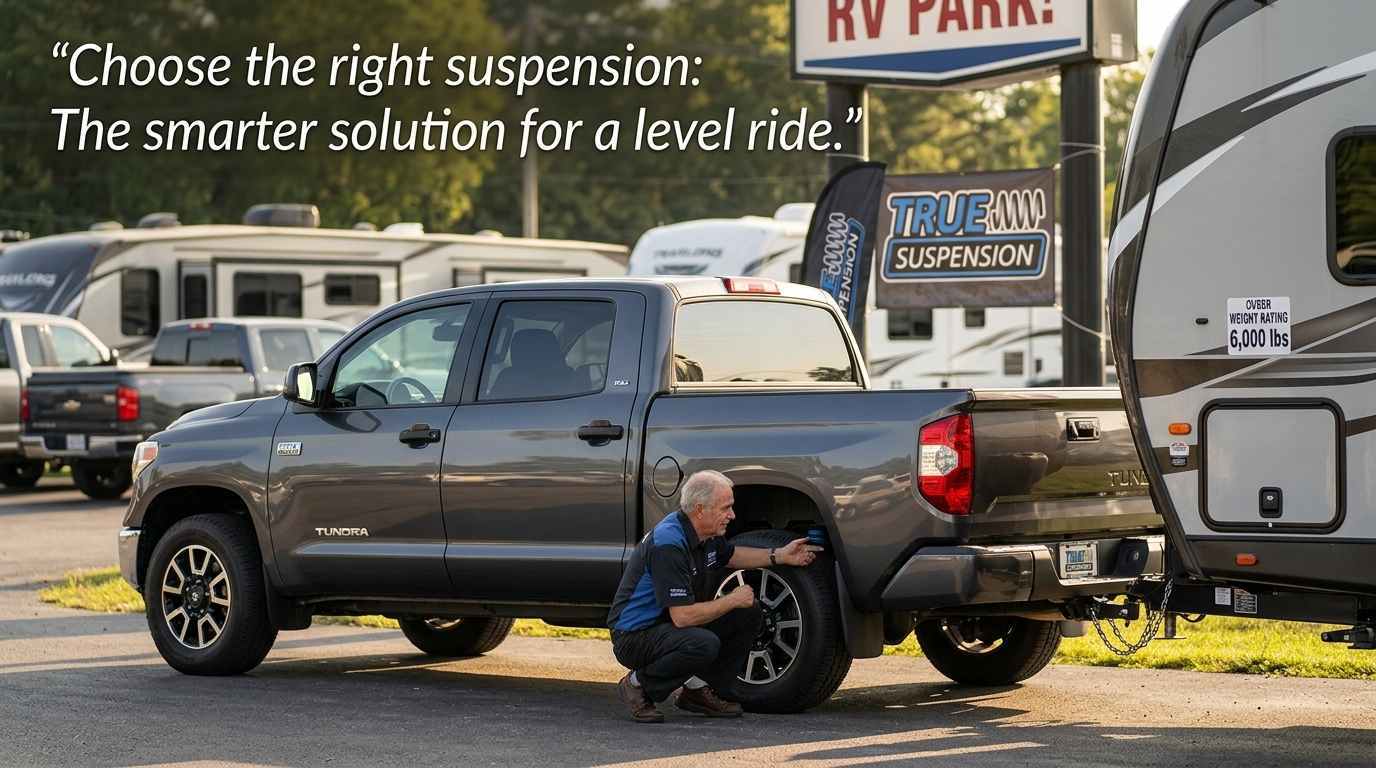
Scenario 1: Tundra Owner Who Hauls Mulch, Furniture, and Occasionally Tows a Boat → Air helper springs win. You need support for bed loads AND trailer loads. A WDH only helps on tow days.
Scenario 2: Tundra Owner Who Exclusively Tows a Heavy Fifth Wheel at Consistent Weight → A weight distribution hitch is acceptable, but adding air bags still improves overall control and protects your suspension.
Scenario 3: Tundra Owner Who Tows Near Max Capacity and Also Uses the Bed Heavily → Both: air bags for overall squat control, WDH for tongue weight distribution on heavy tow days.
Scenario 4: Tundra Owner Who Mostly Daily Drives but Occasionally Loads Up → Air helper springs; the ability to run 5 psi when empty preserves factory ride quality. You won't even know they're there until you need them.
True Suspension's recommendation:For the vast majority of Toyota Tundra owners, a vehicle-specific air helper spring kit is the smarter investment. It costs the same or less than a good WDH, protects your drivetrain, preserves your wheel alignment, and works for every type of load, not just trailers.
Conclusion
Rear squat on a Toyota Tundra is a real problem with a clear solution. When you compare air helper springs vs weight distribution hitch side by side across cost, versatility, adjustability, and long-term protection, air helper springs come out ahead for most Tundra owners.
A weight distribution hitch is a specialized tool for trailer-only towing scenarios. It does that job well. But it doesn't protect your suspension components, doesn't help with bed payload, and doesn't give you the adjustable control that air helper springs deliver.
True Suspension has built vehicle-specific Tundra towing assist air bag kits for the full 2007–2021 lineup, 2WD, 4WD, 4x4, tankless, in-cab control, and everything in between. We don't sell universal parts that almost fit. We engineer kits that fit exactly right the first time.
If your Tundra squats under load, explore our complete Toyota Tundra air helper spring lineup and find the exact kit for your configuration. Your suspension and your drivetrain will thank you.
Frequently Asked Questions
Q1: Will air helper springs eliminate rear squat on my Toyota Tundra?
Yes. When inflated correctly for your load, air helper springs restore factory ride height and eliminate visible rear squat. Pressure is adjustable to match each load precisely, making them highly effective across all payload scenarios.
Q2: Can I run air helper springs and a weight distribution hitch at the same time on my Tundra?
Absolutely. Many serious towers use both together. Air helper springs manage overall truck squat and payload support, while a weight distribution hitch handles tongue weight distribution and trailer sway control for heavy towing.
Q3: How much does it cost to install True Suspension air helper spring kits on a Tundra?
Our Toyota Tundra kits range from $250–$650 depending on configuration. Professional installation adds $150–$300 if you prefer not to DIY. Total investment is typically well under $1,000 for a complete, professional-quality towing assist system.
Q4: Do air helper springs affect ride quality when my Tundra is empty?
No. When you deflate the air helper springs to 5–10 psi for empty driving, ride quality returns to near-stock levels. This is the key advantage over static solutions like leaf spring helper kits or coilover suspension upgrades that stiffen your ride permanently.
Q5: How long do True Suspension air helper spring kits last on a Toyota Tundra?
With normal use and basic maintenance, checking air pressure seasonally and inspecting air lines annually, air helper spring systems from True Suspension are built to last 100,000+ miles. Our hardware uses quality materials rated for long-term durability under heavy towing conditions.