
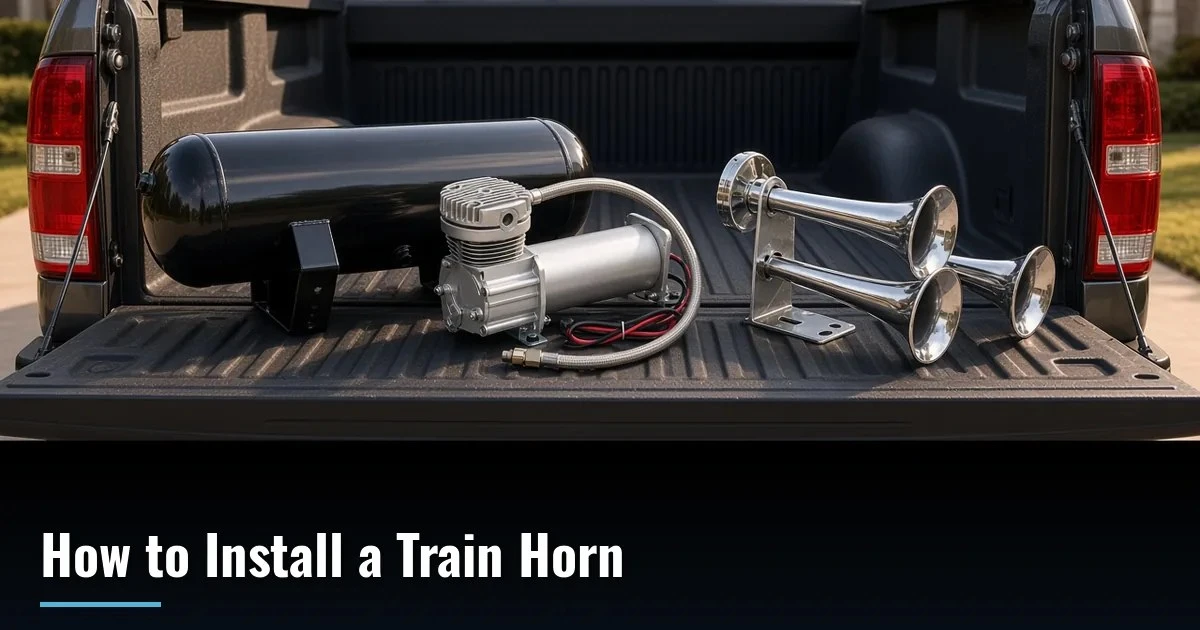
Learning how to install a train horn on a truck is mostly a mounting, plumbing, and 12-volt wiring job, plus one question that should come first: are train horns legal on trucks where you drive? This guide walks through both. We use the live Thunder Series horn system True Suspension sells — a 16-inch triple-horn setup with a 12-volt compressor and a three-gallon tank — as the example, because those are the parts we can price and describe from the product page. We will not invent torque values, wire gauges, or a single “correct” operating pressure. Follow the instructions that ship with the hardware, and treat the legal section as a starting point, not as advice from an attorney.
Prices and stock below were checked on November 27, 2026. The Thunder Series page listed the system at $402.95 (MSRP $442.00, you save $39.05), SKU 00-9800, with availability shown as in stock and Add to Cart available.
Quick Summary
- There is no single nationwide “yes” or “no.” Federal commercial-vehicle rules require a working horn that gives an adequate warning, and they do not name a specific horn style. Many states require a horn audible from at least 200 feet, ban unreasonably loud or harsh sounds, and limit use to when a warning is actually needed. Check your state and city before you install or use one.
- The Thunder Series horn system we sell is a universal, onboard setup: a 16-inch triple-horn configuration, a 12-volt compressor listed at 200 PSI maximum, a three-gallon tank, optional auxiliary ports, a one-year warranty, and a designed-in-the-USA claim on the product page. Current price on November 27, 2026: $402.95, in stock.
- A typical train horn install guide covers placement, a fused 12-volt feed with a relay and pressure switch, air line and fittings, a leak test, and a tank drain. Use the wire size, fuse rating, and torque values in the included instructions — not a guess from a forum.
- What PSI for a truck train horn? Do not exceed the 200 PSI maximum listed for this compressor, and stay inside any lower limit set by the pressure switch, the tank, or the instructions. We will not invent an operating number the product page does not publish.
- Use the horn only as a warning device. The product page states that the user assumes responsibility for installation and use, and that neither the manufacturer nor the seller assumes liability for injury, loss, or damage.
Are Train Horns Legal on Trucks?
Short answer: it depends on where you drive, how loud and harsh the sound is under that state’s wording, and how you use it. There is no federal statute we reviewed that bans a train-style horn on a highway vehicle by name. That is not the same thing as a free pass. State vehicle codes still regulate the sound a horn may make and when you may use it. Local ordinances can add more limits. This section cites the texts we opened on November 27, 2026. Laws change, and enforcement is local. Confirm the current rule with your state legislature or a licensed attorney before you rely on it. This is not legal advice.
What federal rules actually say
For commercial motor vehicles, 49 CFR § 393.81 says every bus, truck, truck-tractor, and every driven motor vehicle in driveaway-towaway operations “shall be equipped with a horn and actuating elements which shall be in such condition as to give an adequate and reliable warning signal.” The section requires a working warning horn. It does not specify a brand, a note, or a decibel number.
Federal Motor Vehicle Safety Standard No. 101 (49 CFR § 571.101), which we also opened on the eCFR, regulates how a horn control is identified in the cabin if a horn is provided. The portions we reviewed address labels, symbols, and when identification is required. They do not set a loudness cap for the horn itself.
The practical reading is narrow: federal equipment rules we cited require a reliable warning signal and, when a horn control is fitted, certain identification. They do not, in the text we reviewed, bless every possible aftermarket sound on every public road.
How three large states write the rule
The pattern in the state codes we checked is consistent, and it is stricter on use and tone than many buyers expect.
California. Vehicle Code § 27000 (FindLaw text, last updated January 1, 2026, on the page we opened) says a motor vehicle operated on a highway “shall be equipped with a horn in good working order and capable of emitting sound audible under normal conditions from a distance of not less than 200 feet, but no horn shall emit an unreasonably loud or harsh sound.” Vehicle Code § 27001 says the driver, “when reasonably necessary to insure safe operation shall give audible warning with his horn,” and that “the horn shall not otherwise be used,” except as a theft alarm that meets a separate article of the code. In plain language: you must have a working horn, it must be audible at 200 feet, it must not be unreasonably loud or harsh, and you use it for a warning, not for show.
Texas. Transportation Code § 547.501 (FindLaw text, last updated January 1, 2026, on the page we opened) requires a horn in good working condition that is audible at least 200 feet away. A motor vehicle operator “shall use a horn to provide audible warning only when necessary to insure safe operation.” A warning device, including a horn, “may not emit an unreasonably loud or harsh sound or a whistle.” The same section also limits sirens, whistles, and bells to certain emergency and theft-alarm uses.
Florida. The official 2026 Florida Statutes, § 316.271, require a horn in good working order that is audible from not less than 200 feet. “No horn or other warning device shall emit an unreasonably loud or harsh sound or a whistle.” The driver shall give audible warning “when reasonably necessary to ensure safe operation.” A violation of that section is a noncriminal traffic infraction, punishable as a nonmoving violation as provided in chapter 318.
Other states often follow a similar 200-foot-plus-“not unreasonably loud or harsh” model, but you cannot assume they do. Some jurisdictions also regulate “modified” exhaust or noise in ways that can overlap with a very loud horn. If you cross state lines, the strictest rule you will meet on that trip is the one that matters.
What this means if you install one
- Install and use the horn as a warning device, not as a toy at a stoplight or in a neighborhood.
- “Unreasonably loud or harsh” is a facts-and-enforcement standard. A system listed on a product page at 150 decibels is loud. Whether a given officer, inspector, or court treats that as “unreasonably loud or harsh” is not something a product page can decide for you.
- Keep the factory horn working unless your instructions and local rules say otherwise. Some vehicles and inspections expect a conventional warning horn in addition to any auxiliary device.
- If you drive a commercial vehicle, you still have to meet § 393.81’s “adequate and reliable warning signal” requirement. Do not disable the required warning in favor of a setup that only works sometimes.
- HOA rules, employer policies, and event venues can restrict use even when the vehicle code does not name your horn.
If any of that is a poor fit for how you planned to use the system, stop here and do not install it.

What You Need for a Train Horn Install Guide
A complete onboard setup has four groups of parts: the horns, a compressor, a tank that stores air, and the electrical and plumbing that tie them together. On the Thunder Series product page, the included pieces are listed as:
- A 16-inch triple-horn configuration
- A 12-volt compressor with a 200 PSI maximum rating, designed to run from the vehicle’s electrical system
- A three-gallon tank
- Optional auxiliary ports so you can add other air accessories later
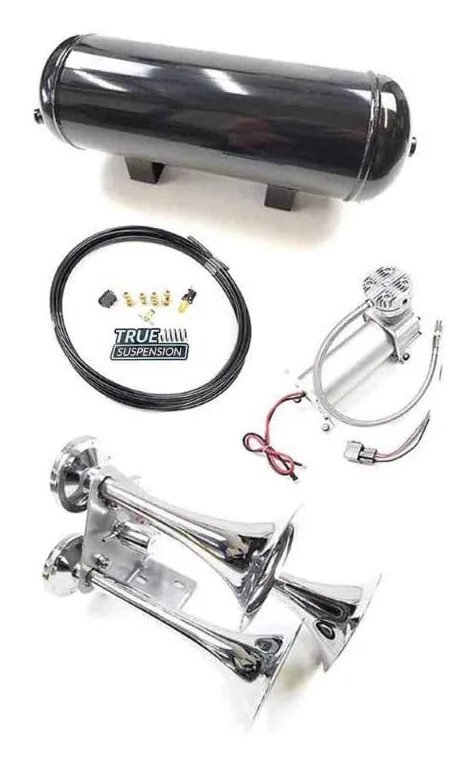
The page also states that the system is a universal application, is designed in the USA, and carries a one-year warranty. It lists a first-purchase checkout code, FirstPurchase, for 5% off. Confirm the code and the price when you order.
You will also need, unless the instruction sheet says they are already in the box, a fused lead from the battery, a relay, a pressure switch or the controller the instructions specify, a dash or column button, air line and fittings, mounting hardware suitable for the tank and compressor weight, and a way to drain moisture from the tank. For fittings and line practice, our air line fittings guide and the air ride management hardware collection are the right place to start if you need extra connectors. If you later add other onboard air, browse air ride management kits.
Tools typically include a drill and bits, wrenches, a torque wrench, a wire stripper and crimper, heat-shrink or quality insulated terminals, a multimeter, thread sealant approved for the fittings you have, and a leak-detection spray or soapy water. Jack stands and a safe way to work under the truck if you mount to the frame are not optional.
What PSI for a Truck Train Horn?
The only pressure number on the Thunder Series product page is the compressor rating: 200 PSI maximum. That is a ceiling, not a target. Many pressure switches cut out below a compressor’s maximum, and a tank and horns have their own limits. The correct operating band is the one in the instructions and on the switch that ships with the system.
So the accurate answer to “what PSI for a truck train horn” is: set and test the system inside the instruction limits, never above the 200 PSI maximum listed for this compressor, and fix any leak rather than “turning it up” to chase volume. If the instructions call for a specific cut-in and cut-out pressure, use those numbers. If they do not, do not copy a PSI value from a different brand or a forum post.
A short blast uses stored air in the tank. The compressor then refills the tank. If you hold the button down, the tank pressure falls and the compressor may run longer. That is expected. What is not expected is a compressor that never shuts off (a leak or a failed switch) or a tank that you never drain (moisture collects). Those are maintenance issues, and they shorten the life of the system. Our air ride compressor sizing guide is written for air-ride duty, but the same idea applies here: a compressor has a duty cycle, and constant running is a warning, not a normal mode.
How to Install a Train Horn on a Truck: Tools, Wiring and Air
Work on a cool, parked truck with the battery disconnect planned before you make electrical connections. Read the entire instruction sheet once before you drill a hole. If a step in the instructions conflicts with this overview, the instructions win.
1. Plan the layout
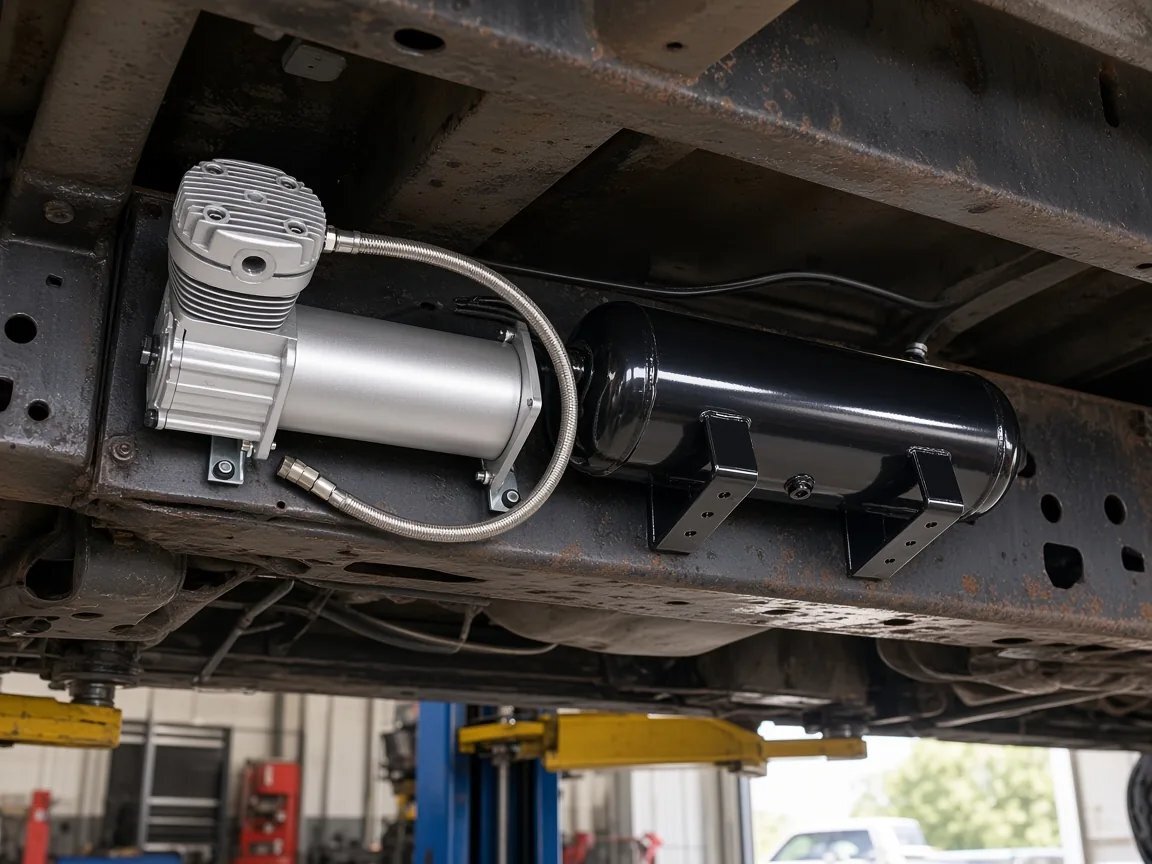
Find solid metal for the tank and the compressor: a frame rail, a bed crossmember, or a mounting plate the instructions allow. The compressor needs airflow and protection from standing water, exhaust heat, and moving driveline parts. The tank should sit where you can reach the drain. Keep the horns where they can project forward or outward without pointing at a surface that will muffle them, and where road spray and debris will not fill the bells with mud. Measure hose runs so you are not kinking line around sharp edges.
Leave room to service the fittings. A pretty install that you cannot tighten later is a leak waiting to happen.
2. Mount the tank and the compressor
Support the tank. A three-gallon cylinder is heavy once it is charged. Use the brackets and grade of hardware the instructions call for, and use lock washers or thread locker if they specify them. Do not hang a tank from thin sheet metal or a plastic bed liner. Mount the compressor so its intake is not in a dirt path, and so vibration is not concentrated on a single sheet-metal screw. Torque the mounts to the values in the instructions.
3. Plumb the air
Run the air line from the compressor outlet to the tank inlet, then from the tank to the horn valves, following the port labels. Use fittings that match the line size the kit specifies. If you need extra push-to-connect or threaded fittings, stay with hardware meant for the pressure and the tubing you have; the air line fittings article explains why a mismatched fitting leaks. Deburr holes, add grommets where line passes through metal, and keep lines away from exhaust and sharp edges. If the kit includes a safety relief or a gauge, install them where the instructions show, not wherever they “fit.”
Do not overtighten a fitting “to be safe.” That is a common way to crack a port. Use the sealant or tape the instructions allow, and only on the threads they say to treat.
4. Train horn wiring and tank setup on the 12-volt side
The compressor is a high-current 12-volt load. The usual safe pattern, which your instructions should confirm, is:
- A fused positive lead that starts at the battery, with the fuse close to the battery
- A relay that lets a small dash-button or switch circuit control the heavy compressor feed
- A pressure switch in the control circuit so the compressor starts and stops at the intended pressures
- A good ground to bare metal
- A horn button that only opens the horn valve or solenoid, which is a separate function from the compressor circuit
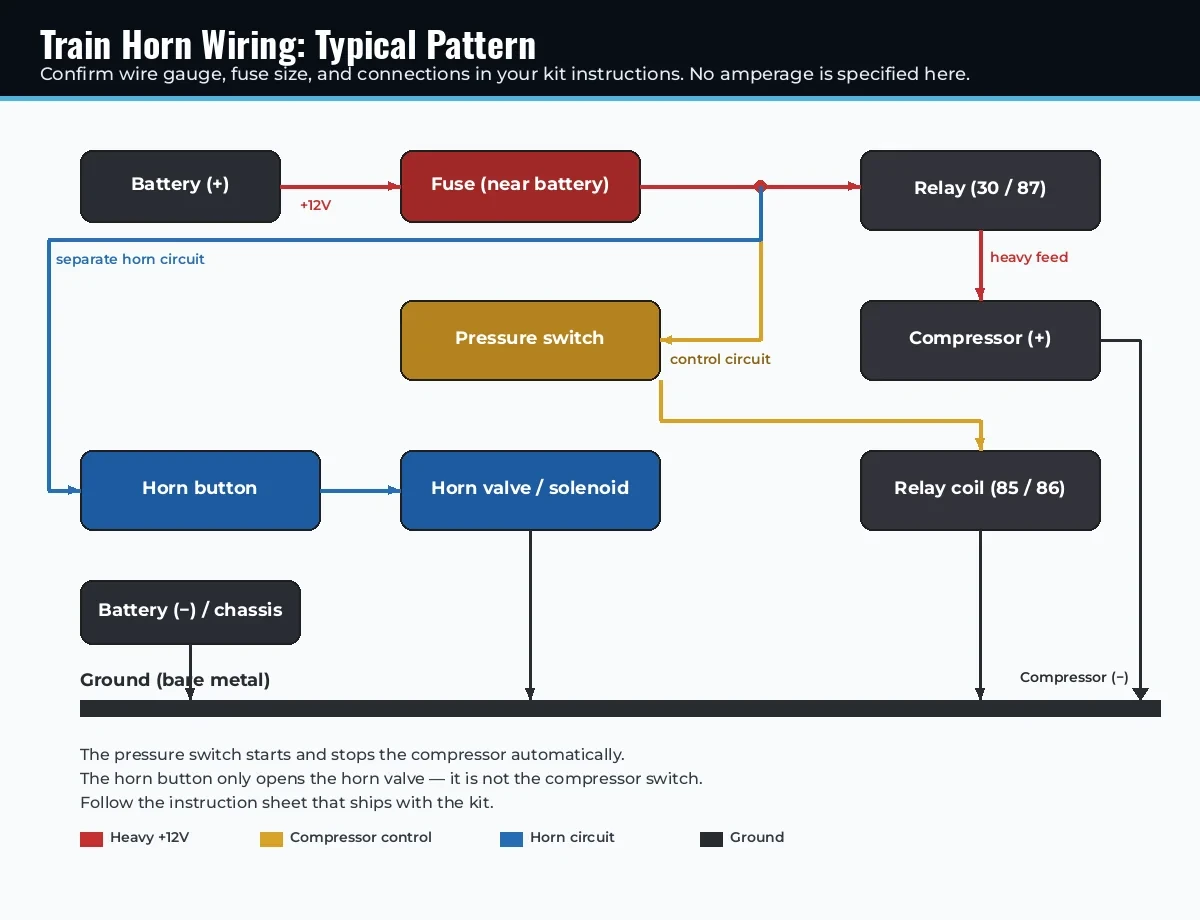
We are not publishing a wire gauge or fuse amperage here because that has to match the compressor and the instruction sheet. Undersize wire is a fire risk. Skip the fuse and you have the same risk with no protection. Crimp or solder and seal every joint. Route the button circuit through the firewall with a grommet, not through a raw punched hole.
If you are not comfortable with a fused, relay-protected 12-volt install, hire a shop that is. This is the part of the job that is least forgiving of improvisation.
5. Leak-test, drain, and function-test
Charge the tank to the instruction pressure, then stop and listen. Soap every fitting. A bubble is a leak. Fix leaks before you use the horns. Cycle the compressor to confirm it shuts off. Press the button for a short warning blast in a place where that is legal and considerate, then confirm the compressor recovers and shuts off again. Open the tank drain and check for moisture; then close it. After the first week of driving, re-check mounts, fittings, and electrical connections.
6. Common problems
- Compressor runs and never stops: leak, bad switch, or a drain left open.
- Weak sound: low pressure, a kinked line, a leaking fitting, or horns blocked with mud.
- Blown fuse or melted wire: a short, a missing relay, or a wire that is not what the instructions require.
- Vibration or a loose tank: mounts that were never torqued, or a tank hung from the wrong panel.
- Battery drain: a relay or switch that is stuck closed. Fix it before you leave the truck overnight.
After the Install: Use and Care
Use the horn the way the state codes above describe a horn: when a warning is reasonably necessary for safe operation. That is the legal and the neighbor-friendly standard.
Drain the tank on a schedule. Moisture in a tank is normal; leaving it there is how rust and a failed compressor start. If you add other air accessories to the auxiliary ports, remember that every extra valve is another leak path and another demand on the same compressor. Our air-ride maintenance habits — inspect, drain, fix leaks early — apply to this onboard air as well.
If you also run tow-assist air springs or a full air-ride system, keep the horn supply and the suspension supply straight unless a combined design is documented. You can shop tow-assist helper kits and custom air ride kits as separate systems. Do not tee a horn into a suspension line just because both use air.
Shop the Thunder Series Horn System
If you are ready to do the install, the system we used as the example is the True Suspension Thunder Series onboard horn system (SKU 00-9800). On November 27, 2026 it was $402.95, off an MSRP of $442.00, and listed as in stock. The page lists a FirstPurchase 5% checkout code for first-time orders. Confirm price, stock, and the code on the live page when you buy, and read the disclaimer on that page: you assume responsibility for proper installation and use.
Final Takeaway
How to install a train horn on a truck is a straightforward mechanical and electrical project if you follow the instructions, fuse the compressor correctly, and leak-test the air side. The harder part is using it within the law. Federal commercial rules require a reliable warning horn and do not name a style. California, Texas, and Florida — and many other states — still require a 200-foot warning, ban unreasonably loud or harsh sounds, and limit use to when a warning is actually needed. Install it cleanly, use it only as a warning, and verify the current rule where you drive.
Frequently Asked Questions
How do you install a train horn on a truck?
Mount the tank and compressor on solid metal, plumb the air line to the horns, and wire a fused 12-volt feed with a relay and pressure switch plus a dash button, all per the included instructions. Leak-test the system before you use it.
Are train horns legal on trucks?
It depends on the state and how you use the horn. There is no federal ban by that name in the rules we reviewed. Many states, including California, Texas, and Florida, require a horn audible from 200 feet, prohibit an unreasonably loud or harsh sound, and allow horn use when a warning is reasonably necessary — not for entertainment. Confirm current law where you drive. This is not legal advice.
What PSI should I run in a truck train horn system?
Do not exceed the 200 PSI maximum listed for the Thunder Series compressor, and follow the cut-in and cut-out pressures in the instructions and on the pressure switch. We do not publish a single invented operating number.
Do I need a tank to install a train horn on a truck?
The Thunder Series system we sell includes a three-gallon tank so you have stored air for a blast without waiting on the compressor. Follow that design rather than deleting the tank unless the manufacturer offers a documented tankless version, which this listing does not.
Can I wire the compressor straight to a dash switch?
That is a poor practice on a high-current compressor. Use the fused battery feed and relay arrangement the instructions specify so the switch is not carrying the full compressor current.
Will this setup fit any truck?
The product page describes a universal application and says it is designed to fit a wide range of vehicles. You still have to find real mounting space, a safe electrical feed, and a legal way to use the horn. Confirm that on your truck before you drill.
Is a 150-decibel output legal on the street?
The product page lists output at 150 decibels. Whether that is “unreasonably loud or harsh” under a state code is a legal and enforcement question, not a number we can clear in advance. Use the horn only as a warning and check your local rules.
How often should I drain the tank?
Drain it regularly, especially in humid weather or after short trips where the compressor has cycled. Moisture left in the tank shortens the life of the system.
Can I use the same compressor and tank for air tools or bags?
The product page mentions optional auxiliary ports for additional air accessories. If you add load, stay inside the compressor’s duty cycle and the tank rating, and do not improvise a tee into a suspension system unless that design is documented.
What does the Thunder Series system cost?
On November 27, 2026, the live price was $402.95 (MSRP $442.00) and the item was in stock. Recheck the product page before you order.