

Air Line Fittings Guide, How a Push-to-Connect Fitting, PTC Hardware and DOT Push-to-Connect Fittings Seal Air Brake Lines Leak-Free
Nothing ruins an air suspension faster than a slow leak. You park at night sitting perfectly, and by morning one corner is on the ground. Quality air line fittings decide whether a system holds pressure for weeks or hisses away all night.
You simply push the tube home, a collet grips it, and an O-ring squeezes it shut, and the right 3/8 inch push-in union fittings 2-pack matches your bag feed size so every joint holds full pressure. The TrueSuspension range builds on that simple, tool-free idea.
This guide walks through how the seal works, how sizes and threads match, when brake plumbing demands DOT push-to-connect fittings, and which routing habits stop leaks early. The TrueSuspension team in Scottsdale, Arizona helps truck owners pick the right pneumatic fittings daily, covering a single repair union, a valve replumb,b or a full 4-corner build.
Quick Summary
- A collet and O-ring pair seals each fitting, keeping zero air loss.
- Match each fitting to tubing OD and NPT thread, or tubes will weep.
- DOT-approved hardware is mandatory on brake lines under heat and salt.
- Brass outlasts plastic near heat; save plastic fittings for gauges.
- Keep a small push-to-connect air line kit in the glove box for roadside fixes.
How does a push-to-connect fitting seal an air line without leaking?
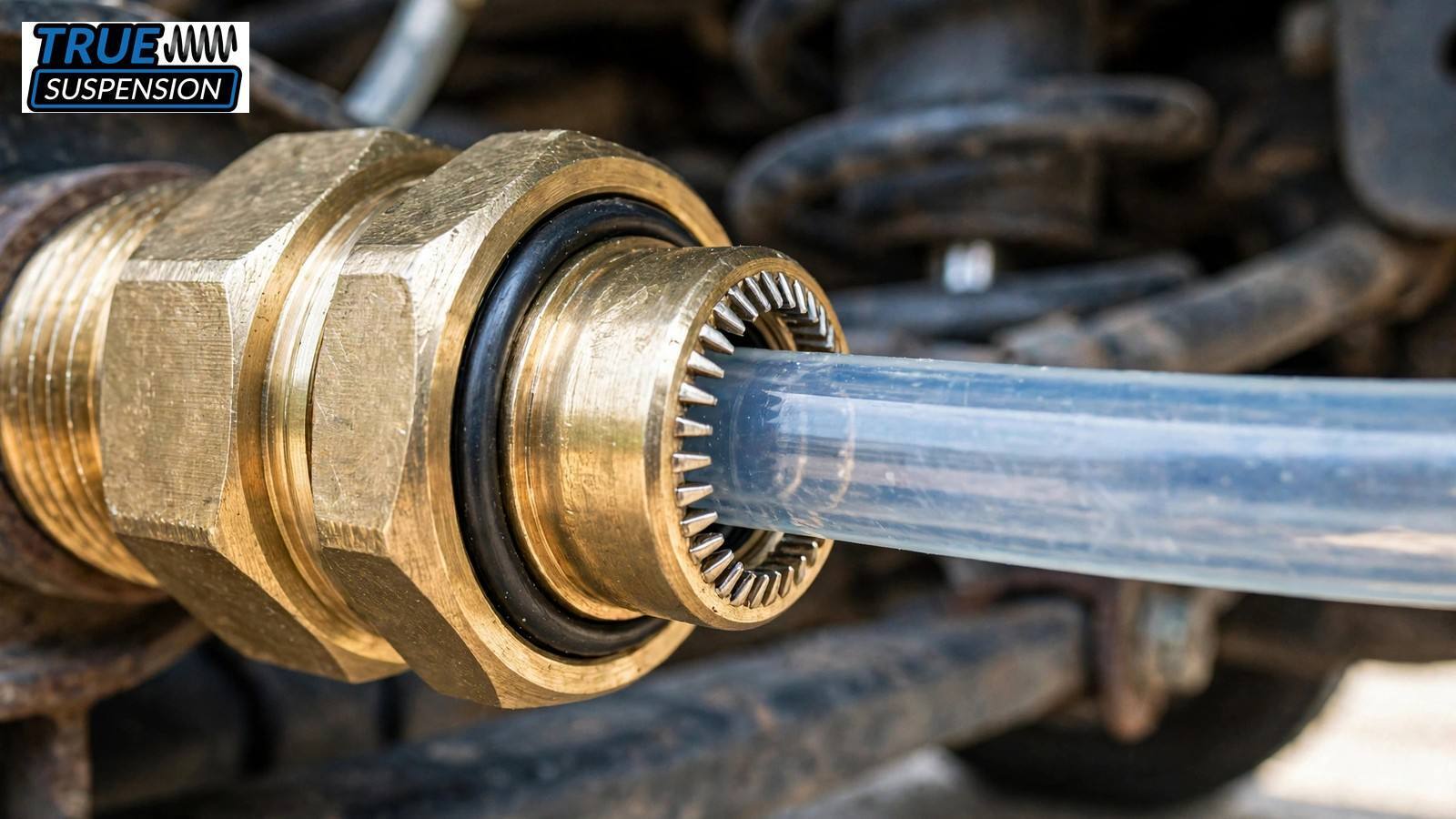
A push-to-connect fitting seals in two steps: the collet teeth bite the tube wall while the O-ring squeezes it shut, and rising pressure tightens both. Inside, a stainless collet does the gripping while the O-ring forms the leak-free seal, so the joint holds without wrench work or tape at full system pressure on every drive.
Source, O-ring
How do the collet and O-ring split the sealing work?
Builders shorten the name to PTC, because you simply push the tube in and the collet locks it, no wrench work at all. The collet teeth bite lightly into the plastic surface, while the O-ring squeezes the tube wall evenly; two jobs split between two parts that each do one task well.
Source, O-ring
Why does rising pressure make the joint seal tighter?
That self-energizing action is why push-to-connect air connections dominate modern pneumatic air builds, from shop tools to trailer brake plumbing. When system pressure rises, the fitting pushes the collet tighter against the tube, so the seal actually improves under high pressure instead of working loose over time on rough roads and long drives.
Source, O-ring
How do you release a tube without cutting fresh line?
To release the tube, press the collet ring flat and pull, which is why roadside repairs take seconds. Each fitting can be reused many times, exactly what PTC fittings were designed for. A small 1/4 inch push-in union fittings 2-pack covers most gauge line repairs and rides along as a handy spare.
Source, O-ring
Quick Summary
- The collet grips, O-ring blocks, and pressure tighten the joint.
- Square cuts and clean tube matter most.
- Spray soapy water; leaks show fast.
Source, O-ring
What sizes do air line fittings come in, and how does tubing OD decide the match
Size matters more than brand. Sizes match two numbers: tubing outside diameter and thread size, and most builds use 1/4, 3/8, or 1/2 inch nylon tubing. An air line fitting must match both dimensions, because an air line that is even slightly undersized will weep under pressure during daily driving and heat cycles.
Source, Nylon
Which tubing size suits gauges, bag feeds and high flow runs?
Most builds use 1/4 inch nylon tubing for gauges and valves, 3/8 inch for bag feeds, and 1/2 inch where flow matters most. Threads are inch NPT standard, most commonly 1/4, and the straight side of a NPT male straight adapter seals with its O-ring, not with tape for reliable sealing.
Source, Nylon
Why does an undersized tube weep under pressure?
Always match your fittings to the tubing OD, because a loose tube leaves a gap the O-ring cannot close. Cut every hose end dead square, since an angled cut is the number one cause of a slow seep. A 1/2 inch push-in union fittings 2-pack keeps high-flow discharge runs breathing freely and sealing cleanly.
Source, Nylon
Quick Summary
- Match fitting to OD and thread; cut ends square.
- A tube support keeps the soft tube round inside.
- Union fittings join two tube ends, with no threaded port.
Source, Nylon
How do NPT threads and square cuts protect a leak-free seal?
Square cuts and clean threads protect the seal because the tube face and port face must meet evenly every time. A tube support insert keeps the soft tube round inside the collet, while union fittings join two tube ends without a threaded port. Quality air line fittings from TrueSuspension reward that care with a lasting joint.
Source: National pipe thread
How does an NPT male straight port seal on its O-ring?
An NPT male straight adapter seals on its O-ring against the port face, not with tape on the threads. The straight side sits flat, the O-ring squeezes shut, and the seal holds as pressure rises. Threads are inch NPT standard, most commonly 1/4, so matching thread to component matters as much as matching tube size.
Sourc:, National Pipe Thread
Why do a tube support and a depth mark protect soft tubing?
Cut every hose end dead square, since an angled cut is the number one cause of a slow seep in a run. A depth mark shows the tube reached the internal stop, past the collet for a full seat. Replace collets a tube slides into too easily, since a worn collet will not hold.
Source: National pipe thread
Quick Summary
- Square cuts and depth marks confirm full seating.
- A tube support keeps tubing round for even grip.
- Replace worn collets before seeps become leaks.
Source: National pipe thread
When do air brake lines need DOT-approved fittings and an air brake union?
Brake plumbing needs DOT-approved hardware because brake connections face heat, vibration, and pressure spikes accessory lines never see. When the plumbing feeds an air brake, the rules change, and only tested hardware can legally join lines on a highway trailer. TrueSuspension stocks air line fittings rated for hard brake service and road spray.
Source: Air brake (road vehicle))
What does the D.O.T. stamp prove about an air brake fitting?
ADOT-approved air brake fitting must survive the heat, vibration, and corrosion testing that air brake service demands, and the D.O.T. stamp proves testing passed. Trailer fittings live a hard life, dragged through road spray and baked by exhaust heat, so stamped hardware gives owners a trusted mark to check before any run.
Sourc:, Air brake (road vehicle))
When does a splice need a proper air brake union?
Use a proper air brake union for inline splices, never a hardware store pneumatic part, because brake connections see pressure spikes that accessory lines never will. Towing builds lean on the same discipline; see the tow assist air bag kits ultimate guide for the load side, and treat every brake fitting as a safety part.
Source: Air brake (road vehicle))
Why do brass bodies suit heavy truck brake runs?
For heavy trucks, a DOT air fitting for trucks uses a corrosion-resistant brass body that shrugs off road salt, and DOT-approved air parts are marked on the body for a glance check. Every air brake system relies on that durability, since sealing standards have only grown stricter through years of hard highway service.
Source: Air brake (road vehicle))
|
Feature |
DOT approved |
Non-DOT |
|
Burst rating |
Tested to federal spec |
Varies by maker |
|
Vibration resistance |
Lab tested |
Not guaranteed |
|
Legal for air brakes |
Yes |
No |
|
Body marking |
DOT stamp on body |
Usually none |
Quick Summary
- Brake lines need DOT-approved hardware and proper unions.
- Brass suits salt and heat; stamp visible at a glance.
- Choose hardware whose fittings meet federal spec.
Source: Air brake (road vehicle))
Push-to-connect fittings vs. compression fittings, which wins for adaily-drivenn truck
.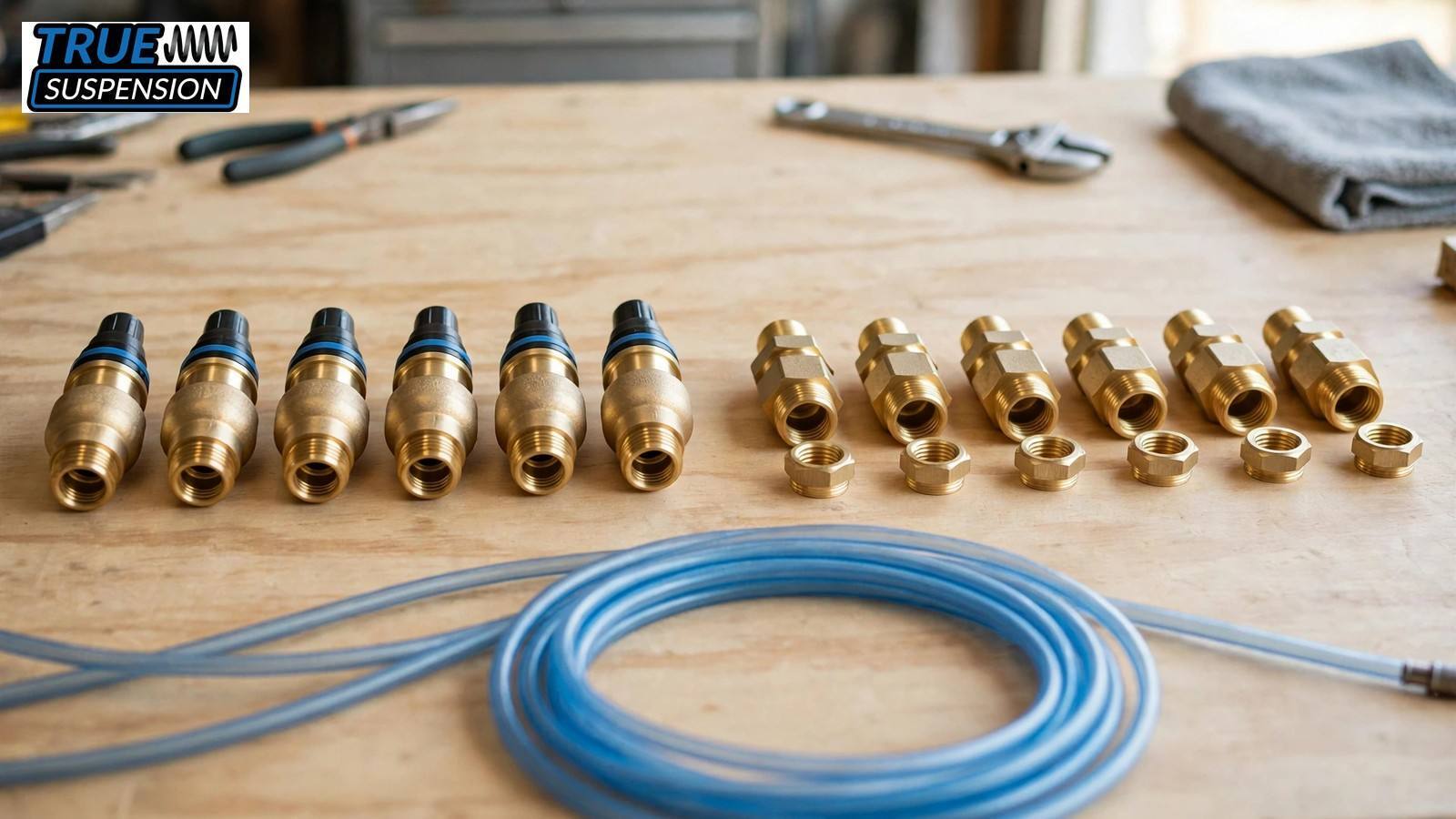 Push-to-connectfittings win on serviceable lines because they install in seconds with no tools, while compression suits permanent hard lines that rarely move. For a daily driven truck, service speed beats saving a few dollars per joint, and quality air line fittings in push style let a driver fix leaks roadside without wrenches.
Source: Compression fitting
|
Fitting style |
How it seals |
Install speed |
Best for |
|
Push-to-connect |
Collet plus O-ring |
Seconds, no tools |
Air ride and cab plumbing |
|
Compression |
Ferrule squeezed by nut |
Minutes, needs wrenches |
Permanent hard lines |
|
Barb plus clamp |
Hose stretched over barb |
Minutes |
Low pressure accessories |
How does a compression fitting seal by crushing a ferrule?
A compression fitting joint seals by crushing a ferrule around the tube as the nut tightens, and that squeezed metal ring creates the grip and seal in one move. The classic fitting works great once, but forgives little on reassembly, because the ferrule deforms permanently and careful torque decides whether the joint holds or weeps.
Source,:Compression fitting
What are the pros and cons of push-to-connect for serviceable lines?
For a daily-driven air fitting that might be serviced on the roadside, the quick-connect fitting style wins on speed and repeatability across pneumatic air builds. Push-style joints reseat cleanly after service, while compression joints need fresh ferrules and more time, so owners weigh higher piece cost against faster repairs and fewer tools carried.
- Push-to-connect pros: installs in seconds, reusable, needs no tools
- Push-to-connect cons: costs more per piece, demands square cuts
- Compression pros: cheap, permanent, very high pressure rating
- Compression cons: slow to install, ferrule is single-use
Source: Compression fitting
Where does each style belong in one build?
Use compression where a line will never move again, like a hard NPT male straight tank port, and push-to-connect wherever a hand may service it at bags and valves. If most runs are 3/8 inch bag feeds, check the 3/8 inch push-in union fittings 2-pack for the union style recommended on serviceable joints.
Source: Compression fitting
Quick Summary
- Push-to-connect wins on serviceable lines, fast and reusable.
- Compression suits permanent hard lines, cheap and strong.
- Mix both styles: push at bags, compression at tank.
Source: Compression fitting
Why does a brass push-to-connect air fitting outlast plastic on an air hose?
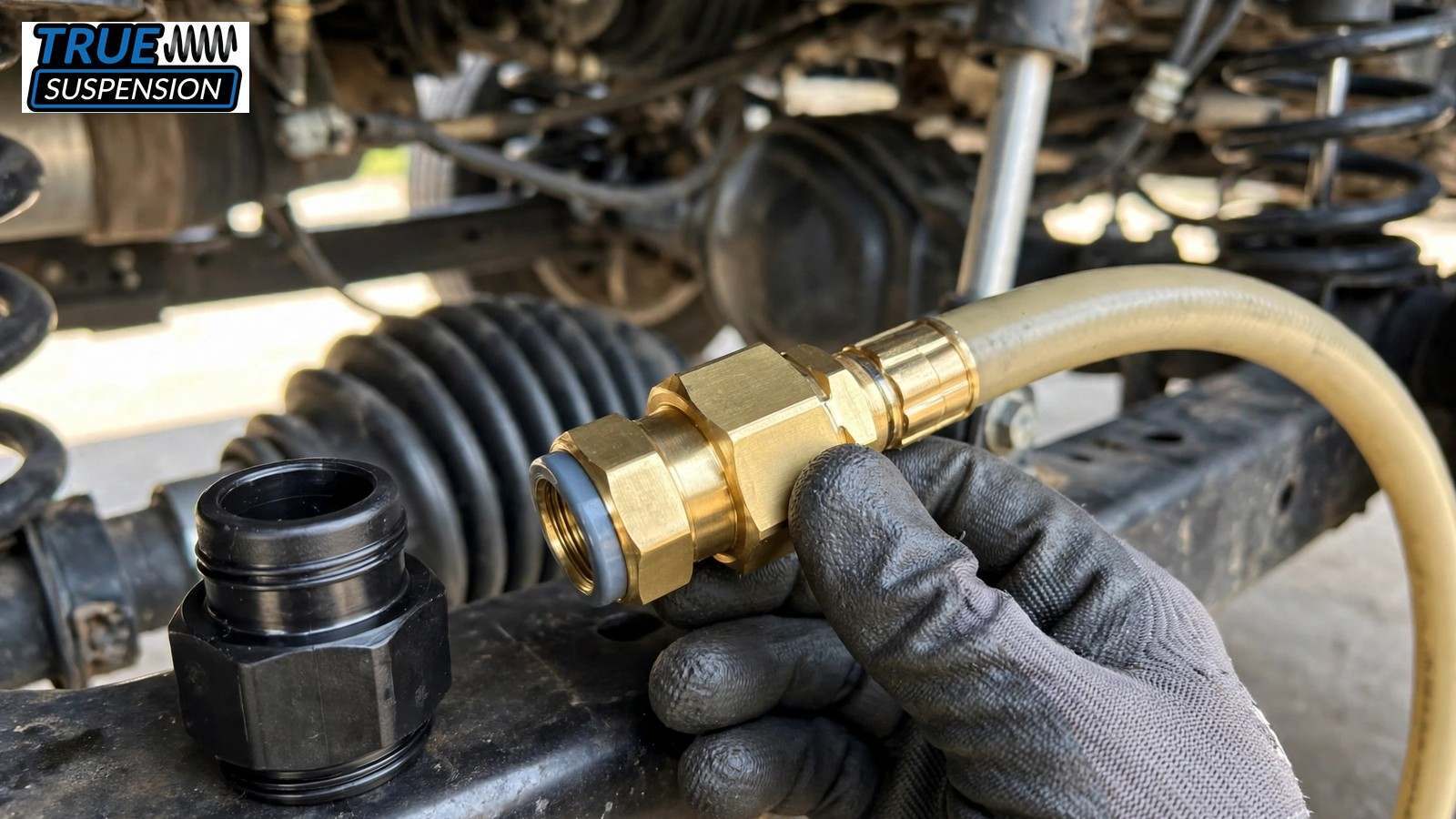
Brass push-to-connect air fitting hardware outlasts plastic near heat and road salt, and a brass push-to-connect body shrugs off moisture while its corrosion-resistant nickel plating earns trust. Fleets trust brass on air hose runs through summer traffic and winter slush, and quality air line fittings in a nickel-plated brass fitting body outlast plain steel.
Source, Brass
Where does plastic push-to-connect stay safe?
Plastic push-to-connect parts and plastic fittings have their place on interior gauge lines, where temperatures stay cool, and runs stay protected inside the cab. Keep plastic air fittings away from exhaust heat, and reserve them forlow-stresss gauge work, where they stay safe and serviceable, while harder exterior runs move to brass.
Source, Brass
How does heat age plastic air hardware near the compressor?
Heat is the enemy of plastic components near the compressor discharge line, so keep gauge lines away from exhaust manifolds and turbo plumbing. Sustained heat softens nylon and weakens the collet bite, while a brass DOT push lock air coupler grips under vibration, and a manual tow assist air hose fill kit shows brass handling harder runs.
Source, Brass
Quick Summary
- Brass wins near heat and salt; its corrosion-resistant body lasts.
- Plastic push-to-connect stays safe on cool gauge lines.
- Match material to the zone, every run lasts longer.
Source, Brass
How do push-in fittings work, and how do the fittings push to seal?Push-inn fittings work in three moves: cut square, push the tube past the internal stop, then tug back to set the collet. Inside quality air line fittings, fittings push the collet teeth into the tube wall while the O-ring squeezes the tube shut, and rising pressure tightens both for a leak-free seal at full pressure.
Source, O-ring
What are the three moves: cut square, push home, tug to set?
Cut every tube end dead square first, because an angled cut lets air escape past the O-ring. Push the tube firmly past the collet and the internal stop until the depth mark meets the fitting face. Tug back lightly to set the collet teeth, then press again to confirm the tube stays seated and holds pressure.
Source, O-ring
Parts Bench Note: how the Scottsdale team proves every joint before blaming the bags
Parts Bench Note: the Scottsdale team marks depth on every tube before pushing it home, so seating shows at a glance. A cutter rides in the glove box, every joint gets sprayed with soapy water, watched for bubbles, a plier helps with tight release rings, and color-coded tubing runs red for supply, blue for bags.
Source, O-ring
How does a push-in union fix a damaged line trailside
A push-in union splices a damaged line fast. Cut out the bad tube, square ends on both sides, push each end home, tug to set the collets, and pressure test. With needle-nose plier jaws, you depress the release ring in tight spots, and the same logic scales up in the custom vs universal air ride kits comparison.
Source, O-ring
Quick Summary
- Cut square, push home, tug to set, test.
- Mark depth and spray each joint, watch for bubbles.
- Keep a cutter,pliers,r and spare unions onboard.
Source, O-ring
Which air hose fittings and quick connect choices suit pneumatic lines best?
Air hose fittings point along suspension travel, seal at bulkheads without chafing, and match the shop quick connect fitting style, so routing stays gentle, and lines survive. Quality air line fittings from TrueSuspension suit pneumatic lines best when every run gets a gentle bend radius, no side load, and protection from sharp edges and heat.
Sourc:, Air suspension
How do you route pneumatic lines for movement instead of reach?
Think about movement before you tighten anything, because pneumatic lines flex with every cycle and a fitting that points against the travel arc works its tube loose. A bulkhead air line connector passes tubing through panels without chafing, and a service loop at each corner leaves slack for full droop with no kink at full compression.
Source: Air suspension
What does a quick connect air hose fitting add at the manifold?
A quick connect air hose fitting at the manifold makes shop air a one-hand job, speeding tire inflation and feeding pneumatic air tools. A manifold such as the 8-valve FBSS air ride manifold block gives each run a labeled port, quality hardware keeps pneumatic systems easy to expand, and a quick release pneumatic coupler stays ready.
Source, Air suspension
Quick Summary
- Route for movement, gentle bends, no side loads.
- Leave service loops at each corner for full travel.
- Keep plastic runs inside the cab.
Source: Air suspension
What should a DOT push-to-connect air line kit include for a full build?
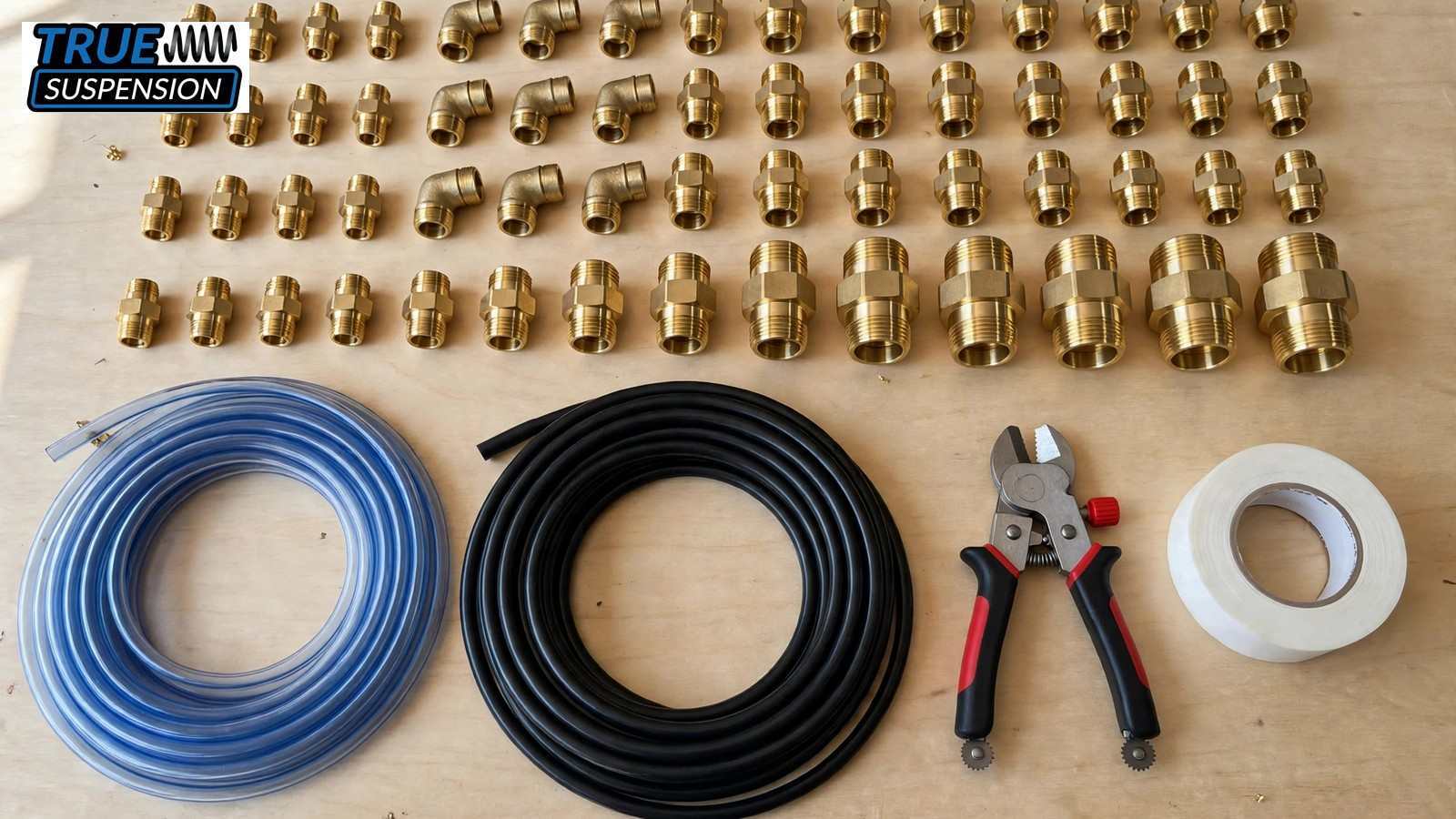
Buying one piece at a time gets expensive, which is why a DOT air line fittings kit covers a whole build in one box. TrueSuspension stocks DOT push-to-connect fittings in 1/4, 3/8, and 1/2 inch, including push-to-connect air line unions, elbows, and tees for every run on the truck or trailer.
Source: Air brake (road vehicle))
What does a kit push assortment cover across sizes?
A kit push assortment keeps every size on hand when a valve or gauge needs replumbing, and one box covers unions, elbows, and tees for gauges, bag feed,s and discharge runs. A compact 100 percent duty cycle air compressor pairs well with the larger sizes, and the table below maps each size to its usual job.
Sour:e, Air brake (road vehicle)
|
Kit size |
Tube OD |
Typical use |
|
1/4 inch |
1/4 |
Gauges, valves, paddle switches |
|
3/8 inch |
3/8 |
Bag feeds, faster fill |
|
1/2 inch |
1/2 |
High-flow compressor discharge |
Why do PCS brass DOT air line packs anchor the box?
Their PCS brass DOT air line packs and DOT-approved 2-piece union sets mean you always have spares on the bench, and every union earns its place because its fittings meet the burst and vibration numbers that brake service demands require. A brass body earns its keep anywhere heat cycles daily, shrugging off road salt through winter slush.
Source, Air brake (road vehicle))
Quick Summary
- Buy one kit of air line fittings, not single pieces; cover the build in one box.
- Keep spares in every size, brass for hot zones.
Source: Air brake (road vehicle))
What fitting mistakes cause leaks in an air brake system?
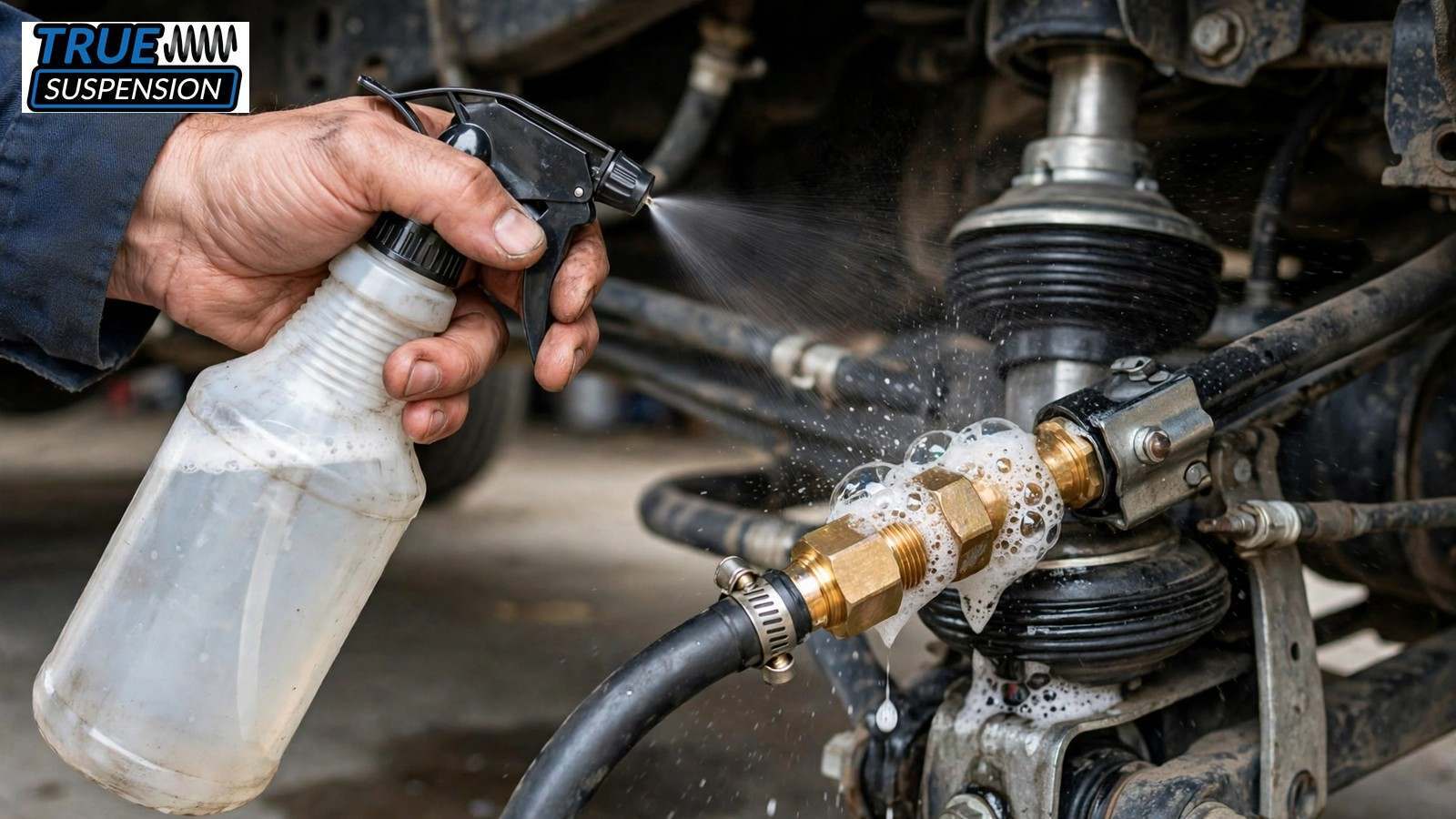
Most leaks trace to five habits: crooked cuts, scored ends, mismatched sizes, tape on sealing threads, and twisted joints. The top mistake is skipping the square cut, and the second is mismatched air line fittings on mixed sizes, because forcing a 6mm tube into a 1/4 inch collet feels close until it blows out.
Source, O-ring
What five habits sit behind most fitting leaks?
Other classics include reusing a scored tube end, which ruins the leak-free connection, skipping a tube support inside soft tubing, and fitting a hardware store part where a DOT air fitting for trucks belongs. Forcing mismatched sizes feels close enough at the bench until pressure climbs and the joint blows out on the road.
Source, O-ring
Why do tape and twisted joints undo good hardware?
Tighten the NPT side first, then push the tube in last, so you never twist a made joint, and remember that inch NPT threads seal on the thread, not tape. Secure each tubing air line with cushioned clamps every 18 inches, and a fresh 2600 series double convoluted air spring deserves the same untwisted routing.
Source, O-ring
How does pressure testing overnight prove the build?
Pressure testing beats hoping, so charge the system, walk away for an hour, and check the gauge on return, because any drop points to a weak joint. Repeat overnight, since systems that hold pressure for 24 hours hold it for weeks, and the questions to ask before buying a lift kit list helps owners plan the job.
Source, O-ring
Quick Summary
- Cut square, match air line fittings to size, keep tape off sealing threads.
- Tighten threads first, then pressure test overnight.
- A leak-proof system aims for zero air loss, and soapy water remains the best air leak check.
Source, O-ring
Final Takeaway
Choose proven air line fittings once, and the system disappears into the background. Cut square, push firmly, pressure test with soapy water, and buy DOT-approved air hardware near brakes. Start with a DOT kit so one order covers the job, and check the 3/8 inch push-in union fittings 2-pack for the anchor union style.
Source, Air suspension
- Start with a parts list and sketch, counting every port on tank, manifold, valves and bags.
- Add spares in each size; a PCS brass DOT air line pack covers most, and lay the kit push assortment out first.
- Keep spare O-rings, unions, a plier, and a brassDOT push-lockk air coupler in the glove box, plus a quick-release pneumatic coupler.
Source: Air suspension
By the TrueSuspension parts team, Scottsdale, Arizona.
Frequently Asked Questions
What does DOT approved mean for a push-to-connect fitting?
It means the air brake fitting passed federal brake service tests for burst strength, vibration, and corrosion, so it is legal to join brake lines on the highway, and anyDOT-approvedd air fitting carries that stamp for a quick glance check at inspection, because brake connections face pressure spikes accessory lines never see.
Source: Air brake (road vehicle))
What size air line should I run to my air suspension bags?
Most bag feeds run 3/8 inch tubing, because it fills and lifts faster than 1/4 inch without the bulk of 1/2 inch. Gauge lines usually stay 1/4 inch, while high-pressure runs off the compressor often step up to 1/2 inch for cooler flow.
Source: Compression fitting
How many fittings does a full 4-corner air suspension build need?
A typical 4-corner build uses 20 to 30 fittings once you count the air line fittings at valves, bags, tank, gauges, and manifold ports. Buy spares in each size, because one damaged collet on install day can stall the whole build.
Sourc:, Air brake (road vehicle))
My truck drops overnight, and I cannot find the lea. Whatt am I missing?
You are most likely missing a joint that weeps only under pressure or after a heat cycle, common with crooked cuts and scored tube ends. Charge the system, spray every joint with soapy water, and watch for slow bubbles. Recheck after the first drive, since warm nylon reveals weak seats.
Source, O-ring
Can I reuse push-to-connect fittings, or are they one and done?
You can reuse PTC fittings many times, as long as the collet teeth and the O-ring stay undamaged. Press the release ring, pull the tube, and cut a fresh square end before reseating. Pressure test afterward, because a scored tube end, not the fitting, causes most repeat leaks.
Source, O-ring
Does TrueSuspension sell DOT-approved fittings for brake lines, or only air suspension parts?
TrueSuspension sells both, with a DOT-approved range whose fittings meet federal brake rules, built for air brake service alongside the suspension push-to-connect hardware. Check the product page for the DOT marking before ordering, and keep brake plumbing on stamped hardware only, never accessory fittings.
Source: Air brake (road vehicle))
How do I know which fitting size to order from TrueSuspension for my truck?
Match two numbers: the outside diameter of your tubing and the thread size of its port, most often a 1/4 inch NPT male straight port. The product pages list both, and the Scottsdale team helps owners confirm the pairing before an order ships, so parts fit the first time.
Source: Compression fitting