
Lift shackles are the simplest way to raise the rear of a leaf-spring truck. They swap the factory shackle, the short swinging link at the back of each leaf spring, for a longer one, so the frame sits higher over the axle without new springs, blocks, or cutting. If you drive a Tacoma, Frontier, Xterra, Colorado, F-150 or similar pickup that sags in the back or sits lower than the front, this is where most owners start.
This guide explains how lift shackles work, how much lift extended shackles really give, and how to install rear lift shackles in your driveway. We also cover what to check afterward and when a different part makes more sense. (Looking for the rigging hardware that hoists loads? That is a different part, so this guide is only about suspension.)
Quick Summary
- A lift shackle is a longer replacement for the factory rear shackle. It raises the rear by changing where the spring hangs from the frame.
- Rule of thumb: the axle gains about half of the extra shackle length, so a 2-inch longer shackle gives roughly 1 inch of lift at the axle.
- True Suspension shackle kits listed here run from $64.95 to $151.95, and the complete F-150 kit with front struts and rear shackles is $319.95.
- Most installs are a 1.5 to 2.5 hour job with basic hand tools, jack stands and a torque wrench.
What Are Lift Shackles and What Do They Do?
A leaf spring is a stack of curved steel plates. The front end bolts straight to a fixed hanger on the frame. The rear end hangs from the frame on a shackle, a short link that swings so the spring can lengthen as it flattens over bumps (see how a leaf spring works). The axle is clamped near the middle of the spring.
A lift shackle does the same job, only longer. Because the rear eye of the spring now hangs lower from the frame mount, the frame, bed and body ride higher above the axle.
Where the shackle sits on your truck
Look at the rear end of each rear leaf spring, where it meets the frame under the bed. The shackle is the pair of plates, or the single bracket, connecting the spring eye to the frame. There is one on each side, so a kit is always sold as a pair.
Lift shackles vs. stock shackles
Stock shackles are stamped to one length. Lift shackles are cut and bent longer, and some are adjustable so you can pick a height inside a range. The adjustable 1 to 1.75 inch shackles for the 1996-2004 Tacoma are one example. If you drive a first-generation Tacoma, our 1st Gen Tacoma adjustable rear lift shackles guide goes deeper on that model.
How Do Lift Shackles Work?
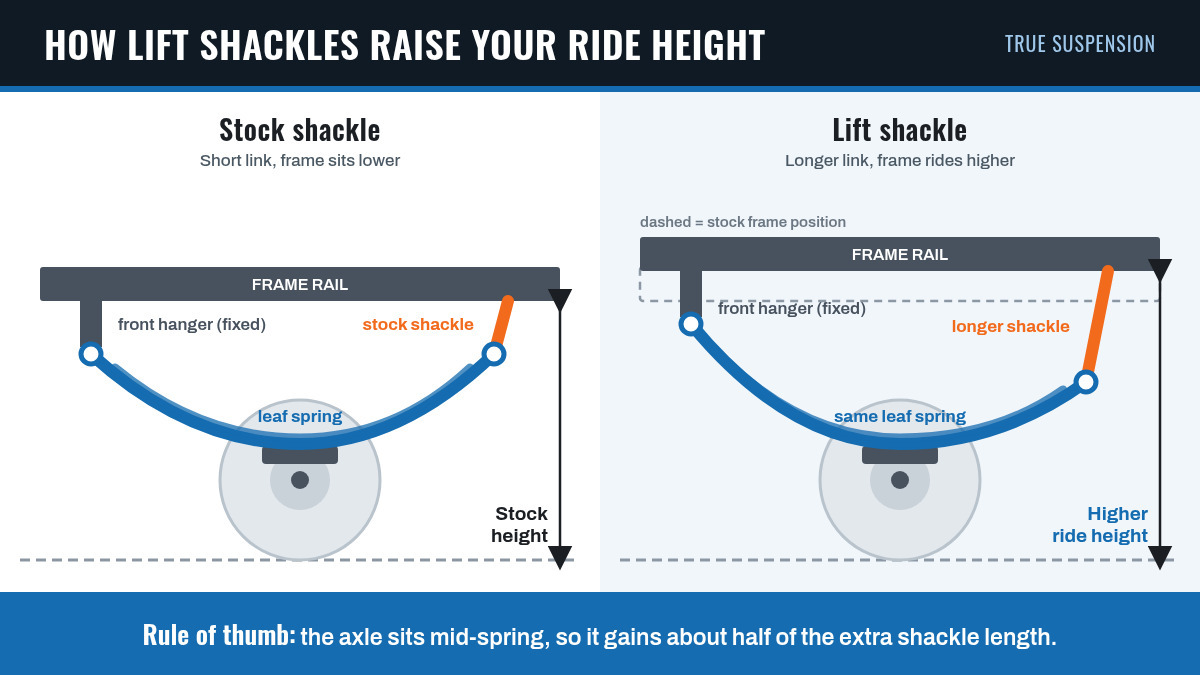
The idea is geometry, not extra spring. A longer shackle moves the rear spring eye farther from the frame mount. The frame has to rise relative to the axle to make room, and that rise is your lift.
The 2:1 rule: why the axle only gets half
The axle is bolted to the middle of the spring, so a height change at the shackle end is cut in half at the axle. Core 4x4 explains it this way: add 2 inches to the shackle length and you get about 1 inch of lift at the axle. True Suspension's listings use the same ratio. The Frontier kit page describes a 2:1 lift ratio that delivers a 2-inch rear lift.
What stays the same
The springs, shocks and axle location do not change. That is why a shackle lift is one of the least invasive ways to raise a rear end, and why it is a favorite for leveling a truck that sits nose-high.
How Much Lift Do Extended Shackles Give?
It depends on the kit. Most bolt-on shackle kits for pickups give between 1 and 3 inches. The table below lists the shackle kits and shackle-based complete kits we carry, with the lift stated on each product page and the price at the time of writing (checked November 19, 2026).
| Vehicle | Kit | Stated rear lift | Price |
|---|---|---|---|
| Nissan Xterra 2005-2014 | Rear lift shackle kit | 2 in. | $64.95 |
| Nissan Frontier 2005-2019 | Rear lift shackle kit | 2 in. | $68.95 |
| Toyota Tacoma 1996-2004 | Adjustable shackles | 1 to 1.75 in. | $84.95 |
| Chevy/GMC Colorado and Canyon 2015-2019 | Strut spacers plus adjustable shackles | 2 to 3 in. (rear shackles) | $151.95 |
| Ford F-150 2004-2013 4WD | Complete kit: 3 in. front lift struts, rear shackles and shocks | 2 in. (rear shackles) | $319.95 |
Fitment differs by year, cab and drivetrain, so open the product page and confirm your exact truck before you order.
Why your real-world lift can differ
Listed lift is a base figure. Load, spring sag and how your truck sat before the install all change the final number. Max Trac's shackle instructions say the same thing: payload and starting ride height vary, so measure before you begin. A truck that has been towing for years may gain a little more at the rear than the same kit on a new truck. Measure from the center of the wheel to the fender lip before and after so you know what you actually got.
How much shackle is too much?
There is a limit. Core 4x4 recommends moving to new leaf springs when you need more than about 4 inches of rear lift, because very long shackles can cause poor ride quality, geometry problems and axle wrap. For most trucks, 1 to 3 inches is the sweet spot.
Parts Bench Note: if you plan to lift only the rear, keep the front in mind. A rear-only lift on a truck that is already level will leave it sitting tail-high. Pair it with a front leveling part, or choose a complete kit.
Quick Summary
- Most pickup shackle kits give 1 to 3 inches of rear lift.
- Listed lift is a base figure. Measure before and after.
- Past about 4 inches, leaf springs usually make more sense than longer shackles.
Lift Shackles vs. Lift Blocks vs. Lowering Shackles
Shackles are one of three common ways to change rear height on a leaf-spring truck.
| Method | How it works | Good to know |
|---|---|---|
| Lift shackles | Longer link at the rear spring eye | No U-bolt changes. Lift at the axle is about half the shackle change. |
| Lift blocks | Spacer between spring and axle with longer U-bolts | Taller gains are possible. Tapered blocks help correct pinion angle. |
| Lowering shackles | Same part idea, used to drop the rear | Covered in our lowering springs vs. lowering shackles guide. |
If you are comparing the full range of options, start with the lift kits page. For individual parts, browse lift suspension parts.
Which Trucks Use Lift Shackles?
Any truck with leaf springs in the rear can use them. These are the platforms we support today:
- Nissan Frontier and Xterra. Both have simple 2-inch shackle kits, and complete kits that pair the shackles with front strut spacers. See the Frontier and Xterra lift kit guide.
- Toyota Tacoma. Adjustable shackles level the 1996-2004 models.
- Chevy/GMC Colorado and Canyon. A 2015-2019 kit pairs 3-inch front strut spacers with adjustable rear shackles.
- Ford F-150. A complete 2004-2013 4WD kit combines 3-inch front lift struts with 2-inch rear shackles and shocks.
How to Install Lift Shackles
Installing rear lift shackles is a job most experienced DIYers can do with jack stands and a few hours. Max Trac lists about 1.5 hours for its shackle install, or 2.5 hours if cutting is required on a given truck. True Suspension's listings recommend a professional installer for anyone without the right equipment, because suspension parts hold heavy loads.
Tools you will need
- Floor jack and two jack stands rated for your truck
- Socket set and breaker bar (the size depends on your kit hardware)
- Torque wrench
- Penetrating oil, applied the day before if bolts look rusty
- Grease gun and grease for the bushings
How to install rear lift shackles, step by step
- Measure first. Write down the distance from the center of each rear wheel to the fender lip. You will compare it afterward.
- Lift and support the truck. Park on level ground, chock the front wheels, raise the rear and put jack stands under the frame rails. Keep the floor jack under the differential.
- Support the axle. Raise the jack slightly so the spring is no longer pulling on the shackle.
- Remove the old shackles. Take out the lower bolt first, then the upper bolt. Do one side at a time so the spring stays in place. On some trucks the bolt sits under the bed or a hitch, which may need to be loosened first. Max Trac notes this for several GM and Ford pickups.
- Prepare the new shackles. Grease the bushings thoroughly. If your kit is adjustable, set the length as the kit instructions say.
- Install loosely. Fit the upper bolt, swing the spring eye into place and fit the lower bolt. Hand-tighten only.
- Repeat on the other side. Match the shackle setting left and right.
- Lower the truck and settle the suspension. Bounce the rear a few times, then torque the bolts with the truck on the ground. Max Trac warns never to tighten bushings while the truck is in the air.
- Torque to spec. Use the number from your kit or factory manual. Published specs differ by truck. Max Trac lists 100 ft-lbs for 14 mm bolts and 150 ft-lbs for 16 mm, while Core 4x4 lists 140 ft-lbs on its Jeep XJ kit.
- Measure again and test drive. Compare your new numbers, then take a short drive and re-check every bolt.
Parts Bench Note: two mistakes cause most comebacks. One is torquing the bolts while the truck hangs on the jack stands. The other is skipping the re-check after the first drive.
Common problems to watch for
- Seized bolts. Soak them with penetrating oil. If a bolt will not turn, a reciprocating saw is the fallback.
- Missing or stripped frame nuts. Older trucks sometimes have a loose captive nut that needs repair.
- Brake line and wiring slack. Check that hoses and ABS wires are not stretched at the new height.
- Driveline vibration. Max Trac says a 2-degree axle shim usually cures vibration that appears after a rear lift.
What to Check After Installing Rear Lift Shackles
A shackle lift takes an afternoon, but the follow-up matters.
- Re-torque. Check every bolt after the first short drive.
- Headlight aim. A taller rear points the beams higher. Re-aim them.
- Front-end alignment. If you also raised the front, or the truck now sits very differently, book an alignment. Our guide on alignment after a leveling kit explains what changes.
- Tire and fender clearance. Test a full steering sweep and a bump to make sure nothing rubs.
How to Choose the Right Lift Shackle Length
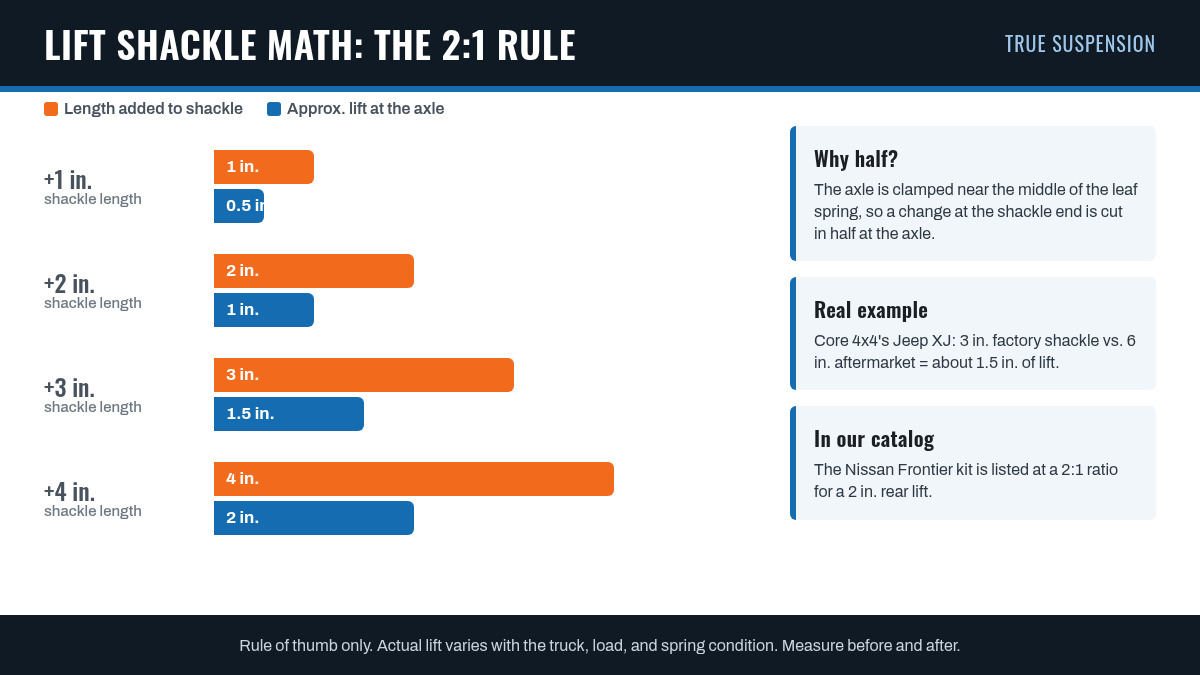
Picking a shackle is a measuring job. Decide how much rear height you want, then work backward from the 2:1 rule.
A simple way to size it
- Measure the rear ride height on both sides today.
- Decide how much higher you want the rear. For leveling, that is usually the gap between your front and rear measurements.
- Double that number. It is the length you need to add to the shackle, bolt center to bolt center.
- Compare the result with the listed range of the kit you are considering.
Here is a real example from Core 4x4. Their Jeep XJ had aftermarket shackles that measured 6 inches bolt to bolt, against a factory length of 3 inches. That 3-inch difference works out to about 1.5 inches of lift at the axle. The same math applies to any leaf-spring truck, but the factory length differs by model.
Fixed or adjustable?
A fixed kit, like the 2-inch Frontier and Xterra sets, is simple and predictable. An adjustable kit, like the Tacoma shackles, lets you dial in the height inside a range. That helps when your truck sags unevenly, or when you are matching a specific front height.
Check the front before you order
If your front end is already level or low, a big rear lift can leave the truck tail-high. Measure both ends first. Then decide whether you want a rear-only part or a complete kit that handles the front too. Kits like the Colorado and Canyon strut spacer and shackle kit are built for exactly that.
Maintenance: Keeping Lift Shackles Quiet and Tight
Shackles are simple, but they pivot every time the suspension moves. A little attention keeps them quiet.
- Grease the bushings. If your shackles have grease fittings, add grease at every oil change. Dry bushings squeak and wear quickly.
- Re-check the bolts. Look at the torque marks or re-torque every few months, especially if you drive off-road.
- Inspect the leaf springs. Look for cracked leaves, shifted center bolts and worn spring eyes while the truck is up.
- Replace tired hardware. Rusty or stretched bolts should never go back on a rear suspension.
Are Lift Shackles Right for Your Truck?
Choose lift shackles if you want a modest, low-cost rear lift on a leaf-spring truck and you prefer bolt-on parts. They are a good fit for fixing a tail-low stance, leveling a truck, or adding a little ground clearance.
Look at other options if you need more than about 3 inches of lift, if the truck is already worn out and sagging, or if you regularly carry heavy loads. In those cases a full kit or new springs will serve you better.
Final Takeaway
Lift shackles work by lengthening the link that hangs the rear spring from the frame, and the axle gains about half of that length. Most kits give 1 to 3 inches, install in a couple of hours, and cost far less than a full suspension lift. Measure before and after, torque on the ground, and re-check after your first drive.
Ready to raise your rear? Shop lift suspension parts or browse complete lift kits for your truck.
Frequently Asked Questions
How do lift shackles work?
A lift shackle is longer than the factory shackle. It moves the rear spring eye farther from the frame mount, which makes the frame sit higher above the axle. The springs and shocks stay in place. Because the axle sits in the middle of the spring, it gains about half the extra shackle length.
How much lift do extended shackles give?
Most pickup shackle kits give between 1 and 3 inches. For example, our Frontier and Xterra kits are listed at 2 inches, and the 1996-2004 Tacoma shackles adjust from 1 to 1.75 inches. Actual lift varies with load and how the truck sat beforehand, so measure before and after.
How do I install lift shackles?
Raise the rear, support the frame on jack stands, and jack the axle slightly to relieve spring tension. Remove the old shackles one side at a time, grease the bushings and install the new ones loosely. Lower the truck, bounce the rear, then torque to spec with the suspension at ride height.
How do I install rear lift shackles if the bed is in the way?
Some trucks have a bed rib or bed seam above the upper shackle bolt. Max Trac's instructions say certain applications need the bed bolts loosened and the bed lifted, or a hitch removed, to get the bolt out. Check your kit's instructions for your exact truck.
Do lift shackles hurt ride quality?
The springs and shocks stay stock, so many owners find the ride close to factory. True Suspension's listings describe the ride as comparable to factory. Very long shackles can change geometry, which is why taller lifts are better handled with springs.
Do I need an alignment after installing rear lift shackles?
Rear shackles mainly change rear height. If you also raised the front, or you notice pulling or uneven tire wear, get an alignment. When in doubt, ask the shop to check it.
Which lift shackle kit should I check first for my truck?
Match your year, model and drivetrain. For a 2005-2019 Frontier, start with the rear 2-inch lift shackle kit. For a 2005-2014 Xterra, see the Xterra lift shackle kit.
Additional reference: Max Trac 1.5-2 inch lift or lowering shackle instructions (PDF).