
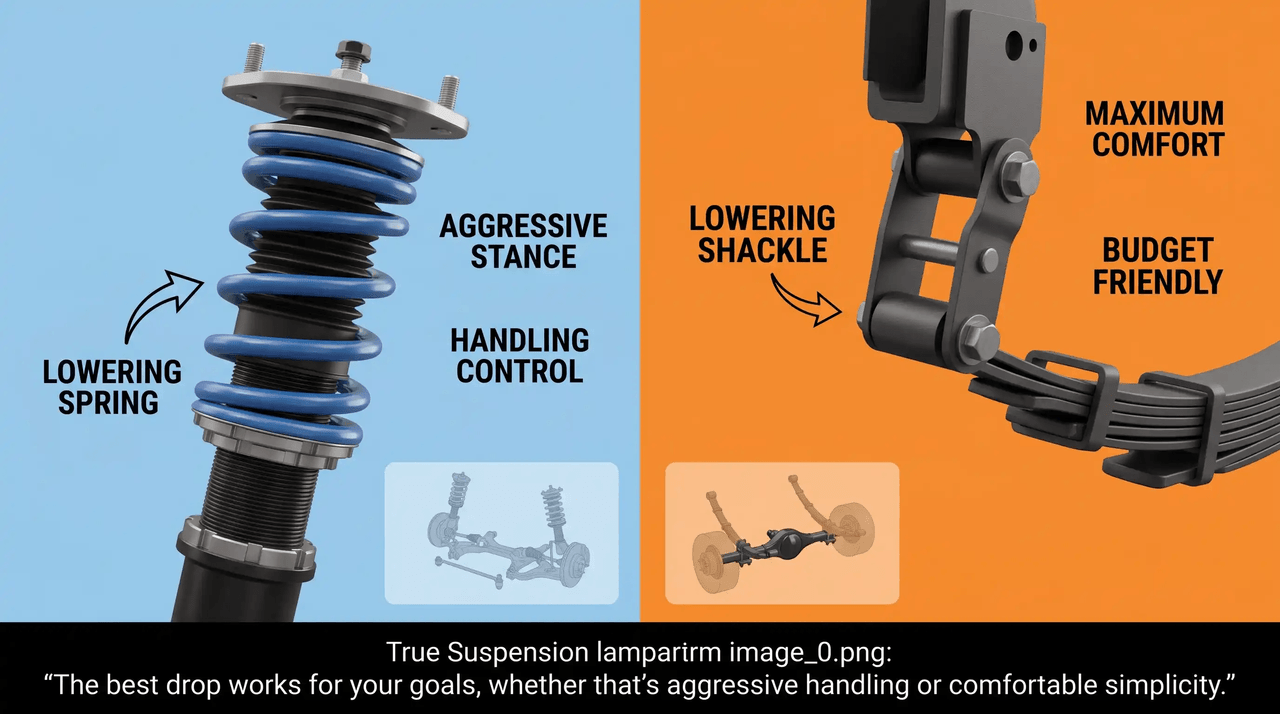
Every truck owner wants that aggressive low stance. But choosing between Lowering Springs vs. Lowering Shackles is one of the most misunderstood decisions in the suspension world. Get it wrong, and you pay the price in ride quality, alignment wear, and wasted money. Get it right, and your truck sits exactly where you want it, rides smooth, and turns heads everywhere.
At True Suspension, we have spent years helping truck owners dial in their setups with confidence. The Lowering Springs vs. Lowering Shackles question comes up constantly, and for good reason. We carry the parts, we know the engineering, and we share real knowledge, not guesswork. This guide cuts through the noise so you can make the right call the first time.
Whether you drive a classic F-150, a Chevy C10, or a modern Dodge Ram, understanding the difference between Lowering Springs and Lowering Shackles affects everything from daily drivability to long-term suspension health. Let us break it all down.
What Are Lowering Springs and How Do They Work?
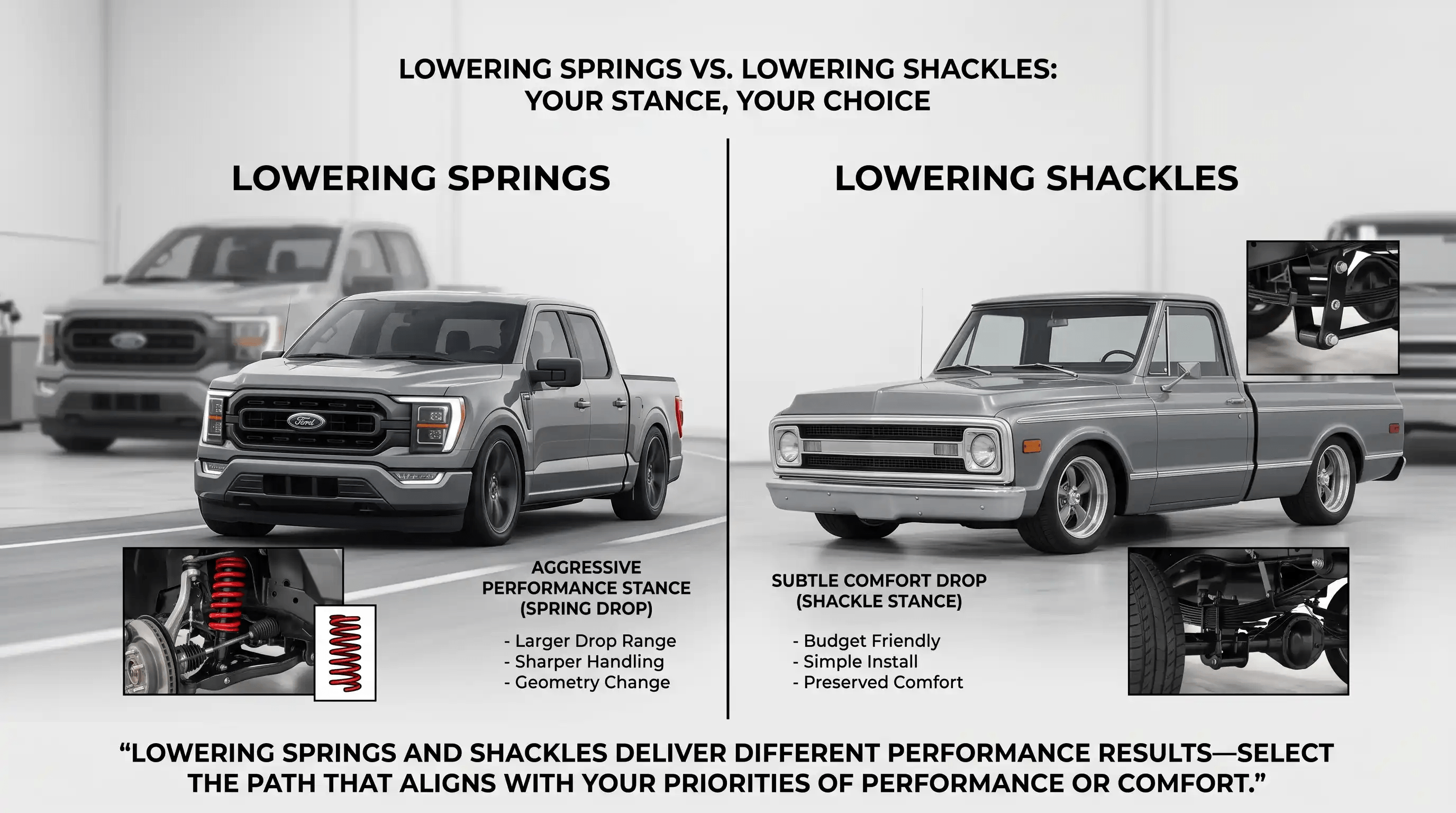
Lowering springs are replacement coil or leaf springs designed with a shorter free height than stock. When installed, they lower the vehicle's ride height by compressing the suspension. Most performance lowering springs also increase spring rate, which means stiffer, more controlled handling.
On coil-spring-equipped vehicles, most cars and modern trucks, lowering springs swap directly with factory units. On leaf-spring trucks, the springs themselves can be re-arched or replaced with a lower-profile pack. The result is a drop of 1 to 3 inches in most cases, depending on the spring design.
Key Characteristics of Lowering Springs
- Spring rate increases, stiffer setup reduces body roll
- Geometry changes, affects camber and caster alignment
- Shock compatibility, OEM shocks may bottom out; performance shocks recommended
- Consistent drop, fixed ride height with no adjustability
- Wider application, works on coil and leaf spring systems
For a wider look at how spring-based suspension modifications compare to other solutions, see our detailed guide on air ride suspension vs coilovers to understand the full spectrum of your options.
What Are Lowering Shackles and How Do They Work?
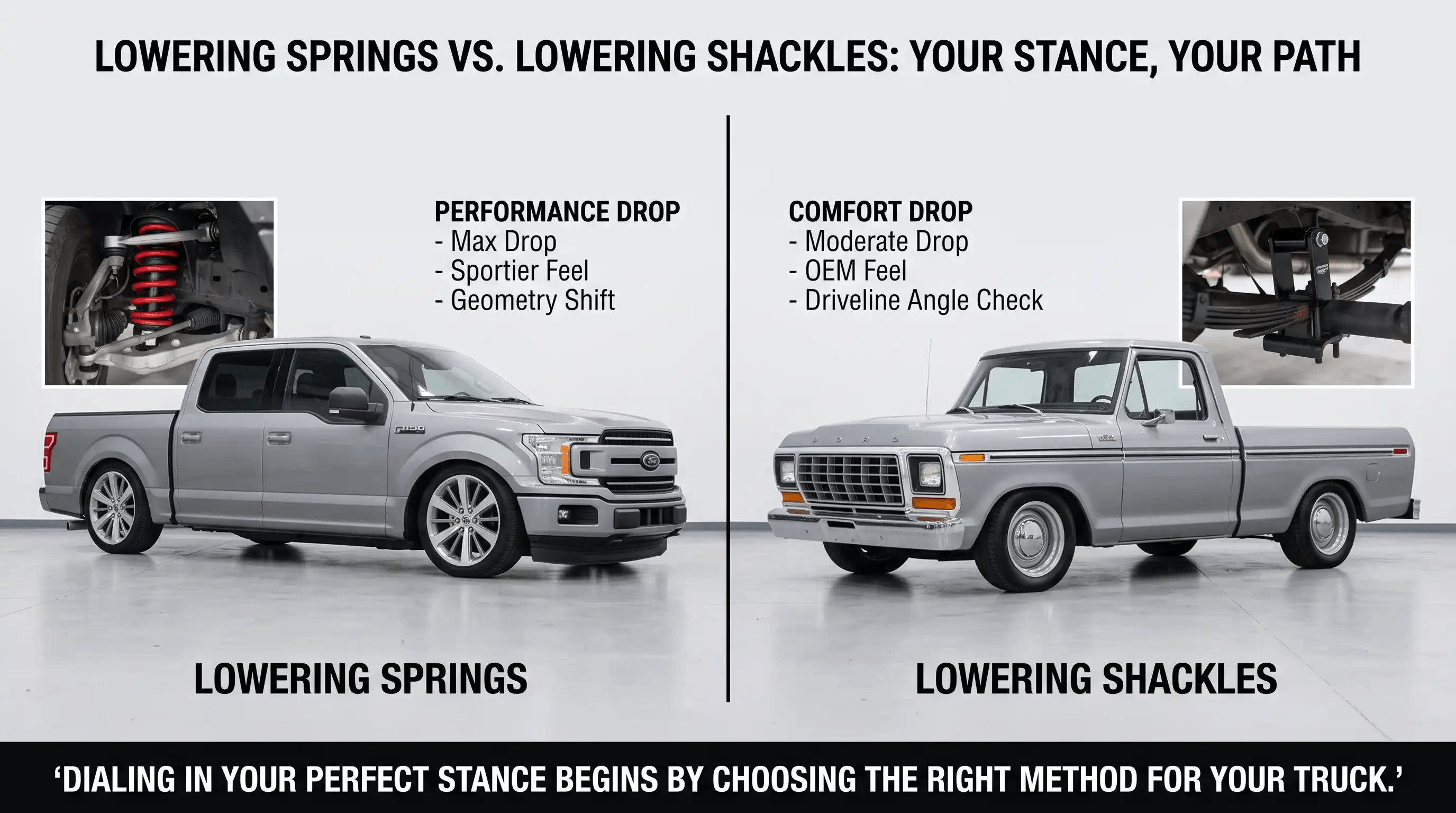
Lowering shackles are designed specifically for leaf-spring suspension systems. A leaf spring shackle is the pivoting link that connects the rear of the leaf spring to the frame. Stock shackles hold the spring at a fixed angle. A shorter shackle repositions that angle, pulling the rear of the vehicle downward and lowering the ride height.
This is a simple, effective, and affordable method for trucks with rear leaf spring suspension. It does not touch the spring itself. It only changes the mounting geometry. Most quality shackles deliver a drop of 1 to 2 inches at the rear. Combined with a front drop solution, you can achieve a level or raked stance.
Key Characteristics of Lowering Shackles
- Leaf-spring only, not applicable to coil-spring systems
- Minimal spring rate change, factory ride feel is largely preserved
- Simple installation, bolt-on with basic tools in most cases
- Affordable entry point, one of the lowest-cost drop options available
- Rear-focused drop, typically used at the rear axle only
True Suspension offers premium Ford F-250 rear lowering shackles (08–16, 2WD) built to exacting standards for a clean, reliable drop with zero compromise on durability.
Lowering Springs vs. Lowering Shackles: Side-by-Side Comparison
Understanding the difference on paper is one thing. Seeing it in a head-to-head comparison makes the decision much clearer. Here is how Lowering Springs vs. Lowering Shackles stack up across every major category.
|
Category |
Lowering Springs |
Lowering Shackles |
|
Suspension Type |
Coil & Leaf Spring |
Leaf Spring Only |
|
Typical Drop Range |
1–3 inches |
1–2 inches |
|
Spring Rate Change |
Yes, stiffer |
Minimal change |
|
Installation Complexity |
Moderate to High |
Low to Moderate |
|
Average Cost |
$150–$600+ |
$40–$200 |
|
Ride Quality Impact |
Firmer, sportier |
Near-stock feel |
|
Alignment Required After? |
Yes, always |
Recommended |
|
Shock Compatibility |
May need upgrade |
Usually stock-compatible |
|
Adjustability |
None (fixed drop) |
None (fixed drop) |
|
Best For |
Performance & aesthetics |
Budget & simplicity |
The table tells a clear story. If you want a sportier feel with maximum drop range and you are on a coil-spring platform, lowering springs win. If you want an easy, affordable rear drop on a leaf-spring truck without touching your spring rate, shackles are the smart move.
Ride Quality: Which Method Keeps Your Truck Comfortable?
Ride quality is where most truck owners feel the biggest difference after a drop. Lowering springs increase the spring rate. This reduces body roll and improves cornering feel, but it also transmits more road harshness into the cabin. Speed bumps feel more abrupt. Expansion joints on highways become more noticeable.
Lowering shackles, by contrast, leave the spring pack unchanged. You keep the factory spring rate. The truck still absorbs bumps and road imperfections the way the manufacturer intended. Many drivers report that a properly installed shackle drop kit feels nearly identical to stock, just lower.
Ride Quality Verdict
|
Scenario |
Winner |
|
Daily commuting on rough roads |
Lowering Shackles |
|
Weekend canyon runs / spirited driving |
Lowering Springs |
|
Towing or hauling light loads |
Lowering Springs (stiffer) |
|
Maximum daily comfort retained |
Lowering Shackles |
|
Long highway cruising |
Lowering Shackles |
At True Suspension, we care deeply about how your truck feels, not just how it looks. Our team has tested both methods extensively. We know which setups hold up over 50,000 miles of daily driving, and we share that knowledge openly because informed customers make the best decisions. If you want to understand how to preserve ride quality after any suspension modification, our guide on maintaining factory ride quality after lift kits applies equally to drop builds.
Installation Difficulty: Which Is Easier to Install at Home?
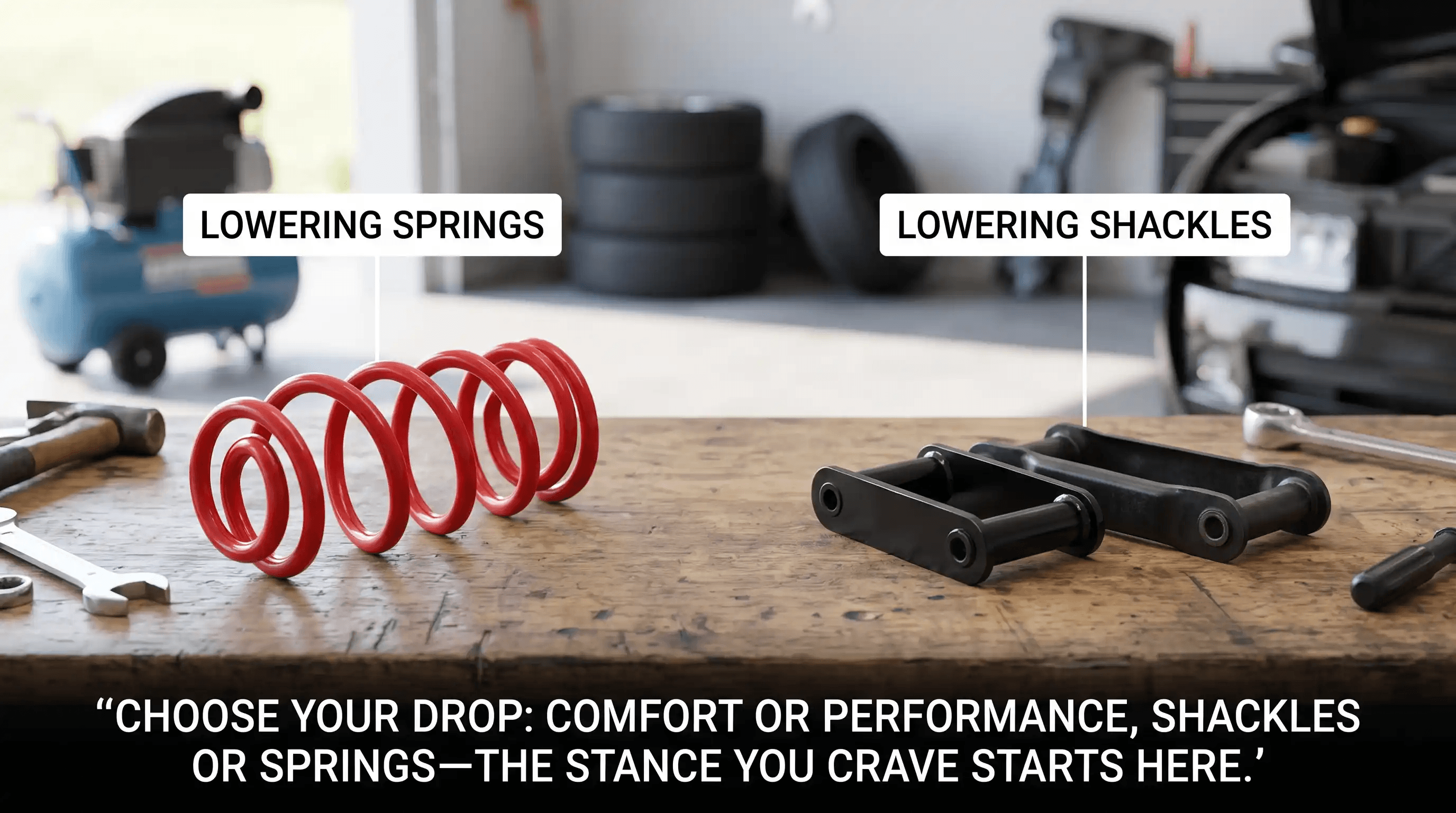
Installation complexity is a real factor in the Lowering Springs vs. Lowering Shackles decision. Not everyone has a full shop with a spring compressor, alignment rack, and hours of free time. Both methods are DIY-possible, but one is significantly more approachable for the average truck owner.
Lowering Springs Installation
Installing lowering springs on a coil-spring vehicle requires:
- Spring compressor tool, mandatory and potentially dangerous without the right equipment
- Removal of the entire strut or shock assembly
- Possible sway bar end link replacement if the drop is significant
- Professional wheel alignment afterward, non-negotiable
- Time investment: 3–6 hours for experienced DIYers
Lowering Shackles Installation
Installing lowering shackles on a leaf-spring truck requires:
- Basic hand tools, socket set, wrench, floor jack, jack stands
- Support of the rear axle to relieve spring tension
- Removal and replacement of the existing shackle bolts
- Time investment: 1–2 hours for most home mechanics
The shackle installation is genuinely beginner-friendly. Many of our customers at True Suspension complete it in an afternoon with nothing more than a floor jack and a basic socket set. We design our lowering shackle kits for straightforward fitment because we believe the installation experience is part of what you are paying for, and it should not be a nightmare.
Check out our Dodge Ram 2500/3500 rear lowering shackles (03–13, 2WD) as an example of how clean and simple a quality bolt-on shackle kit can be.
Cost Analysis: Budget Breakdown for Both Methods
Cost is always a real consideration. When comparing Lowering Springs vs. Lowering Shackles, the price difference can be significant once you factor in all associated parts and labor.
|
Cost Item |
Lowering Springs |
Lowering Shackles |
|
Parts (springs/shackles) |
$150–$600 |
$40–$200 |
|
Replacement shocks (if needed) |
$100–$400 |
Usually $0 |
|
Professional alignment |
$80–$150 |
$80–$150 (recommended) |
|
End links/hardware |
$30–$80 |
$0–$20 |
|
Professional labor (if not DIY) |
$150–$300 |
$50–$100 |
|
Total (DIY, no alignment) |
$150–$600 |
$40–$200 |
|
Total (full shop build) |
$510–$1,530 |
$170–$470 |
The numbers speak clearly. A complete shackle drop build, even done professionally, can cost three to four times less than a full lowering spring setup with new shocks and alignment. If budget is a constraint, shackles deliver remarkable value per dollar spent. If performance is the priority and budget allows, springs offer the bigger, sportier transformation.
True Suspension keeps prices competitive because we believe great suspension should be accessible. Browse our full range of lowering shackles for Dodge Ram 1500 (94–01) to see what real quality looks like at a fair price.
Vehicle Compatibility: Which Trucks Benefit Most From Each Method?
Not every truck is a candidate for every drop method. The suspension type your vehicle uses dictates your options. Understanding this saves you from buying parts that simply will not work on your build.
Best Candidates for Lowering Springs
- Modern half-ton trucks with independent front suspension (IFS)
- Classic cars and muscle cars with coil-over or coil spring setups
- Performance-oriented builds where handling improvement is a priority
- Vehicles with accessible strut assemblies allowing easy spring swap
Best Candidates for Lowering Shackles
- Classic pickups (C10, F-100, Dodge D-series) with solid rear axle leaf springs
- Modern full-size pickups (F-150, Ram 1500, Silverado) with rear leaf packs
- Work trucks that need a lower stance without sacrificing payload capacity
- Budget builds where keeping costs low is essential
True Suspension stocks application-specific lowering shackle kits for dozens of popular truck platforms. From the classic Chevy C10 to the modern Ford F-250, our fitment database is one of the most comprehensive in the industry. We make sure you get the right parts for your exact year, make, model, and drive configuration, every single time.
Explore our Ford F-100/F-150 rear lowering shackles (65–81, 2WD), a benchmark product that shows our commitment to classic truck fitment.
Alignment, Wear, and Long-Term Suspension Health
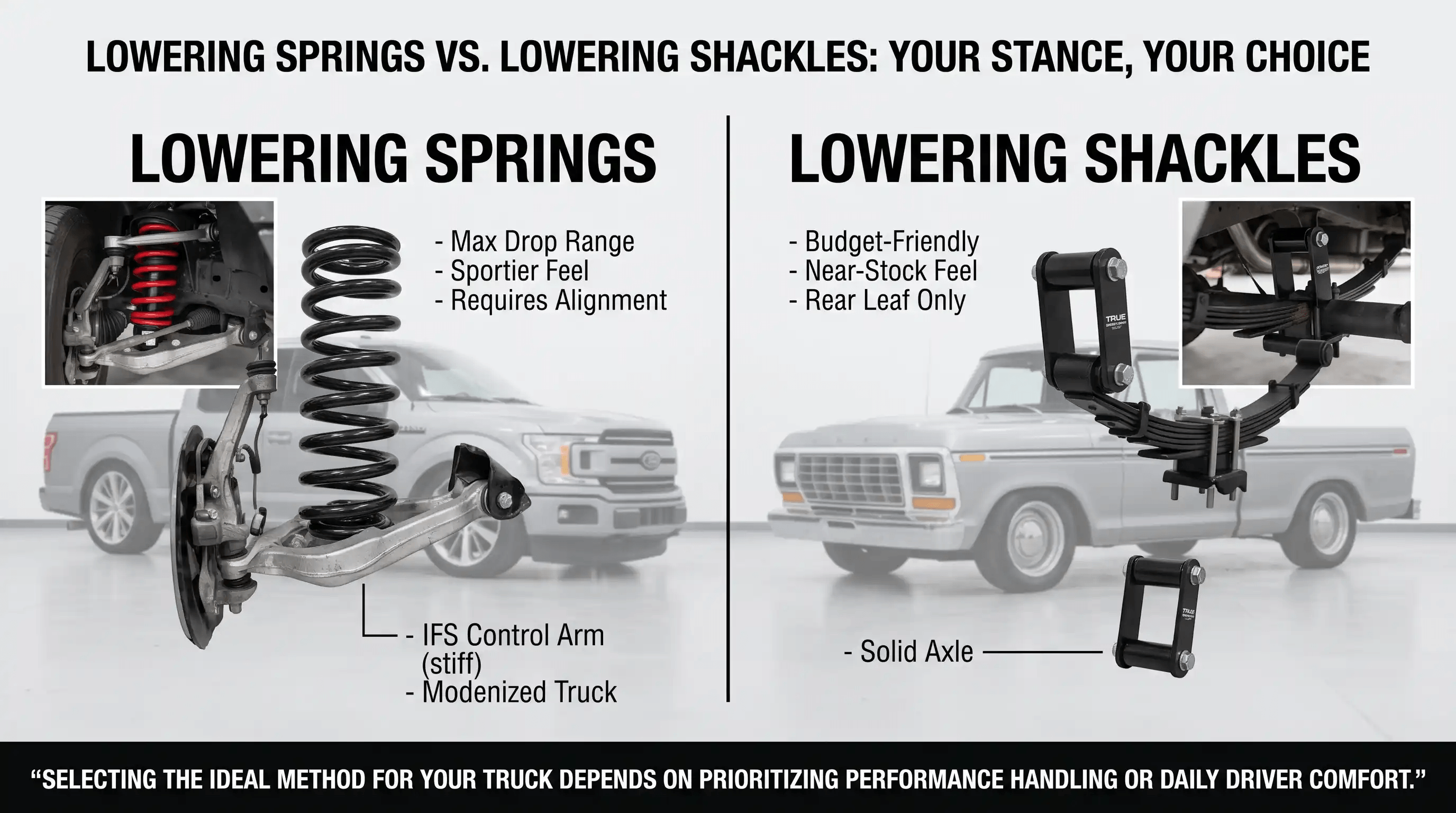
Any suspension modification that changes ride height also changes suspension geometry. This is a critical point that many budget guides skip over. Ignoring alignment after a drop leads to accelerated tire wear, handling instability, and stress on suspension components.
With lowering springs, the geometry change is significant. Camber, caster, and toe all shift when ride height drops. A professional alignment is not optional; it is mandatory. Some vehicles also require aftermarket adjustable control arms or camber bolts to bring alignment back within spec.
With lowering shackles, the geometry impact is less dramatic because you are only changing the shackle angle at the rear. However, pinion angle can shift, which affects driveline vibration. A check of pinion angle after installation is always recommended. Alignment should still be inspected, especially at the rear.
Long-Term Wear Statistics
|
Factor |
Lowering Springs |
Lowering Shackles |
|
Tire wear risk (without alignment) |
High |
Moderate |
|
Ball joint/bushing stress increase |
Moderate–High |
Low–Moderate |
|
Driveline vibration risk |
Low |
Moderate (check pinion angle) |
|
Shock absorber wear rate |
Higher (firmer spring) |
Near stock |
|
Expected service interval change |
Shorter |
Minimal change |
True Suspension does not just sell parts. We provide the full picture. Just as we break down Lowering Springs vs. Lowering Shackles here, we apply the same level of honest analysis to every suspension modification. Understanding the long-term implications of your choice helps you maintain your truck correctly and budget for what is actually needed. This level of transparency is what separates a genuine suspension authority from a parts-moving operation.
Our related guide on lift kits vs leveling kits covers geometry and alignment considerations in depth for anyone exploring suspension height modifications in both directions.
Performance and Handling: Which Drop Method Drives Better?
When we talk about the debate of Lowering Springs vs. Lowering Shackles, handling performance is where the conversation gets interesting. A lower center of gravity always improves cornering confidence. But how much improvement depends heavily on which method you choose.
Lowering springs actively change the suspension's dynamic behavior. A higher spring rate means less body roll under cornering loads. The truck feels planted, responsive, and connected to the road. This is why performance lowering springs are the preferred choice for drivers who use their trucks as daily sport vehicles or who prioritize sharp handling above all else.
Lowering shackles lower the center of gravity too, but they do not change spring rate. The handling improvement is real but more subtle. You gain the visual stance benefit and the minor improvement in cornering dynamics from the lower CG, without the harshness penalty of a stiffer spring.
Handling Comparison: Real-World Scenarios
|
Scenario |
Lowering Springs Score |
Lowering Shackles Score |
|
Tight cornering feel |
9/10 |
7/10 |
|
Highway lane change stability |
9/10 |
8/10 |
|
Washboard road comfort |
5/10 |
8/10 |
|
Parking lot daily driving |
7/10 |
9/10 |
|
Light towing stability |
8/10 |
7/10 |
|
Overall daily driver score |
7.6/10 |
7.8/10 |
Interestingly, for pure daily driving, shackles score marginally higher because comfort matters more than outright cornering sharpness in everyday use. Springs win convincingly on performance metrics. Choose based on how you actually use your truck, not how you imagine you might someday use it.
Pros and Cons: Honest Breakdown of Each Method
We believe in honesty. Every product and every modification has trade-offs. Here is the full, unfiltered pros and cons breakdown for both sides of the Lowering Springs vs. Lowering Shackles debate.
Lowering Springs, Pros and Cons
|
Pros |
Cons |
|
Larger drop range (up to 3 inches) |
Higher total project cost |
|
Improved handling and reduced body roll |
Often requires shock replacement |
|
Works on coil AND leaf spring systems |
Firmer ride can feel harsh daily |
|
Sportier, more aggressive appearance |
Mandatory professional alignment |
|
Better match for performance builds |
Higher installation complexity |
Lowering Shackles, Pros and Cons
|
Pros |
Cons |
|
Extremely affordable entry point |
Rear leaf spring trucks only |
|
Near-stock ride quality preserved |
Smaller drop range (1–2 inches) |
|
Simple DIY-friendly installation |
May affect driveline angle |
|
No shock replacement needed (usually) |
Less dramatic handling improvement |
|
Ideal for daily driver builds |
Not suitable for aggressive drops |
At True Suspension, we stock top-quality options on both sides. Our Chevrolet Silverado 1500 lowering shackles (88–20, 4WD/2WD) are a perfect example of how a well-engineered shackle kit delivers maximum value with minimum hassle.
Which Drop Method Is Right for Your Build?
There is no single right answer. The best choice in the Lowering Springs vs. Lowering Shackles comparison depends entirely on your truck, your goals, and your budget. But we can give you a clear framework to make the decision.
Choose Lowering Springs If:
- Your truck uses coil springs (IFS or rear coil setup)
- You want the maximum drop of 2–3 inches or more
- Handling improvement is a top priority for your build
- You are building a performance street truck or a show vehicle
- You have the budget for shocks, alignment, and hardware
Choose Lowering Shackles If:
- Your truck uses rear leaf springs
- You want a simple, clean 1–2 inch rear drop
- Daily comfort is your number one priority
- Budget is tight, and you want maximum value
- You prefer a straightforward at-home installation
True Suspension has built an incredibly deep product catalog to serve both paths. Whether you are hunting for a set of performance lowering springs for a classic build or a bolt-on rear lowering shackle kit for your daily hauler, we have exactly what you need, made to last, priced right, and backed by our suspension expertise.
Need inspiration for what a lowered classic truck can look like? Our guide on the top 10 classic cars on air ride that look incredible shows the range of what is possible when you combine the right drop method with quality parts.
True Suspension: Why We Are the Authority on Suspension Modifications
Anyone can sell suspension parts. Not everyone can explain, engineer, and support them properly. At True Suspension, we have invested deeply in building the most comprehensive suspension knowledge base available to truck owners, and we back it up with a product range that covers hundreds of vehicles across every major platform.
Our catalog includes everything from lowering shackles and coil spring spacers to complete air ride suspension systems, lift kits, and towing assist kits. We source and test our parts with real-world truck owners in mind. We do not offer cheap throw-away hardware. Every product in our lineup meets strict standards for steel quality, finish, and dimensional accuracy.
What Makes True Suspension Different
|
Standard |
True Suspension Approach |
|
Product Range |
Hundreds of application-specific SKUs across all major platforms |
|
Engineering Quality |
Precision-machined steel, proper surface treatment, verified fitment |
|
Customer Knowledge |
Detailed guides, specs, and compatibility data on every listing |
|
Pricing |
Factory-direct competitive pricing without sacrificing quality |
|
Support |
Real suspension expertise, not automated chatbots |
When you buy from True Suspension, you are not buying from a generic parts warehouse. You are buying from a team that has engineered, tested, and refined these products with a single goal: making your truck perform and look exactly the way you want it to.
Explore our complete lineup of Dodge D150 rear lowering shackles (70–93, 2WD) as a prime example of how deep our fitment coverage goes — all the way back to the classic era of American trucks.
Statistics That Prove the Case for Getting Your Drop Right
Numbers matter. Here are the key data points every truck owner should understand before choosing between lowering springs and lowering shackles
|
Statistic |
Data Point |
Source Context |
|
Center of gravity reduction per inch of drop |
Approximately 0.4–0.6 inches |
Automotive engineering estimates |
|
Roll stiffness improvement with +20% spring rate |
Up to 15–18% reduction in body roll |
Suspension dynamics research |
|
Tire wear increase without alignment after drop |
Up to 40% faster tread wear |
Alignment shop data |
|
Average shackle install time (experienced DIY) |
60–90 minutes |
Community installation data |
|
Cost difference: springs vs shackles (full install) |
3–5x more expensive for springs |
True Suspension pricing data |
|
Drop accuracy of quality shackle kits |
Within ±0.125 inches of stated drop |
Manufacturer spec tolerance |
|
Vehicles with rear leaf spring suspension (US trucks) |
Approximately 65% of full-size pickups |
Industry analysis |
These statistics reinforce what experienced builders already know when considering Lowering Springs vs. Lowering Shackles: the drop method matters, the alignment matters, and the quality of parts matters enormously. Cutting corners on any of these factors turns a simple drop project into an expensive headache. True Suspension exists to help you avoid those headaches entirely.
Combining Both Methods: Can You Run Springs and Shackles Together?
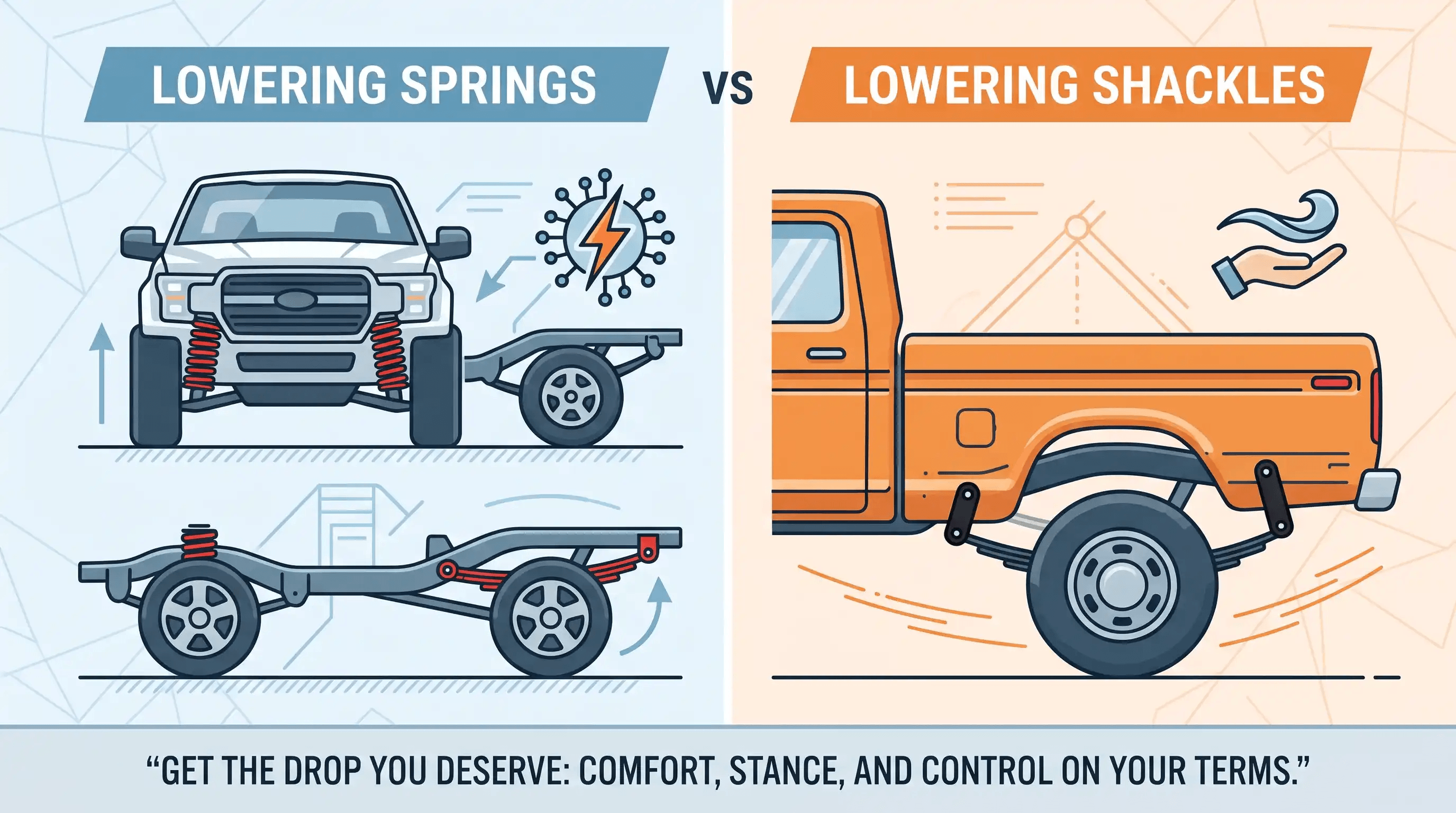
Many builders who have studied the Lowering Springs vs. Lowering Shackles debate eventually ask: can you use both together? On a leaf-spring truck, it is technically possible to use both a re-arched or replacement lower-profile leaf spring AND shorter shackles simultaneously. Some classic truck builders do exactly this to achieve a more dramatic drop while balancing spring rate.
However, combining both methods requires careful calculation. Running a lower spring AND shorter shackles together can create a negative shackle angle, where the shackle tilts forward rather than rearward. This causes handling instability and is dangerous. The shackle must always maintain a slight rearward lean under load.
If you want a dramatic drop beyond what either method alone can provide, the better path is a complete lowering kit that includes matched components designed to work together, exactly the type of complete solutions True Suspension specializes in. Our Dodge D150 complete lowering kit with lowering coils, shackle/hanger combo, and matched shocks shows exactly how we engineer multi-component drop solutions for maximum results and safety.
True Suspension's complete lowering kits take the guesswork out of combining multiple drop components. Everything is matched, everything is tested, and everything is specified to maintain safe suspension geometry at your final ride height.
Conclusion
The debate of Lowering Springs vs. Lowering Shackles does not have a single winner; it has a right answer for each specific truck and each specific goal. Lowering springs deliver maximum drop range, improved handling dynamics, and a sportier overall feel at a higher cost and installation complexity. Lowering shackles deliver a clean, comfortable, affordable rear drop with simple installation and near-stock daily drivability.
At True Suspension, we have built our reputation on knowing this difference, and on carrying the right product for every situation. We do not push one solution over another. We help you find the method that actually fits your truck, your driving style, and your budget.
Whether you choose lowering springs, lowering shackles, or a matched complete kit, True Suspension has the parts, the knowledge, and the commitment to help you build it right. Our Lowering Springs vs. Lowering Shackles coverage is just one example of the depth of expertise we bring to every suspension decision. Explore our full catalog, read our guides, and trust the team that has made suspension knowledge their business.
Frequently Asked Questions
Q1: What is the main difference between lowering springs and lowering shackles?
Lowering springs replace your factory springs to reduce height, while lowering shackles shorten the rear leaf spring mounting point. Springs work on coil and leaf systems; shackles only work on leaf-spring trucks.
Q2: Will lowering shackles affect my truck's towing or payload capacity?
Quality lowering shackles have minimal impact on payload capacity since they do not change the spring rate. However, a significant drop can alter pinion angle, so verify driveline geometry after install, especially if you tow regularly.
Q3: Do I need a wheel alignment after installing lowering shackles?
A full alignment is strongly recommended after any suspension height change. Even small geometry shifts affect tire wear and handling. Always have alignment checked after installing lowering shackles on your truck for best results.
Q4: How much drop can I realistically get from lowering springs vs. lowering shackles?
Lowering springs typically deliver 1–3 inches of drop depending on the spring design. Lowering shackles usually provide 1–2 inches at the rear. For aggressive drops beyond 3 inches, a complete lowering kit with matched components is recommended.
Q5: Can I install lowering shackles myself without professional help?
Yes. Most lowering shackle kits are bolt-on and DIY-friendly with basic hand tools. The process typically takes 1–2 hours. True Suspension designs shackle kits for straightforward home installation with clear fitment specifications.