
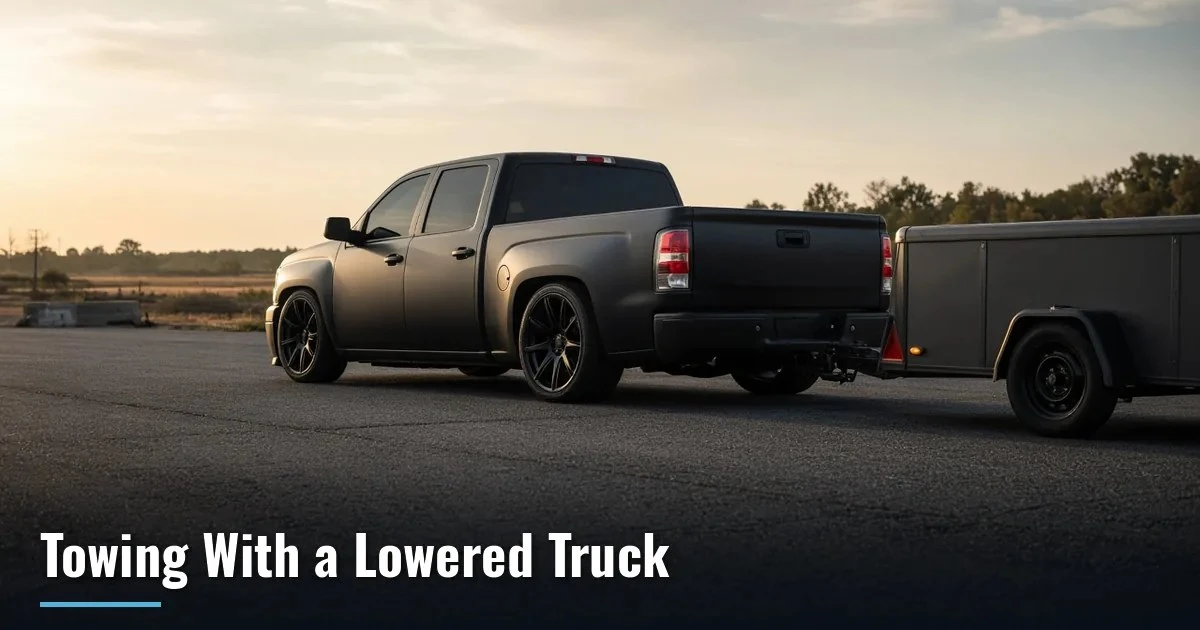
Towing with a lowered truck is something plenty of owners want to do, and the honest answer to “can you tow with a lowered truck?” is: often yes, but the drop does not add capacity, and it can take away the rear travel you were counting on when the tongue load hits the hitch. A static drop lowers the frame and bed toward the axle. A trailer then pushes down on the hitch. If the rear was already sitting low, that extra load can squat the truck, flatten the headlights’ aim, and, on a deep drop, bring the axle uncomfortably close to the bed or the frame.
This guide explains what actually changes, how to stay inside the weight ratings on the door sticker, and how helper bags on a lowered truck can hold the ride height under load without undoing the stance you built. We will use live True Suspension parts that were in stock on November 27, 2026, and official federal language on tongue weight and load labels. We will not invent a towing rating for a lowered chassis, and we will not tell you to exceed the numbers on your certification label.
Quick Summary
- Yes, you can tow with a lowered truck if the truck, the hitch, and the trailer stay inside the manufacturer’s GVWR, gross axle weight rating (GAWR), gross combination weight rating (GCWR), hitch rating, and tongue-weight range. Lowering the truck does not raise those limits.
- A NHTSA final rule published in the Federal Register defines tongue weight as the downward force on the hitch ball (or, for a fifth-wheel, on the bed) and states that tongue weights are typically 10 to 14 percent of the trailer’s weight, though the range can vary. It also treats tongue weight as cargo. Stay inside the trailer maker’s specified range.
- The problem to solve is usually rear sag and remaining axle travel, not “will the hitch accept a ball.” Helper springs that air up under load can level the truck for the trip and come down when you unhitch, which is why people look at helper bags on a lowered truck instead of adding a permanent rear block.
- On a deep rear drop, the axle may need a frame notch for clearance. That is a clearance part, not a towing-capacity part.
- Weigh the truck and trailer if you are close to a limit. Guessing is how rear tires, hitches, and steering all get into trouble at once.
Towing With a Lowered Truck: What Changes Under Load
A stock truck has a designed amount of unused rear travel and a designed hitch height. When you lower the rear — with shackles, hangers, coils, or a full rear package — you use some of that travel up front, in the static stance. The axle sits closer to the frame and the bed. The hitch often sits closer to the ground.
Add a trailer and the tongue or king-pin load presses the hitch down further. Two things happen at once:
- The rear squats. Headlights aim higher, the front end can feel light, and the truck may steer with less authority. This is the same squat you would see on a stock truck, only you started closer to the bump stops.
- The axle has less room left to move. On a mild drop, you may still have enough travel for a modest trailer if you stay inside the ratings. On a deep drop, the axle can contact the bed or the frame under load or over a bump. That is a mechanical interference problem, and it is why some lowered trucks get a notch in the frame.
None of that changes the numbers on the certification label. FMVSS No. 110 requires a tire-and-loading placard on the driver’s side B-pillar (or the alternative location the standard allows) for vehicles with a GVWR of 10,000 pounds or less, and it is built around the idea that the vehicle has a rated cargo and occupant capacity. A NHTSA discussion in the same Federal Register document notes that the tongue weight of a towed trailer counts as cargo. If the tongue load plus people, fuel, and bed cargo would push you over GVWR or over the rear GAWR, the truck was already over the line — lowered or not.
If you want a plain-language walkthrough of what a static drop does to ride, travel, and daily use, start with our article on what lowering does to your truck and the common mistakes people make when they lower a truck. This article picks up where those leave off: the truck is already lowered, and you want to tow with it.
Can You Tow With a Lowered Truck? A Straight Answer
Yes, if all of the following are true:
- The loaded truck stays at or under GVWR, and each axle stays at or under its GAWR.
- The truck plus the loaded trailer stays at or under the GCWR (or the tow rating) the manufacturer published for that cab, engine, axle, and equipment.
- The hitch, receiver, ball, and wiring are rated for the trailer and are installed as designed.
- Tongue weight or king-pin weight is inside the trailer’s specified range — typically around 10 to 14 percent of trailer weight for many conventional trailers, per the NHTSA discussion cited above, but always the manufacturer’s number when one is given.
- The rear axle still has room to travel under that load, or you have added clearance (and, if needed, helper springs) so it does not hit the bed or the frame.
- The hitch height still puts the trailer in a safe attitude — not sharply tail-high or nose-diving — and the lights and brakes work.
If any of those is a no, fix that item before you tow. A lower stance is not, by itself, a reason you “cannot tow.” It is a reason to re-check travel, hitch height, and rear support under load.
Is it safe to tow with a lowered truck? It is as safe as the ratings, the hitch, the trailer attitude, and the remaining suspension travel allow. A two-inch rear shackle drop with a light utility trailer and a receiver still at a sensible height is a different job from a six- or seven-inch slam with a travel trailer and no remaining bump-stop clearance. Treat those as different builds.
Read the Door Sticker Before You Hitch Up
Before you change anything on the truck, find:
- The Safety Compliance Certification label (often on the driver’s door jamb), which lists GVWR and GAWR
- The tire-and-loading placard required by FMVSS No. 110 on many light vehicles, which lists recommended tire size and cold pressure and is tied to the vehicle’s load capacity
- The owner’s manual towing section for that exact cab, drivetrain, and tow package, including hitch type and any required cooling or brake-controller equipment
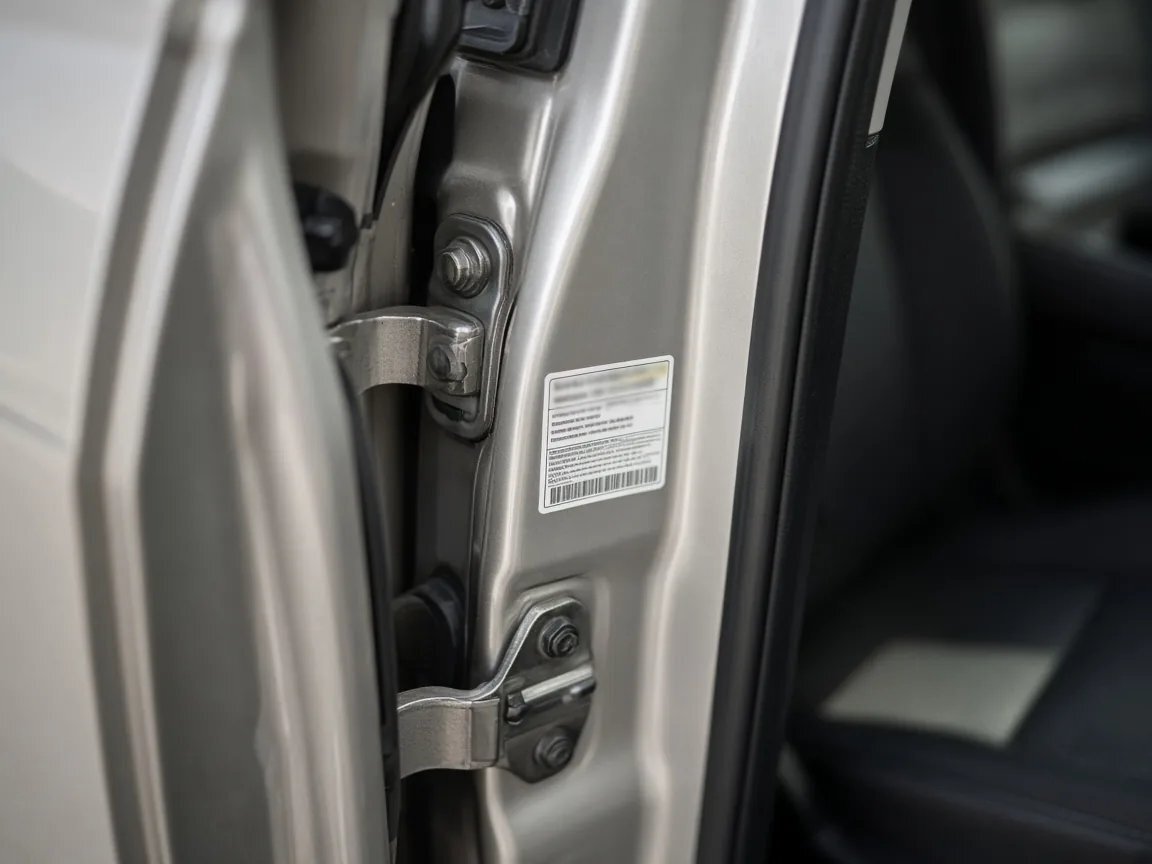
Those documents win over a forum post, including this article. If the manual says a configuration is not rated to tow, a lowered rear does not create a rating.
When you are close to a limit, use a public scale. Weigh the truck loaded for the trip, then weigh the combination, and, if you can, get axle weights. Tongue weight can be checked with a tongue scale or by a scale method your hitch maker describes. The Federal Register notice we cited tells manufacturers and consumers, in substance, to keep tongue weight inside the range the trailer maker specifies. Too little tongue weight can contribute to sway. Too much dumps load onto the rear axle and can lighten the front.
Why a Lowered Truck Sags When Towing — and What To Do About It
Lowered truck sagging when towing is usually just the rear spring doing the same job it always did, from a lower starting point. Leaf springs that were already flattened for style have less remaining arch. Coils that were shortened or exchanged for dropping springs have less remaining travel. Add several hundred pounds of tongue load, and the rear sits down.
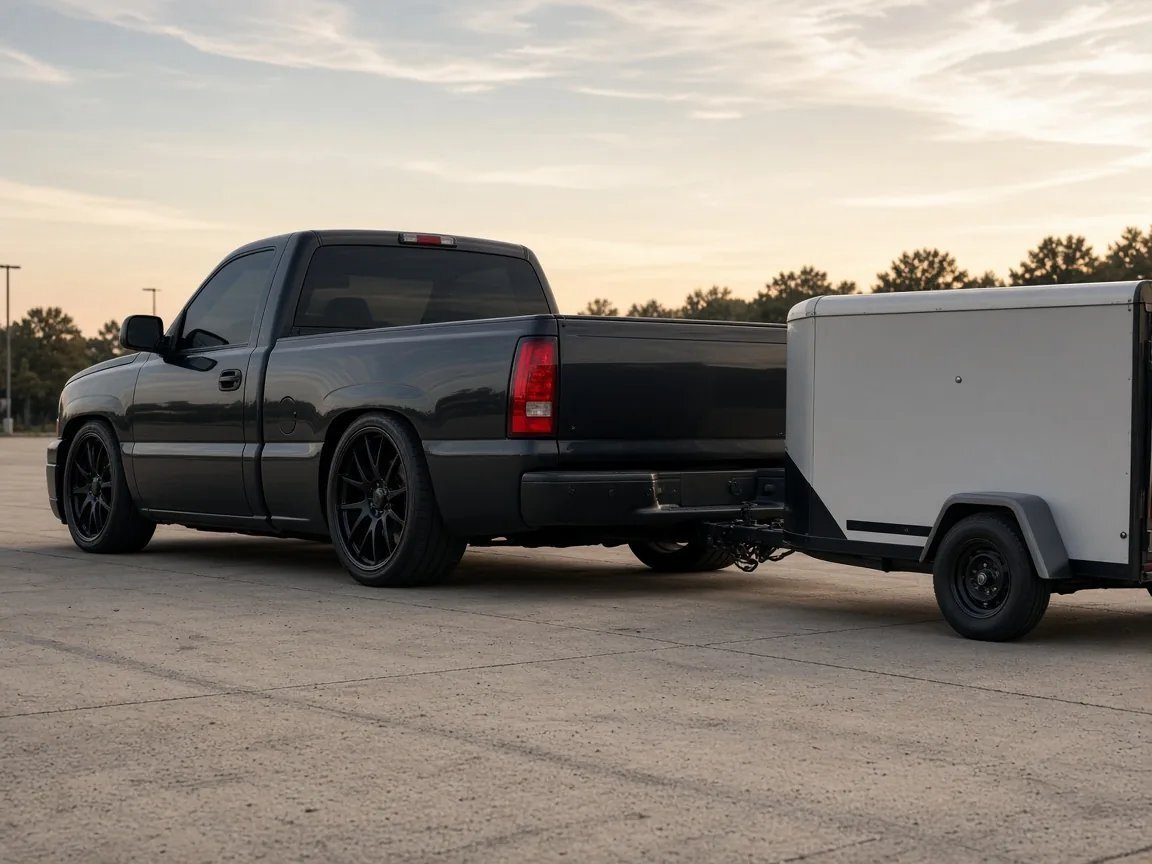
What you can do, in order:
Reduce the load to the rating. If you are over rear GAWR or over GVWR, no spring or bag “fixes” that. Move cargo, use a smaller trailer, or use a truck that is rated for the job.
Correct hitch height and trailer attitude. A ball that is now too low because the truck sits low will tip the trailer and can move weight in ways you did not plan. A hitch with drop or rise, chosen so the trailer tows level, is a first check. Do not confuse a level trailer with a truck that is still badly squatted; you may need both a hitch correction and rear support.
Add rear support that can come on and off with the load. That is the case for helper bags on a lowered truck. Air helper springs sit with the rear suspension and are aired up when you hitch, then aired down when you unhitch, so the static stance can stay low when you are cruising empty. Our tow-assist air bag guide covers how those systems are laid out. The comparison of air springs versus leaf helper springs is there if you are still choosing a style. This article will not repeat that whole comparison.
Give the axle a place to go. If the axle is already close to the bed or the frame at static drop, a helper spring will not create room that is not there. Some trucks need a notch so the axle can travel under load without a hit. See our C-notch and step-notch guide.
Do not “solve” squat by adding random rear blocks to a lowered truck just for towing days. A block changes the static height and the pinion angle. If your goal is a low stance in town and a level stance on a trip, an air helper is the tool that can do both. If your goal is a permanent higher rear, you are no longer building a lowered tow vehicle; you are building something else.
Helper Bags on a Lowered Truck
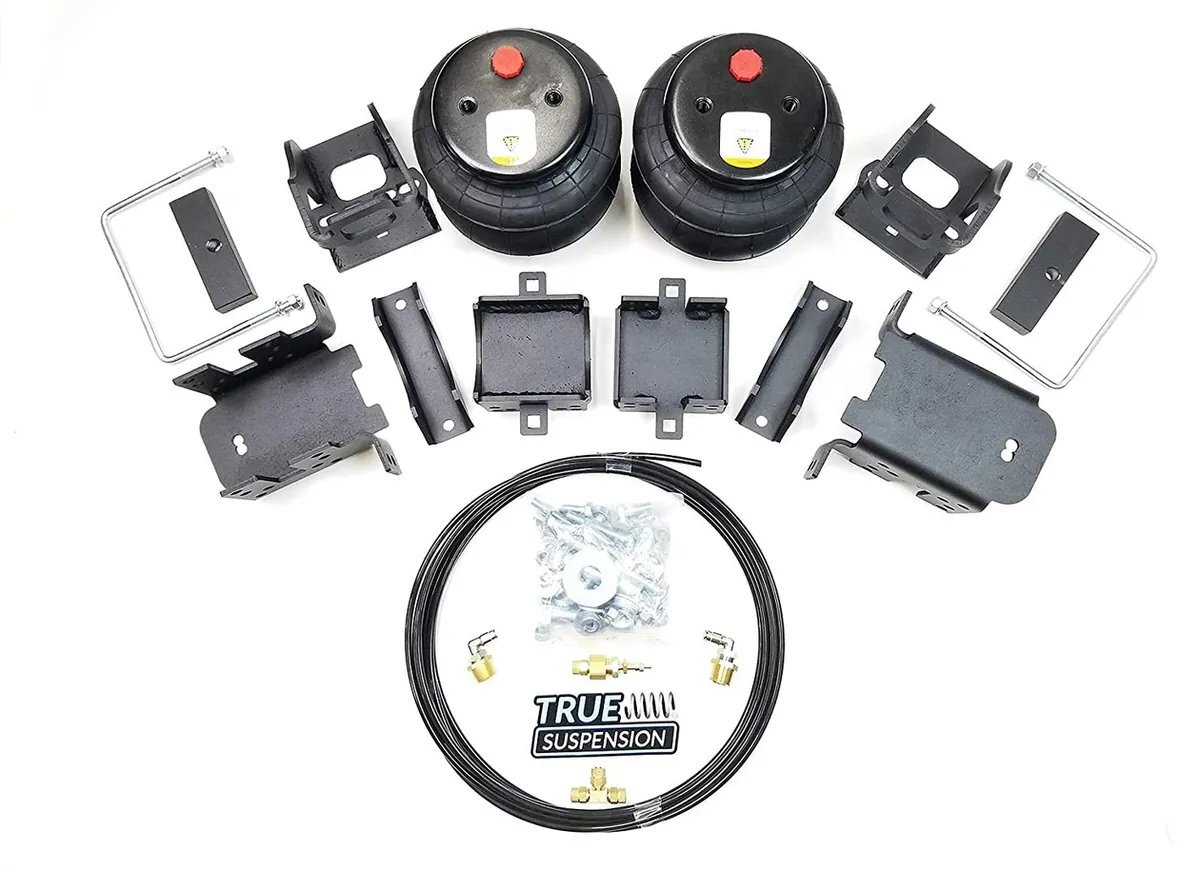
Helper bags on a lowered truck work because they add a second spring, with a pressure you can change, at the rear axle. Empty, you can run a low or moderate pressure so the truck still sits at the drop you want (within the instructions). Loaded, you add air until the hitch height and headlight aim come back into a sensible range, without exceeding the bag, the tank, or the truck’s weight ratings.
True Suspension sells these as tow-assist systems, some as helper springs only and some complete with in-cab controls. Two examples that were in stock on November 27, 2026:
- A 1999-2004 Ford F-250 4WD helper-spring system (SKU 97-994) at $392.95.
- A 2005-2010 Ford F-250/F-350 4WD in-cab tow-assist system (SKU 97-042) at $705.95.
Those two are year- and drivetrain-specific. Do not order either one for a different generation. Start on the tow-assist helper collection and match the cab, year, and 2WD or 4WD exactly.
What helper springs will not do:
- They will not raise GVWR, GAWR, or the tow rating.
- They will not fix a hitch that is too light for the trailer.
- They will not create frame clearance that a deep drop already used up. Check for contact first.
- They will not replace a weight-distributing hitch if the trailer and the tow vehicle call for one. A weight-distributing hitch and helper springs do different jobs; some combinations use both, per the hitch and vehicle makers.
If you already have a lowered stance and you are shopping rear support, measure the static gap from the axle to the bed and to the frame, then air a helper (or have a shop mock it up) and cycle the suspension. Look for contact at full compression. If it hits, solve clearance before you tow.
Hitch Height, Lights, and Brakes
A lowered rear changes the starting height of a receiver. After you hitch the trailer, look at the trailer from the side. A slight nose-down or level attitude is what most conventional-trailer makers want; a sharp tail-high or nose-down trailer is a sign the ball height is wrong. Use a drawbar with the correct drop or rise, not a stack of improvised adapters.
Then check the things that are easy to skip on a lowered truck:
- Trailer lights and the brake controller. A new stance does not change the need for working lamps and, where required, working electric brakes.
- Rear camera and mirror view. A low bed and a high trailer can hide what you used to see. Adjust before you leave the lot.
- Mud flaps and the spare. Confirm nothing rubs at the new running height.
- Safety chains, breakaway switch, and pin or lock. Same rules as any tow.
Our towing-safety upgrade overview is a broader checklist if you are also thinking about tires, brakes, and rear support together.
When a Lowered Truck Needs a Frame Notch
If you dropped the rear far enough that the axle is already near the bed floor or the frame rail, towing will only close that gap. A frame notch — on some trucks a C-shaped cut with a boxed reinforcement, on some a bolt-on notch kit — gives the axle a pocket to move into.
True Suspension sells a bolt-on frame notch for 1973-1991 Chevrolet and GMC C30 1-ton trucks (SKU 35-11) at $162.95, in stock on November 27, 2026, listed for a 6- to 7-inch dropped or slammed stance. That is a vehicle-specific part. It is not a universal fix for every lowered tow vehicle, and it is not a substitute for staying inside the weight ratings. If your truck is not a 1973-1991 C30, use the notch article above and the product collections rather than forcing this SKU.
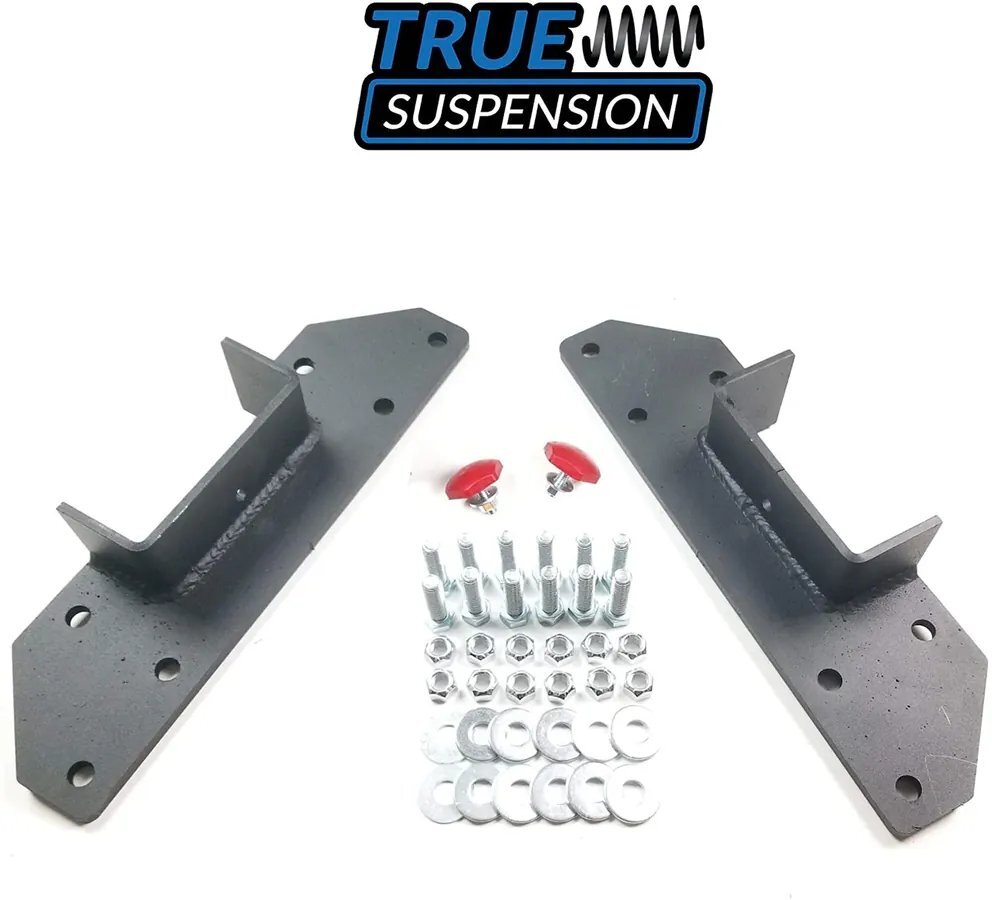
A notch is fabrication-sensitive work even when the kit is bolt-on. If you are not set up to do it correctly, have a qualified shop handle it. A poorly reinforced cut is a safety problem, not a style problem.
Lowered-Stance Parts That Were In Stock (and How They Fit This Job)
If you are still building the stance, or you are matching helper springs to a drop you already have, these live collection and product pages were checked on November 27, 2026:
- Lowering and drop collections and lowering suspension parts
- Adjustable torsion keys and rear shackles for Chevrolet and GMC 2500/3500 HD 4WD at $199.95, in stock. This package can be used to set front and rear height; it is not a towing-capacity upgrade.
- 1965-1979 F-100/F-150 2WD front drop I-beams at $1,595.95, in stock, if you are building a classic Ford and need to think about hitch height at the front as well as the rear.
- 1970-1993 Dodge D100/D150 2WD 3-inch front, 4-inch rear package at $1,354.95, in stock.
Match year, cab, and 2WD or 4WD. If a product is for a classic truck, do not assume the same part exists for a late-model half-ton. And if you already lowered the truck and you are only here for towing support, skip the stance parts and go straight to the tow-assist collection.
A Practical Pre-Trip Checklist
- Confirm GVWR, GAWR, GCWR or tow rating, hitch rating, and tire load rating.
- Weigh if you are close.
- Set tongue weight in the trailer maker’s range (often around 10 to 14 percent of trailer weight, but use the specified range).
- Inspect rear axle-to-bed and axle-to-frame clearance at static height, then with the trailer hitched.
- Air helper springs (if fitted) until the truck sits level enough for headlight aim and steering feel, without exceeding the bag or the ratings.
- Set hitch height so the trailer tows in the attitude the trailer maker describes.
- Check lights, brakes, chains, and mirrors.
- Take a short test drive, then re-check clearance and tire pressure.
If something rubs, bottoms, or wanders on that test drive, do not leave for a long trip. Fix the clearance or the load first.
Final Takeaway
Towing with a lowered truck is workable when you respect the door-sticker ratings, keep tongue weight in range, and make sure the rear axle still has a place to go under load. The drop does not add capacity. Helper bags on a lowered truck are the clean way to hold hitch height for the trip and return to a low stance when the trailer comes off. If the axle is already against the bed or the frame, add clearance before you add miles. When in doubt, weigh the rig and read the owner’s manual for that exact truck.
Frequently Asked Questions
Can you tow with a lowered truck?
Yes, if you stay inside the truck’s GVWR, GAWR, and tow rating, use a hitch rated for the trailer, keep tongue weight in the specified range, and still have rear axle clearance under load. Lowering the truck does not increase those ratings.
Is it safe to tow with a lowered truck?
It can be, when the ratings, hitch, trailer attitude, and remaining suspension travel are all correct. A mild drop with a light, legal trailer is not the same as a deep slam with a heavy trailer and no remaining clearance.
Why is my lowered truck sagging when towing?
The tongue load is pressing the already-lowered rear further down. You have less unused spring travel than a stock truck. Reduce load if you are over a rating, correct hitch height, and consider helper springs that air up under load.
Do helper bags on a lowered truck let me tow more weight?
No. They help control ride height under a load the truck is already rated to carry. They do not raise GVWR, GAWR, or the tow rating.
How much tongue weight should I have?
Use the range the trailer manufacturer specifies. A NHTSA final rule discussion in the Federal Register states that tongue weights are typically 10 to 14 percent of the trailer’s weight, but the range can vary, and you should stay in the specified range. Tongue weight counts as cargo.
Do I need a frame notch to tow with a lowered truck?
Only if the axle is close to the bed or the frame and will contact under load or over bumps. A notch adds clearance. It does not add towing capacity. Some trucks, such as a 1973-1991 C30 with a deep drop, have a specific notch part; others need a different approach.
Will a weight-distributing hitch replace helper springs?
Not always. A weight-distributing hitch moves load toward the tow vehicle’s front axle. Helper springs support the rear of the truck. Some setups use both, following the hitch and vehicle makers. They are not automatic substitutes for each other.
Does a lower hitch height matter?
Yes. A receiver that now sits too low can tip the trailer. Use a drawbar with the correct drop or rise so the trailer tows in the attitude the trailer maker describes.
Where do I start if I already lowered the truck and it squats with a trailer?
Confirm you are under the door-sticker limits, measure axle clearance, then shop a year-correct tow-assist system on our tow-assist helper collection. Air it up for the trip and down when you unhitch.
Do you have parts in stock for this?
On November 27, 2026, example in-stock items included the 1999-2004 F-250 4WD helper-spring system at $392.95, the 2005-2010 F-250/F-350 4WD in-cab system at $705.95, and the 1973-1991 C30 bolt-on frame notch at $162.95. Recheck the live pages for current stock and price, and match your exact year and drivetrain.