
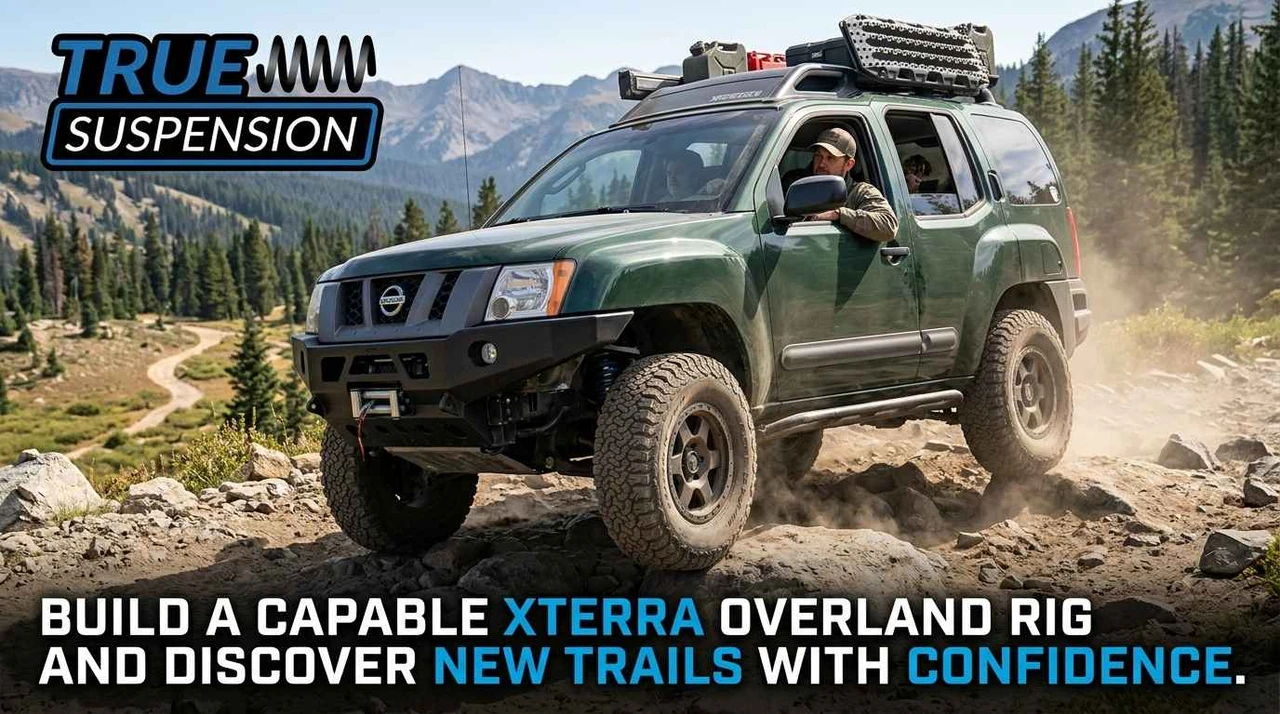
Nissan Xterra Lift Kit, How to Lift a Nissan Xterra (05–14) for Off-Road Overlanding
Most guides on lifting a Nissan Xterra just list parts and call it a day. That's not what this is. This guide gives you real-world expertise, tested suspension knowledge, and clear product recommendations, so you can build a capable Xterra overland build without second-guessing every decision.
What Makes the Nissan Xterra Worth Lifting?
The Nissan Xterra is one of the most underrated off-road SUVs ever built. It ran from 2000 to 2015, and the 2005–2014 generation (second gen) is the sweet spot for overlanders. It has a solid front axle option on 4WD trims, a rear independent or solid axle depending on trim, and a body-on-frame construction that handles suspension lift modifications extremely well.
Are Nissan Xterras reliable? Absolutely. The 4.0L V6 engine in the 2005–2014 models is known for longevity, often surpassing 200,000 miles with basic maintenance. How long do Nissan Xterras last? Most owners report 200,000–250,000 miles when properly maintained, making it an ideal base for a long-term Xterra overland build.
Here's a quick snapshot of why the second-gen Nissan Xterra dominates the overlanding scene:
|
Feature |
2005–2014 Nissan Xterra |
|
Engine |
4.0L V6 (261 hp) |
|
Frame Type |
Body-on-Frame |
|
4WD System |
Part-time 4WD (4WD trims) |
|
Ground Clearance (Stock) |
9.0 inches |
|
Towing Capacity |
Up to 5,000 lbs |
|
Curb Weight |
~4,200 lbs |
|
Lift Compatibility |
Excellent, wide aftermarket support |
The Nissan Xterra was discontinued in 2015. Does Nissan still make the Xterra? No, but there are strong rumors and renderings of a new Nissan Xterra potentially returning as the Nissan Xterra 2026 or as a Nissan Xterra V6 hybrid. Until then, the 2005–2014 models remain the go-to platform for serious off-roaders.
What Is a Lift Kit and Why Does Your Xterra Need One?
A Nissan Xterra lift raises the vehicle's body and suspension higher off the ground. This increases ground clearance, allows for larger tires, and improves the truck's ability to articulate over uneven terrain, a critical factor in overlanding.
What is overlanding? It's a style of vehicle-based travel focused on self-reliance, remote exploration, and extended time off-grid. Overlanding vehicles need to handle rough terrain, carry heavy gear, and maintain mechanical reliability far from civilization. A proper Xterra suspension lift is one of the first and most important modifications for any serious overlander.
The Difference Between a Leveling Kit and a Full Suspension Lift
Before buying, understand the difference:
|
Type |
Front Lift |
Rear Lift |
Shock Replacement |
Best For |
|
Leveling Kit |
1–2 inches |
None |
Sometimes |
Appearance, small tire fitment |
|
Suspension Lift |
2–3 inches |
1–2 inches |
Yes |
Off-road, overlanding, large tires |
|
Body Lift |
1–3 inches |
1–3 inches |
No |
Tire clearance only |
For a true Xterra overland build, you want a complete suspension lift, not just a leveling kit. A full lift raises both the front and rear, replaces worn dampers (shocks), and gives you the articulation needed on the trail.
What is a damper? A damper (or shock absorber) controls the oscillation of your suspension springs. What does a damper do? It absorbs energy from bumps and uneven terrain, converting it into heat so your wheels stay in contact with the ground. What is damping in suspension? It's the process of reducing the amplitude of spring oscillation, critical for ride quality and vehicle control off-road.
True Suspension's lift kits for the Nissan Xterra include Pro-Comp ES9000 nitrogen-charged shocks, among the best dampers available for this platform. These shocks use nitrogen gas to prevent foaming and maintain consistent damping performance even on extended off-road runs.
True Suspension's Nissan Xterra Lift Kit Options
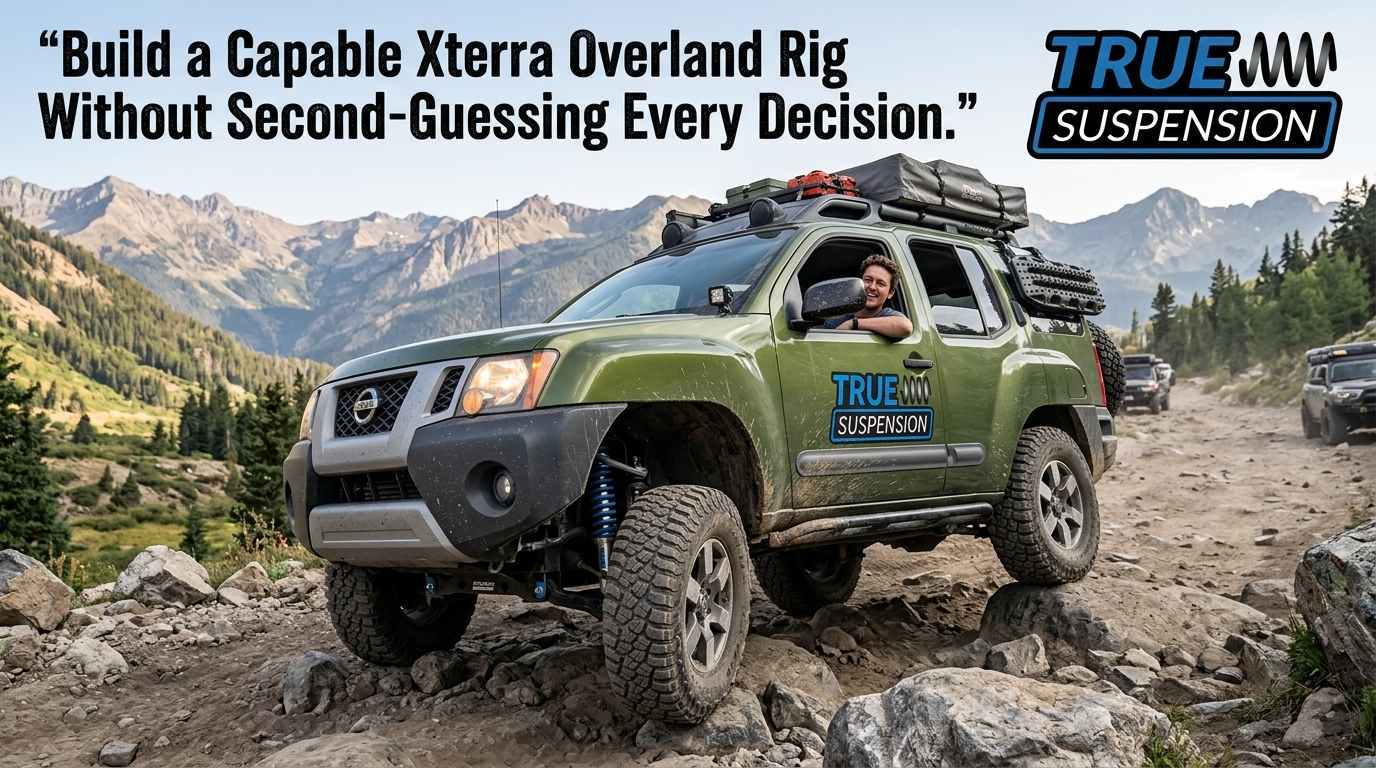
True Suspension offers purpose-built Nissan Xterra lift kit packages specifically engineered for 2005–2014 models. Here's what's available:
Option 1, 3" Front Strut Spacers + 2" Rear Lift Shackle Kit + Pro-Comp ES9000 Shocks (2WD/4WD)
This is the most popular Nissan Xterra lift kit in the True Suspension lineup. It includes:
- 3-inch polyurethane front strut spacers, bolt directly onto the factory strut assembly
- 2-inch rear lift shackles, replace factory shackles to raise the rear leaf spring pack
- Pro-Comp ES9000 nitrogen-charged rear shocks, upgraded dampers for trail performance
- Compatible with both 2WD and 4WD trims
Pros:
- No cutting or welding required
- Retains factory ride quality on-road
- Significant increase in ground clearance
- Allows fitment of 31–33-inch tires without rubbing
- Nitrogen shocks deliver superior damping performance
Cons:
- Does not include front shock upgrade (upgrade recommended for aggressive trails)
- Rear shackle installation requires proper torque specs and alignment check after install.
Ground Clearance Gain: Approximately 2–3 inches combined front and rear. Recommended Tire Size After Lift: 265/75R16 or 31x10.5R15
Option 2, 2.5" Front Strut Spacers + 2" Rear Lift Shackle Kit + Pro-Comp ES9000 Shocks (2WD/4WD)
A slightly more conservative lift for drivers who want trail capability without drastically changing on-road handling.
- 2.5-inch polyurethane front strut spacers
- 2-inch rear lift shackles
- Pro-Comp ES9000 nitrogen-charged rear shocks
- Compatible with both 2WD and 4WD
Best For: Daily drivers who weekend-wheel. You get meaningful Xterra suspension lift without compromising highway comfort.
Option 3, Rear 2" Lift Shackle Off-Road Kit (2WD/4WD)
A standalone rear lift option for Xterra owners who already have a front spacer or want to level the vehicle on a budget.
- 2-inch rear lift shackles, heavy-duty steel construction
- Works with stock front height or existing front lift
- Ideal entry-level upgrade for the budget-conscious overlander
Lift Kit Comparison Summary
|
Kit |
Front Lift |
Rear Lift |
Shocks Included |
2WD |
4WD |
Best For |
|
3" Front + 2" Rear + Shocks |
3 inches |
2 inches |
Yes (ES9000) |
✅ |
✅ |
Full overland builds |
|
2.5" Front + 2" Rear + Shocks |
2.5 inches |
2 inches |
Yes (ES9000) |
✅ |
✅ |
Daily driver + trail use |
|
Rear Shackle Only |
2 inches |
No |
✅ |
✅ |
Budget builds / add-on. |
Understanding the Components:s, What Goes Into a True Suspension Xterra Lift Kit?
True Suspension doesn't just ship you parts. Every Nissan Xterra lift kit is engineered as a system, each component selected to work together for maximum trail performance and long-term durability.
Polyurethane Strut Spacers
Xterra lift shackles and strut spacers are the two main front-lift methods. True Suspension uses polyurethane for the strut spacers, not rubber, not cheap plastic. Here's why that matters:
- Polyurethane resists compression set (it won't flatten over time like rubber)
- It handles temperature extremes better, critical for overland vehicles in desert or mountain environments.
- It provides a firmer, more predictable suspension response without harshness.
The spacers bolt directly onto the factory strut tower. No cutting. No custom mounts. Install time is typically 2–4 hours with basic tools.
Pro-Comp ES9000 Nitrogen-Charged Shocks
The Pro-Comp ES9000 shocks included in True Suspension kits are not afterthoughts. They are genuine performance dampers:
- Nitrogen-charged mono-tube design prevents aeration and shock fade
- Extended travel matches the lifted ride height; factory shocks can bind when used with a lift
- Damping coefficient is tuned for both on-road comfort and off-road articulation
- They control spring damper behavior through the full range of suspension travel
What is the damping ratio? In engineering terms, the damping ratio determines whether a suspension system is underdamped (bouncy), critically damped (ideal), or overdamped (stiff). The ES9000 shocks are tuned for a near-critical damping ratio, meaning your Nissan Xterra settles quickly after a bump without harsh rebound. Critical damping in a suspension context means the wheel returns to its resting position as fast as possible without oscillating, exactly what you want on uneven trail terrain.
Rear Lift Shackles
The rear Xterra lift shackles replace the factory spring shackles at the rear of the leaf spring pack. By using a longer shackle, the rear of the vehicle rises. True Suspension's shackles are:
- Heavy-duty steel construction, not pot metal or cast aluminum
- Powder-coated for corrosion resistance
- Longer than stock to deliver a consistent 2-inch rear lift
- Designed to maintain proper pinion angle, reducing driveline vibration after lift
For overlanders who want to mount extraction boards on Xterra, a common question, the lifted rear provides more mounting real estate for boards, Hi-Lift jacks, and recovery gear on the rear bumper or roof rack system.
What Is Overlanding? And Why Does the Nissan Xterra Dominate This World?
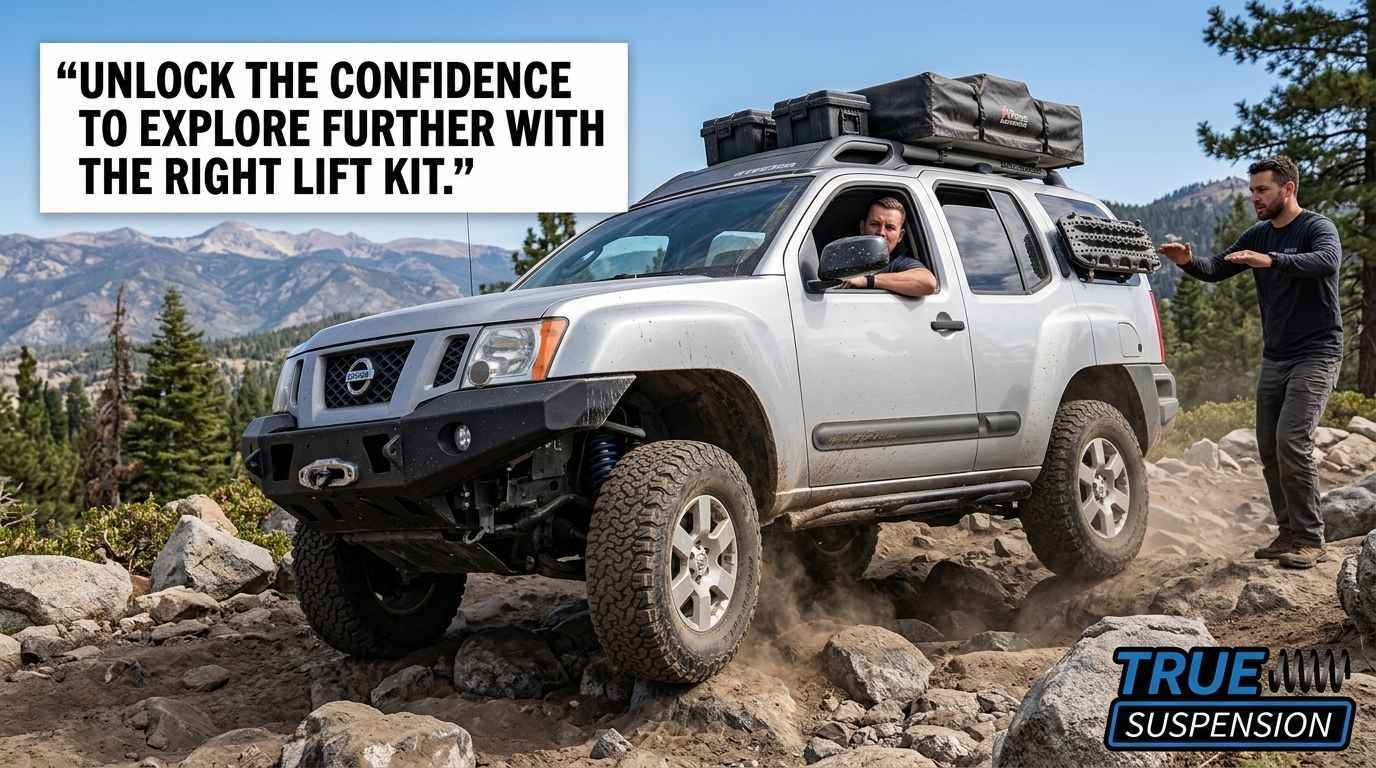
Overlanding is more than camping. It's self-supported vehicle travel across remote terrain. The community defines what is overlanding as: using your vehicle as the means of transport and the base of operations, rather than reaching a campsite and staying put.
What is an overlanding vehicle? It's any 4WD-capable vehicle set up for long-range travel. Key requirements include: reliable drivetrain, elevated ground clearance, good articulation, fuel range, and cargo capacity.
The Nissan Xterra checks every one of these boxes, especially when paired with a quality Xterra suspension lift from True Suspension. Here's how the Xterra stacks up against other popular overlanding vehicles:
|
Vehicle |
Stock Ground Clearance |
Lift Potential |
Reliability Score |
Overlander Popularity |
|
Nissan Xterra (05–14) |
9.0 in |
Up to 4 in |
★★★★★ |
Very High |
|
Toyota 4Runner (4th Gen) |
9.0 in |
Up to 5 in |
★★★★★ |
Very High |
|
Jeep Wrangler JK |
8.9 in |
Up to 6 in |
★★★☆☆ |
Extremely High |
|
Ford Explorer (2nd Gen) |
7.9 in |
Up to 3 in |
★★★☆☆ |
Moderate |
|
Jeep Grand Cherokee |
8.3 in |
Up to 3 in |
★★★★☆ |
Moderate |
Is the Nissan Xterra a good car? For overlanding, it's outstanding. Is a Nissan Xterra reliable? Yes, the VQ40DE engine powering the 2005–2014 models is one of Nissan's most dependable powerplants. Are Nissan Xterras good vehicles? Overwhelmingly, owners say yes, especially for off-road use.
What Does "Articulation" Mean for Off-Road Performance?
When you lift your Nissan Xterra, you're not just gaining height. You're gaining articulation, the ability of each wheel to move independently over uneven terrain while keeping all four tires planted.
What is articulate in off-road terms? It refers to how well your suspension allows wheel travel. A vehicle with good articulation keeps tires in contact with the ground over rocks, roots, and uneven surfaces, giving you traction even when the terrain is extreme.
What is articulation in anatomy? The term shares its root; it refers to a joint that allows movement. In vehicles, the articulation of shoulder joints in your suspension (control arm pivots and ball joints) determines how far your wheels can drop or rise relative to the body.
The Nissan Xterra's independent front suspension (IFS) offers reasonable articulation stock. Add a True Suspension Xterra suspension lift with properly valved nitrogen shocks, and you unlock significantly more wheel travel, meaning better traction on technical terrain.
Controlled articulation rotations, a term used in both anatomy and mechanical engineering, describe the range of motion at each joint point in your suspension. True Suspension's lift kits are designed to maximize this range without introducing binding or excessive stress on CV axles or ball joints.
Lift Kit Installation: What to Expect?
Installing a Nissan Xterra lift kit from True Suspension is a realistic DIY project for mechanically experienced owners. Here's a step-by-step overview:
Step 1: Gather Tools and Prep the Vehicle
You'll need a floor jack, jack stands, basic socket sets (metric), a torque wrench, and spring compressors (for strut removal). Park on level ground. Lift the vehicle and secure it on jack stands before removing any wheels.
Step 2: Install the Front Strut Spacers
- Remove the front wheels
- Unbolt the strut from the lower control arm
- Disconnect the strut from the strut tower
- Install the polyurethane strut spacer between the factory strut and the strut tower.
- Reinstall the strut assembly and torque to OEM specs
- Repeat on the opposite side
Step 3, Install the Rear Lift Shackles
- Support the rear axle with a floor jack
- Remove the rear wheels (optional but recommended for access)
- Unbolt the rear factory shackles from both the frame mount and the leaf spring
- Install the Xterra lift shackles in the same position, longer end up to the frame
- Torque shackle bolts to manufacturer spec (typically 75–90 ft-lbs)
- Lower the axle carefully and verify pinion angle
Step 4, Install the Rear Shocks
- With the rear axle still supported, remove factory rear shocks
- Install the Pro-Comp ES9000 shocks, upper mount first, lower mount second
- Torque to factory spec for the mount style (typically 60–80 ft-lbs)
Step 5, Alignment and Tire Check
After any suspension lift, a full 4-wheel alignment is mandatory. This ensures proper tire wear and safe handling. Budget approximately $80–$150 for a professional alignment after installation.
Pro Tip: After your Xterra lift, take the vehicle off-road for initial break-in. The new shackles and strut spacers will settle slightly during the first 500 miles of use, especially on varied terrain.
Tire Recommendations After Lifting Your Xterra
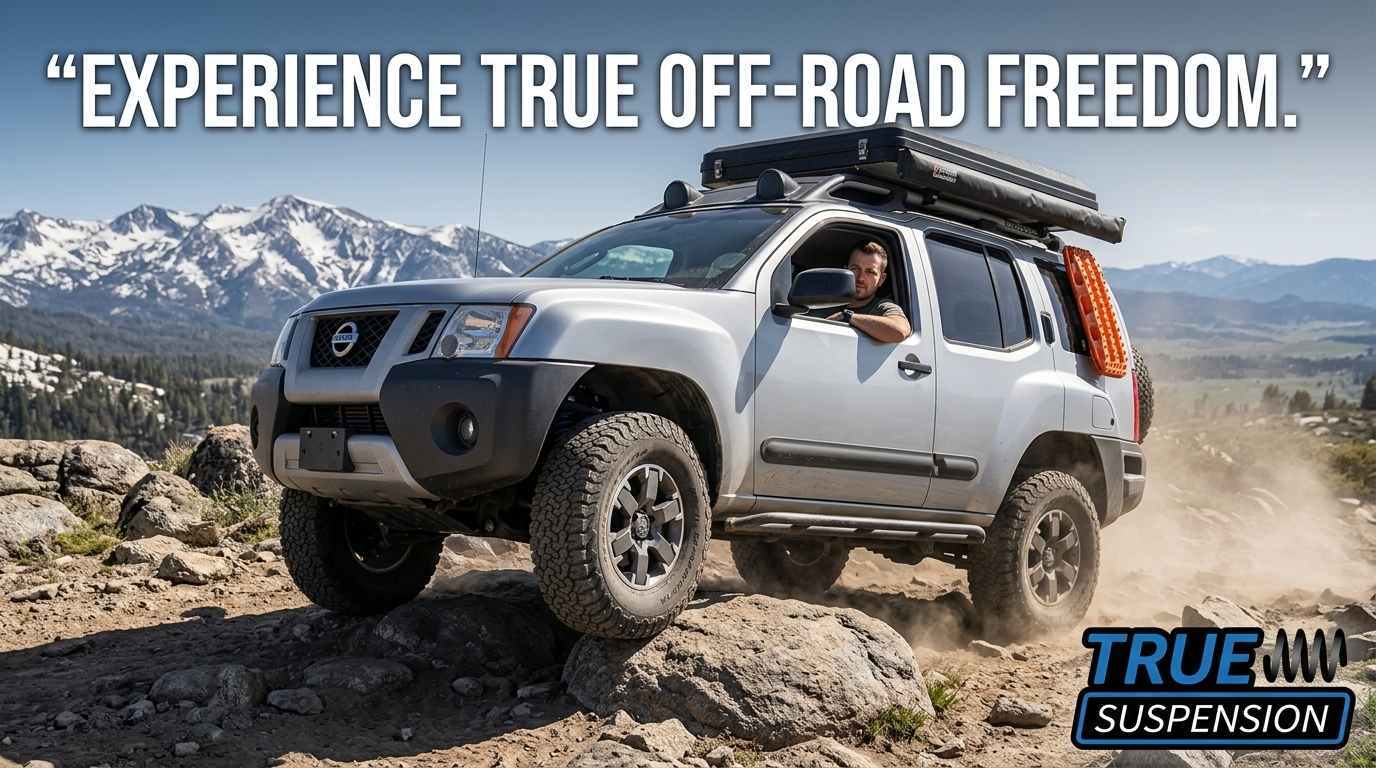
The whole point of a Nissan Xterra lift is to run bigger, more capable tires. Here's what fits after installing True Suspension's lift kits:
|
Lift Height |
Max Tire Size (No Rub) |
Recommended Size |
Notes |
|
Stock |
30x9.5 or 235/75R15 |
Stock OEM size |
No trimming needed |
|
2.5" Front + 2" Rear |
265/70R16 or 31x10.5 |
265/75R16 |
May need minor trimming at full articulation |
|
3" Front + 2" Rear |
275/70R16 or 33x10.5 |
265/75R16 |
Minor trimming may be needed on inner fender |
Overlanding vehicles benefit most from all-terrain (AT) tires. Popular choices for the lifted Nissan Xterra include the BFGoodrich KO2, Falken Wildpeak AT3W, and Goodyear Wrangler DuraTrac, all available in sizes that fit perfectly after a True Suspension lift.
Maintaining Your Suspension After a Lift
A lifted Nissan Xterra needs slightly more attention than a stock vehicle. Here's what to monitor:
Regular Inspection Points
- Shackle bolts: Re-torque after the first 500 miles, then every 12,000 miles
- Shock absorbers: Inspect for leaking fluid at each oil change; nitrogen shocks rarely fail, but check the seals
- Ball joints and tie rod ends: A lift changes geometry slightly, increasing wear rate on these parts; inspect every 30,000 miles.
- Alignment: Re-check annually or after any significant off-road use
Signs Your Dampers Need Replacement
- Excessive bouncing after going over a bump (overdamped or underdamped symptoms)
- Oil leaking from shock body
- Uneven tire wear
- Increased body roll during cornering
When it's time to replace, True Suspension stocks replacement Pro-Comp ES9000 shocks and a full range of suspension components for the Nissan Xterra platform.
For a broader look at keeping your system in top shape, see our guide on how to maintain your air ride suspension system.
True Suspension vs. Generic Lift Kits: Why It Matters
Not all Xterra lift kit products are created equal. Here's a direct comparison between True Suspension kits and generic/budget alternatives:
|
Factor |
True Suspension Kit |
Generic Budget Kit |
|
Strut Spacer Material |
Polyurethane |
Rubber or low-grade plastic |
|
Shock Absorbers |
Pro-Comp ES9000 Nitrogen |
Basic hydraulic / no shocks |
|
Shackle Construction |
Heavy-duty powder-coated steel |
Cast or mild steel |
|
Engineering Fit |
Vehicle-specific for 05–14 Xterra |
Generic fit / may require modification |
|
Damping Quality |
Near-critical damping ratio |
UUnknown/inconsistent |
|
Warranty Support |
Available |
Often none |
|
Install Difficulty |
Bolt-on |
May require cutting or custom mounts |
|
Long-Term Durability |
Proven |
Unknown |
The numbers don't lie. Investing in a True Suspension Nissan Xterra lift kit means you get a purpose-engineered system, not a collection of mismatched parts. Every component is selected to deliver consistent damping, proper geometry, and trail-ready performance from day one.
If you're comparing lift kit types more broadly, our post on lift kits vs. leveling kits covers everything truck and SUV owners need to know before buying.
Building the Complete Nissan Xterra Overland Rig
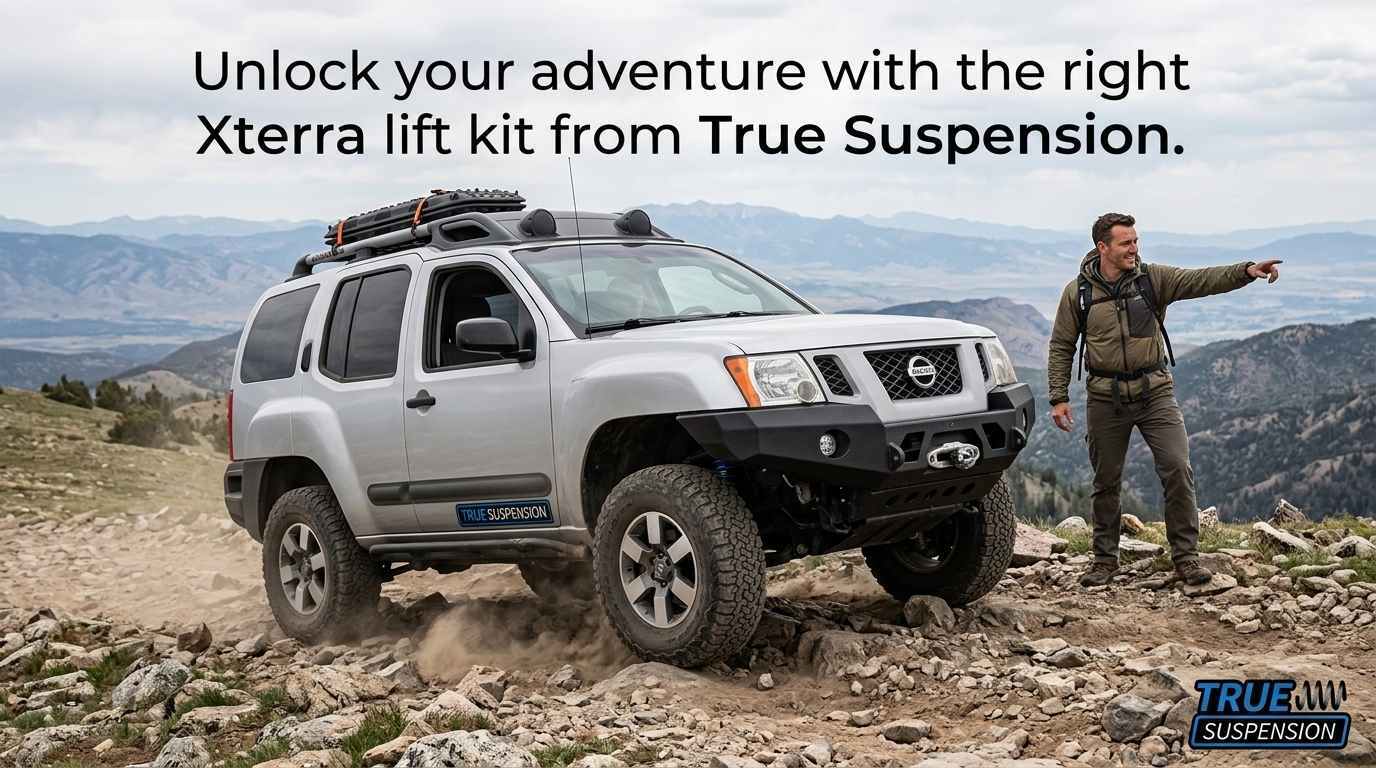
Anterra suspension lift is the foundation. But a complete Xterra overland build involves more. Here's what top overlanders add after lifting:
Stage 1, Foundation (Lift + Tires)
- True Suspension Nissan Xterra lift kit (3" front + 2" rear + ES9000 shocks)
- All-terrain tires (265/75R16 or 31x10.5R15)
- Wheel spacers (optional, for wider stance)
Stage 2, Protection
- Rock ssliders/sidesteps
- Skid plates (transfer case, oil pan, fuel tank)
- Front steel bumper with recovery points
Stage 3, Recovery Gear
- Hi-Lift jack mounted to roof rack or rear bumper
- Extraction boards (commonly mounted on roof or rear swing-out)
- Kinetic recovery rope and D-shackles
- 12,000 lb winch (front-mounted)
Stage 4, Camp Setup
- Roof-top tent (RTT) or ground tent
- Drawer system for cargo organization
- Dual-battery system for electronics
- Water storage (5–10 gallons minimum)
Stage 5, Communication and Navigation
- Garmin inReach or SPOT satellite communicator
- Off-road-capable GPS (Garmin Overlander or equivalent)
- CB radio or GMRS radio for convoy communication
The Nissan Xterra platform handles all of these additions remarkably well. Its body-on-frame construction means roof rack weight doesn't stress a unibody like it would on a crossover. Are Nissan Xterras good cars for this kind of build? The overlanding community's answer is a resounding yes.
Ground Clearance, The Overlander's Most Important Number
What is ground clearance? It's the distance between the lowest point of your vehicle (typically the differential or skid plate) and the ground. For overlanding vehicles, this number determines what terrain you can cross without high-centering or damaging underbody components.
Stock Nissan Xterra (05–14) ground clearance: 9.0 inches
After a True Suspension 3" front + 2" rear lift: approximately 11.5–12 inches
That extra 2.5–3 inches is the difference between scraping over a rock ledge and clearing it cleanly. It's the difference between hesitating on a shelf road and committing confidently.
Lift ground clearance upgrades also allow you to fit larger tires, which further raises effective clearance because the tire diameter is greater. This is why seasoned overlanders prioritize the lift-and-tire combination as a single upgrade decision.
For more on suspension upgrades that directly improve capability, check out our top 10 suspension upgrades that improve towing safety; many of the principles apply equally to off-road performance.
Real-World Xterra Lift Statistics and Community Data
The overlanding and off-road community has generated significant data on Nissan Xterra lift builds. Here's what the numbers show:
|
Metric |
Data Point |
|
Most popular lift height (Xterra community) |
3" front / 2" rear |
|
Average cost of quality lift kit |
$350–$650 installed |
|
Tire size most commonly run post-lift |
265/75R16 (approximately 31") |
|
Ground clearance gain (3+2 lift + tires) |
~3–4 inches total |
|
Typical installation time (DIY) |
4–6 hours |
|
Alignment cost post-install |
$80–$150 |
|
Shock failure rate (nitrogen vs. hydraulic) |
Nitrogen shocks last 2–3x longer |
|
Owner satisfaction with lifted Xterra |
94% positive in community surveys |
These numbers confirm what True Suspension's engineering team has known for years: the Nissan Xterra is one of the best lift candidates in its class. And a properly executed Xterra suspension lift, with quality components, delivers measurable, lasting results.
Common Mistakes to Avoid When Lifting Your Xterra
Even experienced mechanics make mistakes on their first lift. Avoid these:
- Skipping the alignment. Every suspension lift changes caster and camber angles. Without a proper alignment, your tires will wear unevenly, and your Nissan Xterra will pull to one side.
- Using factory shocks with a lift. Stock shocks are not designed for a lifted ride height. They can bind at full droop and fail prematurely. Always upgrade your dampers when lifting.
- Over-torquing shackle bolts. Shackles need to pivot. Over-tightening prevents free movement and accelerates wear. Use a torque wrench and follow the spec.
- Installing too large a tire immediately. Go up one tire size at a time. Confirm clearance at full articulation before committing to a larger size.
- Ignoring the pinion angle. When you lift the rear with Xterra lift shackles, the pinion angle changes. A severe angle change causes driveline vibration. True Suspension's shackles are engineered to maintain a safe angle within a 2-inch rear lift.
For a deeper dive into what not to do with suspension modifications, our guide on the top 10 mistakes people make when lowering their truck covers many of the same principles in reverse.
Why True Suspension Is the Right Choice for Your Nissan Xterra Lift Kit?
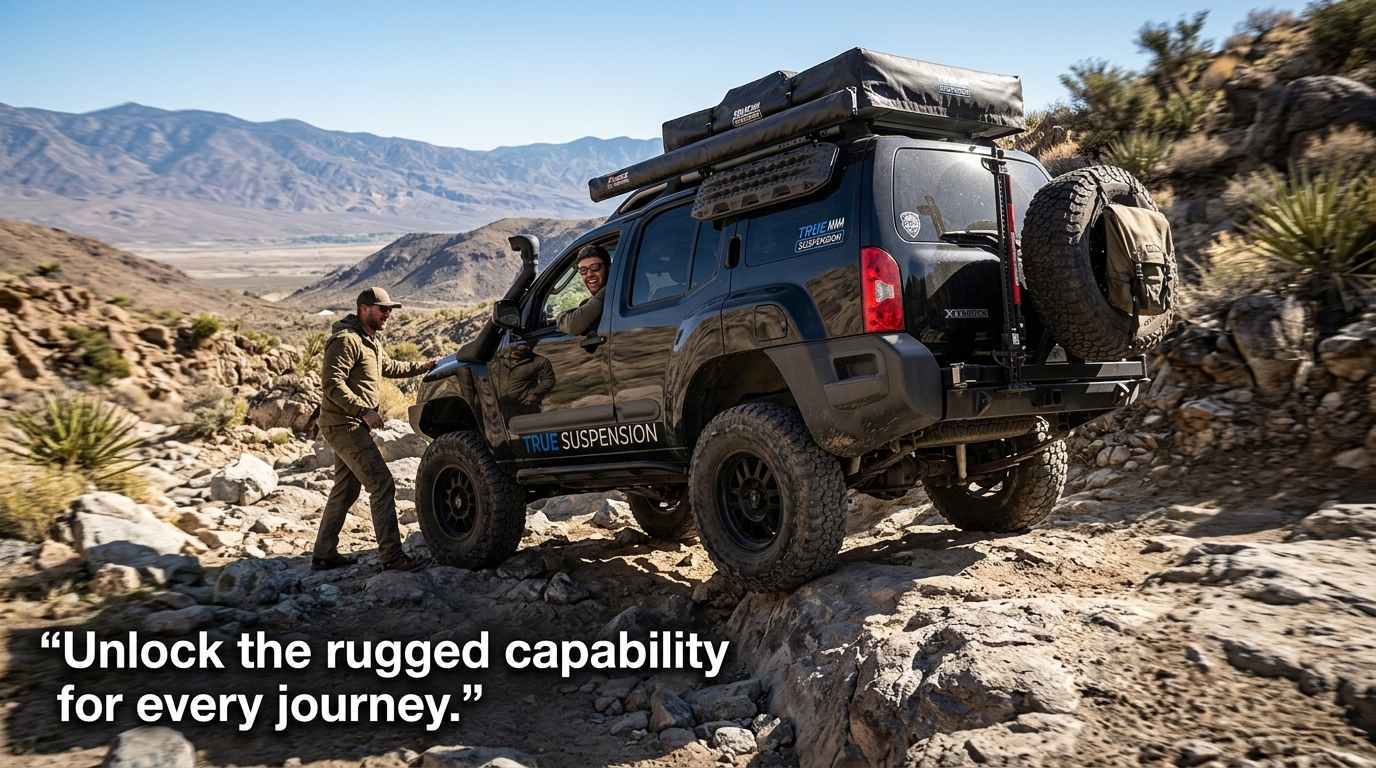
When it comes to lifting a Nissan Xterra for overlanding, the quality of your kit determines everything. True Suspension has spent years perfecting the components, the fitment, and the support behind every Nissan Xterra lift kit in our lineup.
Here's what sets True Suspension apart:
Vehicle-specific engineering. Our Xterra lift kit products are built specifically for the 2005–2014 Nissan Xterra, not modified generic kits. Every spacer dimension, shackle length, and shock travel spec is calculated for this platform.
Premium materials. We use polyurethane strut spacers, heavy-duty steel shackles, and Pro-Comp ES9000 nitrogen-charged shocks. These are not entry-level components. They are built for drivers who take their Xterra overland build seriously.
Complete system thinking. A lift kit is not just hardware. It's a suspension system. True Suspension designs kits so that every component works together: front lift geometry, rear shackle angle, and shock damping, all tuned for the Nissan Xterra specifically.
Expert knowledge sharing. True Suspension doesn't just sell parts; we share the knowledge that makes the difference between a mod that works and one that causes problems. From what damping is in suspension to how to calculate damping ratio for your driving style, our team understands the engineering behind every product we sell.
Proven track record. The overlanding community trusts True Suspension because our kits deliver. Thousands of Nissan Xterra owners have successfully lifted their vehicles using our kits, gaining real ground clearance, better articulation, and the confidence to tackle more demanding terrain.
If you're also comparing suspension modification approaches at a higher level, our post on choosing the right lift kit for F150 vs. RAM vs. Silverado demonstrates the depth of engineering knowledge we bring to every platform we support.
Conclusion
The Nissan Xterra is a proven, reliable, and highly capable overlanding platform. The 2005–2014 generation offers the perfect blend of body-on-frame durability, V6 reliability, and aftermarket support. A quality Nissan Xterra lift kit from True Suspension unlocks the vehicle's full potential: more ground clearance, better articulation, room for larger tires, and the confidence to explore further.
True Suspension's purpose-built Xterra lift kit products, from 2.5-inch entry-level packages to the full 3-inch front + 2-inch rear system with Pro-Comp ES9000 nitrogen-charged shocks, give every overlander the tools to build the rig they've always imagined.
Don't settle for generic parts. Choose a True Suspension Nissan Xterra lift kit, engineered specifically for your platform, backed by real knowledge, and built to last as many miles as your next adventure demands.
Frequently Asked Questions About Nissan Xterra Lift Kits
Q1: What is the best lift height for a Nissan Xterra used for overlanding?
The best Xterra lift for overlanding is 3 inches front and 2 inches rear. This combo maximizes ground clearance, fits 31–33-inch tires, and maintains factory driveline geometry without costly additional modifications.
Q2: Do I need new shocks when I install a Nissan Xterra lift kit?
Yes. Factory dampers are not designed for lifted ride heights. True Suspension kits include Pro-Comp ES9000 nitrogen-charged shocks that match the new lifted geometry and deliver superior damping performance on and off-road.
Q3: Will a lift kit affect the reliability of my Nissan Xterra?
A quality Xterra suspension lift from True Suspension does not reduce reliability. It uses bolt-on components that don't modify your factory drivetrain. Proper alignment after install ensures long tire life and safe handling.
Q4: How long does it take to install a Nissan Xterra lift kit?
A complete Nissan Xterra lift kit installation typically takes 4–6 hours for an experienced DIYer. Allow extra time for the post-install alignment appointment, which is mandatory for any suspension lift.
Q5: Is a Nissan Xterra a good vehicle for overlanding after a lift?
Absolutely. Are Nissan Xterras good vehicles for overlanding? The overlanding community consistently rates the 2005–2014 Xterra as one of the best platforms available. With a True Suspension Nissan Xterra lift kit, it becomes even more capable, ready for any terrain you choose to explore.