
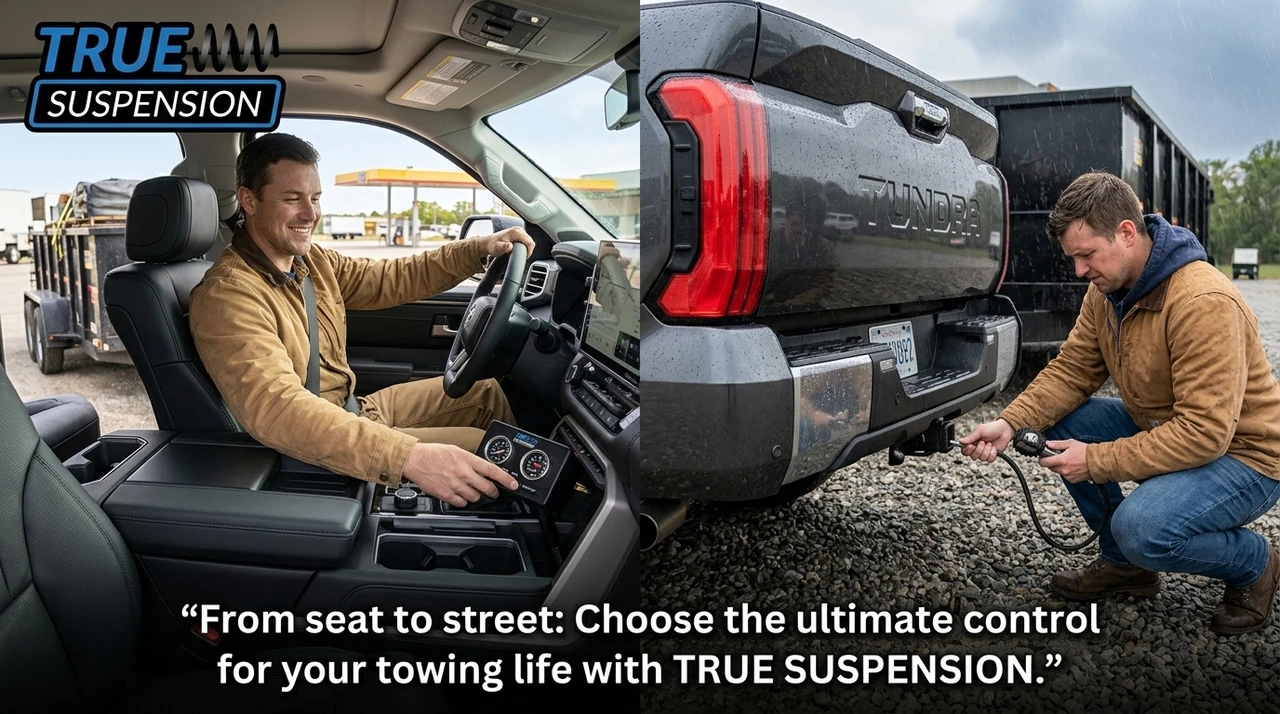
Most guides on Tundra air bag towing setups just throw specs at you and call it a day.
That is not what this is.
If you haul heavy loads with a Toyota Tundra, you already know that the stock suspension system was not built for maximum tow stress. Your rear sags. Your steering gets light. Your trailer sways. And every trip feels like a gamble.
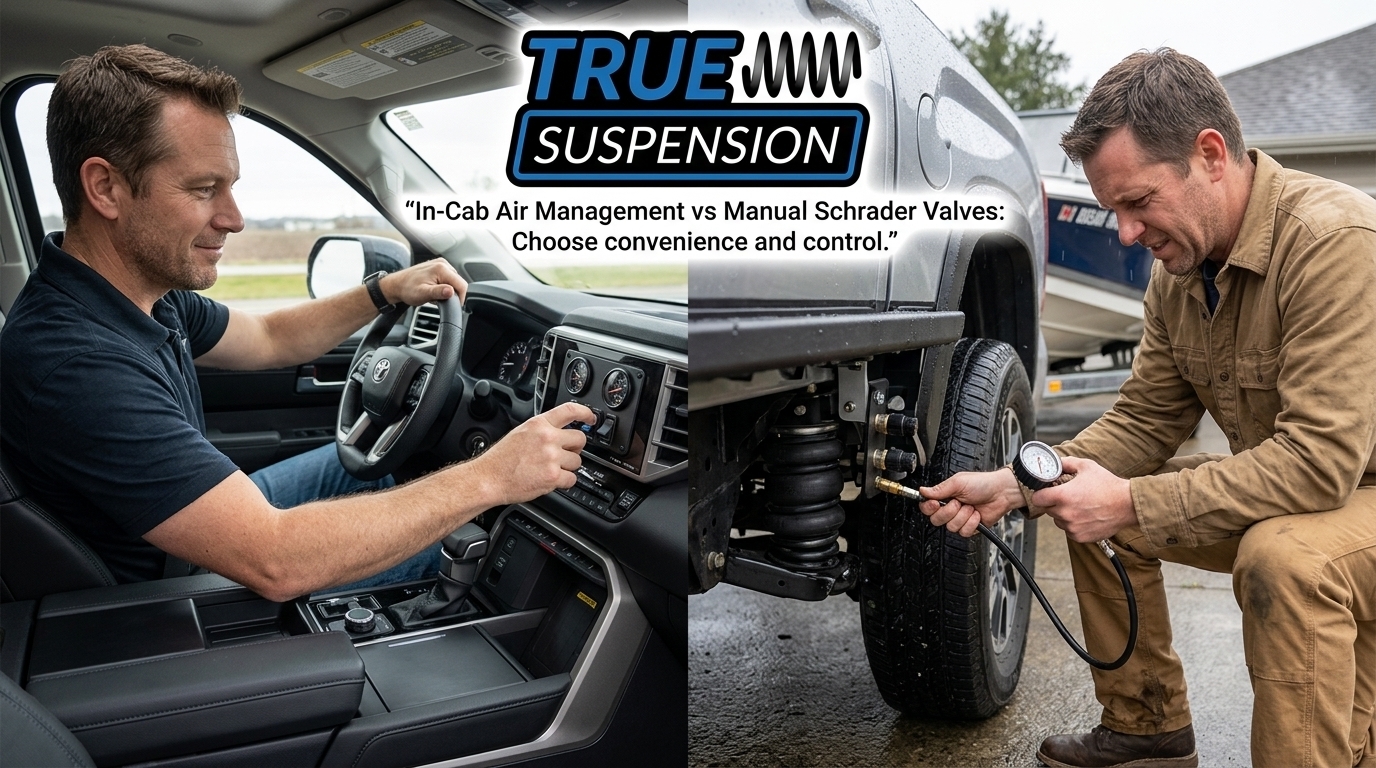
The real fix is a quality tow assist air bag kit, but once you decide to install one, a second big question hits fast: do you go with an in-cab air management system or stick with simple manual Schrader valves?
That choice matters more than most people realize. It affects your safety, your convenience, your budget, and how your vehicle suspension performs every single time you hook up a trailer.
At True Suspension, we have helped thousands of truck owners solve exactly this problem. We have engineered kits for 2WD and 4WD Tundras from 2007 all the way through 2021. We know what works, what fails, and what separates a frustrating install from a setup you rely on for years.
This guide breaks down In-Cab Air Management vs Manual Schrader Valves in full detail, features, real-world use, pros and cons, cost, and which one actually fits your towing life.
Let's get into it.
What Is a Tundra Air Bag Towing Setup and Why Does It Matter?
Before we compare systems, let's make sure we are on the same page about what a tow assist air bag kit actually does.
Your Toyota Tundra rides on a coil spring suspension or leaf spring suspension at the rear, depending on trim and year. Under heavy load, a fifth wheel, a boat, a loaded flatbed, those springs compress. The rear drops. The front lifts. Your wheel alignment shifts. Your vehicle suspension works harder than it was designed to.
A towing assist air bag kit installs air springs alongside your existing rear suspension components. You inflate them to a set pressure, and they carry the load that would otherwise crush your factory springs. The result is a level truck, stable steering, and a dramatically safer tow.
The difference between the two delivery systems, in-cab air management vs manual Schrader valves, is all about how you control that air pressure.
According to industry data, trucks with properly pressurized air bag suspension reduce rear sag by up to 90% under maximum load. That stat alone should make you pay attention to how you manage your pressure.
Understanding Manual Schrader Valves, The Basics
Manual Schrader valves are the entry-level control option for tow assist suspension kits. They work exactly like the valve stem on your tire.
You install two valves, one per airbag, usually somewhere accessible under the truck, near the rear bumper, or along the frame. To adjust pressure, you grab a hand gauge and air chuck, crawl under or around the truck, and manually inflate or deflate each bag.
It is the simplest possible setup. And for certain users, that simplicity is a genuine advantage.
How Manual Schrader Valves Work?
|
Feature |
Detail |
|
Valve Type |
Standard tire-style Schrader valve |
|
Adjustment Method |
Hand pump or air compressor + gauge |
|
Location |
Frame rail, bumper, or accessible body panel |
|
Pressure Check |
Manual gauge only |
|
Adjustment Time |
5–10 minutes per session |
|
Electrical Required |
None |
|
Cost |
Lowest of all options |
You connect your air source, watch the gauge, and stop when you hit your target PSI. Disconnect. Done.
It is not fast. It is not glamorous. But it works reliably every time because there is almost nothing that can go wrong with it.
Pros and Cons of Manual Schrader Valves
Pros:
- Lowest upfront cost
- Zero electrical components to fail
- Dead-simple to understand and use
- Works with any air source
- Easy DIY install
- No wiring harness required
Cons:
- Requires getting out of the truck to adjust
- Cannot adjust pressure while driving or while loaded
- No visual pressure gauge in cab
- Uneven inflation between bags is possible without careful technique
- Inconvenient in bad weather, tight spaces, or time-sensitive situations
- No real-time monitoring
The manual valve approach is best for users who tow infrequently, always have time to prep before hitching, and want a budget-friendly, reliable baseline for their rear suspension improvement.
Understanding In-Cab Air Management, Full Control at Your Fingertips
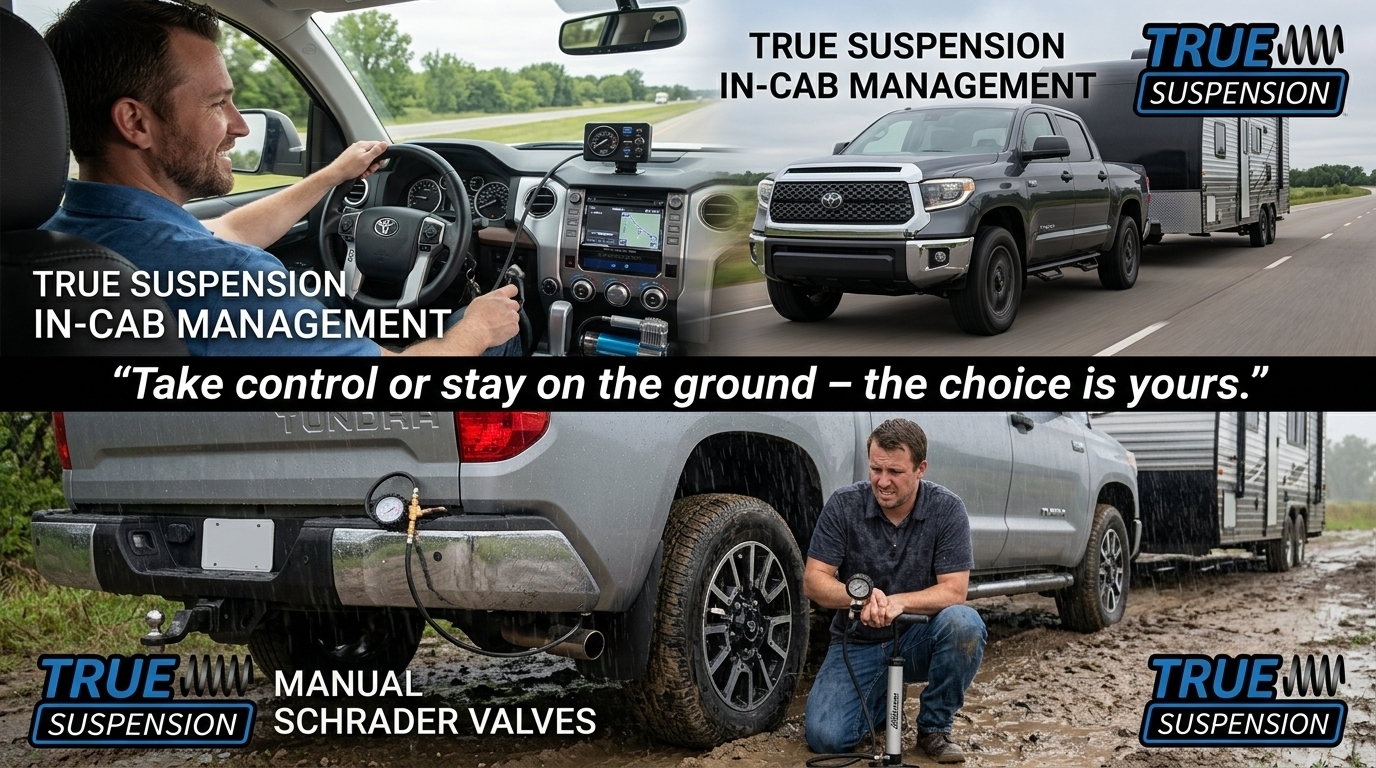
In-cab air management takes everything the manual valve does and moves it to a control panel mounted inside your truck.
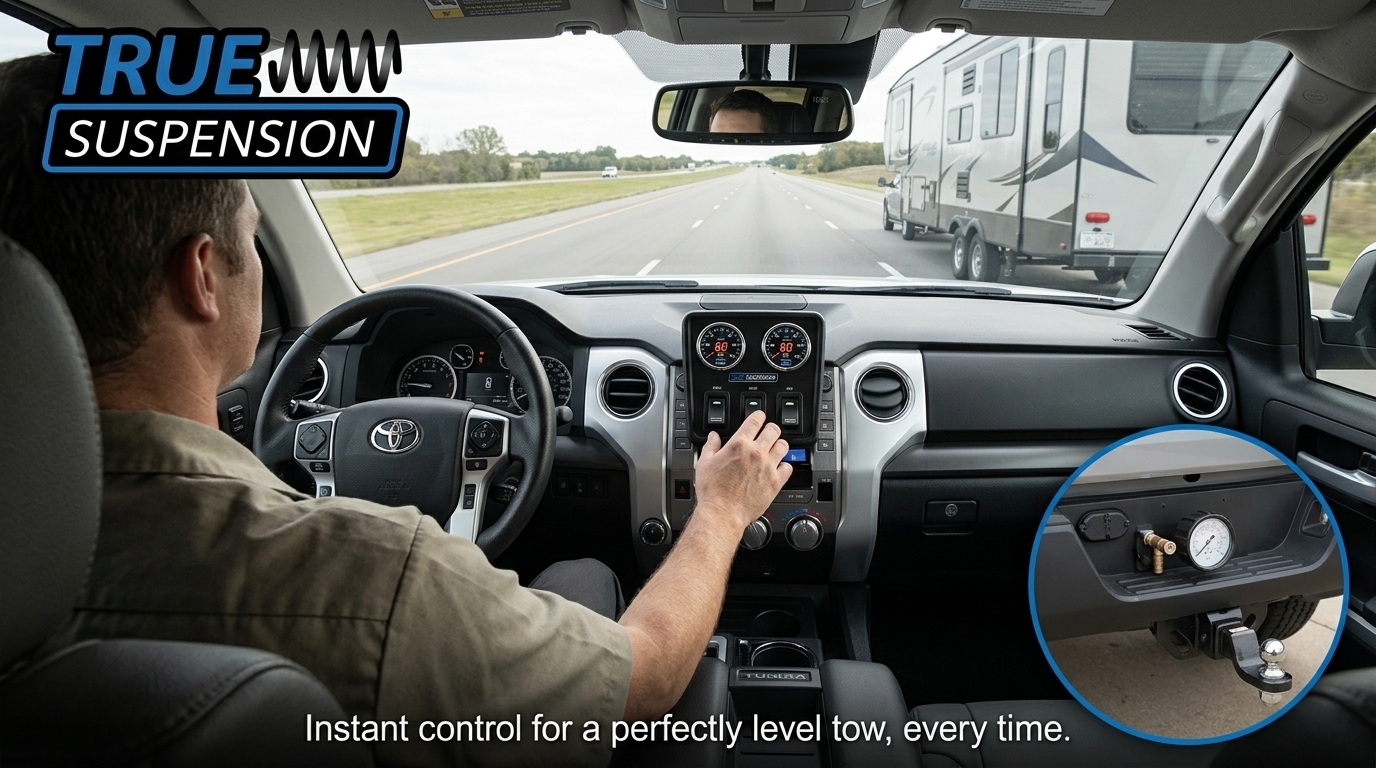
You get gauges. You get switches. You get real-time pressure readout. You control your air bag pressure from the driver's seat, before you leave the driveway or while you are stopped at a gas station, without ever reaching for a hand pump.
True Suspension's in-cab management systems are engineered specifically for trucks like the Tundra. Our dual-switch panel kits deliver a clean, professional install that looks factory and performs on a different level than stock.
How In-Cab Air Management Works
The system routes air lines from your bags to a control panel mounted in the cab. An onboard compressor or a tank (depending on the kit configuration) supplies air. You flip a switch or press a button. The bag inflates. A gauge tells you exactly where pressure sits, on both sides simultaneously.
|
Feature |
Detail |
|
Control Panel |
Dash or console-mounted |
|
Pressure Display |
Analog or digital gauge (per bag or dual) |
|
Adjustment Method |
Switch or paddle from inside cab |
|
Air Source |
Onboard compressor or tank |
|
Adjustment Time |
Under 60 seconds |
|
Electrical Required |
Yes, basic 12V wiring |
|
Real-Time Monitoring |
Yes |
|
Cost |
Mid to premium range |
Pros and Cons of In-Cab Air Management
Pros:
- Adjust pressure from driver's seat in seconds
- Real-time PSI readout keeps you informed
- Inflate both bags simultaneously for even pressure
- Ideal for frequent towers or changing loads
- Looks professional and adds resale value
- Works without leaving the truck in rain, cold, or tight spots
- Pairs perfectly with compressor kits for on-the-go adjustment
Cons:
- Higher upfront cost than Schrader valves
- Requires basic electrical wiring during install
- Compressor adds a component that can eventually wear
- More parts = slightly more to maintain long-term
For serious Tundra owners who tow regularly, the in-cab system is not a luxury. It is the smarter, safer, more professional choice.
Head-to-Head Comparison, In-Cab Air Management vs Manual Schrader Valves
Let's put both systems side by side across every key metric that matters for a Toyota Tundra towing setup.
|
Comparison Factor |
In-Cab Air Management |
Manual Schrader Valves |
|
Ease of Use |
⭐⭐⭐⭐⭐ |
⭐⭐⭐ |
|
Adjustment Speed |
Under 60 seconds |
5–10 minutes |
|
Real-Time Monitoring |
Yes |
No |
|
Even Bag Inflation |
Automatic / Simultaneous |
Manual / User-dependent |
|
Weather Convenience |
Fully in-cab |
Requires exterior access |
|
Installation Complexity |
Moderate (wiring) |
Simple |
|
Upfront Cost |
$$ – $$$ |
$ |
|
Long-Term Reliability |
High with basic maintenance |
Very high |
|
Best For |
Frequent towers, heavy loads |
Occasional towers, budget builds |
|
Towing Safety Level |
Maximum |
Good |
|
Professional Appearance |
Yes |
Minimal |
|
Resale Appeal |
High |
Low |
The numbers tell a clear story. In-cab air management wins on nearly every performance metric. Manual Schrader valves win on simplicity and initial cost.
Why the Toyota Tundra Specifically Benefits From Air Management Upgrades?
The Toyota Tundra is one of the most capable half-ton trucks on the road. Its towing capacity ranges from 8,800 to 10,200 lbs depending on configuration. But factory rear suspension is tuned for comfort, not maximum load stability.
When you load a Tundra to near its rated capacity, you will feel:
- Rear squat and nose-high attitude
- Reduced braking effectiveness
- Steering that feels vague or floaty
- Vibration while driving that gets worse under load
- Increased tire wear from axle angle changes
A properly pressurized tow assist air bag kit solves all of that. And the way you manage that pressure, in-cab or manual, determines how consistently you dial in the fix.
True Suspension offers dedicated kits for the Tundra from 2007–2021 in both 4WD and 2WD/RWD configurations. Every kit is engineered to match the Tundra's geometry, spring rates, and load ratings precisely. No guesswork. No universal fit-all compromise.
The True Suspension Advantage: Why Our Kits Set the Standard
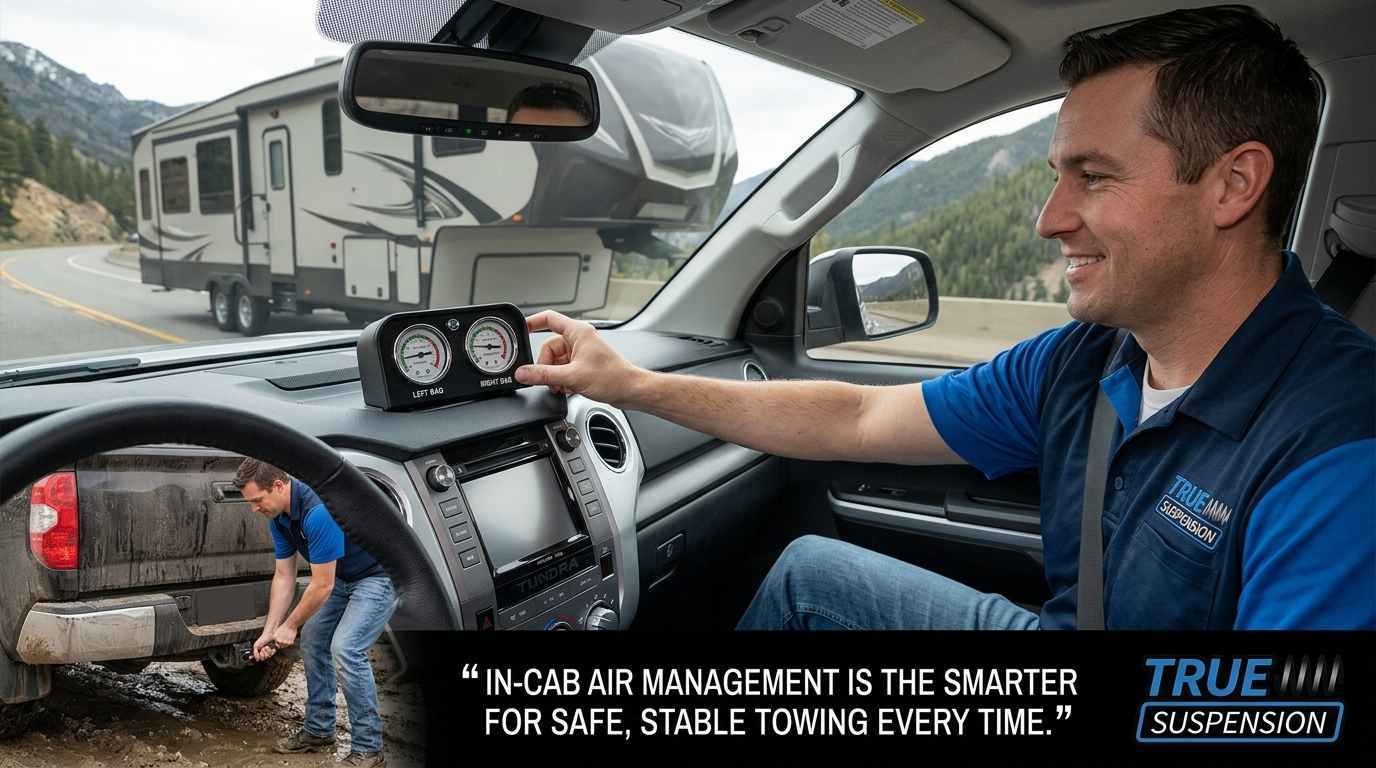
There are a lot of air bag kits on the market. Not all of them are built the same.
True Suspension kits for the Toyota Tundra are designed with three priorities: precision fit, maximum load support, and long-term durability. Here is what makes our products different:
Engineered for the Tundra, Not Just Compatible With It
Generic suspension components cause problems because they are not designed around the Tundra's specific geometry. Our kits are purpose-built. Axle angle, spring rates, bracket geometry- all of it is dialed in for your specific truck year and drivetrain configuration.
Complete Kit Packages, Nothing to Hunt Down Separately
Our in-cab management kits include everything you need: air springs, brackets, lines, fittings, and the control panel. You are not hunting down missing parts or making aftermarket modifications to make things fit.
Dual-Bag Pressure Management for Even Load Distribution
Uneven air bag suspension pressure is a real problem. It can create alignment issues and uneven wear on suspension components. Our in-cab systems inflate both bags simultaneously to deliver even, balanced support across both sides of the rear axle.
Industry-Leading Support and Fitment Guarantee
We stand behind every kit we build. If it does not fit correctly, we make it right. That level of commitment is rare in the aftermarket suspension space.
Real-World Towing Scenarios, Which System Wins?
Theory is useful. Real-world scenarios are more useful. Here is how each system performs in actual towing situations.
Scenario 1: Weekend Boat Hauler
Your situation: You tow a 22-foot boat 3–4 times per summer. You always prep at home before leaving.
Manual Schrader Valves: Works well here. You inflate your bags in the driveway before hooking up. Pressure holds all day. You deflate when you get home. Simple.
In-Cab Management: Still better, because you can adjust at the boat ramp if conditions change. But the manual system handles this use case just fine.
Winner: Tie, manual is sufficient, in-cab is more convenient.
Scenario 2: Commercial Contractor With Changing Loads
Your situation: You haul different loads daily. Sometimes 3,000 lbs, sometimes 7,000 lbs. Load changes multiple times a week.
Manual Schrader Valves: Painful. You are crawling around the truck every time the load changes. You may skip adjustments because it is inconvenient, which means you are towing with the wrong pressure.
In-Cab Management: Perfect. You adjust pressure from your seat between jobs. Sixty seconds. Done. Every load gets the right pressure every time.
Winner: In-Cab Air Management by a wide margin.
Scenario 3: Cross-Country Towing in Variable Weather
Your situation: You tow a 5th wheel across multiple states. Temperature swings of 40–50°F change air bag pressure significantly; cold air compresses, heat expands.
Manual Schrader Valves: You have to stop, get out, and manually adjust as temperatures change. In rain or freezing conditions, that is genuinely unpleasant and potentially dangerous.
In-Cab Management: You monitor pressure changes on the gauge in real time. You adjust in seconds from the driver's seat without stopping. Your rear suspension stays perfectly tuned across the entire route.
Winner: In-Cab Air Management, not even close.
Scenario 4: Budget-Conscious First-Time Builder
Your situation: You want to upgrade your vehicle suspension but want to spend as little as possible on the first build. You tow once or twice a month, nothing extreme.
Manual Schrader Valves: Smart choice here. You get the core benefit, rear suspension support, without the added cost of a full in-cab system. You can always upgrade later.
In-Cab Management: You will love the convenience, but it may not fit the current budget.
Winner: Manual Schrader Valves for budget-first builds.
Choosing the Right True Suspension Kit for Your Tundra
True Suspension offers multiple configurations to match exactly what you need. Here is how to choose:
By Drivetrain
- 4WD / 4x4 Tundra (2007–2021): Choose the 4WD in-cab management kit for full control or the standard 4WD kit for a simpler setup.
- 2WD / RWD Tundra (2007–2021): The 2WD in-cab no-tank kit delivers top-tier performance without the bulk of a reserve tank.
By Towing Frequency
|
Towing Frequency |
Recommended System |
|
1–2x per month, same load |
Manual Schrader or Basic Kit |
|
Weekly, variable loads |
In-Cab Management (No Tank) |
|
Daily or commercial use |
In-Cab Management with Compressor |
|
Cross-country, heavy loads |
Full In-Cab with Tank |
By Budget
|
Budget Range |
Best Option |
|
Entry-level |
Standard air bag kit with Schrader valves |
|
Mid-range |
In-cab management, no tank |
|
Full build |
In-cab management with compressor + tank |
The Suspension Science Behind Why This Works
Understanding the physics helps you trust the system and use it correctly.
When you load your Tundra, your rear suspension components compress under the weight. This changes the axle angle at the differential and at the wheels. It changes your vehicle alignment specs. It shifts weight distribution in ways that affect braking, steering, and tire contact.
Air bag suspension adds a variable-rate spring to the equation. Unlike coil springs or leaf springs with fixed rates, air bags allow you to dial in exactly the spring rate you need for the current load. 30 PSI for a light load. 65 PSI for maximum tow capacity. The pressure you choose determines how stiff the spring acts.
This is why in-cab management is so powerful. Different loads need different pressure. If you always run the same PSI regardless of load, you are either over-inflated (harsh, bouncy ride, poor traction) or under-inflated (sag, instability, stress on other suspension parts).
Research from truck suspension engineers shows that running incorrect air bag pressure can increase trailer sway risk by up to 40%. Getting the pressure right, every time, is not optional; it is a safety requirement.
The True Suspension blog on top suspension upgrades for towing safety covers this in detail and is worth reading before your first loaded trip.
Air Management Hardware, What Makes a Quality Control System?
Not all in-cab air management components are created equal. Here is what to look for, and what True Suspension delivers on every kit.
Gauges
You want accurate, easy-to-read gauges for both bags. True Suspension's control panels feature clear 150 PSI gauges that give you an instant visual readout. Analog gauges are easier to read at a glance than digital, especially in bright sunlight.
Our dual paddle switch panel with 150 PSI gauge is one of our most popular standalone control options.
Switches
Paddle switches are more intuitive and easier to operate one-handed than toggle switches. True Suspension panels use ergonomic paddle switches that let you inflate and deflate with a single finger. Our single paddle switch panel is perfect for simpler setups.
Air Lines
Quality air line fittings matter more than people realize. Cheap fittings leak. They crack in cold weather. They fail under vibration. True Suspension uses push-in fittings with proven sealing compounds. Our 1/4" push-in tube connectors and 3/8" connectors are engineered for long-term reliability.
Compressors
If your kit includes an onboard compressor, its duty cycle matters. Cheap compressors overheat. True Suspension's compact 1/3 HP 100% duty cycle compressor runs continuously without thermal shutdown, critical for frequent or extended inflation sessions.
For a full breakdown of what to look for, check out the True Suspension guide to must-have air ride management hardware.
Installation Overview, What to Expect?
Both systems install on the same foundation; the air springs themselves mount identically. The difference is what happens with the air lines after they leave the bags.
Manual Schrader Valve Install
- Mount air spring brackets and bags to rear axle/frame
- Route air lines from bags to Schrader valve mounting location
- Mount valves in accessible location (bumper area, frame rail)
- Pressurize system and check for leaks
- Label valves for left and right bag
Total install time: 2–4 hours for most DIYers
In-Cab Management Install
- Mount air spring brackets and bags (same as above)
- Route air lines from bags through firewall or existing grommets
- Mount control panel in cab (dash, console, or overhead)
- Wire panel to 12V power source (fused)
- Connect compressor if included
- Pressurize system and check for leaks
Total install time: 4–6 hours for most DIYers
Neither install requires cutting the frame or modifying factory components. Both are fully reversible.
For deeper guidance on maintaining your setup after install, the True Suspension air ride maintenance guide walks you through every step.
What Happens If You Skip the Air Bag Upgrade Entirely?
Some Tundra owners try to skip the air bag upgrade and solve rear sag with other approaches. Here is why those approaches fall short:
Helper Springs
Helper springs add a fixed spring rate on top of your existing rear springs. They solve sag under load, but they make the unloaded ride harsh. You cannot adjust them for different loads. And they do nothing for alignment issues or axle angle problems.
Overloading Factory Springs
Some people just load their truck and accept the sag. This is dangerous. Sagged rear suspension means the front of the truck lifts, reducing front tire traction. It increases vibration while driving. It accelerates wear on wheel bearing components and CV axle assemblies from abnormal stress angles.
Aftermarket Leaf Springs
Stiffer leaf springs can help, but they are expensive, require professional installation, and cannot be tuned for variable loads. Once you install them, you are committed to that spring rate forever.
An adjustable tow assist air bag kit is the only solution that adapts to every load situation, every time. That adaptability is the entire point.
True Suspension vs Generic Air Bag Kits, A Direct Comparison
|
Factor |
True Suspension |
Generic Brands |
|
Fitment Specificity |
Exact Tundra fitment by year and drivetrain |
Universal or loosely compatible |
|
Kit Completeness |
Everything included |
Often requires separate hardware purchases |
|
Air Line Quality |
Industrial-grade push-in fittings |
Variable quality |
|
Gauge Accuracy |
Calibrated 150 PSI panels |
Often uncalibrated |
|
Engineering Support |
Dedicated tech support |
Limited or none |
|
Warranty |
Strong product warranty |
Variable |
|
Tundra-Specific Testing |
Yes |
Rarely |
|
Control Panel Options |
Multiple configurations |
Usually one size fits all |
The difference is real. A poorly fitted air bag kit can actually make suspension issues worse by loading the axle incorrectly or creating stress on suspension arm components.
True Suspension kits are tested on the actual platforms they are designed for. That is a difference you feel the first time you load up and drive.
Comparing Control Panel Options From True Suspension
True Suspension offers multiple standalone control options to match your preference and budget.
|
Panel Type |
Best For |
Link |
|
Dual Switch, White Face, Round |
Clean aesthetic, daily driver |
|
|
Dual Switch, Black Face, Round |
Stealth / dark cab interior |
|
|
Single Switch, White Face |
Budget in-cab option |
|
|
Dual Switch System (Complete) |
Full system upgrade |
|
|
Manual Toggle (Active Air) |
Simple manual inflate |
Every panel is built to deliver clear readout, reliable switching, and a clean, professional look inside your Tundra cab.
Key Stats That Prove Why Air Bag Management Matters?
Numbers matter. Here are the key data points every Tundra tower should know:
- 90% reduction in rear sag when bags are properly pressurized at load capacity
- 40% increased trailer sway risk from incorrect air bag pressure
- 5–10 minutes saved per adjustment session with in-cab vs manual systems
- Up to 150 PSI maximum rated pressure on True Suspension control panels
- 60 seconds or less to full inflation with an onboard compressor system
- 2007–2021, full Tundra year range covered by True Suspension kits
- 2WD and 4WD configurations both supported with dedicated, purpose-built kits
These are not marketing numbers. They reflect real-world performance from properly installed, correctly pressurized tow assist suspension systems.
What True Suspension Customers Say About In-Cab Management?
The most compelling proof of any product is what real users experience. Here is what Tundra owners consistently report after installing True Suspension in-cab management systems:
"Night and day difference." Tundra owners who upgrade from manual valves to in-cab management consistently describe the convenience gap as dramatic. Adjusting pressure in 30 seconds from the driver's seat versus crawling under the truck in a parking lot is a completely different experience.
"The truck drives level now." Proper pressure management eliminates the nose-high attitude that makes towing feel unstable. When your vehicle suspension is correctly loaded, the truck drives like a truck, not like a seesaw.
"I adjust at every fuel stop now." In-cab management makes it easy to check and fine-tune pressure during long hauls. Temperature changes affect pressure, and being able to correct it without stopping the trip is a genuine safety improvement.
"The install was easier than I expected." True Suspension kits include detailed instructions and all required hardware. Most customers complete the install in a Saturday afternoon with basic hand tools.
For more insight on how suspension upgrades improve towing safety and ride quality, check out the True Suspension guide to top suspension upgrades for towing.
How In-Cab Air Management Pairs With Other Suspension Upgrades?
In-cab air management does not exist in isolation. For Tundra owners who want the ultimate towing setup, it pairs well with several other vehicle suspension upgrades.
Leveling Kits
A front leveling kit corrects the factory rake on your Tundra. Combined with rear air bags, you get a truck that sits perfectly level empty and loaded. True Suspension covers this topic in depth in the lift kits vs leveling kits guide.
Quality Shocks
Air bags support load, but shocks control movement. Upgrading to quality shocks alongside your air bags delivers the best combination of load support and ride control. This is especially important for heavy towing on rough or winding roads.
Torsion Bar Adjustments (If Applicable)
For certain Tundra configurations, torsion keys can be adjusted to dial in front ride height. This works in concert with rear air bag pressure to maintain optimal geometry across your entire vehicle suspension system.
For a broader look at upgrading your suspension for better towing performance, the True Suspension tow assist kit ultimate guide is the most comprehensive resource we have published.
The Final Verdict: Which System Is Right for Your Tundra?
Here is the honest breakdown:
Choose Manual Schrader Valves if:
- You tow infrequently (less than 2x per month)
- Your load weight is consistent and predictable
- You are on a tight build budget
- You want the simplest possible system with zero electrical components
- You always have time to prep your truck before towing
Choose In-Cab Air Management if:
- You tow weekly or more often
- Your load weight changes frequently
- You value real-time pressure monitoring
- You want the safest, most dialed-in towing setup
- You want a professional finish that adds to your truck's value
- You tow in varying weather or across long distances
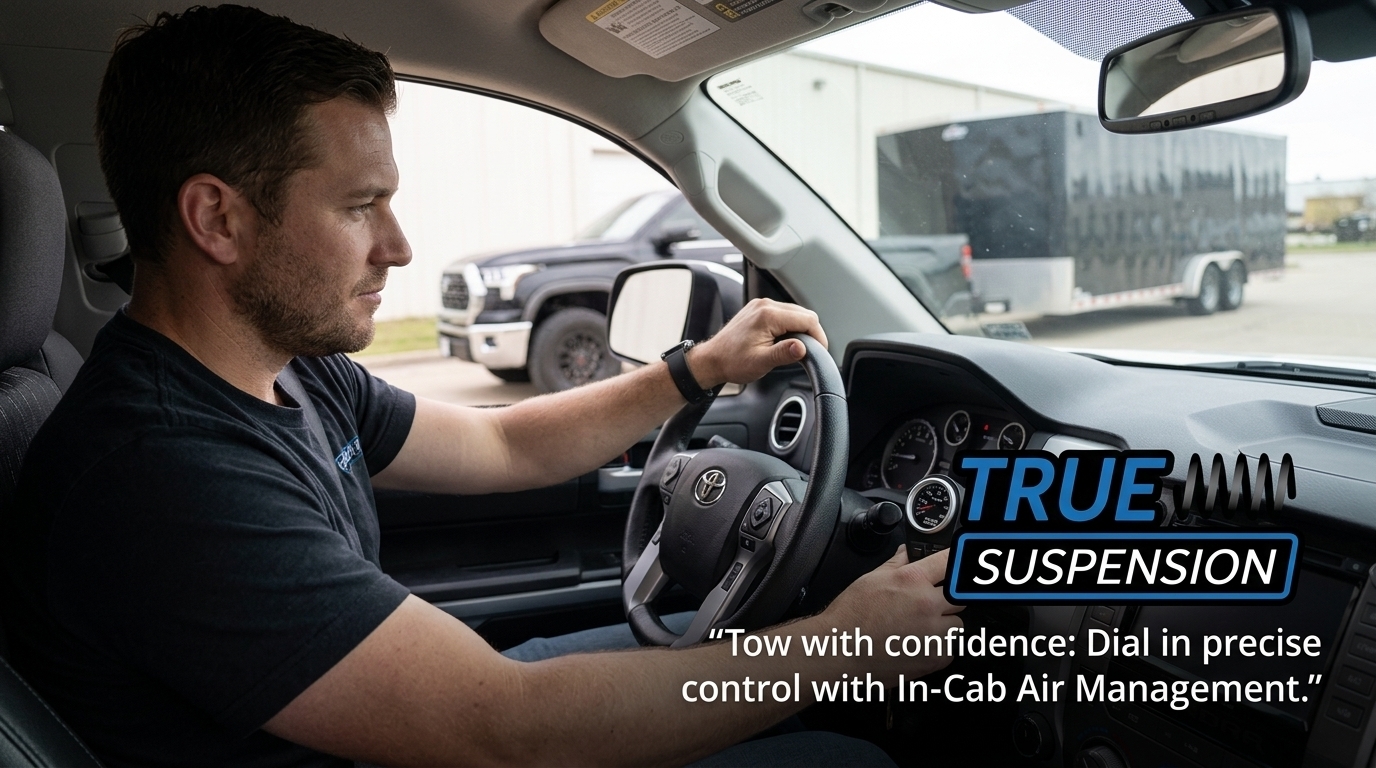
For the majority of Tundra owners who tow seriously, in-cab air management is the smarter long-term investment. The convenience, safety, and precision it delivers pay for themselves after your first heavy-load trip.
True Suspension's Tundra kits, both in-cab and standard, are the benchmark in this category. Every kit is purpose-built, every component is quality-tested, and every configuration is available for your exact truck.
Start with the right system. Tow with confidence. That is what True Suspension delivers.
Conclusion
The debate between In-Cab Air Management vs Manual Schrader Valves comes down to how seriously you take your towing setup and how often you haul heavy loads.
Manual Schrader valves are a reliable, budget-friendly solution that works well for light, infrequent towers. They eliminate rear sag and improve stability at a lower entry cost.
In-cab air management is the professional choice. It gives you real-time pressure control, eliminates adjustment hassle, and ensures your vehicle suspension is perfectly tuned for every load, from the driver's seat, in under a minute.
True Suspension builds both. We build them specifically for the Toyota Tundra, for both 2WD and 4WD, from 2007 through 2021. We include everything you need, nothing you do not, and we back every kit with the technical support to get your install right.
Browse our full range of Tundra tow assist kits and find the configuration that matches your truck and your towing life.
Tow smarter. Tow safer. Choose True Suspension.
Frequently Asked Questions
- What is the difference between in-cab air management and manual Schrader valves for Tundra air bag kits?
In-cab air management lets you control air bag pressure from inside the truck using a mounted panel. Manual Schrader valves require you to use an external pump at the valve location. In-cab is faster, more convenient, and delivers real-time pressure monitoring.
- How much PSI should I run in my Tundra air bags when towing?
Most tow assist air bag kits operate between 20–100 PSI depending on load. Light loads need 20–40 PSI. Heavy loads near max capacity need 60–100 PSI. Always consult your specific kit's guidelines for precise pressure recommendations by load weight.
- Can I upgrade from manual Schrader valves to in-cab air management later?
Yes. The air spring components are identical. You simply swap out the valve-based air line routing for in-cab lines and add the control panel. True Suspension kits are designed to support this upgrade path without replacing the core suspension components.
- Will a True Suspension air bag kit affect my Tundra's factory warranty?
Tow assist air bag kits are bolt-on accessories that do not modify factory components. They typically do not void factory powertrain or drivetrain warranty coverage. Consult your dealer for specifics, as warranty policies vary by manufacturer and service agreement terms.
- How long does it take to install a True Suspension Tundra in-cab air management kit?
Most DIY installers complete the full install in 4–6 hours with basic hand tools. The vehicle suspension components are bolt-on. The in-cab wiring is straightforward 12V work. True Suspension includes detailed instructions and all required hardware in every complete kit.